To the east and south, on a peninsula far and away where the tribes of the Druugii, Dravidians, Aldacians, and Cassites now dwell in dominion under the Cytherean Kingdom, the Good God himself once stepped down to the world, incarnated in flesh, to teach mortals how to love one another.
Born to a virgin shepherd-girl, Tumuzid was raised as a shepherd himself, and his childhood was marked with the little miracles of enlightenment that usually accompany miraculous births; but it was not until his full manhood that he was called to the wilderness to dwell in a cave as an anchorite, from thence to return to civilization revealed in his glory as the Good God made flesh.
He wandered the wilderness and the little towns, preaching love and simplicity and mortification of the flesh to turn to higher virtues, and crowds gathered round him, and many miracles were performed by him and his followers. And in the cities, he disputed with the priests of the Lawful city cults, the priests of Bel, the philosophers of Zalmoxis, and the priestesses of Cytherea, and too rebuked the Snake-Handlers for their evil ways.
But all this earned Tumuzid the hatred and envy of the priestly sects, and they complained to the Four Kings that the shepherd-prophet was slandering the gods and teaching people to turn away from anything but their own selfish salvation, and refusing to give money for the liturgies of the city-gods. So Tumuzid was arrested by the Four Kings; each questioned him, and disputed with him as to the nature of virtue, and he bested each in his knowledge and personal piety. But though the other Kings would have released him, the King of the Druugii was ashamed of his failure, and acting alone without the consent of the others of the Four Kings, he had Tumuzid scourged at a pillar and crucified in the wilderness.
Then all the land was aggrieved; calamities were reported for and wide, of storms suddenly blown up, of the earth cracking open, of plagues descending on cities. The followers of Tumuzid took down his body and washed him and buried him, and prayed for his return--but he did not return. He lay dead in his tomb, cold and unmoving.
So this is how the cult of Mourning sprang up; the followers of Tumuzid, who saw that the Good God was dead, put on their mourning black, cut their hair and flagellated themselves in anguish, and refused to touch good things to eat or wine to drink. They held a funeral game for Tumuzid, in which the most wretched among them took up swords and in pairs plunged the blade into their partners' bellies to die alongside the Dead God. And though is is not mete for the mourning period for a mortal to last more than a year, the Mourners did not put off their black cloaks, and still refused good things even after thirty years, still waiting for the return of their god.
Two major sects arose out of this Mourning: 1) those who believed that because the divine Good had died, then mortals must perforce resurrect the Good in themselves; and 2) those who believed that because the divine Good had died, that all Goodness was gone, and that therefore all moral strictures and boundaries are henceforth broken. Needless to say, there is much bad blood between these two sects ...
Unfortunately, for those not well versed in the intricacies of Mourning theodicy, the two sects can be difficult to distinguish. Both go about in robes and cloaks of black, shave their hair, and mutilate their flesh, all in accordance with public displays of mourning. They are to be found in their places of worship keening and wailing, and each sect holds regular funereal games in which men and women are encouraged to kill one another. And both sects advocate the abandonment of the traditional city-cults--though the former because they wish for people to turn toward righteousness and salvation, while the latter ridicule the other gods as upholding a meaningless facade of "order".
The clearest distinction between sects is whether they allow the drinking of wine or not--those who seek righteousness tend to abstain completely from any wine, preferring milk as it is the traditional libation for the dead. Those who flout strictures, however, prefer wine at their funereal games.
And the games themselves are another way to distinguish the Good sect from the Evil sect, for the Mourners of the former hold austere games with sober food, simple wrestling-matches, and simultaneous dispatch of the death-seekers. The latter, meanwhile, often throw elaborate games that for all intents and purposes resemble great gladiatorial games, sometimes with slaves forced to fight one another, sometimes with trained gladiators dueling in earnest before the assembled Mourners (and perhaps other citizens attracted to the sport of blood ...).
Because of their excessive mourning practices and because of the unclear mingling of Good and Evil philosophies, the Mourners are often reviled by other cults, and must practice their cult on the outskirts of civilization. Nevertheless, many slaves and others who are downtrodden are attracted to the philosophies, be it the promise of salvation for all men, regardless of status--or the promised transgression of the boundaries established by Lawful and aristocratic elites.
As a final note, the cult of Tumuzid the Dead God is often confused with the cult of the God of Shepherds, Aristios, who also performed miracles for herdsmen and rustics, and who also died. But Aristios died because he gave himself up as a sacrifice, and when he died his gut split open with good crops and good things to eat, given of himself for the people; and in the hollow breast of his corpse, a tribe of bees built their hive, and from the honeycomb of the bees, Aristios himself was reborn, to walk the earth again.
Showing posts with label setting info. Show all posts
Showing posts with label setting info. Show all posts
Wednesday, August 8, 2018

Saturday, August 4, 2018
DIY 30 #3: Skotia, Goddess of Darkness and Death
She is the darkness. And out of the darkness of her womb sprang Mother-born Ophalle, who has no father. And Ophalle walked the earth, planting his seed in the fields that they might grow thick with good crops, and filling women and animals with children, so that all the earth teemed with living things. Where sheep and cattle were, he learned from the shepherds and kine-herds how to increase their flocks; and where wheat grew, he learned how to reap it, and where grapes grew, he learned how to press them, and he gave seed to the mash so that it fermented and so wine was made. And when the darkness of night came again, Ophalle was delighted that men and women would pair off and go into the darkness of their rooms to lose themselves in sleep, or the little deaths of love.
But in the darkness Skotia came, and Ophalle saw her and was smitten, but he knew her not. He called to her and she did not answer, for she is the Silent One. He gave her wine, and she drank it, but she did not laugh for she was silent. Then he came to her, and together they lay down in the darkness, and the night lasted for many days, until she got up again from his couch and went away; but she was ever silent.
And she was his mother, so she was wroth that they had lain together; and when she came again and found that Ophalle was asleep, she took up his sickle for reaping, and she reaped the hair from his head, and it was wheat, and it wilted in her hand. And she raised the sickle again, and she reaped off his phallus, and it was a gourd that she devoured. Then she raised the sickle a third time, and now she cut apart his body, limb from limb, bone from bone, and she scattered the pieces across the earth and buried them.
Then winter was upon the world, and crops died, and the animals starved, and the people shivered. The sun himself was wan, for he feared the anger of Skotia, and the heat of the world had gone out of it when Ophalle's life-source was cut from his trunk; and the winter was dark.
But Skotia is the darkness, and in her belly Ophalle grew again. And out of the darkness again sprang Mother-born Ophalle, and again he walked the earth, and filled it with his seed and with growing things.
------
Skotia, that is, Σκότια,
She is the Darkness, the Silent One, the Destroyer, She of the Long Sleep
She is the Darkness (to quote Glen Cook), the darkness that was before the world, and which some believe comes with death, or will come after the crack of doom. Her shrines are either secreted in necropolises, or hidden away in unlooked-for places, and always shrouded in shadow. Her visage is fearsome: skin black as obsidian, she dances with her six arms upraised, each bearing a sickle, a harpe-sword, a kris-knife, and other symbols of her godhead--including the phallus of her son Ophalle, a Priapus-like god of sex and fertility, whom she castrated for the sin of seducing her.
Not specifically a goddess of the night, nevertheless she is associated with that darkness; and because she is Death, and sleep is a presage of death, and orgasm is metaphorically the "little death", so she is also a goddess of sleep and a fertility goddess in her own right. But ever is she silent, never revealing what happens to those who enter her embrace in the long sleep; not even her priestesses (and few priests) have ever received an answer from her after their most strenuous prayers--nothing but the vaguest of omens are offered to her followers.
This silence has allowed for a great schism to arise in her cult, and differences in the particular interpretation of her place in the cosmology are as myriad as the priestesses who serve her. Most devotees fall into one of the two major cults (and the majority of all devotees fall into the first): 1) the Silent Sisters, and 2) the Death Cult.
------
The Silent Sisters do not exactly worship Skotia, so much as recognize her embrace as the ultimate destination for all mortals, and so do what they can to aid the passage into the Long Sleep. They do this primarily by accepting the bodies of those who are too poor for proper funereal preparations, or those who have no family and so have no family tombs in which to be interred; these bodies the Sisters wash and prepare for burial, and then inter in their necropolis-shrines. The Sisters also take in and care for those who are too poor or downtrodden to receive proper care otherwise--beggars, lepers, plague-victims, etc. are received into their shrines to receive care under the Sisters until such a time as they are healed, or have passed on in Skotia's embrace, thence to be interred like the others ...
Most people understand Skotia in this light, that of an embodiment of a natural inevitability. Her footstep is feared as the tread of doom, but she is certainly not seen as any kind of demon or moral evil--all men die, and so all men must eventually come face to face with Skotia.
------
Some, however, would use Skotia as an idol and object of a Death Cult whose members revel in spreading death and destruction in imitation of the goddess' avatar as the Destroyer. These Death Cults of Skotia are some of the secret Evil cults that plague the world; and sometimes those who worship the Destroyer intermix secretly within the cults of the Silent Sisters, making their detection even more difficult.
The cultic imagery of the Death Cults is virtually the same as that of the Silent Sisters, including an idol of the goddess, six-armed and dancing, shrouded in shadow (sometimes magical, sometimes not); but the rites include monthly blood sacrifice, of kine or swine at least, but preferably human or demi-human, be they slaves, prisoners, or free and willing. Such rites take place only at night, in utter darkness and utmost secrecy; and those initiated into the higher mysteries of the Death Cult are often tasked with further secret rites.
Priestesses who worship the Destroyer are often accompanied by undead, which they raise as walking avatars of the end that comes to all mortals, and high priestesses are also often served by demons, much as any Evil cult might be. The Spiders of Darkness, those silent and implacable hunters, are their preferred servants.
Most of those initiated into the higher mysteries of Skotia tend to be women and priestesses; nevertheless, males are not excluded from the priesthood, and many do rise to power. Of these, however, many priests are self-made eunuchs! For in their enthusiasm in the greater rites, it is common for men to emasculate themselves in imitation of the myth of Ophalle or to become more feminine like Skotia (similar to the Galli, priests of Cybele and Attis, who castrated themselves during a certain holiday, and thereafter went about dressed as women)
------
She is the darkness. Out of the darkness of her womb sprang Seed-sowing Ophalle, who took the earth as his bride, and forced her to bear his myriad children.
The earth groaned with the pangs of her labor, and in her despair, she cried out to the gods to relieve her of her woes, but the gods denied her. "We have built our kingdom over your children," they said. "Shall we give up everything we have made?"
And the earth groaned, for her pains were great, and she called out to the sun. But he turned his face from her, saying, "Do not ask this thing of me. I would help if I could, but the gods have set me here to light their kingdom, and they would destroy me if I desert my place." So it was night because his face was turned.
Then the earth called out to the stars, whose children are the Elves, because she was wracked with the hurt of her labors. But stars only shone and laughed among themselves. "It is absurd," they said. "What do we, who are so high above you, care for your pains?"
"Will no one aid me?" the earth cried at last.
But Skotia had heard, and so she stepped down. In silence did she walk, and in the night Ophalle saw her, and was smitten. And he went to her, and he asked her name, but she was silent. And he gave her wine, and she drank it, but she did not laugh, for she was silent. Then she took his hand and led him to lay down, and he laughed, but she was silent.
And when Ophalle slept beside her after his exertion, Skotia rose up, and she took his sword, called Harpe, so that he would go unarmed at the final battle when the Gjallarhorn is sounded. And with Harpe she cut his hair so that she might bind him with it, there and thereafter; for witches often use the hair of their victims in rituals of binding and unbinding, and so Skotia would do at Gjallarhorn's winding. And raising Harpe again, Skotia unmanned Ophale a third time, cutting off source and member; these she took, and holds them yet.
So, taking Harpe, hair, and phallus, Skotia went her way again, and Seed-sowing Ophalle was left unmanned in his pain. And when Gjallarhorn sounds, he will try to rise up; but he will be weaponless, for his sword is gone; and his limbs will be bound with the magic of Skotia; and his blood will be cold for the lack of his life-source, and all things will pass again into darkness, and the earth will groan no more, but will know peace in oblivion.
But in the darkness Skotia came, and Ophalle saw her and was smitten, but he knew her not. He called to her and she did not answer, for she is the Silent One. He gave her wine, and she drank it, but she did not laugh for she was silent. Then he came to her, and together they lay down in the darkness, and the night lasted for many days, until she got up again from his couch and went away; but she was ever silent.
And she was his mother, so she was wroth that they had lain together; and when she came again and found that Ophalle was asleep, she took up his sickle for reaping, and she reaped the hair from his head, and it was wheat, and it wilted in her hand. And she raised the sickle again, and she reaped off his phallus, and it was a gourd that she devoured. Then she raised the sickle a third time, and now she cut apart his body, limb from limb, bone from bone, and she scattered the pieces across the earth and buried them.
Then winter was upon the world, and crops died, and the animals starved, and the people shivered. The sun himself was wan, for he feared the anger of Skotia, and the heat of the world had gone out of it when Ophalle's life-source was cut from his trunk; and the winter was dark.
But Skotia is the darkness, and in her belly Ophalle grew again. And out of the darkness again sprang Mother-born Ophalle, and again he walked the earth, and filled it with his seed and with growing things.
------
Skotia, that is, Σκότια,
She is the Darkness, the Silent One, the Destroyer, She of the Long Sleep
She is the Darkness (to quote Glen Cook), the darkness that was before the world, and which some believe comes with death, or will come after the crack of doom. Her shrines are either secreted in necropolises, or hidden away in unlooked-for places, and always shrouded in shadow. Her visage is fearsome: skin black as obsidian, she dances with her six arms upraised, each bearing a sickle, a harpe-sword, a kris-knife, and other symbols of her godhead--including the phallus of her son Ophalle, a Priapus-like god of sex and fertility, whom she castrated for the sin of seducing her.
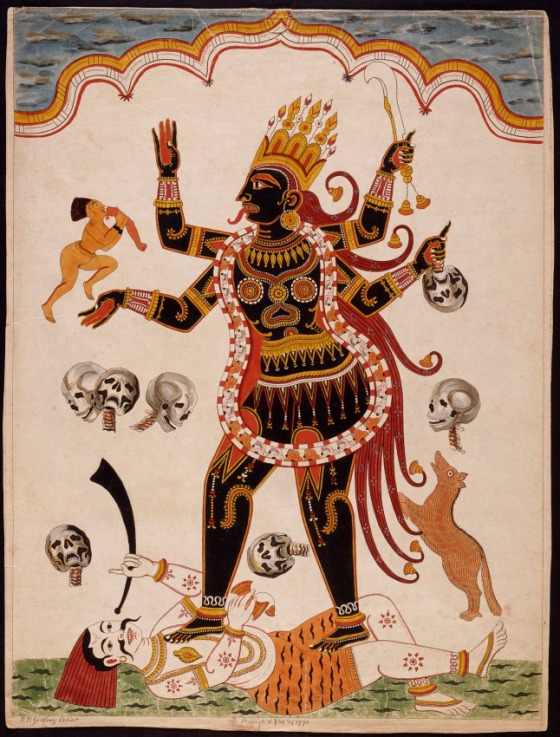 |
| Yep, I just based Skotia on images of the goddess Kali ... a many-armed goddess of darkness was a fixture in my dungeons well before I codified her as Skotia. Also, notice the harpe (sickle-sword) in the top-right corner ... |
Not specifically a goddess of the night, nevertheless she is associated with that darkness; and because she is Death, and sleep is a presage of death, and orgasm is metaphorically the "little death", so she is also a goddess of sleep and a fertility goddess in her own right. But ever is she silent, never revealing what happens to those who enter her embrace in the long sleep; not even her priestesses (and few priests) have ever received an answer from her after their most strenuous prayers--nothing but the vaguest of omens are offered to her followers.
This silence has allowed for a great schism to arise in her cult, and differences in the particular interpretation of her place in the cosmology are as myriad as the priestesses who serve her. Most devotees fall into one of the two major cults (and the majority of all devotees fall into the first): 1) the Silent Sisters, and 2) the Death Cult.
------
The Silent Sisters do not exactly worship Skotia, so much as recognize her embrace as the ultimate destination for all mortals, and so do what they can to aid the passage into the Long Sleep. They do this primarily by accepting the bodies of those who are too poor for proper funereal preparations, or those who have no family and so have no family tombs in which to be interred; these bodies the Sisters wash and prepare for burial, and then inter in their necropolis-shrines. The Sisters also take in and care for those who are too poor or downtrodden to receive proper care otherwise--beggars, lepers, plague-victims, etc. are received into their shrines to receive care under the Sisters until such a time as they are healed, or have passed on in Skotia's embrace, thence to be interred like the others ...
Most people understand Skotia in this light, that of an embodiment of a natural inevitability. Her footstep is feared as the tread of doom, but she is certainly not seen as any kind of demon or moral evil--all men die, and so all men must eventually come face to face with Skotia.
------
Some, however, would use Skotia as an idol and object of a Death Cult whose members revel in spreading death and destruction in imitation of the goddess' avatar as the Destroyer. These Death Cults of Skotia are some of the secret Evil cults that plague the world; and sometimes those who worship the Destroyer intermix secretly within the cults of the Silent Sisters, making their detection even more difficult.
The cultic imagery of the Death Cults is virtually the same as that of the Silent Sisters, including an idol of the goddess, six-armed and dancing, shrouded in shadow (sometimes magical, sometimes not); but the rites include monthly blood sacrifice, of kine or swine at least, but preferably human or demi-human, be they slaves, prisoners, or free and willing. Such rites take place only at night, in utter darkness and utmost secrecy; and those initiated into the higher mysteries of the Death Cult are often tasked with further secret rites.
Priestesses who worship the Destroyer are often accompanied by undead, which they raise as walking avatars of the end that comes to all mortals, and high priestesses are also often served by demons, much as any Evil cult might be. The Spiders of Darkness, those silent and implacable hunters, are their preferred servants.
Most of those initiated into the higher mysteries of Skotia tend to be women and priestesses; nevertheless, males are not excluded from the priesthood, and many do rise to power. Of these, however, many priests are self-made eunuchs! For in their enthusiasm in the greater rites, it is common for men to emasculate themselves in imitation of the myth of Ophalle or to become more feminine like Skotia (similar to the Galli, priests of Cybele and Attis, who castrated themselves during a certain holiday, and thereafter went about dressed as women)
------
She is the darkness. Out of the darkness of her womb sprang Seed-sowing Ophalle, who took the earth as his bride, and forced her to bear his myriad children.
The earth groaned with the pangs of her labor, and in her despair, she cried out to the gods to relieve her of her woes, but the gods denied her. "We have built our kingdom over your children," they said. "Shall we give up everything we have made?"
And the earth groaned, for her pains were great, and she called out to the sun. But he turned his face from her, saying, "Do not ask this thing of me. I would help if I could, but the gods have set me here to light their kingdom, and they would destroy me if I desert my place." So it was night because his face was turned.
Then the earth called out to the stars, whose children are the Elves, because she was wracked with the hurt of her labors. But stars only shone and laughed among themselves. "It is absurd," they said. "What do we, who are so high above you, care for your pains?"
"Will no one aid me?" the earth cried at last.
But Skotia had heard, and so she stepped down. In silence did she walk, and in the night Ophalle saw her, and was smitten. And he went to her, and he asked her name, but she was silent. And he gave her wine, and she drank it, but she did not laugh, for she was silent. Then she took his hand and led him to lay down, and he laughed, but she was silent.
And when Ophalle slept beside her after his exertion, Skotia rose up, and she took his sword, called Harpe, so that he would go unarmed at the final battle when the Gjallarhorn is sounded. And with Harpe she cut his hair so that she might bind him with it, there and thereafter; for witches often use the hair of their victims in rituals of binding and unbinding, and so Skotia would do at Gjallarhorn's winding. And raising Harpe again, Skotia unmanned Ophale a third time, cutting off source and member; these she took, and holds them yet.
So, taking Harpe, hair, and phallus, Skotia went her way again, and Seed-sowing Ophalle was left unmanned in his pain. And when Gjallarhorn sounds, he will try to rise up; but he will be weaponless, for his sword is gone; and his limbs will be bound with the magic of Skotia; and his blood will be cold for the lack of his life-source, and all things will pass again into darkness, and the earth will groan no more, but will know peace in oblivion.
Tuesday, April 24, 2018
Jungles of Chult: Wakanga's Journal
Given to the players by the merchant prince Wakanga, after last session--their successful return from down the River Tiryki seeking the Tomb of the Serpent Kings.
The journal is worn and waterlogged ... except the physical copy I gave to the players is not, because I wasn't sure what would happen to the 24-page pocket-journal if I threw it into a puddle.
------
p2.
[a MAP of the route]
p.3
EXPEDITION from NYANZARU
-- Myself & VORN
-- TXALA & SIGHING WIND -- guides
-- NBOMA OXFIST --
-- ZEBU the WILD -- fighting-men
-- MLALA TURKA -- fighting woman
-- SIFISO, FUDU, CWATHA, porters
3 CANOES
350 days rations
insect repellant
dozen canteens, pots for boiling water
3 tents
OUR GOAL: the lost city of OROLUNGA & its ORACLE!
p4.
Day 1 -- Sailed from Nyanzaru to Ngana to collect final supplies. Clear skies, no sign of AREMAG. Arrived in good spirits. Shared a feast and a toast to our continued success at the inn. Now to bed--set out early in the morning.
Day 2 -- Word of plesiosaurs off beach--we hired mules to port our canoes & set off due south. Passed through the Palm Orchards of Ishau, bought palm wine to add
p5.
to our supplies for morale. At jungle's edge, sent mules and teamsters back. Claw-runners shadowed camp, but NBOMA & MLALA scattered them with well-shot bows. Into jungle to morrow [sic].
Day 3 -- Weird mists in the morning. Passed 3 women by a broken canoe on the shore as we paddled by. I wanted to help, but ZEBU & TXALA shook their heads--"They are evil spirits." They called out to us most pitifully, but we went on.
p6.
I thought I heard cackling through the mists when we lost sight of them. Am left discomfitted & restless.
Day 5 -- Spotted a behemoth in the morning, eating from the treetops with its long neck. Almost lost a canoe when its tail swept beneath. Then, once camp was made, a mist rolled out of the jungle--blue & thick. TXALA & WIND got everyone
p7.
up the trees to let it pass. Poor FUDU got a lungful, though, & now won't stop telling us that he feels something watching him.
Day 6 -- An easy day. We're making progress upriver
Day 7 -- FUDU is still raving about being watched. Almost started a fight by accusing NBOMA of stealing. MLALA got NBOMA cooled down & ZEBU pulled FUDU aside for some kind of tea concoction. He's calm now
p8.
Day 8 -- Met a group of folks coming downriver--led by HEW HACKINSTONE the dwarf. Warned us about the forest upriver--"place of a thousand demons"--we sent FUDU downriver with them.
Further upriver found a dead man on the bank--one of their expedition? Was badly eaten.
Took right fork in river, but by night it seemed wrong choice--became narrow, difficult to traverse. Forest filled with evil eyes & sounds.
p9.
Day 9 -- LOST. River became a maze. A talking ape with black eyes followed us, offering directions, but only seemed to get us more lost.
The forest is filled with mutterings, and we have lost a full pack of rations--taken by thieving monkeys?
Day 10 -- back on track. Found dead explorer on bank--much decayed already. Took left fork of river--seems good so far.
p10.
Day 11 -- Canoe capsized in the morning by snake-like beast. ZEBU was badly bitten, but spears, &c. were able to drive it off.
ZEBU patched himself up, & we made good time after that. Lost a week of rations.
Day 12 Passed a herd of duck-bills feeding at the riverside around noon. They watched us, but did not flee. Seemed a free herd--very beautiful. Otherwise, made good time.
p11.
Day 13 -- Caught side [sic] of a fortress on a high outcropping of rock--TXALA called it TAMBA ROCK. WIND added that the master is old & eccentric & some kind of magic-user. Considered going to ask for supplies, but decided against. Continued on.
Day 14 -- A good day of travel. Had some trouble getting to the bank to make camp b/c a swarm of piranhas decided to hang around beneath our boats all afternoon.
p12.
Day 15 -- An aarakocra patrol passed over us in the morning, but did not hail us. We continued upriver without further incident.
Day 16 -- No trouble today
Day 17 -- No trouble. Counted rations--175 days remaining. We'll need to resupply somehow, as we must push on.
Day 18 -- Good day. Clear air, river beautiful. Sometimes I enjoy the jungle & its majesty!
p13.
Day 19 -- Lost ZEBU & SIGHING WIND. Were ambushed by lizardmen shortly after midday. Their javelins killed WIND, & then while we got into the boats, ZEBU went back to try to grab WIND'S body. They pulled him down ...
The blood in the water attracted piranhas & we just camped in the boats, run aground as well as we could.
Day 20 -- Damn piranhas stayed with us all night. Damn this place. Damn it all.
p14.
Day 21 -- Killed a giant snake tonight & cooked & ate it. Good thing too. Supplies are getting low--we lost some after the lizardmen attacked
Day 22 We hailed some passing aarakocra in the morning & sought to trade with them for rations. They gave us a week of their fare for a share of spears from us. Uneventful otherwise
Day 23 -- A great Stone tree rises out of the jungle to
p15.
the northwest. It is not OROLUNGA, but we will investigate it nonetheless. Killed another snake in the morning--they are not bad eating at all!
Day 24 Left the canoesag [sic] tied & hidden at the bank--we now strike inward, into the jungle. May the gods help us.
--Later--made camp--no trouble through the day. STone [sic] tree not far, we'll get there tomorrow I think
p16.
Day 25 -- Got to the tree at midday. The place is filled with giant wasps. CWATHA was stung--I do not think he will make it. The tree is hollow--inside, it seems it was once furnished. There are pieces that make me think another practitioner of the arcane arts once dwelt w/in, but the place is long abandoned.
--Later--CWATHA did not make it. We buried him under a cairn in the jungle.
p17.
Day 26 -- We go SW, seeking a NW tributary to the SOSHENSTAR. I hope to find OROLUNGA at its head.
CLAW-runners attacked us as we made camp, but VORN drove them off. He has always been a stalwart companion--if only he could know how much I appreciate his presence.
Day 27 -- Still SW. It is difficult going through the jungle. Always hacking with the machete, climbing roots, fighting mosquitoes. I can't wait for a bath in Nyanzaru.
p18.
Day 28 -- Found the tributary! A flock of leatherwings descended on us as we came on it, but our arrows and my spells brought some down. We tried to eat them, but there is surprisingly little meat on the creatures. The rest of the day was spent following the tributary NW. No other trouble.
Day 29 -- Disaster. We were attacked by a mouth-dragon as we rested at midday. It came out
p19.
of the jungle & before we could do anything it had snapped jaws around NBOMA & tossed him into the air. It was horrible ...
We fled, & it seemed content to eat him & let us go.
That was not the end of our trouble, though--that evening as we made camp, horrible things like small mangy bears came up out of the jungle. They attacked with their claws, & I saw MLALA'S & TXALA'S
p.20
armor literally deteriorate before my eyes as they struck. But I managed to put them all to sleep with a dwimmer, & we slew the things then. TXALA called them "Zorbos"--foul creatures!
Day 30 Continuing NW along the tributary. I hope we are close to OROLUNGA.
Day 31 Attacked by stirges at midday--I slept them, & we slaughtered
p21.
them. In the afternoon, mists began to roll down from upriver to the NW--not the evil blue mists, but a natural fog ...
Day 32 -- The tributary has led us into an area of hot springs, mists, & volcanic activity. There are geysers & deep pools of hot acidic water of brilliant blue color; & there are fissures of hot rock & mud that open up into the
p22.
We were attacked. Lizardmen came from the mists.
Killed everyone--TXALA, MLALA, SIFISO
VORN is with me. I am injured. Without VORN I would be dead.
They came out of the mists--bright red skin, some were mounted on bird-things.
They hurled javelins, & one was a sorcerer--summoned fire in his hands & cast it forth.
p23.
Poor MLALA burned to death. TXALA was overcome. SIFISO ran, & died w/a javelin in his back. At least, I think he was dead.
VORN saved me. We fled into the jungle--I am lost. Must try to find the river. find my way back.
My leg is wounded--the blood dried--it hurts, but I should not die of blood loss.
I fear I will not make it out.
p24.
LOST
HUNGRY
FOUND FRUIT
CANNOT FIND WATER
ATTACKED BY SNAIL
LEG SWOLLEN--INFECTED
I AM DYING
VORN CANNOT HELP ME
CURSE THIS PLACE
CURSE THIS JUNGLE
CURSED BE THE THOUGHT EVER TO SET FOOT IN THIS HELL
The journal is worn and waterlogged ... except the physical copy I gave to the players is not, because I wasn't sure what would happen to the 24-page pocket-journal if I threw it into a puddle.
 |
| A sketch of some of the crew at the outset of the expedition, ready and optimistic ... |
------
p2.
[a MAP of the route]
p.3
EXPEDITION from NYANZARU
-- Myself & VORN
-- TXALA & SIGHING WIND -- guides
-- NBOMA OXFIST --
-- ZEBU the WILD -- fighting-men
-- MLALA TURKA -- fighting woman
-- SIFISO, FUDU, CWATHA, porters
3 CANOES
350 days rations
insect repellant
dozen canteens, pots for boiling water
3 tents
OUR GOAL: the lost city of OROLUNGA & its ORACLE!
p4.
Day 1 -- Sailed from Nyanzaru to Ngana to collect final supplies. Clear skies, no sign of AREMAG. Arrived in good spirits. Shared a feast and a toast to our continued success at the inn. Now to bed--set out early in the morning.
Day 2 -- Word of plesiosaurs off beach--we hired mules to port our canoes & set off due south. Passed through the Palm Orchards of Ishau, bought palm wine to add
p5.
to our supplies for morale. At jungle's edge, sent mules and teamsters back. Claw-runners shadowed camp, but NBOMA & MLALA scattered them with well-shot bows. Into jungle to morrow [sic].
Day 3 -- Weird mists in the morning. Passed 3 women by a broken canoe on the shore as we paddled by. I wanted to help, but ZEBU & TXALA shook their heads--"They are evil spirits." They called out to us most pitifully, but we went on.
p6.
I thought I heard cackling through the mists when we lost sight of them. Am left discomfitted & restless.
Day 5 -- Spotted a behemoth in the morning, eating from the treetops with its long neck. Almost lost a canoe when its tail swept beneath. Then, once camp was made, a mist rolled out of the jungle--blue & thick. TXALA & WIND got everyone
p7.
up the trees to let it pass. Poor FUDU got a lungful, though, & now won't stop telling us that he feels something watching him.
Day 6 -- An easy day. We're making progress upriver
Day 7 -- FUDU is still raving about being watched. Almost started a fight by accusing NBOMA of stealing. MLALA got NBOMA cooled down & ZEBU pulled FUDU aside for some kind of tea concoction. He's calm now
p8.
Day 8 -- Met a group of folks coming downriver--led by HEW HACKINSTONE the dwarf. Warned us about the forest upriver--"place of a thousand demons"--we sent FUDU downriver with them.
Further upriver found a dead man on the bank--one of their expedition? Was badly eaten.
Took right fork in river, but by night it seemed wrong choice--became narrow, difficult to traverse. Forest filled with evil eyes & sounds.
p9.
Day 9 -- LOST. River became a maze. A talking ape with black eyes followed us, offering directions, but only seemed to get us more lost.
The forest is filled with mutterings, and we have lost a full pack of rations--taken by thieving monkeys?
Day 10 -- back on track. Found dead explorer on bank--much decayed already. Took left fork of river--seems good so far.
p10.
Day 11 -- Canoe capsized in the morning by snake-like beast. ZEBU was badly bitten, but spears, &c. were able to drive it off.
ZEBU patched himself up, & we made good time after that. Lost a week of rations.
Day 12 Passed a herd of duck-bills feeding at the riverside around noon. They watched us, but did not flee. Seemed a free herd--very beautiful. Otherwise, made good time.
p11.
Day 13 -- Caught side [sic] of a fortress on a high outcropping of rock--TXALA called it TAMBA ROCK. WIND added that the master is old & eccentric & some kind of magic-user. Considered going to ask for supplies, but decided against. Continued on.
Day 14 -- A good day of travel. Had some trouble getting to the bank to make camp b/c a swarm of piranhas decided to hang around beneath our boats all afternoon.
p12.
Day 15 -- An aarakocra patrol passed over us in the morning, but did not hail us. We continued upriver without further incident.
Day 16 -- No trouble today
Day 17 -- No trouble. Counted rations--175 days remaining. We'll need to resupply somehow, as we must push on.
Day 18 -- Good day. Clear air, river beautiful. Sometimes I enjoy the jungle & its majesty!
p13.
Day 19 -- Lost ZEBU & SIGHING WIND. Were ambushed by lizardmen shortly after midday. Their javelins killed WIND, & then while we got into the boats, ZEBU went back to try to grab WIND'S body. They pulled him down ...
The blood in the water attracted piranhas & we just camped in the boats, run aground as well as we could.
Day 20 -- Damn piranhas stayed with us all night. Damn this place. Damn it all.
p14.
Day 21 -- Killed a giant snake tonight & cooked & ate it. Good thing too. Supplies are getting low--we lost some after the lizardmen attacked
Day 22 We hailed some passing aarakocra in the morning & sought to trade with them for rations. They gave us a week of their fare for a share of spears from us. Uneventful otherwise
Day 23 -- A great Stone tree rises out of the jungle to
p15.
the northwest. It is not OROLUNGA, but we will investigate it nonetheless. Killed another snake in the morning--they are not bad eating at all!
Day 24 Left the canoes
--Later--made camp--no trouble through the day. STone [sic] tree not far, we'll get there tomorrow I think
p16.
Day 25 -- Got to the tree at midday. The place is filled with giant wasps. CWATHA was stung--I do not think he will make it. The tree is hollow--inside, it seems it was once furnished. There are pieces that make me think another practitioner of the arcane arts once dwelt w/in, but the place is long abandoned.
--Later--CWATHA did not make it. We buried him under a cairn in the jungle.
p17.
Day 26 -- We go SW, seeking a NW tributary to the SOSHENSTAR. I hope to find OROLUNGA at its head.
CLAW-runners attacked us as we made camp, but VORN drove them off. He has always been a stalwart companion--if only he could know how much I appreciate his presence.
Day 27 -- Still SW. It is difficult going through the jungle. Always hacking with the machete, climbing roots, fighting mosquitoes. I can't wait for a bath in Nyanzaru.
p18.
Day 28 -- Found the tributary! A flock of leatherwings descended on us as we came on it, but our arrows and my spells brought some down. We tried to eat them, but there is surprisingly little meat on the creatures. The rest of the day was spent following the tributary NW. No other trouble.
Day 29 -- Disaster. We were attacked by a mouth-dragon as we rested at midday. It came out
p19.
of the jungle & before we could do anything it had snapped jaws around NBOMA & tossed him into the air. It was horrible ...
We fled, & it seemed content to eat him & let us go.
That was not the end of our trouble, though--that evening as we made camp, horrible things like small mangy bears came up out of the jungle. They attacked with their claws, & I saw MLALA'S & TXALA'S
p.20
armor literally deteriorate before my eyes as they struck. But I managed to put them all to sleep with a dwimmer, & we slew the things then. TXALA called them "Zorbos"--foul creatures!
Day 30 Continuing NW along the tributary. I hope we are close to OROLUNGA.
Day 31 Attacked by stirges at midday--I slept them, & we slaughtered
p21.
them. In the afternoon, mists began to roll down from upriver to the NW--not the evil blue mists, but a natural fog ...
Day 32 -- The tributary has led us into an area of hot springs, mists, & volcanic activity. There are geysers & deep pools of hot acidic water of brilliant blue color; & there are fissures of hot rock & mud that open up into the
p22.
We were attacked. Lizardmen came from the mists.
Killed everyone--TXALA, MLALA, SIFISO
VORN is with me. I am injured. Without VORN I would be dead.
They came out of the mists--bright red skin, some were mounted on bird-things.
They hurled javelins, & one was a sorcerer--summoned fire in his hands & cast it forth.
p23.
Poor MLALA burned to death. TXALA was overcome. SIFISO ran, & died w/a javelin in his back. At least, I think he was dead.
VORN saved me. We fled into the jungle--I am lost. Must try to find the river. find my way back.
My leg is wounded--the blood dried--it hurts, but I should not die of blood loss.
I fear I will not make it out.
p24.
LOST
HUNGRY
FOUND FRUIT
CANNOT FIND WATER
ATTACKED BY SNAIL
LEG SWOLLEN--INFECTED
I AM DYING
VORN CANNOT HELP ME
CURSE THIS PLACE
CURSE THIS JUNGLE
CURSED BE THE THOUGHT EVER TO SET FOOT IN THIS HELL
Sunday, April 22, 2018
The Three Crowns
Kord, half-orc fighter/cleric of Kord the god of strength, was seeking a means of advancing beyond the limit of cleric level 4 set for half-orcs. His god sent him a dream-quest: find the Black Crown of the Getae and make yourself their priest-king, and I will reward you with greater power.
Seeking out the aid of Axxl the Mask, one of the local sages in the Greyhame Game (and paying him a fair amount of gold for the sage's work and time), Kord is told something of the lore of the Three Crowns ... The short of it is:
The White Crown is hid in the Mouth of the River ...
the Black Crown is held by the Old Man Under-Mountain ...
and the Red Crown was lost, but has been seen again, on the brow of Veiteric, chief among the Getae ...
------
When the Brondings came down out of the north to seize their kingdom from the Chaotic princes and barbarians who had squabbled since time immemorial, Brond was at their head, and on his brow there shone the White Crown of the Brondings.
Brond it was who fell in love with a naiad queen on the banks of the Coldwater River, and it was there, later, that he was ambushed by the Getae under the falls. Rather than surrender his sword, he broke it against a rock, and was slain there; but the naiads took the sword at their queen's behest, and reforged it in secret, and gave it to Brond's son, Gram, for vengeance. And so the Brokenbrand Falls had got their name.
Then the Brondings warred against the Getae of the forest and their Elfin masters; and they drove back the Elves to the eastern reaches of the Dwimmerholt, and overmastered the tribes of the Getae.
Ever had the Getae been led by two kings, the War-King and Priest-King; now the Brondings renewed that custom, but they gave to the Getae two crowns, the Red Crown for the War-King, and the Black Crown for the Priest-King, and the two crowns of the Getae were bound by powerful oaths and ancient magic so that those who wore them were sworn forever to serve the wearer of the White Crown (the rightful king of the Brondings).
For a time, then, there was peace in the land; and several generations knew war only as they went to seek it in foreign realms, for gold or for glory. ... But Chaos has a way of worming into the hearts of men, and corrupting the Order they have built when they think their cherished kingdoms are secure ...
So it was that the last of the Brondings, Durand-King, fell for and wedded a serpent in the guise of a woman, and her influence poisoned the realm. The tribe of Galad, scions of a knight who had served loyally under Brond and who were led now by his great-great grandson Aldanus, denounced the queen as a serpent; but Durand refused to listen, and he named the sons of Galad wolves and traitors to be hunted down. Armies were raised; the tower of the Galad tribe was reduced and taken, and the tribe was hunted down and destroyed root and branch.
But of old, the Galad tribe had been the keepers of the Crowns of the Getae, situated as they were between the Bronding kingdom and the forest realms of the Getae; and so they had their revenge. The Black Crown they secreted deep in the caverns below the Glimmervaults, entrusted to an elusive earth-spirit known only as the Old Man Under-Mountain. And with the Red Crown, the last surviving nephew of Aldanus, one Aldaric, raised the tribes of the Getae in rebellion against Durand-King.
So a great battle was fought in the depths of the Dwimmerholt--Aldaric Galad, nephew of Aldanus, wore the Red Crown of War; but he was cut down in battle, and the Crown was lost in the confusion that ensued. ... And for a long time it was lost or thought destroyed; but there are rumors now that a certain chieftain of the Getae, Veiteric hight, wears a band of red gold upon his brow, and that his glance cows all who look on him, and that his word is law among the forest tribes ...
As for the White Crown, it was taken from Durand-King after his victory in the Dwimmerholt, taken by a council of his own knights. They had stood by their king when Aldanus Galad first denounced him, but after the extermination of that gallant tribe, they came around to see Durand-King as the tyrant and wolf that he was. So they ambushed him one day while he hunted, and took the White Crown from his brow, though they left him his life--to their demise in the end.
Still, the Crown they took to the naiads of the Brokenbrand Falls, to secret away as they would, until one worthy of the Bronding kingship should come again and claim it. Legends say that the naiads hid the White Crown in the Mouth of the River--though that makes little sense when the mouth of the Coldwater lies so many hundreds of leagues to the west, pouring into Ocean ...
So that is the tale of the Three Crowns, so far as it goes; it touches upon much of the history of the realms, but not all of the history is needed to understand their significance.
Seeking out the aid of Axxl the Mask, one of the local sages in the Greyhame Game (and paying him a fair amount of gold for the sage's work and time), Kord is told something of the lore of the Three Crowns ... The short of it is:
The White Crown is hid in the Mouth of the River ...
the Black Crown is held by the Old Man Under-Mountain ...
and the Red Crown was lost, but has been seen again, on the brow of Veiteric, chief among the Getae ...
------
When the Brondings came down out of the north to seize their kingdom from the Chaotic princes and barbarians who had squabbled since time immemorial, Brond was at their head, and on his brow there shone the White Crown of the Brondings.
Brond it was who fell in love with a naiad queen on the banks of the Coldwater River, and it was there, later, that he was ambushed by the Getae under the falls. Rather than surrender his sword, he broke it against a rock, and was slain there; but the naiads took the sword at their queen's behest, and reforged it in secret, and gave it to Brond's son, Gram, for vengeance. And so the Brokenbrand Falls had got their name.
 |
| Roland blowing his horn Olifant at the battle of Roncevaux after failing to break his unbreakable sword Durendal; but it may as well be Brond, having broken his sword ... |
Then the Brondings warred against the Getae of the forest and their Elfin masters; and they drove back the Elves to the eastern reaches of the Dwimmerholt, and overmastered the tribes of the Getae.
Ever had the Getae been led by two kings, the War-King and Priest-King; now the Brondings renewed that custom, but they gave to the Getae two crowns, the Red Crown for the War-King, and the Black Crown for the Priest-King, and the two crowns of the Getae were bound by powerful oaths and ancient magic so that those who wore them were sworn forever to serve the wearer of the White Crown (the rightful king of the Brondings).
For a time, then, there was peace in the land; and several generations knew war only as they went to seek it in foreign realms, for gold or for glory. ... But Chaos has a way of worming into the hearts of men, and corrupting the Order they have built when they think their cherished kingdoms are secure ...
So it was that the last of the Brondings, Durand-King, fell for and wedded a serpent in the guise of a woman, and her influence poisoned the realm. The tribe of Galad, scions of a knight who had served loyally under Brond and who were led now by his great-great grandson Aldanus, denounced the queen as a serpent; but Durand refused to listen, and he named the sons of Galad wolves and traitors to be hunted down. Armies were raised; the tower of the Galad tribe was reduced and taken, and the tribe was hunted down and destroyed root and branch.
But of old, the Galad tribe had been the keepers of the Crowns of the Getae, situated as they were between the Bronding kingdom and the forest realms of the Getae; and so they had their revenge. The Black Crown they secreted deep in the caverns below the Glimmervaults, entrusted to an elusive earth-spirit known only as the Old Man Under-Mountain. And with the Red Crown, the last surviving nephew of Aldanus, one Aldaric, raised the tribes of the Getae in rebellion against Durand-King.
So a great battle was fought in the depths of the Dwimmerholt--Aldaric Galad, nephew of Aldanus, wore the Red Crown of War; but he was cut down in battle, and the Crown was lost in the confusion that ensued. ... And for a long time it was lost or thought destroyed; but there are rumors now that a certain chieftain of the Getae, Veiteric hight, wears a band of red gold upon his brow, and that his glance cows all who look on him, and that his word is law among the forest tribes ...
As for the White Crown, it was taken from Durand-King after his victory in the Dwimmerholt, taken by a council of his own knights. They had stood by their king when Aldanus Galad first denounced him, but after the extermination of that gallant tribe, they came around to see Durand-King as the tyrant and wolf that he was. So they ambushed him one day while he hunted, and took the White Crown from his brow, though they left him his life--to their demise in the end.
Still, the Crown they took to the naiads of the Brokenbrand Falls, to secret away as they would, until one worthy of the Bronding kingship should come again and claim it. Legends say that the naiads hid the White Crown in the Mouth of the River--though that makes little sense when the mouth of the Coldwater lies so many hundreds of leagues to the west, pouring into Ocean ...
So that is the tale of the Three Crowns, so far as it goes; it touches upon much of the history of the realms, but not all of the history is needed to understand their significance.
Monday, March 12, 2018
Amrohir's Tale -- the Goblin King and the missing Elf-princess
In my last post about the 22nd Greyhame Game, I mentioned the Elf Amrohir who was a guest of the usurper Morholt, and who was on a quest to seek out the missing Elf-princess Amaltheia. The party was invited to an audience in the castle by Morholt, who then allowed Amrohir to state his case with the hope that the characters might aid in seeking out Amaltheia.
It was poorly a considered move from Morholt and Amrohir, as the characters listened to them and then immediately decided that they distrusted the usurper and the Elf, and if they were to seek out Amaltheia, that they would be on her side. Nevertheless, their attention was not on the Elf-woman yet--they're rather more concerned with the fact that the stars are singing and that the Goblin King and the Lord of Werewolves are stirring up the trouble with the stars ...
Still, I wanted to provide more details about the situation than I did during play (I'm pretty terrible at the NPC infodump at the table, I'm afraid). So here is the tale, as told by Amrohir:
------
"Some time ago--many, many years ago, as mortals count them, in fact--the Goblin King and his servants and allies were destroyed by the Elves in a battle in the forested depths of the Dwimmerholt. The wolves and werewolves were slain or driven away, the spiders were slaughtered, and those goblins who were not killed were captured and enslaved once more--mostly sent to toil in the mines and deep places, hard labor that would break their spirits and their bodies.
"It was thought that the Goblin King had been slain--his entourage was certainly destroyed, and the body of a goblin in his panoply was one of those recovered from the field. We Elves, naturally, crucified the body and carried it before us as a sign to others what would come of rebellion, and we broke the enchantments in the armor and displayed it before our armies as we returned to the courts of the forest in triumph.
"Of the Goblin King's bodyguard, only his shieldbearer had survived, a pathetic creature that called itself Mirk. He was such a crooked and pathetic thing that it seemed even the bearing of a shield must be difficult, and yet he was cunning with the twisted magic of the goblins, and knew something of lore and of poetry. And it was because of his quick wit and wry humor that Danur, Captain of the Elfin bowmen, took Mirk for himself to be a slave in his own household, rather than one of those sent to eternal toil in the mines.
"This decision was to be the cause of much evil, as I'm sure you have guessed.
"In Danur's household, Mirk quickly became a favorite and was made the chief slave. He always carried out his tasks intelligently, and though he had a tongue that was quick with criticism for his fellows, he was equally obsequious before his master. He was given much freedom as the years wore on--and ultimately used this freedom for evil. In secret, he read the books of power in Danur's possession, and cut his own runes on wands to develop his powers. And Danur wielded for himself a Ring into which had been bound the ancient spirit Calirath, and Mirk seduced her with promises of freedom. And lastly, working only on the nights of the new moon was all was most in darkness, Mirk forged for himself a Spear, and poured into it all the poison of his malice and his long simmering hatred.
"And when the Spear was finished at last, Mirk was ready. He caught and betrayed Danur while they were out hunting, and Calirath did nothing to save her master, but allowed the goblin slave to drive the Spear into Danur's heart. Then she bore up Mirk and returned with him to their dead master's household, and while all slept, Mirk stole the Name and the Shadow of Danohir, son of Danur.
"Then, wearing the face of Danohir, Mirk took his final revenge. That same night, he visited the Elf-princess Amaltheia, who was betrothed to marry Danohir, and Mirk seduced her, and left her with a goblin child growing in her womb. And after that, he, with the help of Calirath, and leading many freed goblin slaves, made an escape through the darks of the Dwimmerholt, out to Anduril Rock, there to renew the old alliance with the wolves.
"So it was that Goblin King has returned, and calls himself Danohir the Mirk, and he dwells in the Howling Tower with his misbegotten servants--no longer slaves of the Elves, they are his slaves now, and who knows what evil they are stirring up in their dungeons.
"But as for Amaltheia, she did not know the truth of her rape until the child was born nine months hence; she had thought only that her betrothed had come to her that night, and been murdered the next day, and much was her confusion when the child was born to her with a goblin's crooked features. She was much amazed, and much grieved too--into a swoon she fell, and when she awoke again, a terror had entered her that the child would be destroyed, and she as well, and so she got up in the night from her bed of labor, and taking the child in secret, she and it were spirited away by the night winds.
"I fear that some enchantment has affected her mind, or that some lingering spell of the Goblin King has poisoned her spirit. She must be found, and returned to her people! And so I, and many others of the Elfin courts of the Dwimmerholt, have gone forth seeking high and low and looking into the secret places of the world to find her. Myself, I have come to seek into the Glimmervaults--for though others think it is too well-known among Elves, and too near the evils of the Goblin King, I think perhaps she has strayed there in her terror, and dwells now in the deeps somewhere, lonely and afraid.
"I hope that you all may aid me in discovering her, thus to return Amaltheia to her people and to her own wits. And do not think that you will go unrewarded for it! We Elves can be a very generous people for those who prove themselves our Friends."
--such is the story that Amrohir told to Morholt, and later to the characters as they listened, and the details of it have spread around town as well--
It was poorly a considered move from Morholt and Amrohir, as the characters listened to them and then immediately decided that they distrusted the usurper and the Elf, and if they were to seek out Amaltheia, that they would be on her side. Nevertheless, their attention was not on the Elf-woman yet--they're rather more concerned with the fact that the stars are singing and that the Goblin King and the Lord of Werewolves are stirring up the trouble with the stars ...
Still, I wanted to provide more details about the situation than I did during play (I'm pretty terrible at the NPC infodump at the table, I'm afraid). So here is the tale, as told by Amrohir:
------
"Some time ago--many, many years ago, as mortals count them, in fact--the Goblin King and his servants and allies were destroyed by the Elves in a battle in the forested depths of the Dwimmerholt. The wolves and werewolves were slain or driven away, the spiders were slaughtered, and those goblins who were not killed were captured and enslaved once more--mostly sent to toil in the mines and deep places, hard labor that would break their spirits and their bodies.
"It was thought that the Goblin King had been slain--his entourage was certainly destroyed, and the body of a goblin in his panoply was one of those recovered from the field. We Elves, naturally, crucified the body and carried it before us as a sign to others what would come of rebellion, and we broke the enchantments in the armor and displayed it before our armies as we returned to the courts of the forest in triumph.
"Of the Goblin King's bodyguard, only his shieldbearer had survived, a pathetic creature that called itself Mirk. He was such a crooked and pathetic thing that it seemed even the bearing of a shield must be difficult, and yet he was cunning with the twisted magic of the goblins, and knew something of lore and of poetry. And it was because of his quick wit and wry humor that Danur, Captain of the Elfin bowmen, took Mirk for himself to be a slave in his own household, rather than one of those sent to eternal toil in the mines.
"This decision was to be the cause of much evil, as I'm sure you have guessed.
"In Danur's household, Mirk quickly became a favorite and was made the chief slave. He always carried out his tasks intelligently, and though he had a tongue that was quick with criticism for his fellows, he was equally obsequious before his master. He was given much freedom as the years wore on--and ultimately used this freedom for evil. In secret, he read the books of power in Danur's possession, and cut his own runes on wands to develop his powers. And Danur wielded for himself a Ring into which had been bound the ancient spirit Calirath, and Mirk seduced her with promises of freedom. And lastly, working only on the nights of the new moon was all was most in darkness, Mirk forged for himself a Spear, and poured into it all the poison of his malice and his long simmering hatred.
"And when the Spear was finished at last, Mirk was ready. He caught and betrayed Danur while they were out hunting, and Calirath did nothing to save her master, but allowed the goblin slave to drive the Spear into Danur's heart. Then she bore up Mirk and returned with him to their dead master's household, and while all slept, Mirk stole the Name and the Shadow of Danohir, son of Danur.
"Then, wearing the face of Danohir, Mirk took his final revenge. That same night, he visited the Elf-princess Amaltheia, who was betrothed to marry Danohir, and Mirk seduced her, and left her with a goblin child growing in her womb. And after that, he, with the help of Calirath, and leading many freed goblin slaves, made an escape through the darks of the Dwimmerholt, out to Anduril Rock, there to renew the old alliance with the wolves.
"So it was that Goblin King has returned, and calls himself Danohir the Mirk, and he dwells in the Howling Tower with his misbegotten servants--no longer slaves of the Elves, they are his slaves now, and who knows what evil they are stirring up in their dungeons.
"But as for Amaltheia, she did not know the truth of her rape until the child was born nine months hence; she had thought only that her betrothed had come to her that night, and been murdered the next day, and much was her confusion when the child was born to her with a goblin's crooked features. She was much amazed, and much grieved too--into a swoon she fell, and when she awoke again, a terror had entered her that the child would be destroyed, and she as well, and so she got up in the night from her bed of labor, and taking the child in secret, she and it were spirited away by the night winds.
"I fear that some enchantment has affected her mind, or that some lingering spell of the Goblin King has poisoned her spirit. She must be found, and returned to her people! And so I, and many others of the Elfin courts of the Dwimmerholt, have gone forth seeking high and low and looking into the secret places of the world to find her. Myself, I have come to seek into the Glimmervaults--for though others think it is too well-known among Elves, and too near the evils of the Goblin King, I think perhaps she has strayed there in her terror, and dwells now in the deeps somewhere, lonely and afraid.
"I hope that you all may aid me in discovering her, thus to return Amaltheia to her people and to her own wits. And do not think that you will go unrewarded for it! We Elves can be a very generous people for those who prove themselves our Friends."
--such is the story that Amrohir told to Morholt, and later to the characters as they listened, and the details of it have spread around town as well--
Subscribe to:
Posts (Atom)