Three items associated with the cult of Skotia, goddess of darkness, silence, and death, or with goddesses of darkness in general:
Harpe of Castration
A "harpe" is a kind of sickle-sword; the most famous depiction is of Perseus' sword, which resembles a short sword with a hook on the back of one side of the blade--but what is more likely is that a harpe was more of a real sickle-sword, with a curved blade and perhaps with the cutting edge on the inside of the curve.
This particular harpe has been enchanted in imitation of the mythology of Skotia and her emasculation of her son, Ophalle. It is a shortsword +1, +3 vs. men. Additionally to the extra bonus to hit and damage, when a critical hit is rolled against a man in combat (a roll of a 20 on the die without modifiers), the blade threatens the opponent's genital integrity. Whether this actually risks castration or emasculation in such a moment is up to the referee, but the effect of the threat is such that the target of the attack must making a saving throw against fear (or paralysis if there is no particular fear save), or fight at -2 on all dice rolls for the remainder of the combat.
There are tales of priestesses sent out to collect fifties of cut-off phalluses for their goddess, in much the way that David was sent by Saul to collect the foreskins of the Philistines. The reward for such a quest is conjecture, and the truth of such tales is debatable as possible fear-mongering by more male-centric cults.
Ring of Darkness
A thin ring of a dark metal, a ring of darkness is so light that it seems almost nothing in the palm. And yet, worn when under darkness' cloak, the power inherent in the ring is palpable.
A ring of darkness confers several benefits on its wearer while the wearer lurks in shadows. First, the wearer gains the ability to heal through regeneration at the rate of 1 hp per turn. Secondly, the wearer may become invisible at will. Thirdly, rather than becoming invisible, the wearer may become incorporeal, and thus struck only by silver or magical weapons, as well as capable of passing through walls and other solid objects.
However, if the wearer is exposed to sunlight or any other significantly bright light while using the powers of the ring (e.g. the daylight spell, or a chamber filled with bright torches that banish any shadow), the powers immediately cease, revealing the wearer in whatever capacity they were intent upon.
Lastly of note, the use of the powers of invisibility and incorporeality incur a risk with every activation: upon activating the power, the wearer must make a saving throw versus death or suffer one permanent point of Constitution loss (only a wish or some similarly powerful magic might restore it!). If a character is ever brought to 0 Constitution by the invocation of these powers, they immediately fade away into the Shadow Realm, a place from which they can no longer access or affect the Prime Material Plane. This is permanent; though it is left up to the referee to devise some means of restoration from such a fate, if they so desire ...
Shadow Cloak
This cloak is nearly insubstantial and seems to be but an ethereal wisp of shadow that one throws about one's shoulders and secures with a silver cloak pin. The insubstantiallity is no illusion--this cloak is a shadow, literally pinned by the cloak pin.
Any character wearing the cloak while in melee may command the cloak to attack exactly per the description of the shadow creature in the rule book. It attacks on the wearer's initiative.
It is possible for an enemy to strike the cloak pin that binds the shadow, rather than the character wearing it. Only particularly intelligent or aware monsters should generally take the option to do so. The cloak pin has an AC equal to that of the shadow monster, plus any Dexterity bonuses (or penalties) appropriate to the character wearing it. It can sustain 6 hp of damage before breaking; if broken, the pin no longer binds the shadow, and the creature will most likely (1-4 on a d6) attack the wearer of the cloak, or (5-6 on a d6) continue attacking whatever creature it had been commanded to attack, before fleeing away and seeking some dark hole in which to hide and succor itself in shadow and hatred ...
Showing posts with label skotia. Show all posts
Showing posts with label skotia. Show all posts
Tuesday, August 14, 2018

Saturday, August 4, 2018
DIY 30 #3: Skotia, Goddess of Darkness and Death
She is the darkness. And out of the darkness of her womb sprang Mother-born Ophalle, who has no father. And Ophalle walked the earth, planting his seed in the fields that they might grow thick with good crops, and filling women and animals with children, so that all the earth teemed with living things. Where sheep and cattle were, he learned from the shepherds and kine-herds how to increase their flocks; and where wheat grew, he learned how to reap it, and where grapes grew, he learned how to press them, and he gave seed to the mash so that it fermented and so wine was made. And when the darkness of night came again, Ophalle was delighted that men and women would pair off and go into the darkness of their rooms to lose themselves in sleep, or the little deaths of love.
But in the darkness Skotia came, and Ophalle saw her and was smitten, but he knew her not. He called to her and she did not answer, for she is the Silent One. He gave her wine, and she drank it, but she did not laugh for she was silent. Then he came to her, and together they lay down in the darkness, and the night lasted for many days, until she got up again from his couch and went away; but she was ever silent.
And she was his mother, so she was wroth that they had lain together; and when she came again and found that Ophalle was asleep, she took up his sickle for reaping, and she reaped the hair from his head, and it was wheat, and it wilted in her hand. And she raised the sickle again, and she reaped off his phallus, and it was a gourd that she devoured. Then she raised the sickle a third time, and now she cut apart his body, limb from limb, bone from bone, and she scattered the pieces across the earth and buried them.
Then winter was upon the world, and crops died, and the animals starved, and the people shivered. The sun himself was wan, for he feared the anger of Skotia, and the heat of the world had gone out of it when Ophalle's life-source was cut from his trunk; and the winter was dark.
But Skotia is the darkness, and in her belly Ophalle grew again. And out of the darkness again sprang Mother-born Ophalle, and again he walked the earth, and filled it with his seed and with growing things.
------
Skotia, that is, Σκότια,
She is the Darkness, the Silent One, the Destroyer, She of the Long Sleep
She is the Darkness (to quote Glen Cook), the darkness that was before the world, and which some believe comes with death, or will come after the crack of doom. Her shrines are either secreted in necropolises, or hidden away in unlooked-for places, and always shrouded in shadow. Her visage is fearsome: skin black as obsidian, she dances with her six arms upraised, each bearing a sickle, a harpe-sword, a kris-knife, and other symbols of her godhead--including the phallus of her son Ophalle, a Priapus-like god of sex and fertility, whom she castrated for the sin of seducing her.
Not specifically a goddess of the night, nevertheless she is associated with that darkness; and because she is Death, and sleep is a presage of death, and orgasm is metaphorically the "little death", so she is also a goddess of sleep and a fertility goddess in her own right. But ever is she silent, never revealing what happens to those who enter her embrace in the long sleep; not even her priestesses (and few priests) have ever received an answer from her after their most strenuous prayers--nothing but the vaguest of omens are offered to her followers.
This silence has allowed for a great schism to arise in her cult, and differences in the particular interpretation of her place in the cosmology are as myriad as the priestesses who serve her. Most devotees fall into one of the two major cults (and the majority of all devotees fall into the first): 1) the Silent Sisters, and 2) the Death Cult.
------
The Silent Sisters do not exactly worship Skotia, so much as recognize her embrace as the ultimate destination for all mortals, and so do what they can to aid the passage into the Long Sleep. They do this primarily by accepting the bodies of those who are too poor for proper funereal preparations, or those who have no family and so have no family tombs in which to be interred; these bodies the Sisters wash and prepare for burial, and then inter in their necropolis-shrines. The Sisters also take in and care for those who are too poor or downtrodden to receive proper care otherwise--beggars, lepers, plague-victims, etc. are received into their shrines to receive care under the Sisters until such a time as they are healed, or have passed on in Skotia's embrace, thence to be interred like the others ...
Most people understand Skotia in this light, that of an embodiment of a natural inevitability. Her footstep is feared as the tread of doom, but she is certainly not seen as any kind of demon or moral evil--all men die, and so all men must eventually come face to face with Skotia.
------
Some, however, would use Skotia as an idol and object of a Death Cult whose members revel in spreading death and destruction in imitation of the goddess' avatar as the Destroyer. These Death Cults of Skotia are some of the secret Evil cults that plague the world; and sometimes those who worship the Destroyer intermix secretly within the cults of the Silent Sisters, making their detection even more difficult.
The cultic imagery of the Death Cults is virtually the same as that of the Silent Sisters, including an idol of the goddess, six-armed and dancing, shrouded in shadow (sometimes magical, sometimes not); but the rites include monthly blood sacrifice, of kine or swine at least, but preferably human or demi-human, be they slaves, prisoners, or free and willing. Such rites take place only at night, in utter darkness and utmost secrecy; and those initiated into the higher mysteries of the Death Cult are often tasked with further secret rites.
Priestesses who worship the Destroyer are often accompanied by undead, which they raise as walking avatars of the end that comes to all mortals, and high priestesses are also often served by demons, much as any Evil cult might be. The Spiders of Darkness, those silent and implacable hunters, are their preferred servants.
Most of those initiated into the higher mysteries of Skotia tend to be women and priestesses; nevertheless, males are not excluded from the priesthood, and many do rise to power. Of these, however, many priests are self-made eunuchs! For in their enthusiasm in the greater rites, it is common for men to emasculate themselves in imitation of the myth of Ophalle or to become more feminine like Skotia (similar to the Galli, priests of Cybele and Attis, who castrated themselves during a certain holiday, and thereafter went about dressed as women)
------
She is the darkness. Out of the darkness of her womb sprang Seed-sowing Ophalle, who took the earth as his bride, and forced her to bear his myriad children.
The earth groaned with the pangs of her labor, and in her despair, she cried out to the gods to relieve her of her woes, but the gods denied her. "We have built our kingdom over your children," they said. "Shall we give up everything we have made?"
And the earth groaned, for her pains were great, and she called out to the sun. But he turned his face from her, saying, "Do not ask this thing of me. I would help if I could, but the gods have set me here to light their kingdom, and they would destroy me if I desert my place." So it was night because his face was turned.
Then the earth called out to the stars, whose children are the Elves, because she was wracked with the hurt of her labors. But stars only shone and laughed among themselves. "It is absurd," they said. "What do we, who are so high above you, care for your pains?"
"Will no one aid me?" the earth cried at last.
But Skotia had heard, and so she stepped down. In silence did she walk, and in the night Ophalle saw her, and was smitten. And he went to her, and he asked her name, but she was silent. And he gave her wine, and she drank it, but she did not laugh, for she was silent. Then she took his hand and led him to lay down, and he laughed, but she was silent.
And when Ophalle slept beside her after his exertion, Skotia rose up, and she took his sword, called Harpe, so that he would go unarmed at the final battle when the Gjallarhorn is sounded. And with Harpe she cut his hair so that she might bind him with it, there and thereafter; for witches often use the hair of their victims in rituals of binding and unbinding, and so Skotia would do at Gjallarhorn's winding. And raising Harpe again, Skotia unmanned Ophale a third time, cutting off source and member; these she took, and holds them yet.
So, taking Harpe, hair, and phallus, Skotia went her way again, and Seed-sowing Ophalle was left unmanned in his pain. And when Gjallarhorn sounds, he will try to rise up; but he will be weaponless, for his sword is gone; and his limbs will be bound with the magic of Skotia; and his blood will be cold for the lack of his life-source, and all things will pass again into darkness, and the earth will groan no more, but will know peace in oblivion.
But in the darkness Skotia came, and Ophalle saw her and was smitten, but he knew her not. He called to her and she did not answer, for she is the Silent One. He gave her wine, and she drank it, but she did not laugh for she was silent. Then he came to her, and together they lay down in the darkness, and the night lasted for many days, until she got up again from his couch and went away; but she was ever silent.
And she was his mother, so she was wroth that they had lain together; and when she came again and found that Ophalle was asleep, she took up his sickle for reaping, and she reaped the hair from his head, and it was wheat, and it wilted in her hand. And she raised the sickle again, and she reaped off his phallus, and it was a gourd that she devoured. Then she raised the sickle a third time, and now she cut apart his body, limb from limb, bone from bone, and she scattered the pieces across the earth and buried them.
Then winter was upon the world, and crops died, and the animals starved, and the people shivered. The sun himself was wan, for he feared the anger of Skotia, and the heat of the world had gone out of it when Ophalle's life-source was cut from his trunk; and the winter was dark.
But Skotia is the darkness, and in her belly Ophalle grew again. And out of the darkness again sprang Mother-born Ophalle, and again he walked the earth, and filled it with his seed and with growing things.
------
Skotia, that is, Σκότια,
She is the Darkness, the Silent One, the Destroyer, She of the Long Sleep
She is the Darkness (to quote Glen Cook), the darkness that was before the world, and which some believe comes with death, or will come after the crack of doom. Her shrines are either secreted in necropolises, or hidden away in unlooked-for places, and always shrouded in shadow. Her visage is fearsome: skin black as obsidian, she dances with her six arms upraised, each bearing a sickle, a harpe-sword, a kris-knife, and other symbols of her godhead--including the phallus of her son Ophalle, a Priapus-like god of sex and fertility, whom she castrated for the sin of seducing her.
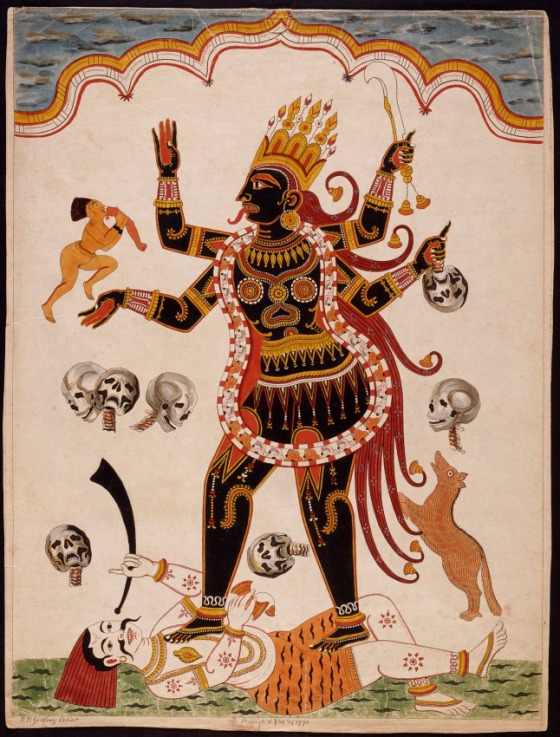 |
| Yep, I just based Skotia on images of the goddess Kali ... a many-armed goddess of darkness was a fixture in my dungeons well before I codified her as Skotia. Also, notice the harpe (sickle-sword) in the top-right corner ... |
Not specifically a goddess of the night, nevertheless she is associated with that darkness; and because she is Death, and sleep is a presage of death, and orgasm is metaphorically the "little death", so she is also a goddess of sleep and a fertility goddess in her own right. But ever is she silent, never revealing what happens to those who enter her embrace in the long sleep; not even her priestesses (and few priests) have ever received an answer from her after their most strenuous prayers--nothing but the vaguest of omens are offered to her followers.
This silence has allowed for a great schism to arise in her cult, and differences in the particular interpretation of her place in the cosmology are as myriad as the priestesses who serve her. Most devotees fall into one of the two major cults (and the majority of all devotees fall into the first): 1) the Silent Sisters, and 2) the Death Cult.
------
The Silent Sisters do not exactly worship Skotia, so much as recognize her embrace as the ultimate destination for all mortals, and so do what they can to aid the passage into the Long Sleep. They do this primarily by accepting the bodies of those who are too poor for proper funereal preparations, or those who have no family and so have no family tombs in which to be interred; these bodies the Sisters wash and prepare for burial, and then inter in their necropolis-shrines. The Sisters also take in and care for those who are too poor or downtrodden to receive proper care otherwise--beggars, lepers, plague-victims, etc. are received into their shrines to receive care under the Sisters until such a time as they are healed, or have passed on in Skotia's embrace, thence to be interred like the others ...
Most people understand Skotia in this light, that of an embodiment of a natural inevitability. Her footstep is feared as the tread of doom, but she is certainly not seen as any kind of demon or moral evil--all men die, and so all men must eventually come face to face with Skotia.
------
Some, however, would use Skotia as an idol and object of a Death Cult whose members revel in spreading death and destruction in imitation of the goddess' avatar as the Destroyer. These Death Cults of Skotia are some of the secret Evil cults that plague the world; and sometimes those who worship the Destroyer intermix secretly within the cults of the Silent Sisters, making their detection even more difficult.
The cultic imagery of the Death Cults is virtually the same as that of the Silent Sisters, including an idol of the goddess, six-armed and dancing, shrouded in shadow (sometimes magical, sometimes not); but the rites include monthly blood sacrifice, of kine or swine at least, but preferably human or demi-human, be they slaves, prisoners, or free and willing. Such rites take place only at night, in utter darkness and utmost secrecy; and those initiated into the higher mysteries of the Death Cult are often tasked with further secret rites.
Priestesses who worship the Destroyer are often accompanied by undead, which they raise as walking avatars of the end that comes to all mortals, and high priestesses are also often served by demons, much as any Evil cult might be. The Spiders of Darkness, those silent and implacable hunters, are their preferred servants.
Most of those initiated into the higher mysteries of Skotia tend to be women and priestesses; nevertheless, males are not excluded from the priesthood, and many do rise to power. Of these, however, many priests are self-made eunuchs! For in their enthusiasm in the greater rites, it is common for men to emasculate themselves in imitation of the myth of Ophalle or to become more feminine like Skotia (similar to the Galli, priests of Cybele and Attis, who castrated themselves during a certain holiday, and thereafter went about dressed as women)
------
She is the darkness. Out of the darkness of her womb sprang Seed-sowing Ophalle, who took the earth as his bride, and forced her to bear his myriad children.
The earth groaned with the pangs of her labor, and in her despair, she cried out to the gods to relieve her of her woes, but the gods denied her. "We have built our kingdom over your children," they said. "Shall we give up everything we have made?"
And the earth groaned, for her pains were great, and she called out to the sun. But he turned his face from her, saying, "Do not ask this thing of me. I would help if I could, but the gods have set me here to light their kingdom, and they would destroy me if I desert my place." So it was night because his face was turned.
Then the earth called out to the stars, whose children are the Elves, because she was wracked with the hurt of her labors. But stars only shone and laughed among themselves. "It is absurd," they said. "What do we, who are so high above you, care for your pains?"
"Will no one aid me?" the earth cried at last.
But Skotia had heard, and so she stepped down. In silence did she walk, and in the night Ophalle saw her, and was smitten. And he went to her, and he asked her name, but she was silent. And he gave her wine, and she drank it, but she did not laugh, for she was silent. Then she took his hand and led him to lay down, and he laughed, but she was silent.
And when Ophalle slept beside her after his exertion, Skotia rose up, and she took his sword, called Harpe, so that he would go unarmed at the final battle when the Gjallarhorn is sounded. And with Harpe she cut his hair so that she might bind him with it, there and thereafter; for witches often use the hair of their victims in rituals of binding and unbinding, and so Skotia would do at Gjallarhorn's winding. And raising Harpe again, Skotia unmanned Ophale a third time, cutting off source and member; these she took, and holds them yet.
So, taking Harpe, hair, and phallus, Skotia went her way again, and Seed-sowing Ophalle was left unmanned in his pain. And when Gjallarhorn sounds, he will try to rise up; but he will be weaponless, for his sword is gone; and his limbs will be bound with the magic of Skotia; and his blood will be cold for the lack of his life-source, and all things will pass again into darkness, and the earth will groan no more, but will know peace in oblivion.
Subscribe to:
Posts (Atom)