Showing posts with label travel. Show all posts

Wednesday, March 21, 2018

Travelling in the Wilderness: Becoming Lost

(new rule idea in the middle of this post)


"If a party is lost, the DM may choose the direction the party moves in, or use a random die roll. The DM must keep track of the party's actual position, as well as the direction the party believes it is moving. For example, the DM determines that a party ... has become lost. ... the party wishes to travel north; however, the DM has secretly determined that the party will head northeast. If after travelling in this direction for 6 miles, should the group decided to turn northwest, they will actually turn north." ("Travelling in the Wilderness", Dungeons and Dragons Expert Rules, p.X56)

A diagram using hexes follows.

I have never used this rule.

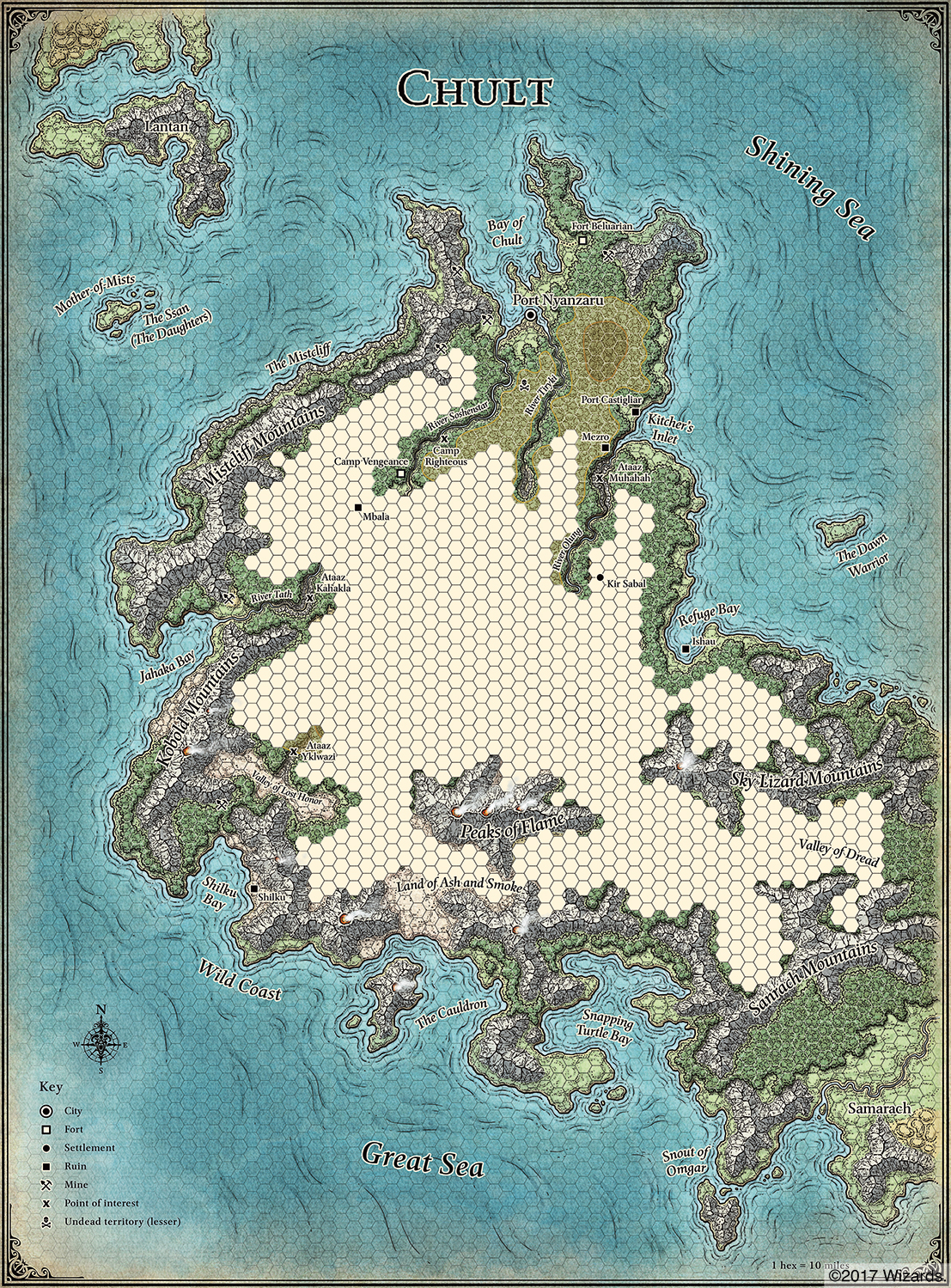
I did invoke a "becoming lost" rule once, in my Jungles of Chult game, which in 5e is of course a skill check (a Survival [Wisdom] check, DC 10 for waterways or DC 15 for jungles). Failure indicates that when the party moves into the "next" hex, roll a d6 to randomly determine which neighboring hex they actually enter. "... While the party is lost, players can't pinpoint the group's location on their map of Chult. The next time a navigator succeeds on a Wisdom (Survival) check made to navigate, reveal the party's actual location to the players." ("Chapter 2: The Land of Chult", Tomb of Annihilation, p.38)

Actually, I didn't use that rule by-the-text either, because I allowed a player character to make a second roll to get on track after the navigators (River Mist and Flask of Wine) got themselves turned around with a failed roll.

Where I have used rules like it is when playing Outdoor Survival (the hex map of which, as I understand it, was the basis for much D&D exploration back in the genesis-days). In that game it makes sense. As a board game, each player has perfect information about the board and the state of his "character" and position on the board, and even everyone else's character and position. The only way to simulate "lostness" in such a case is to force a player to move in a random direction as indicated by a die roll. (Every turn you roll a die to determine how lost you are; a good roll allows you to choose a direction, a bad roll forces you to move in a die-rolled direction)

image from Boardgamegeek


But D&D is emphatically not a game of perfect information. A player has the information on his character sheet and on whatever map he may have drawn, and beyond that relies on the referee's description of his character's location and surroundings. D&D is a game of discovery, of epistemology one might say ... a game in which players map a space according to the referee's descriptions which may or may not conform to the referee's map of the "actual" space, and where such accuracy or deviation can have serious consequences for the state of the characters and the game.

So D&D doesn't need to simulate "lostness" in the way that Outdoor Survival does. The players already don't know the map, and don't know where they're going. And I don't much like the idea of running "getting lost" at the table by travelling in a random direction--to go back to the B/X quote at the top, to keep track of where the characters are on my map and also where they think they are on my map, and to adjust their movements accordingly seems like a hassle. I won't lie, I already have trouble keeping track of where the party is on a hex map just for myself when I'm supposed to be notating it in pencil ... sometimes I forget to mark a day's travel, or when they're not moving at the speed of one hex per day I forget how far through the hex they've moved this turn ... (maybe I'll post about hex maps in the future).

------

Long story short, I have a thought for another way to simulate becoming lost that would mitigate the hassle of the map and confusion on the referee's (my) part:

Becoming Lost
When moving from hex to hex (or from area to area, maybe), treat navigation as an "open door" type check. The party rolls a die (be it a straight 1-2 on a d6 or rolling a d20 plus Survival [Wisdom] against some DC, or whatever) and if they succeed, they may proceed into the next area. If they fail the roll, their day's travel is suspended as they try to find a passable way into the next area but their way is blocked by impassable brambles, a raging river, a sheer cliff, or their own incompetence at wilderness travel. They do not advance or move anywhere else.

On the next day, they may either try again with another roll, or must try to circumvent the barrier through magic or by traveling another direction (depending on whether you, the referee, treat the roll as final or as re-rollable).

In most situations, the party is able to backtrack the way they've come without having to roll anything, especially in the cast that they've mapped their way there. But in especially thick wilderness (a jungle, say), the party might have to make a roll to make their way into another hex or area even if that is the same hex or area from whence they've just come. I'd probably still allow a bonus to backtrack, especially with a map ...

------

This method of getting lost would cut out an element of the game that I feel is intellectually interesting, but which often bogs down at the table: the mode of play in which it is up to the players to ensure that their map is correct, to interrogate the fictive space that the referee is describing to be certain that they have grasped the "truth" of their representation of it.

Theoretically, the rules for getting lost in B/X D&D actually appeal to me, in the way that the sliding corridors, one-way doors, and secret teleporters that Gygax seems so fond of in dungeons are theoretically appealing. What fun it would be, I think to myself reading such rules, to be in a dungeon where I was suddenly deposited somewhere from which I don't know how to get to the exit. I would have to map myself back to a familiar space on my map!

The problem with this type of play is that most of the time I'm stuck with two or three hours for the game at most, and I've got to resolve things by the end (for my pick-up games ... same-people campaigns are a bit different, and you can put things on hold until next session). Jeff Rients' Triple Secret Random Dungeon Fate Chart of Very Probable Doom (scroll to the bottom) can help with resolving what happens when characters are stuck or lost in the dungeon (or wilderness--need a new table!) at the end of a session; but what happens when characters are split up in the middle of play? Do you split time between them? Cut one side out and have them roll to get out while you stay with the other group?

I know there must be good ways for referees to deal with these things effectively and without bogging play down, but I am not at the moment privy to them. Perhaps someone out there has procedures that make this part of the game as easy as the rest is--and I would be glad to learn from them!--but as of now, I haven't played in anyone else's hexcrawl, and only one other referee's "squarecrawl", so I'm just muddling things out for myself.

Sunday, January 28, 2018

Jungles of Chult -- Around the Head of the River Tiryki

In the first session of Tomb of Annihilation, the players decided that they would journey up the River Tiryki, which they can see entire on their copy of the hex map (much of central Chult are just blank hexes to be explored, but the Tiryki is "known territory"). They made this decision in large part because they hired two Tabaxi, River Mist and Flask of Wine, as their jungle guides, and the two mentioned that they knew directly of at least two sites near the head of the Tiryki--Firefinger and Dungrunglung. (the characters had otherwise been interested in seeking Camp Righteous and Camp Vengeance, up the River Soshenstar)

The Tiryki is the central of the three northern rivers

As a couple other reviews of ToA (at Dungeon of Signs and Against the Wicked City) make clear, the hex map of Chult is actually a kind of howling emptiness of hundreds of miles (dozens of days) of random encounters, interspersed with a sprinkling of interesting adventure locations. My intent is to create content for all those empty hexes--and because my players are headed up the Tiryki, I'll start with locations around its head.

The information is that which is known well enough locally in Nyzanzaru that rumors could be picked up just by mentioning the Tiryki, or is information directly from River Mist and Flask of Wine.

------

the Pilgrims' Guide
There is a statue on the bank of the river, a great idol like a stern king, River Wind says. That is when we know we are halfway up the River Tiryki. He is a stern king, but he points to the east directing pilgrims on their way to the City of Mists. Sometimes they leave offerings at his altar, but I do not touch them because he is a god.

There are other altars too, Flask of Wine adds. There are too many gods in these jungles.


Sailback Hill
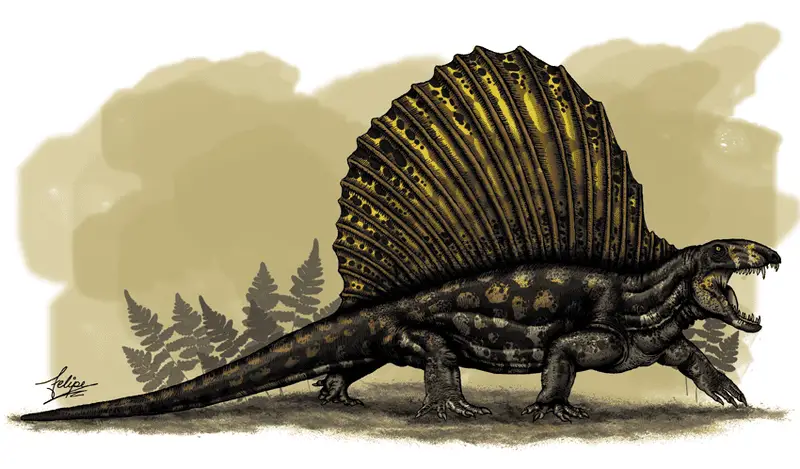
There is an outcropping in a swamp shaped like a sailback, according to River Wind. We only saw it from afar, because it stands in a swamp, and we did not wish to wade there. But I think I saw a face at the hill's base, a gaping jaw with big fangs. There were many storks in that swamp, and I did not like the way their eyes looked at us.

The mouth is a cave, Flask of Wine says, but says no more.

A sailback, i.e. dimetrodon


Firefinger
It is a pinnacle topped with fire! River Wind explains. It lies on the right bank of the Tiryki--a finger pointed at the sky, with a pyre burning brightly, day and night, at its top. The dead lie thick around it--all those taken up by the pterafolk, and then thrown down from the top. We have climbed, Flask and I, and found a cave inside the finger--but we have gone no higher. Just the two of us, what would we do against the many pterafolk that nest at its top?

Flask of Wine only nods agreement.


Ataaz Ahiya ("the Weeping Gorge")
The head of the River Tiryki is in a gorge (other gorges are also named with "Ataaz" in Chult, so I assume that's what it means), approximately 25 miles long north to south, and ten miles wide east to west. Smaller tributaries to the Tiryki pour in around the gorge, either as high waterfalls cascading down cliff faces, or as narrower streams that have cut their way down through the surrounding highland. Many tribes of pterafolk roost in the heights of the cliffs around the gorge, ruled by an ogiso or king.

The face of Olokuna is said to have been carved into the southern cliff-face, with waterfalls pouring from its eyes, and a mouth that opens into a deep cavern and shrine. Olokuna is an androgynous water god, possessed of both male and female features, and idols to it often include both an erect phallus and a maze-like vulva.

Yes, yes, River Wind says, we have seen the face of the goddess. She weeps because she is forgotten by all but the monkeys who dwell in her mouth. I too would weep if stinking apes were in my mouth. Her servants, the lobster-men, peer with cold eyes from the waters beneath her shrine.

He weeps because he has waterfall eyes, Flask of Wine adds. There is gold and gems in his mouth, but the baboons are too many.


Dungrunglung
Dungrunglung is the greatest shrine of the grungs--the frog men, you know, River Wind says. We have looked on it only from afar, because it lies in the midst of a wide swamp, and it is closely surrounded by a hedge of thorns. The head of the shrine towers over the hedge like an evil frog, grinning at the swamp, and all the while the croaking of the frogs and the frog-men is sounding around you. It is southwest of the Weeping Gorge perhaps twenty miles--who knows? It is difficult to judge distance in the jungle.

And it is filled with treasures, I am sure of it, Flask of Wine mutters, almost to himself. Riches to make a man wealthy.

I might end up calling them grippli or bullywugs,
we'll see ...


City of the Faceless Men
Somewhere in the jungles south of the Ataaz Ahiya lies an ancient and ruined city, its name forgotten and only its curse remembered in tales and old epics. It was a city of the Eshowe, perhaps, before their slaughter; or a city of Omuans, cursed by God for the pride of their ways. Regardless of the origin a curse lies over the city--all those who enter are damned to contract a horrifying disease that slowly eats the flesh of the face until only a gaping hole remains where once were mouth, nose, and eyes. The legends vary about what lies within its cursed grounds--treasures untold, or only old broken stones? But one thing that is certain is that a tribe of cursed men live among the ruins (or eke out an undead existence)--the Faceless Men, the Mask-Wearers ... in every tale, they are said to haunt the ruins, perhaps as cannibals, perhaps as undead horrors, but always wearing masks to cover the horror of their hollow faces.

It is there, River Wind says, and her ears lower, and her eyes narrow. It is an evil place. I have forgotten the way, but I have seen the obelisks that mark its boundaries. They tell its curse, because the men there have no mouths behind their masks. I will not go back. She shakes her head after saying this, going to bathe in the river, and will not talk about the City any more after that.

I remember the way, Flask of Wine murmurs. There must be something there.


Friday, November 17, 2017

Wilderness Encounters as Attrition 2

I received a comment on a recent post inquiring if I had fiddled with my rules for "wilderness attrition" at all, and whether I had anything further to write about them. The short answer heretofore was "no" because I have been using the rules as I wrote them for the last few sessions (and they've been pretty simple and effective so far, and people are starting to carry back-up items, which is one thing I envisioned for these rules ... thus necessitating a mule and porters ... mwahaha!)

The longer answer is, I do actually have an idea for making "wilderness attrition" a little better, I hope--"concreteness".

As written so far, and as used so far, I roll the encounter chance, elucidate the results and the number of damage dice for the party, and then come up with a lame reason for it afterward (especially when prompted by the player of Rendorsheeg the Elf). This is abstract; abstraction, of course, was the main purpose for creating these rules; yet nevertheless, D&D is so often about concreteness that it pains me to just kind of handwave why a week of rations, 12 arrows, a spear, and a shield were all lost. Generally I've been calling it skirmishes with goblins or orcs ... but what if I had said it was wolves, and a druid, say, replied by saying, "I want to cast speak with animals and talk them out of attacking us"?

Moreover, of the three dice I roll for every encounter/wandering monster check, on of them is not pulling much weight in these "attrition" rules, and I think "concreteness" could be a better use of its pips on the table.

Therefore:

When I roll for encounters, I roll 3d6, one black, one white, one red:
black -- encounter chance
white -- party surprise chance
red -- monster surprise chance

I ignore the red and white dice if black comes up nothing.

For attrition in the wilderness, rather than rolling up a full encounter on a positive result from the black die, I look to the other dice:
The white die determines "attrition dice" inversely to the number rolled on the die, e.g. 1 is 6d6, 2 is 5d6, 3 is 4d6, 4 is 3d6, etc.
Instead of an extra chance to "ignore" the encounter as I originally wrote, the red die can be used to determine "concretely" just what happened, thus:

1 - animal encounter -- a bear, a pack of wolves, a rutting moose, a baboon troupe, etc.

2 - men encounter -- a group of hunters, some brigands, some local ruffians

3 - humanoid encounter -- a skirmish with orcs, goblins, ogres, etc. per what I've generally said

4 - fey/unusual encounter -- undead perhaps, or faerie trees/briars that grasp at characters, etc.

5-6 - non-creature encounter -- a freak storm, a patch of poison ivy, a nest of young ticks, etc.

These are vague, and I think necessarily. As I said above, abstractness is the reason for these rules of attrition--what I get out of them is focusing on the dungeon while retaining some of the danger of the wilderness and travel through it. Attrition is a quick way to move through the consequences of the wilderness than having to describe an entire encounter with a band of orcs transporting prisoners, etc.

And yet, having a sense of what concretely the characters have encountered allows the players to respond to it with their skills, spells, etc in somewhat of the way that they would if presented with a full encounter. The best example I have is that if the referee rolls an "animal" encounter of six attrition dice, and the party includes a druid who responds by casting the spell speak with animals, the referee could allow the druid to just talk to the animals and avoid the encounter altogether, OR allow that spellcasting to replace one (or so) of the "usual" means of eliminating attrition dice (including the otherwise invulnerable sixth die, perhaps!).

Perhaps the party encounters "animals"--the referee declares them spiders
... and the halfling of the party uses his halfling abilities to sneak around
distracting the spiders with anti-arachnid slurs like, "Hey, atter-cop!"

Maybe an "unusual encounter" is undead, and the cleric can turn undead to eliminate an attrition die; or perhaps a group of men can be charmed or slept by a magic user to eliminate dice ... etc.

And of course, if the players just blithely accept the dice that you put forth, break their items, and move on, it's no skin off the referee's back. I just felt a strong need to have a way to clearly allow more player agency in response to the "attrition".


Wednesday, November 1, 2017

On the Road Again ... Encounters

In my regular (non-Greyhame Dungeon game), I've had the party move areas a couple times, first relocating them down south for the winter to deal with the return of Sakatha the Lizard-King (module I2), and then of course moving them back north to the original town of Calpurnia where they started. I've now also got half the party continuing even farther north to go help the halflings of Hopshire.

For these travels, I came up with a d20 table of Encounters on the Road from which I roll one item for every week of travel, rather than rolling on the wilderness encounter table day by day by day. This speeds long distance travel up significantly, without necessarily just "jump-cutting", so that the travel itself retains some interest and impact; and it is to my mind justified, because the particular journeys being made by my group are not wilderness exploration, but rather along major thoroughfares within civilization, so rolling constantly on the wilderness encounter tables just doesn't make much sense.

There's no great need for me to keep this secret from my players--I'll roll what I roll, and they can deal with it!--I thought I'd present it here:

Encounters on the Road -- roll 1d20 per week, roll a random day if you want

1 - Dragon, on a d6 (1-2) basking, (3-4) hunting, (5-6) patrolling. Will accept mere flattery sometimes, demand food if hunting, or demand tribute if patrolling. I either roll up a new dragon and place it in the world near where it was encountered, or have a dragon already placed nearby who can stand in for the enounter

"Why yes, I am quite magnificent. Do go on, mortal,
and I might let you pass without eating your mule."

2 - Zauldron the Sage and Clara Clairvoyant -- for 2000 gp, they can do in 2-5 days what takes a normal sage 1 month (because of the synergy from his encyclopedic memory and her clairvoyance!); OR, Clara can commune with a higher power for the characters (also costs 2000 gp)

3 - Caravan/Free Market -- opportunity to buy/sell/resupply, plus the possibility to get in on some arbitrage/speculative trading of goods

4 - Magic Item Peddler -- buys magic items (500 gp/+ bonus, OR per offer); has 2-7 potions from the list for sale, as well as 1 item from my magic item for sale table; and don't try to rob him, he's got a competent guard of many well-armored fellows, plus a leveled fighting-man, magic-user, or whatever

5 - Storms and/or Bad Weather -- add 2-9 days of to travel time to the party's destination

6 - Castle -- per the rules in the Expert Book, OR just assess some kind of toll on the party, demanded by a party of armored knights on their lord's behalf

7 - Fey Encounter -- the party comes upon a Faerie-knight, a nymph-grotto, a dryad-grove, a nixie/naiad-pool, an oread's mountain, dwarvish underkingdom, etc. etc. Make it weirder than just a combat encounter with a dryad

8 - Wild Animal Peddler -- sells animals per my table of Animals For Sale; like the peddler of magic items, he is well guarded by a party of armed men

9 - Haunted Keep/Shrine -- either some kind of combat encounter with undead, esp if the party comes nigh around dusk; OR come up with a unique way to use turn undead or bless ... I haven't rolled this yet, so I haven't fleshed it out like I wanted to

10 - a Hermit -- on a d6 (1-2) Good saint, (3) Lawful anchorite, (4) Chaotic outlaw, (5-6) Arcane hedge wizard/witch. The saint offers succor and healing; the anchorite can offer sage advice; the outlaw might have a band with him, likely has a bounty on his/her head (200-1200 gp?), but can offer pathfinding, etc., to those who won't snitch; the hedge wizard has 2-5 potions and 1-2 scrolls possibly for sale

You see this fellow hunched under an oak by the tree; being
St. Anthony, he can help you resist the temptations of demons

11 - Fellow Travelers -- 1) arrogant aristocrat and entourage, 2) party of pilgrims, 3) dust-weary villeins, 4) adventurers-errant, 5) muddy-booted men-at-arms, or 6) roll on the MEN wandering monster table

12-13 Wandering Monster per that table

14 - Peasants seeking aid -- when I rolled this, I had peasants seeking aid after some natural disaster, and the group decided to give them I think several hundred gold pieces--naturally, the peasants used some of that wealth to raise a shrine dedicated to the party cleric's goddess/saint in gratitude

15 - roll on the FLYERS wandering monster table

16 - Elf-Pilgrims -- you may carouse with them for the night, according to the carousing rules, but if you fail your save you might just join them and return to the mortal realm some time much later


17 - Ankhegs (I just like ankhegs; obviously, replace this with whatever particular monster you want)

18 - Greater Werewolf and his pack, obviously in the guise of fellow pilgrims/travelers; it's probable that they'll try to eat the party at some inopportune time (these fellows are currently rising in power as Chaos is on the rise in my world; given other circumstances, I would alter the particular creature)

19 - Diseased Inn or Plague Victims -- save v. poison or random members of the party are infected

20 - Doomsaying Prophet or Itinerant Preacher -- maybe he's just a madman mumbling nonsense, maybe he's a man inspired by God or the gods to bring a warning the world, a local city, or even the king; he could even just be a wandering holy man, offering healing to the injured and sick, blessings, and words of advice to those in need