There's no text to quote concerning this topic that I know off the top of my head.
I'm chewing on another means of running wilderness exploration than the venerable hexcrawl. Not like there couldn't be tricks and traps in a hex or in a traditional hexcrawl, but I've been thinking of "dungeonizing" the wilderness, if I can. We'll see what happens.
But I'm stumbling. The utter freedom of the wilderness is too much, and populating any area in my map is like, "Is this a grove of trees? A boulder field? A ridgeline? A cliff-face? An area with knucker-holes? etc. etc." So I'm paralyzed by possibility, and I wanted to try to focus myself with a table of discreet ideas. Ideas for traps at the moment. So here goes.
------
20 Wilderness Traps (these are a little "conservative" in scope, but they're just the beginning of what could be out there ...)
1) Tree fall -- 1 in 6 chance that a dead tree falls on 1-3 randomly selected characters. They may save v. paralysis (or using DEX) or take 4-24 damage
2) Poison ivy -- or other rash-causing plant; characters moving through the area are automatically affected by an itching rash that incurs a penalty of -1 on "to hit", damage, and saving rolls because of discomfort for 2-7 days. Characters looking out for the plants are only affected on a 2 in 6 chance.
3) Stonefish -- or other venomous animal, e.g. vipers or scorpions; characters moving through the area have a 2 in 6 chance of being stung. Those stung must make a save v. death/poison (or CON) or die in 1-3 days.
4) Rock fall -- like a tree fall, except it happens where boulder are and causes 5-30 damage. Sorry for the overlap
5) Glue-resin -- characters moving through the area have a 3 in 6 chance of contacting glue-like resin and being thus bound to the resin-tree. The resin binds quickly, but may be loosed by liberal application of alcohol ... otherwise, the character remains bound to the resin for 1-3 days and wandering monster checks ensue ... (strength based options to remove them are of course optional)
6) Strangle-bracken -- the bracken in the area reacts to movement through it by tightening; characters moving through the area must make a save v. paralysis or be stuck. One day without movement is required before the bracken "relaxes" enough to allow a character to struggle back out the way they entered (or to the nearest clearing).
7) Loose scree -- characters in leather or lighter armor may move nimbly enough not to fall, but those in metal armor (scale, mail, splint, banded, or plate) who move over scree have a 2 in 6 chance of falling 20 to 120 feet (1-6 damage per 10 feet fallen).
8) Razorgrass -- characters moving through the area without any armor take 1-6 damage per mile traveled. Those in armor are allowed a save against paralysis, +0 for leather, +1 for mail, +3 for plate armor, those who fail take damage as if unarmored, those who succeed take no damage.
9) Sandflies (diseased) -- the biting insects in the area carry a disease. Unless some means of repellent is used, characters passing through must save v. poison or contract a disease. If no other specific disease is used, it will cause -1 CON and 1-6 fewer hit points until cured.
10) Tick-nest -- the foliage in this area is thick with ticks. Characters who pass through have a 2 in 6 chance of getting bitten by ticks, which causes -1 CON and 1-4 fewer hit points until dealt with. Furthermore, 1 in 20 ticks are diseased and the character must save v. poison or contract a disease that will be fatal in 1-6 weeks.
11) Geyserhole -- entering the superheated water causes 4-32 damage, but who would do that? More importantly, there is a 1 in 6 chance that the geyser "goes off" and causes 2-16 damage to all those nearby.
12) Sleep-river -- like the stream in Mirkwood, the water of this river causes a magical sleep to all who touch it
13) Black-water -- worse than the stream in Mirkwood, the water of this river is rife with negative energy; all who touch it are drained of one life-energy level per round of contact with the water. Those who are reduced to 0 levels are killed and rise as hostile wraiths in 1-4 rounds thereafter. Such wraiths must remain within 1 mile of the body whence they sprang, so if borne downriver, downriver the wraith must go ...
14) Labyrinth-root -- a particularly pernicious kind of tree with excessive root-systems that magicall compel people who come across them to trace them like a labyrinth, save v. spell to resist; the labyrinth will take 1-3 days to complete, incurring wandering monster checks as usual (though non-flyers might also become caught in the magical labyrinth?)
15) Drawstone -- a kind of super-powerful magnetic rock formation; metal-armored characters that pass too close (1 chance in 6 when passing through its area) cannot move farther away; those who fail a save v. paralysis must move closer. Shedding armor takes enough time to allow a wandering monster check
16) Corpseflower -- flowers that smell like rotting flesh and always draw the attention of monsters that would eat such. Passing through the area incurs an extra wandering monster check; coming into contact with the flowers (3 in 6 chance unless explicitly avoiding them) continues to draw one extra monster check per day for 1-4 days
17) Hotspring slime -- it's a green or grey slime, but bigger; OR a brown mold colony that makes the hot spring just a spring, but touching the mold causes the normal 4-32 cold damage
18) Social insect colony -- stepping into an underground wasp colony is a nightmare of mine, and the characters just did it! Save v. poison or take 3-18 damage from the stinging insects, save at +1 in leather armor, +2 in mail, or +4 in plate. There are 1-3 swarms; they might pursue for a bit if the reaction roll is particularly bad, but only do 1-6 damage after that first round
19) Yellow mold (always a favorite) -- it's a wild yellow mold colony; 50% chance that the characters nearest it save v. death or die in 6 rounds as they choke to death on the spores. Outdoors, these colonies could get huge
20) Wormrose -- wildflowers with a magical worm that dwells within them; 3 in 6 chance that a character comes into contact with one if wormrose is in the area, and such a character must save v. breath weapon or fall into a coma for 1-4 days and be a hassle for their party to haul around unconscious ... it's difficult to harvest wormrose, but many magic-users, sages, etc. will pay a good price for intact flowers with the worms inside if they can be brought back safely ...
... 'What about a little light?' said Bilbo apologetically. ---- 'We like the dark,' said all the dwarves. 'Dark for dark business! There are many hours before dawn.' ---- ... 'We are met to discuss our plans,' [said Thorin], 'our ways, means, policy, and devices. We shall soon before the break of day start on our long journey, a journey from which some of us, or perhaps all of us ... may never return.' ...
Showing posts with label wilderness. Show all posts
Friday, March 23, 2018
Wednesday, March 21, 2018
Travelling in the Wilderness: Becoming Lost
(new rule idea in the middle of this post)
"If a party is lost, the DM may choose the direction the party moves in, or use a random die roll. The DM must keep track of the party's actual position, as well as the direction the party believes it is moving. For example, the DM determines that a party ... has become lost. ... the party wishes to travel north; however, the DM has secretly determined that the party will head northeast. If after travelling in this direction for 6 miles, should the group decided to turn northwest, they will actually turn north." ("Travelling in the Wilderness", Dungeons and Dragons Expert Rules, p.X56)
A diagram using hexes follows.
I have never used this rule.
I did invoke a "becoming lost" rule once, in my Jungles of Chult game, which in 5e is of course a skill check (a Survival [Wisdom] check, DC 10 for waterways or DC 15 for jungles). Failure indicates that when the party moves into the "next" hex, roll a d6 to randomly determine which neighboring hex they actually enter. "... While the party is lost, players can't pinpoint the group's location on their map of Chult. The next time a navigator succeeds on a Wisdom (Survival) check made to navigate, reveal the party's actual location to the players." ("Chapter 2: The Land of Chult", Tomb of Annihilation, p.38)
Actually, I didn't use that rule by-the-text either, because I allowed a player character to make a second roll to get on track after the navigators (River Mist and Flask of Wine) got themselves turned around with a failed roll.
Where I have used rules like it is when playing Outdoor Survival (the hex map of which, as I understand it, was the basis for much D&D exploration back in the genesis-days). In that game it makes sense. As a board game, each player has perfect information about the board and the state of his "character" and position on the board, and even everyone else's character and position. The only way to simulate "lostness" in such a case is to force a player to move in a random direction as indicated by a die roll. (Every turn you roll a die to determine how lost you are; a good roll allows you to choose a direction, a bad roll forces you to move in a die-rolled direction)
But D&D is emphatically not a game of perfect information. A player has the information on his character sheet and on whatever map he may have drawn, and beyond that relies on the referee's description of his character's location and surroundings. D&D is a game of discovery, of epistemology one might say ... a game in which players map a space according to the referee's descriptions which may or may not conform to the referee's map of the "actual" space, and where such accuracy or deviation can have serious consequences for the state of the characters and the game.
So D&D doesn't need to simulate "lostness" in the way that Outdoor Survival does. The players already don't know the map, and don't know where they're going. And I don't much like the idea of running "getting lost" at the table by travelling in a random direction--to go back to the B/X quote at the top, to keep track of where the characters are on my map and also where they think they are on my map, and to adjust their movements accordingly seems like a hassle. I won't lie, I already have trouble keeping track of where the party is on a hex map just for myself when I'm supposed to be notating it in pencil ... sometimes I forget to mark a day's travel, or when they're not moving at the speed of one hex per day I forget how far through the hex they've moved this turn ... (maybe I'll post about hex maps in the future).
------
Long story short, I have a thought for another way to simulate becoming lost that would mitigate the hassle of the map and confusion on the referee's (my) part:
Becoming Lost
When moving from hex to hex (or from area to area, maybe), treat navigation as an "open door" type check. The party rolls a die (be it a straight 1-2 on a d6 or rolling a d20 plus Survival [Wisdom] against some DC, or whatever) and if they succeed, they may proceed into the next area. If they fail the roll, their day's travel is suspended as they try to find a passable way into the next area but their way is blocked by impassable brambles, a raging river, a sheer cliff, or their own incompetence at wilderness travel. They do not advance or move anywhere else.
On the next day, they may either try again with another roll, or must try to circumvent the barrier through magic or by traveling another direction (depending on whether you, the referee, treat the roll as final or as re-rollable).
In most situations, the party is able to backtrack the way they've come without having to roll anything, especially in the cast that they've mapped their way there. But in especially thick wilderness (a jungle, say), the party might have to make a roll to make their way into another hex or area even if that is the same hex or area from whence they've just come. I'd probably still allow a bonus to backtrack, especially with a map ...
------
This method of getting lost would cut out an element of the game that I feel is intellectually interesting, but which often bogs down at the table: the mode of play in which it is up to the players to ensure that their map is correct, to interrogate the fictive space that the referee is describing to be certain that they have grasped the "truth" of their representation of it.
Theoretically, the rules for getting lost in B/X D&D actually appeal to me, in the way that the sliding corridors, one-way doors, and secret teleporters that Gygax seems so fond of in dungeons are theoretically appealing. What fun it would be, I think to myself reading such rules, to be in a dungeon where I was suddenly deposited somewhere from which I don't know how to get to the exit. I would have to map myself back to a familiar space on my map!
The problem with this type of play is that most of the time I'm stuck with two or three hours for the game at most, and I've got to resolve things by the end (for my pick-up games ... same-people campaigns are a bit different, and you can put things on hold until next session). Jeff Rients' Triple Secret Random Dungeon Fate Chart of Very Probable Doom (scroll to the bottom) can help with resolving what happens when characters are stuck or lost in the dungeon (or wilderness--need a new table!) at the end of a session; but what happens when characters are split up in the middle of play? Do you split time between them? Cut one side out and have them roll to get out while you stay with the other group?
I know there must be good ways for referees to deal with these things effectively and without bogging play down, but I am not at the moment privy to them. Perhaps someone out there has procedures that make this part of the game as easy as the rest is--and I would be glad to learn from them!--but as of now, I haven't played in anyone else's hexcrawl, and only one other referee's "squarecrawl", so I'm just muddling things out for myself.
"If a party is lost, the DM may choose the direction the party moves in, or use a random die roll. The DM must keep track of the party's actual position, as well as the direction the party believes it is moving. For example, the DM determines that a party ... has become lost. ... the party wishes to travel north; however, the DM has secretly determined that the party will head northeast. If after travelling in this direction for 6 miles, should the group decided to turn northwest, they will actually turn north." ("Travelling in the Wilderness", Dungeons and Dragons Expert Rules, p.X56)
A diagram using hexes follows.
I have never used this rule.
I did invoke a "becoming lost" rule once, in my Jungles of Chult game, which in 5e is of course a skill check (a Survival [Wisdom] check, DC 10 for waterways or DC 15 for jungles). Failure indicates that when the party moves into the "next" hex, roll a d6 to randomly determine which neighboring hex they actually enter. "... While the party is lost, players can't pinpoint the group's location on their map of Chult. The next time a navigator succeeds on a Wisdom (Survival) check made to navigate, reveal the party's actual location to the players." ("Chapter 2: The Land of Chult", Tomb of Annihilation, p.38)
Actually, I didn't use that rule by-the-text either, because I allowed a player character to make a second roll to get on track after the navigators (River Mist and Flask of Wine) got themselves turned around with a failed roll.
Where I have used rules like it is when playing Outdoor Survival (the hex map of which, as I understand it, was the basis for much D&D exploration back in the genesis-days). In that game it makes sense. As a board game, each player has perfect information about the board and the state of his "character" and position on the board, and even everyone else's character and position. The only way to simulate "lostness" in such a case is to force a player to move in a random direction as indicated by a die roll. (Every turn you roll a die to determine how lost you are; a good roll allows you to choose a direction, a bad roll forces you to move in a die-rolled direction)
![]() |
| image from Boardgamegeek |
But D&D is emphatically not a game of perfect information. A player has the information on his character sheet and on whatever map he may have drawn, and beyond that relies on the referee's description of his character's location and surroundings. D&D is a game of discovery, of epistemology one might say ... a game in which players map a space according to the referee's descriptions which may or may not conform to the referee's map of the "actual" space, and where such accuracy or deviation can have serious consequences for the state of the characters and the game.
So D&D doesn't need to simulate "lostness" in the way that Outdoor Survival does. The players already don't know the map, and don't know where they're going. And I don't much like the idea of running "getting lost" at the table by travelling in a random direction--to go back to the B/X quote at the top, to keep track of where the characters are on my map and also where they think they are on my map, and to adjust their movements accordingly seems like a hassle. I won't lie, I already have trouble keeping track of where the party is on a hex map just for myself when I'm supposed to be notating it in pencil ... sometimes I forget to mark a day's travel, or when they're not moving at the speed of one hex per day I forget how far through the hex they've moved this turn ... (maybe I'll post about hex maps in the future).
------
Long story short, I have a thought for another way to simulate becoming lost that would mitigate the hassle of the map and confusion on the referee's (my) part:
Becoming Lost
When moving from hex to hex (or from area to area, maybe), treat navigation as an "open door" type check. The party rolls a die (be it a straight 1-2 on a d6 or rolling a d20 plus Survival [Wisdom] against some DC, or whatever) and if they succeed, they may proceed into the next area. If they fail the roll, their day's travel is suspended as they try to find a passable way into the next area but their way is blocked by impassable brambles, a raging river, a sheer cliff, or their own incompetence at wilderness travel. They do not advance or move anywhere else.
On the next day, they may either try again with another roll, or must try to circumvent the barrier through magic or by traveling another direction (depending on whether you, the referee, treat the roll as final or as re-rollable).
In most situations, the party is able to backtrack the way they've come without having to roll anything, especially in the cast that they've mapped their way there. But in especially thick wilderness (a jungle, say), the party might have to make a roll to make their way into another hex or area even if that is the same hex or area from whence they've just come. I'd probably still allow a bonus to backtrack, especially with a map ...
------
This method of getting lost would cut out an element of the game that I feel is intellectually interesting, but which often bogs down at the table: the mode of play in which it is up to the players to ensure that their map is correct, to interrogate the fictive space that the referee is describing to be certain that they have grasped the "truth" of their representation of it.
Theoretically, the rules for getting lost in B/X D&D actually appeal to me, in the way that the sliding corridors, one-way doors, and secret teleporters that Gygax seems so fond of in dungeons are theoretically appealing. What fun it would be, I think to myself reading such rules, to be in a dungeon where I was suddenly deposited somewhere from which I don't know how to get to the exit. I would have to map myself back to a familiar space on my map!
The problem with this type of play is that most of the time I'm stuck with two or three hours for the game at most, and I've got to resolve things by the end (for my pick-up games ... same-people campaigns are a bit different, and you can put things on hold until next session). Jeff Rients' Triple Secret Random Dungeon Fate Chart of Very Probable Doom (scroll to the bottom) can help with resolving what happens when characters are stuck or lost in the dungeon (or wilderness--need a new table!) at the end of a session; but what happens when characters are split up in the middle of play? Do you split time between them? Cut one side out and have them roll to get out while you stay with the other group?
I know there must be good ways for referees to deal with these things effectively and without bogging play down, but I am not at the moment privy to them. Perhaps someone out there has procedures that make this part of the game as easy as the rest is--and I would be glad to learn from them!--but as of now, I haven't played in anyone else's hexcrawl, and only one other referee's "squarecrawl", so I'm just muddling things out for myself.
Monday, February 5, 2018
Jungles of Chult Session 2
Beware the crocodiles of the Tiryki River ...
---
our intrepid heroes:
Sound of Distant Rain (cat-man rogue)
Terahn Atzi (human priest)
Nugiri (lizardman monk)
Takashi Kaga (human magic-user)
Nebin (halfling barbarian)
Chiratidzo (human druid)
with River Mist and Flask of Wine (cat-man guides)
The last session ended just into the expedition up the River Tiryki, after five days of travel following the river, the characters led by River Mist and Flask of Wine and porting a rowboat with them through the jungle (despite the river being right there ...)
Picking up where we left off, on the morning of the sixth day, Chira noticed a strange little creature at the edge of camp as everyone else was breaking things down. The thing looked like a root knotted into a six-inch high humanoid form, with pebbles for eyes and mouth, eagerly watching the party. It was sitting on a mess kit. Chira informed the party as to its presence, and Takashi, miffed as he realized that the thing had taken his mess kit, mage handed the kit up and as it rose through the air, the little creature jumped off and ran away.
Takashi discovered an empty wasp nest left in his bag in the mess kit's place; and Chira informed everyone that the thing was a Chwinga, a kind of nature spirit that is generally harmless though sometimes mischievous.
Continuing on, through the evening, the characters noticed eyes watching them from the river--insectile eyes from rocky carapaces. Asking their guides after these sightings, River Mist informs the party that these must be Aldani, the lobster-men the haunt the waters of Chult. "Don't take what's theirs, and they won't bother you," she says, and then continues the hike.
Day 8 -- morning -- Chiratidzo heads down to the river as camp is breaking to wash his face. As he crouches there, he gives a shout--"There's something in the water!"--as what looks like a waterlogged tree drifts toward him and the rest of the party comes nearer. Then the log surges out of the water with a huge splash, and a giant crocodile's jaws close around Chira, snap his back, and the crocodile beings to drag his body back into the river. The rest of the party threw missile weapons at the crocodile, but to no avail, and the reptile and its prey both disappear under the waters of the lake ...
River Mist and Flask of Wine shrug. "The jungle is dangerous," River Mist says, and then she and Flask continue to lead everyone on.
Day 9 -- diseased bite -- Sound of Distant Rain saves
Day 10 -- morning -- the party comes across Quinsela, or "Quin", another druid, now out hunting alone. He agrees to accompany the party, knowing that the crocodiles along the River Tiryki are deadly things to contend with ...
Later, the party comes across a kind of idol rising out of a series of rocks in a kind of calm area of the river. The idol is an obelisk, vaguely carved, dedicated to Olokuna, other than a maze-like vulva and stone phallus rising from near the water line. An altar of flat stone lies just under the water, covered at the moment with worked stone offerings (stones with carvings of hands, crabs, phalluses, mazes, vulvas, etc.); Sound of Distant Rain deposits a flask of palm wine on the altar for deceased Chiratidzo, further offering a prayer to the Cat Lord for the man's dead soul ...
Day 11 -- physical barrier -- the party runs into a cliff blocking their path; they decide to backtrack for a day rather than attempt to climb or circumvent it
Day 13 -- morning -- Flask of Wine calls Sound of Distant Rain forward to look at something--it's a dead body, half-eaten by a mouth-dragon and now abandoned in the bole of mighty tree-roots.
Day 14 -- morning -- The party enters a small mango grove and Flask of Wine (from scouting ahead) comes back with broken fruit on his shoulders. "There are mad apes ahead," he says and brushes himself off; he is immediately backed up by the sound of screaming apes from behind and another thrown fruit. Nugiri steps out and catches some thrown fruit, and also grins broadly at the two apes he can see.
The apes interpret that as a threat and charge into combat. One runs all the way forward while the other throws rocks from behind; but Sound of Distant Rain hates monkeys, as do the rest of the party, and they quickly kill both apes (though one does knock Nugiri out with its fists before dying from other melee attacks)
River Mist then points out that the swamp containing the Sailback Hill/Shrine is within a day's travel, if anyone were interested in checking it out. Everyone agrees that it sounds interesting, and so the party moves to the east bank of the river (they've been hiking down the west bank), and they find a wide swamp with both stork-men and sail-backs lurking in its midst.
| The stork-men with the evil-eyes |
Almost immediately, the party spies a group of stork-men between them and the sail-back hill; Sound of Distant Rain and Flask of Wine sneak out to (bag?) them, but Sound decides to talk instead. Fortunately, one of the several stork-men speaks the Common tongue, though hissing like a swan; "These are our swamps! What do you offer to move through them? Give us shiny things!" The party gave a mirror and a disassembled mess-kit, and I rolled an 11 for reactions, so that was enough. "I am Sssra," the lead stork-man declared. "You may travel our swamp. And let me say, the best place to rest is beneath the banyan outside the mouth of the sailback shrine," it adds.
---
The party deposited the boat in the banyan "grove" matching Sssra's description; they felt a supernatural sense that it would be "good" to camp there, indeed; then they headed for the dungeon in the open mouth of the sailback hill.
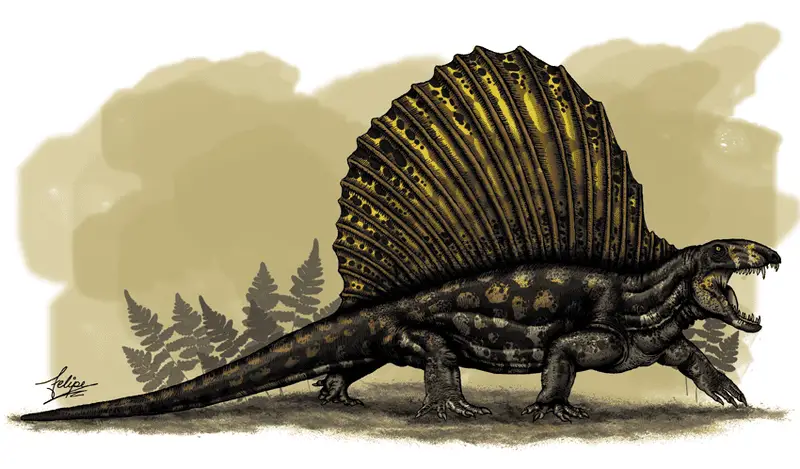
The mouth opened onto a stairway down (the gullet); this led down to a three-way fork; the party went west and found themselves in a stairway that ended in water. Nugiri checked under the water and didn't seem to find anything. The party then glanced down the east way, but ultimately went down the south way into a large chamber with stone pillars rising up that look like they support the stone spines of the hill that make it resemble a sailback. There were pit traps around these pillars; then entering the main chamber, the party saw a ruby, pulsing slowly, in the jaws of a small stone sailback on top of an altar against the south wall; the other walls were carved to resemble up-curving ribs. The altar was dedicated to SUCHOS, a god like an animal-headed Egyption god, but with a dimetrodon head.
A small swarm of mosquito-bats attacked the party here, but were easily dispatched ...
Furthermore, there were four other exits from the room ... the party checked one and found a collapsed corridor; checked another and found a closed door; but looking down the south west corridor, they found a series of natural caverns, of which one held a crevice in its floor filled with glittering coin. The party went for the coin, but were surprised by a "nest" of creepy monkeys with blood-red hands hanging from the stalactites on the ceiling of the chamber. Sound of Distant Rain was foremost in the party seeking the coin in the crevice, and he suddenly keeled over dead, clutching his head; Takashi also fell over, blood pooling from his nose, but not quite dead.
| The creepy-monkeys with blood-red hands |
While Nugiri saved Takashi and Flask of Wine ran forward to save his friend's (Sound's) body, the party elected (after a first intuition to run), to fight--and because they killed one monkey and injured two others with a variety of spells and attacks, the creepy monkeys fled deeper into the cave after failing a morale check.
"Let's loot this thing and get the hell out of here!" Nebin cried, and then the party quickly grabbed what they could of the coin (including 2 scrolls) and then fled back to the large room with the pulsing ruby-heart. They pitoned the little sailback statue's mouth open and took the ruby, but heard the grinding of stone nevertheless--the mouth of the cave had closed! Placing the ruby back re-opened the closed jaws. The cat-men thought they might be able to run fast enough to grab the gem and then make it out ahead of the jaws, but the party balked in the end and elected to return later.
So deciding, they checked one more room and found a tomb filled with sarcophagi for sailbacks. Opening the most ornate one, Teran forced open the sarcophagus and breathed in a poisonous cloud, but lived ... inside they found a sailback skeleton plated with gold, which they took ...
With a couple thousand coin (from the monkeys) and a gold-plated skeleton in their possession, the party went straight for the river with their rowboat and began to row their way back down the River Tiryki toward Nyanzaru. On the river, flowing downstream, their movement doubled to 10 miles per day (one hex per day).
---
Day 16 -- evening -- rare plants, zabou, 4 "doses" of zabou mushrooms which the party collects (Quin as an herbalist can pick them without trouble)
Day 20 -- evening -- croaking of giant frogs ahead--the party decides to accept another roll on the encounter die in the future to avoid the frogs now ...
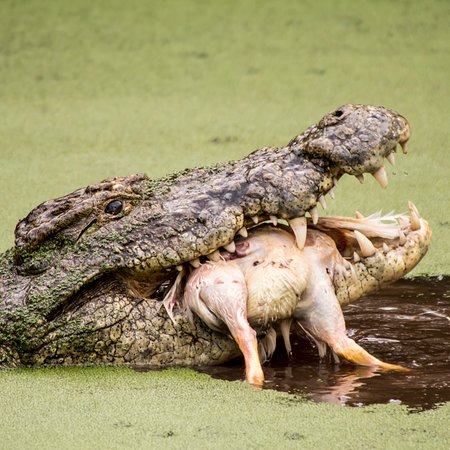
Day 21 -- morning -- as Teran hauls the boat down into the water of the river, a giant crocodile surges out of the water with a high initiative and snaps Teran up in its huge jaws. Teran is instantly killed and dragged away into the water, leaving the party bereft of a third member ...
| Except the hindquarters are Tehran's, not a zebra .... |
Day 22 -- back in town! (now everyone can get XPs)
In Nyanzaru, the party went to Jobal, whom they know collects hunting trophies, to sell the gold-plated skeleton to him. Jobal is sad to hear of Chira's death, but is glad to buy the skeleton off of them for 250 gold. During this conversation, Nebin brings up the mosquito-bats they killed (and the bodies they saved) trying to sell them to him too, but Jobal shows his colors, racist against "lesser" folk by "belittling" Nebin. "What, did you step on that? How cute!"
The party then also sold their 4 "doses" of zabou to Jessamine, who has been interested in rare plants.
And in the end, Nebin and Takashi caroused. Nebin ended up in debt to Jessamine 100 gold and in love with Talara, halfling wife of a local halfling merchant, Haban Widewater; and Takashi ended in debt to Jobal for 400 gold, and furthermore beaten and robbed so that he starts the next adventure slightly injured ...
------
Remembrance for the Dead
Tehran Atzi (human cleric of Ubtao 1), Sound of Distant Rain (cat-man rogue 1), Chiratidzo (human druid 1)
The party then also sold their 4 "doses" of zabou to Jessamine, who has been interested in rare plants.
And in the end, Nebin and Takashi caroused. Nebin ended up in debt to Jessamine 100 gold and in love with Talara, halfling wife of a local halfling merchant, Haban Widewater; and Takashi ended in debt to Jobal for 400 gold, and furthermore beaten and robbed so that he starts the next adventure slightly injured ...
------
Remembrance for the Dead
Tehran Atzi (human cleric of Ubtao 1), Sound of Distant Rain (cat-man rogue 1), Chiratidzo (human druid 1)
Sunday, January 28, 2018
Jungles of Chult -- Around the Head of the River Tiryki
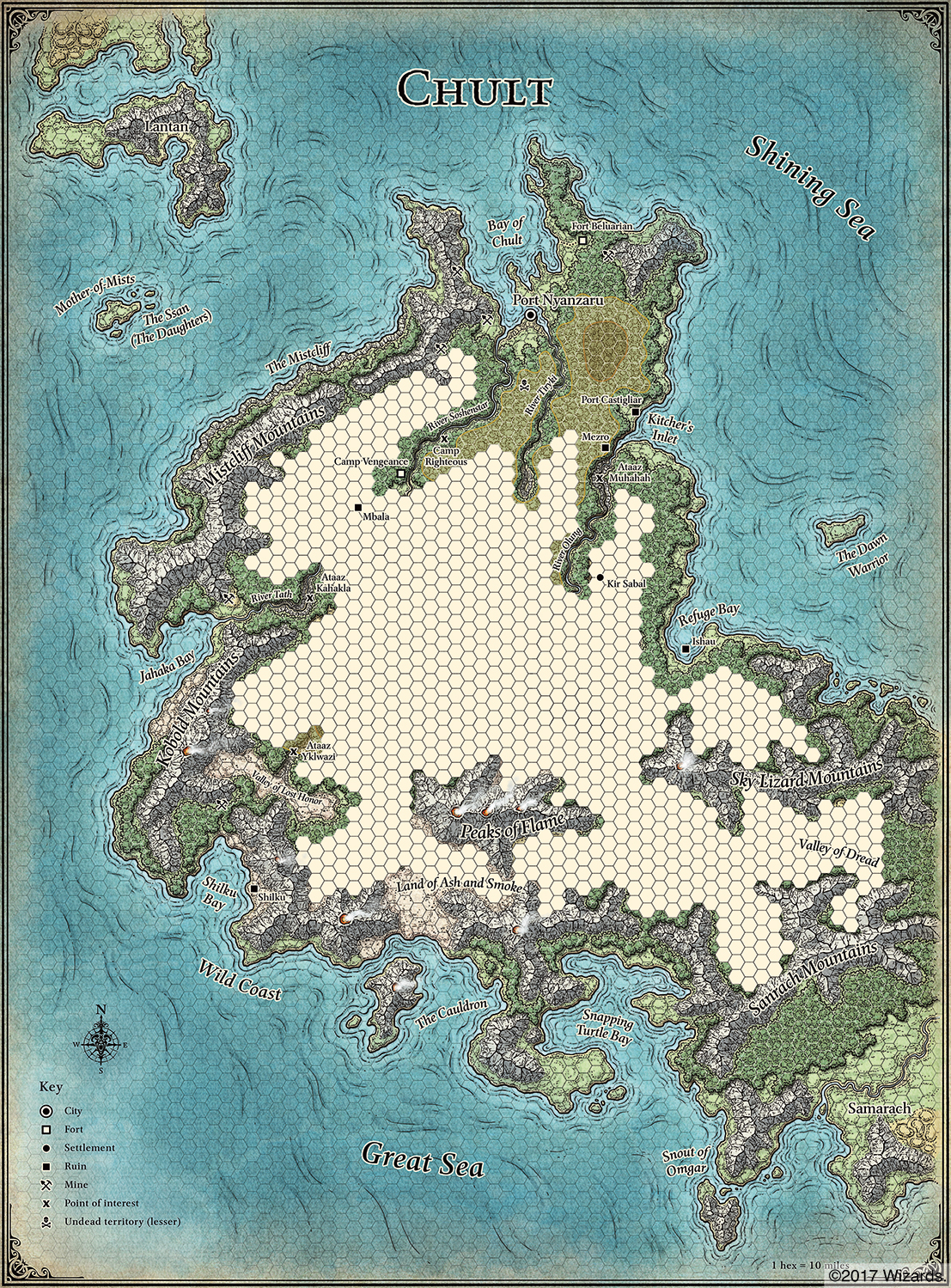
In the first session of Tomb of Annihilation, the players decided that they would journey up the River Tiryki, which they can see entire on their copy of the hex map (much of central Chult are just blank hexes to be explored, but the Tiryki is "known territory"). They made this decision in large part because they hired two Tabaxi, River Mist and Flask of Wine, as their jungle guides, and the two mentioned that they knew directly of at least two sites near the head of the Tiryki--Firefinger and Dungrunglung. (the characters had otherwise been interested in seeking Camp Righteous and Camp Vengeance, up the River Soshenstar)
As a couple other reviews of ToA (at Dungeon of Signs and Against the Wicked City) make clear, the hex map of Chult is actually a kind of howling emptiness of hundreds of miles (dozens of days) of random encounters, interspersed with a sprinkling of interesting adventure locations. My intent is to create content for all those empty hexes--and because my players are headed up the Tiryki, I'll start with locations around its head.
The information is that which is known well enough locally in Nyzanzaru that rumors could be picked up just by mentioning the Tiryki, or is information directly from River Mist and Flask of Wine.
------
the Pilgrims' Guide
There is a statue on the bank of the river, a great idol like a stern king, River Wind says. That is when we know we are halfway up the River Tiryki. He is a stern king, but he points to the east directing pilgrims on their way to the City of Mists. Sometimes they leave offerings at his altar, but I do not touch them because he is a god.
There are other altars too, Flask of Wine adds. There are too many gods in these jungles.
Sailback Hill
There is an outcropping in a swamp shaped like a sailback, according to River Wind. We only saw it from afar, because it stands in a swamp, and we did not wish to wade there. But I think I saw a face at the hill's base, a gaping jaw with big fangs. There were many storks in that swamp, and I did not like the way their eyes looked at us.
The mouth is a cave, Flask of Wine says, but says no more.
Firefinger
It is a pinnacle topped with fire! River Wind explains. It lies on the right bank of the Tiryki--a finger pointed at the sky, with a pyre burning brightly, day and night, at its top. The dead lie thick around it--all those taken up by the pterafolk, and then thrown down from the top. We have climbed, Flask and I, and found a cave inside the finger--but we have gone no higher. Just the two of us, what would we do against the many pterafolk that nest at its top?
Flask of Wine only nods agreement.
Ataaz Ahiya ("the Weeping Gorge")
The head of the River Tiryki is in a gorge (other gorges are also named with "Ataaz" in Chult, so I assume that's what it means), approximately 25 miles long north to south, and ten miles wide east to west. Smaller tributaries to the Tiryki pour in around the gorge, either as high waterfalls cascading down cliff faces, or as narrower streams that have cut their way down through the surrounding highland. Many tribes of pterafolk roost in the heights of the cliffs around the gorge, ruled by an ogiso or king.
The face of Olokuna is said to have been carved into the southern cliff-face, with waterfalls pouring from its eyes, and a mouth that opens into a deep cavern and shrine. Olokuna is an androgynous water god, possessed of both male and female features, and idols to it often include both an erect phallus and a maze-like vulva.
Yes, yes, River Wind says, we have seen the face of the goddess. She weeps because she is forgotten by all but the monkeys who dwell in her mouth. I too would weep if stinking apes were in my mouth. Her servants, the lobster-men, peer with cold eyes from the waters beneath her shrine.
He weeps because he has waterfall eyes, Flask of Wine adds. There is gold and gems in his mouth, but the baboons are too many.
Dungrunglung
Dungrunglung is the greatest shrine of the grungs--the frog men, you know, River Wind says. We have looked on it only from afar, because it lies in the midst of a wide swamp, and it is closely surrounded by a hedge of thorns. The head of the shrine towers over the hedge like an evil frog, grinning at the swamp, and all the while the croaking of the frogs and the frog-men is sounding around you. It is southwest of the Weeping Gorge perhaps twenty miles--who knows? It is difficult to judge distance in the jungle.
And it is filled with treasures, I am sure of it, Flask of Wine mutters, almost to himself. Riches to make a man wealthy.
City of the Faceless Men
Somewhere in the jungles south of the Ataaz Ahiya lies an ancient and ruined city, its name forgotten and only its curse remembered in tales and old epics. It was a city of the Eshowe, perhaps, before their slaughter; or a city of Omuans, cursed by God for the pride of their ways. Regardless of the origin a curse lies over the city--all those who enter are damned to contract a horrifying disease that slowly eats the flesh of the face until only a gaping hole remains where once were mouth, nose, and eyes. The legends vary about what lies within its cursed grounds--treasures untold, or only old broken stones? But one thing that is certain is that a tribe of cursed men live among the ruins (or eke out an undead existence)--the Faceless Men, the Mask-Wearers ... in every tale, they are said to haunt the ruins, perhaps as cannibals, perhaps as undead horrors, but always wearing masks to cover the horror of their hollow faces.
It is there, River Wind says, and her ears lower, and her eyes narrow. It is an evil place. I have forgotten the way, but I have seen the obelisks that mark its boundaries. They tell its curse, because the men there have no mouths behind their masks. I will not go back. She shakes her head after saying this, going to bathe in the river, and will not talk about the City any more after that.
I remember the way, Flask of Wine murmurs. There must be something there.
| The Tiryki is the central of the three northern rivers |
As a couple other reviews of ToA (at Dungeon of Signs and Against the Wicked City) make clear, the hex map of Chult is actually a kind of howling emptiness of hundreds of miles (dozens of days) of random encounters, interspersed with a sprinkling of interesting adventure locations. My intent is to create content for all those empty hexes--and because my players are headed up the Tiryki, I'll start with locations around its head.
The information is that which is known well enough locally in Nyzanzaru that rumors could be picked up just by mentioning the Tiryki, or is information directly from River Mist and Flask of Wine.
------
the Pilgrims' Guide
There is a statue on the bank of the river, a great idol like a stern king, River Wind says. That is when we know we are halfway up the River Tiryki. He is a stern king, but he points to the east directing pilgrims on their way to the City of Mists. Sometimes they leave offerings at his altar, but I do not touch them because he is a god.
There are other altars too, Flask of Wine adds. There are too many gods in these jungles.
Sailback Hill
There is an outcropping in a swamp shaped like a sailback, according to River Wind. We only saw it from afar, because it stands in a swamp, and we did not wish to wade there. But I think I saw a face at the hill's base, a gaping jaw with big fangs. There were many storks in that swamp, and I did not like the way their eyes looked at us.
The mouth is a cave, Flask of Wine says, but says no more.
![]() |
| A sailback, i.e. dimetrodon |
Firefinger
It is a pinnacle topped with fire! River Wind explains. It lies on the right bank of the Tiryki--a finger pointed at the sky, with a pyre burning brightly, day and night, at its top. The dead lie thick around it--all those taken up by the pterafolk, and then thrown down from the top. We have climbed, Flask and I, and found a cave inside the finger--but we have gone no higher. Just the two of us, what would we do against the many pterafolk that nest at its top?
Flask of Wine only nods agreement.
Ataaz Ahiya ("the Weeping Gorge")
The head of the River Tiryki is in a gorge (other gorges are also named with "Ataaz" in Chult, so I assume that's what it means), approximately 25 miles long north to south, and ten miles wide east to west. Smaller tributaries to the Tiryki pour in around the gorge, either as high waterfalls cascading down cliff faces, or as narrower streams that have cut their way down through the surrounding highland. Many tribes of pterafolk roost in the heights of the cliffs around the gorge, ruled by an ogiso or king.
The face of Olokuna is said to have been carved into the southern cliff-face, with waterfalls pouring from its eyes, and a mouth that opens into a deep cavern and shrine. Olokuna is an androgynous water god, possessed of both male and female features, and idols to it often include both an erect phallus and a maze-like vulva.
Yes, yes, River Wind says, we have seen the face of the goddess. She weeps because she is forgotten by all but the monkeys who dwell in her mouth. I too would weep if stinking apes were in my mouth. Her servants, the lobster-men, peer with cold eyes from the waters beneath her shrine.
He weeps because he has waterfall eyes, Flask of Wine adds. There is gold and gems in his mouth, but the baboons are too many.
Dungrunglung
Dungrunglung is the greatest shrine of the grungs--the frog men, you know, River Wind says. We have looked on it only from afar, because it lies in the midst of a wide swamp, and it is closely surrounded by a hedge of thorns. The head of the shrine towers over the hedge like an evil frog, grinning at the swamp, and all the while the croaking of the frogs and the frog-men is sounding around you. It is southwest of the Weeping Gorge perhaps twenty miles--who knows? It is difficult to judge distance in the jungle.
And it is filled with treasures, I am sure of it, Flask of Wine mutters, almost to himself. Riches to make a man wealthy.
![]() |
| I might end up calling them grippli or bullywugs, we'll see ... |
City of the Faceless Men
Somewhere in the jungles south of the Ataaz Ahiya lies an ancient and ruined city, its name forgotten and only its curse remembered in tales and old epics. It was a city of the Eshowe, perhaps, before their slaughter; or a city of Omuans, cursed by God for the pride of their ways. Regardless of the origin a curse lies over the city--all those who enter are damned to contract a horrifying disease that slowly eats the flesh of the face until only a gaping hole remains where once were mouth, nose, and eyes. The legends vary about what lies within its cursed grounds--treasures untold, or only old broken stones? But one thing that is certain is that a tribe of cursed men live among the ruins (or eke out an undead existence)--the Faceless Men, the Mask-Wearers ... in every tale, they are said to haunt the ruins, perhaps as cannibals, perhaps as undead horrors, but always wearing masks to cover the horror of their hollow faces.
It is there, River Wind says, and her ears lower, and her eyes narrow. It is an evil place. I have forgotten the way, but I have seen the obelisks that mark its boundaries. They tell its curse, because the men there have no mouths behind their masks. I will not go back. She shakes her head after saying this, going to bathe in the river, and will not talk about the City any more after that.
I remember the way, Flask of Wine murmurs. There must be something there.
Monday, January 22, 2018
Encounters in Chult -- Non-Monster Encounters
In Tomb of Annihilation, "While characters are exploring or camping in the wilderness, roll a d20 three times per day of game time, checking for encounters each morning, afternoon, and evening or night. An encounter occurs on a roll of 16 or higher." (Tomb of Annihilation, pg. 193)
On the result of an encounter (16-20), one is then directed to roll percentile dice on the "Wilderness Encounters" table on the next pages (194-5), which includes columns for different terrain types, including Beach, several types of Jungle, Mountains, Rivers, Ruins, Swamp, and Wasteland. These different terrains have different values for the various creatures that haunt Chult and its environs--but almost every entry is a creature of some kind, implying combat (6 out of 90 entries are with non-creatures, while at least half a dozen more are with neutral or friendly NPCs).
There follows a description of each encounter in pages 196-203, of the number of creatures or the nature of the non-creature thing found. These are generally good entries, though I find it irritating how many of them coyly resolve into non-encounters if the players don't provoke the creatures, e.g. of the dinosaurs, the Ankylosaurus, Brontosaurus, Hadrosaurus, Pteranodon, Stegosaurus, and Triceratops all ignore the characters unless attacked, touched, or bothered. And these aren't the only entries like that. Which is to say, if I roll an 18 on my d20 and then a triceratops encounter, inform the players, and then they walk away, nothing happens ... over the course of hundreds of hexes of travel this will become dozens of dice rolls to nothing, sapping my time and my players' interest.
All of which is a longwinded way of saying, these wilderness encounters need sprucing up!
First, because it seems to me that travel should involve a variety of mishaps/encounters not necessarily all of which involve creatures, I'd like to rewrite a table of non-monster wilderness occurrences that I use for wilderness travel in my homebrew game. (other blog-entries may include creating more specific wilderness terrains and resulting encounter tables, and/or nesting the results on the ToA tables with greater random variety)
So, per the rules, per day that the characters spend in the wilderness, roll three d20s. A result of a 16-20 indicates an encounter; the first and last such rolls indicate an encounter on the "Wilderness Encounters" table from the book, but the second/middle roll indicates a further roll on this table:
------
Non-Monster Wilderness Encounters
1-3 -- Bad weather -- half movement for the next 1-6 days
4-5 -- Lamed mule/Sprained ankle -- cannot move forward until the injury is healed, either by magic or by 1-3 days of rest
6-7 -- Spoiled rations -- 1-2 weeks of rations are spoiled by mold, maggots, etc.
8 -- Lost supplies -- the party loses ... 1) 50' rope, 2) 100-600 gp, 3) 1 week of rations,
4) tinderbox, 5) lantern and 1-4 flasks of oil OR 2-12 torches, 6) 50' rope and roll again ((or one useful item at random))
9-10 -- Heatstroke -- a character at random is incapacitated and cannot act until they take a full day of rest
11-12 -- Wrong turn -- not lost per se, but no movement for the day as all "progress" must be retraced back in the proper direction
13 -- Venomous bite -- a character at random must save against poison or using CON, or die; neutralize poison or other such spells would naturally be handy in such a situation
14 -- Diseased bite -- a character at random must save against poison or using CON, or become infected with a debilitating disease; the character loses 1 STR per day of travel, and a week of full rest is required to overcome the disease; during the "crisis" another save v. poison or with CON is required, and failure indicates that 1 point of CON is permanently lost
15-16 -- Good foraging/hunting -- no rations are needed for the day due to plentiful game/forage
17-18 -- Bad water -- 1-3 characters must save against poison or using CON, or contract a debilitating disease per (14)
19-20 -- Physical Barrier -- the party has hiked into a box canyon, cul de sac, bog, mire, etc. etc., and must backtrack; no movement unless a thief with ropes climbs a way through, or a druid demonstrates a path, or some other rule or narrative is invoked by the player characters to pass through
On the result of an encounter (16-20), one is then directed to roll percentile dice on the "Wilderness Encounters" table on the next pages (194-5), which includes columns for different terrain types, including Beach, several types of Jungle, Mountains, Rivers, Ruins, Swamp, and Wasteland. These different terrains have different values for the various creatures that haunt Chult and its environs--but almost every entry is a creature of some kind, implying combat (6 out of 90 entries are with non-creatures, while at least half a dozen more are with neutral or friendly NPCs).
There follows a description of each encounter in pages 196-203, of the number of creatures or the nature of the non-creature thing found. These are generally good entries, though I find it irritating how many of them coyly resolve into non-encounters if the players don't provoke the creatures, e.g. of the dinosaurs, the Ankylosaurus, Brontosaurus, Hadrosaurus, Pteranodon, Stegosaurus, and Triceratops all ignore the characters unless attacked, touched, or bothered. And these aren't the only entries like that. Which is to say, if I roll an 18 on my d20 and then a triceratops encounter, inform the players, and then they walk away, nothing happens ... over the course of hundreds of hexes of travel this will become dozens of dice rolls to nothing, sapping my time and my players' interest.
All of which is a longwinded way of saying, these wilderness encounters need sprucing up!
First, because it seems to me that travel should involve a variety of mishaps/encounters not necessarily all of which involve creatures, I'd like to rewrite a table of non-monster wilderness occurrences that I use for wilderness travel in my homebrew game. (other blog-entries may include creating more specific wilderness terrains and resulting encounter tables, and/or nesting the results on the ToA tables with greater random variety)
| "I hope we don't run into any mouth dragons out here ..." |
So, per the rules, per day that the characters spend in the wilderness, roll three d20s. A result of a 16-20 indicates an encounter; the first and last such rolls indicate an encounter on the "Wilderness Encounters" table from the book, but the second/middle roll indicates a further roll on this table:
------
Non-Monster Wilderness Encounters
1-3 -- Bad weather -- half movement for the next 1-6 days
4-5 -- Lamed mule/Sprained ankle -- cannot move forward until the injury is healed, either by magic or by 1-3 days of rest
6-7 -- Spoiled rations -- 1-2 weeks of rations are spoiled by mold, maggots, etc.
8 -- Lost supplies -- the party loses ... 1) 50' rope, 2) 100-600 gp, 3) 1 week of rations,
4) tinderbox, 5) lantern and 1-4 flasks of oil OR 2-12 torches, 6) 50' rope and roll again ((or one useful item at random))
9-10 -- Heatstroke -- a character at random is incapacitated and cannot act until they take a full day of rest
11-12 -- Wrong turn -- not lost per se, but no movement for the day as all "progress" must be retraced back in the proper direction
13 -- Venomous bite -- a character at random must save against poison or using CON, or die; neutralize poison or other such spells would naturally be handy in such a situation
14 -- Diseased bite -- a character at random must save against poison or using CON, or become infected with a debilitating disease; the character loses 1 STR per day of travel, and a week of full rest is required to overcome the disease; during the "crisis" another save v. poison or with CON is required, and failure indicates that 1 point of CON is permanently lost
15-16 -- Good foraging/hunting -- no rations are needed for the day due to plentiful game/forage
17-18 -- Bad water -- 1-3 characters must save against poison or using CON, or contract a debilitating disease per (14)
19-20 -- Physical Barrier -- the party has hiked into a box canyon, cul de sac, bog, mire, etc. etc., and must backtrack; no movement unless a thief with ropes climbs a way through, or a druid demonstrates a path, or some other rule or narrative is invoked by the player characters to pass through
Wednesday, January 17, 2018
Jungles of Chult Session 1
I started a new in-person game of 5e D&D with my friends this last Saturday, 13 January, in which I will run WotC's Tomb of Annihilation (2017) approximately every other Saturday, while my friend continues running his dungeon on the "off" weekends. So why not title this post "Tomb of Annihilation"? Because I decided to de-emphasize the Tomb's centrality to the game, and focus rather on the jungle hexcrawl--because that part of the book hooked my interest, while not so much the eponymous tomb.
Because there are only three players, I allowed each to create two characters, and further requested that half the characters be rolled according to +Anders H's "Into the Unknown" a B/X hack of 5e so that we can help playtest the rules (and also because I'm probably just going to run the game like B/X anyway, so it's nice to have a ruleset that backs me up on it). I'd already informed everyone that I'd be changing the XP tables, so they were down with "Into the Unknown" characters too ...
so, our intrepid adventurers:
Sound of Distant Rain (cat-man rogue)
Terahn Atzi (human priest)
Nigiri (lizardman monk)
Takashi Akaga (human magic-user and gourmand)
Nebin (halfling barbarian)
Chiratidzo (human druid)
We started in Port Nyzanzaru somewhat "fresh off the boat" (Chira and Terahn are both Chultan natives, but not well-traveled), and I dropped an info dump on everyone to introduce the game: Chult is a land where death is permanent, regardless of magic--not even a wish spell can revive a slain character within the bounds of Chult. This has been the case for several generations now, and those who were rich enough and unwilling to live in a land where death was permanent left for other shores when the "death curse" first fell upon the land, but people have been living their lives normally since. No one knows whence this curse has come, but it has lain over the land for some time. (those who are familiar with the adventure will note that I significantly altered the facts here, to de-emphasize the curse as a worldwide "time bomb" and allow more emphasis on hexcrawling)
I also outlined the history of Chult and the war between the city of Mezro and the Eshowe, the rise of Ras Nsi as a lord of undead, and the fact that a dragon turtle called Aremag extorts treasure from ships passing in and out of the Bay of Chult.
And so what were our characters interested in doing? They looked over the hex map I gave them, wondering at all the empty hexes they could explore--but their chief priority was, as players of D&D, to secure some quick money before committing to anything major.
Using his "highborn" background, Terahn secured an audience with one of the local merchant-lords, one Jessamine, who was rumored to be interested in buying certain flora from the jungle. Jessamine appeared in the courtyard of her villa silently in the midst of the characters, and then proceeded to answer their questions about valuable flora by pointing out that senda berries and wildroot are both particularly valuable to her, and there are a few other rare plants that she would pay for.
The party was glad to know this ... hearing that another merchant-lord, one Jobal, was an outfitter maintaining a stable of jungle guides, they next sought him out and managed to secure an audience with him as well. His villa was filled with trophies of the animals he had hunted and killed, and he immediately hit it off with Chira, not only because Chira was guzzling the proffered palm wine, but also because Chira is a druid and a man of the wilderness. After a few stories about the animals killed (including a "mouth dragon"), Jobal turned to business and counted off a number of guides whose services he could recommend (including a tabaxi pair he is not supposed to recommend--typo number one!--I corrected it later)--but when the party revealed that they did not have the requisite funds for 5 gp/day, 30 day upfront payment (150 gp), the wine stopped flowing. "Come back when you have some coin!" Jobal told them as he sent them out (though not unkindly).
Now especially in need of funds, the party asked around for quick money and heard that the Flaming Fist regularly supplies Fort Beluarian, a Flaming Fist encampment on the peninsula northwest of Nyanzaru. Rowed galleys carry the supplies across the Bay of Chult to the Fort, and then carry ingots from the mines above the Fort back to Nyanzaru, and the galleys require both rowers and guards/porters out and back. Odo, quartermaster of the Flaming Fist in Nyanzaru, was approached by Sound of Distant Rain, and offered him and his associates 3 gp/day to act as guards and porters on the next galley.
The galley set out the next dawn; because it wasn't leaving/entering the Bay, it would not be subject to the extortions of Aremag. The first leg of the trip was a short jaunt to a camp on a peninsula halfway between Nyanzaru and the beachhead below Beluarian; on the second day the galley arrived at the beachhead and the supplies were offloaded from the ship; on the third day, the supplies were ported up a path to the Fort itself. The fourth day was slated as a day of rest, and then the last three days of the trip would mirror the first three.
The only encounter seen by the characters on the way out was a flock of scintillating snakes flying through the trees near the beach on the first day.
At Fort Beluarian, after all the porting was done, the characters could rest; Sound elected to gamble with the soldiers of the Flaming Fist (against regulations, but under the noses of their superiors) and won 20 gp after staking a mere 10 gp to start. Nigiri, meanwhile (the lizardman) went forth from the fort and hunted down some local iguanas, herbs, etc., and in-fort cooked up a mouthwatering meal that gathered a number of Flaming Fist soldiers to ask for a portion (they had to jockey with Takasha, the gourmand magic-user who follows Nigiri specifically for his lizardman-cooking).
The Flaming Fist soldiers then laid out chests of iron and copper ingots stamped with the seal of the Fist, all of which were ported back down to the beachhead and loaded onto the ship; and then the galley set out back for Nyanzaru the next dawn.
On the first day to the halfway peninsula, the ship was buzzed by a flock of pteranodons which ultimately left the galley alone; then later in the day, a band of aarakocra (bird-men) appeared over the galley. These aarakocra were invited down by the characters, and relayed to the party that an injured comrade of theirs was on a beach nearby, having been wounded in a scuffle with lizardmen. The characters arranged for the aarakocra to carry their companion to the ship, there to be healed by a use of cure light wounds; and when this aarakocra was healed by Terahn, she told the players that her name was Skir of the Kaaraa Eyrie, and she presented Terahn with her javelin and one of her pinion feathers as tokens of friendship.
Then, on the third day, early in the morning on the beach, the characters were awakened by one of the ship's rowers, one Osuware. "Quickly!" he whispered, pointing to the treeline and to a flock of iridescent snakes basking in the morning sun in the trees. "Let us take the serpents, and we can sell them back in Nyanzaru!" Most of the party followed; they watched Osuware stuff a serpent into a sack, and then Takasha cast sleep over the rest of the nine snakes; he then demanded that he receive two of the snakes for Nigiri to cook up for him, while the other eight can be sold, and the party reluctantly agreed.
So, back in town, Osuware guided the party to the villa of Ifan Tal'Roa, another merchant lord. This Ifan is a great seller of animals, beasts, etc. both as beasts of burden and as creatures bound for gladiatorial games, and he was glad to receive a party attempting to sell him flying snakes. He first offered 25 gp per snake, which Osuware was over-eager to take, and so Sound talked Ifan up to 30 gp per snake. Osuware was glad for it, and, being bad at math, agreed to take 40 gp while the party split the other 200. Ifan advised the party to look out for other beasts in the jungles that he would be glad to buy.
The party then returned to Jobal to get his take on jungle guides; and despite his excessive friendliness now that they were in some money, and despite his protestations not to seek out his former employees River Mist and Flask of Wine, a couple of tabaxi (cat-man) guides who had just broken with him, the party of course, sought out River and Flask. These two agreed to guide the party for a lesser sum of 4 gp/day, with no upfront payment (but they would be glad for a cut of treasure after the fact!). Moreover, they are familiar with the jungle around the River Tiryki, and with two landmarks, one Firefinger (a spire with a ptera-folk tribe) and the other Dungrunglung (a shrine-city of grung frog-men).
The party then needed to actually plan their first expedition into the jungles, and ultimately decided to abandon their first plan to seek Camp Righteous and Camp Vengeance on the River Soshenstar, and to follow their guides up the Tiryki River. They bought a rowboat (50 gp) and several weeks of rations, but were confident in their own ability to forage in the jungle for food (and they agreed beforehand to boil their water). Round trip, this expedition is expected to last something like 70 days, most of it the trip there and back, but with a week at the head of the river for in-depth exploration.
We got four days into this seventy day expedition before it was 1:20 am and we needed to break for the night. Each hex on the map is 10 miles across; the travel rules in Tomb of Annihilation indicate that a party can travel 10 miles in one day, but I find that completely ridiculous for jungle travel; being generous, I cut that in half to 5 miles per day (I would have cut it further, following accounts I've read of jungle travel, but I still want this to be a game ...). I was many beers in at this point, and so didn't roll for the party getting lost, but I did roll all of the encounters for each day--and as a further modification to the rules, I'm going to devise another table of my own for non-creature "encounters" to roll on once each day, following other tables I've written for other hexcrawls I've run.
Nothing happened on the first day ... on the second day, the party was ambushed by a party of Batiri (jungle-goblins) as they traveled along the banks of the Tiryki. The goblins charged from the bush, but were repulsed by a concerted effort, and when the "boss" was slain, the Batiri rolled poorly on morale, panicked, and ran back into the jungle. From the corpse of the "boss", the party took up a painted mask they think could be worth something back in town, and then they continued on their way south.
On the third day, the party came across a shield-head (or "ytepka" or "three-horns") grazing alone in a meadow not far from the banks of the river. River and Flask were enamored of it, trying to get the party to attack and subdue it so that they could lead it back to town to sell to Ifan Tal'Roa--then they could sell the beast to him for a tidy profit (and only a few days out!) and then restart their expedition with even higher funds. Alas, the party balked at attacking such a large creature, and merely walked around it. Later that day, they provoked a troop of baboons, which attacked them, but were easily driven off with another poor morale roll for the creatures ...
And on the fourth day, the party encountered a pair of giant spiders, easily dispatched without even the need for a morale roll--and this is where we quit for the night, as it was nigh 2 am and we were semi-incoherent.
So like I said, these encounters need to be spiced up with some non-monster "wilderness encounters" that will vary things beyond mere roleplaying/combat encounters (also, need some roleplaying encounters anyway). The book recommends rolling three times per day; I was thinking of rolling twice on the book's encounter table, and once on my own table each day. Ultimately, this would alter the checks from 3 encounter checks per 10 miles to 4 monster encounter checks and 2 non-monster encounter checks per 10 miles, so I don't feel like it's too much.
The next Chult game will probably be in about two weeks; I'll be sprucing up the hexmap in the meantime and probably sharing ideas and additions here--I admit, I just can't run an adventure/module without tinkering with a fair amount.
Because there are only three players, I allowed each to create two characters, and further requested that half the characters be rolled according to +Anders H's "Into the Unknown" a B/X hack of 5e so that we can help playtest the rules (and also because I'm probably just going to run the game like B/X anyway, so it's nice to have a ruleset that backs me up on it). I'd already informed everyone that I'd be changing the XP tables, so they were down with "Into the Unknown" characters too ...
so, our intrepid adventurers:
Sound of Distant Rain (cat-man rogue)
Terahn Atzi (human priest)
Nigiri (lizardman monk)
Takashi Akaga (human magic-user and gourmand)
Nebin (halfling barbarian)
Chiratidzo (human druid)
We started in Port Nyzanzaru somewhat "fresh off the boat" (Chira and Terahn are both Chultan natives, but not well-traveled), and I dropped an info dump on everyone to introduce the game: Chult is a land where death is permanent, regardless of magic--not even a wish spell can revive a slain character within the bounds of Chult. This has been the case for several generations now, and those who were rich enough and unwilling to live in a land where death was permanent left for other shores when the "death curse" first fell upon the land, but people have been living their lives normally since. No one knows whence this curse has come, but it has lain over the land for some time. (those who are familiar with the adventure will note that I significantly altered the facts here, to de-emphasize the curse as a worldwide "time bomb" and allow more emphasis on hexcrawling)
I also outlined the history of Chult and the war between the city of Mezro and the Eshowe, the rise of Ras Nsi as a lord of undead, and the fact that a dragon turtle called Aremag extorts treasure from ships passing in and out of the Bay of Chult.
And so what were our characters interested in doing? They looked over the hex map I gave them, wondering at all the empty hexes they could explore--but their chief priority was, as players of D&D, to secure some quick money before committing to anything major.
Using his "highborn" background, Terahn secured an audience with one of the local merchant-lords, one Jessamine, who was rumored to be interested in buying certain flora from the jungle. Jessamine appeared in the courtyard of her villa silently in the midst of the characters, and then proceeded to answer their questions about valuable flora by pointing out that senda berries and wildroot are both particularly valuable to her, and there are a few other rare plants that she would pay for.
The party was glad to know this ... hearing that another merchant-lord, one Jobal, was an outfitter maintaining a stable of jungle guides, they next sought him out and managed to secure an audience with him as well. His villa was filled with trophies of the animals he had hunted and killed, and he immediately hit it off with Chira, not only because Chira was guzzling the proffered palm wine, but also because Chira is a druid and a man of the wilderness. After a few stories about the animals killed (including a "mouth dragon"), Jobal turned to business and counted off a number of guides whose services he could recommend (including a tabaxi pair he is not supposed to recommend--typo number one!--I corrected it later)--but when the party revealed that they did not have the requisite funds for 5 gp/day, 30 day upfront payment (150 gp), the wine stopped flowing. "Come back when you have some coin!" Jobal told them as he sent them out (though not unkindly).
![]() |
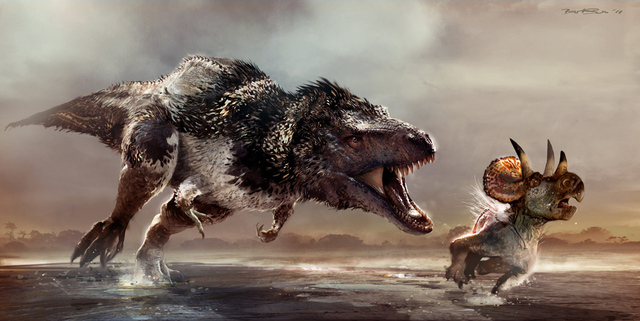
| A mouth-dragon pursuing a shield-head |
The galley set out the next dawn; because it wasn't leaving/entering the Bay, it would not be subject to the extortions of Aremag. The first leg of the trip was a short jaunt to a camp on a peninsula halfway between Nyanzaru and the beachhead below Beluarian; on the second day the galley arrived at the beachhead and the supplies were offloaded from the ship; on the third day, the supplies were ported up a path to the Fort itself. The fourth day was slated as a day of rest, and then the last three days of the trip would mirror the first three.
The only encounter seen by the characters on the way out was a flock of scintillating snakes flying through the trees near the beach on the first day.
At Fort Beluarian, after all the porting was done, the characters could rest; Sound elected to gamble with the soldiers of the Flaming Fist (against regulations, but under the noses of their superiors) and won 20 gp after staking a mere 10 gp to start. Nigiri, meanwhile (the lizardman) went forth from the fort and hunted down some local iguanas, herbs, etc., and in-fort cooked up a mouthwatering meal that gathered a number of Flaming Fist soldiers to ask for a portion (they had to jockey with Takasha, the gourmand magic-user who follows Nigiri specifically for his lizardman-cooking).
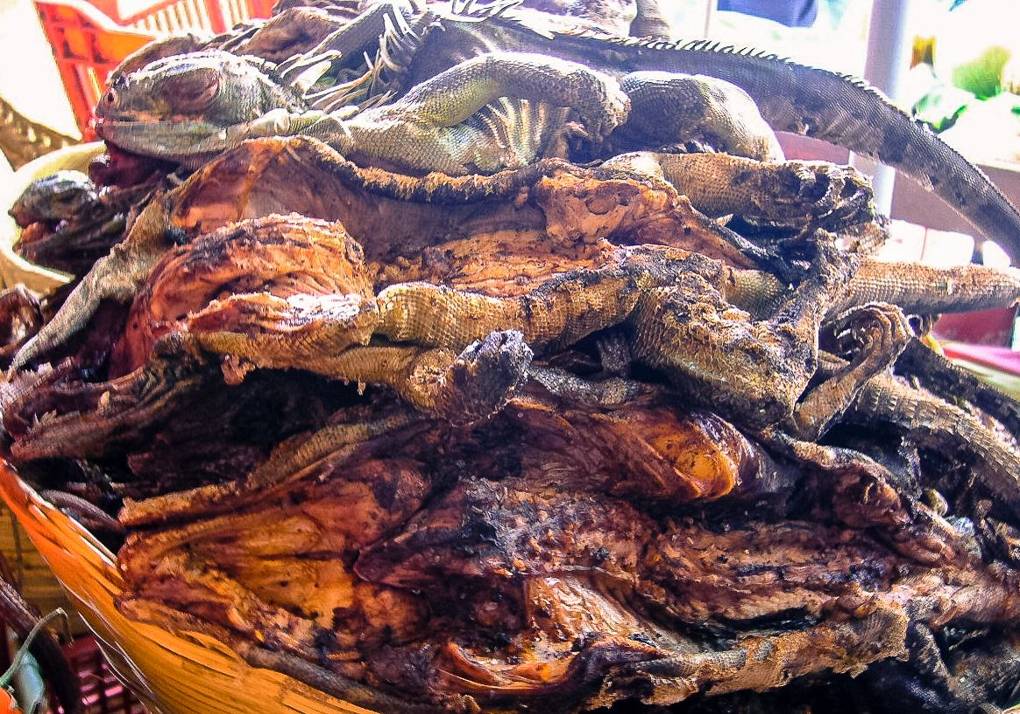
| Grilled iguanas ... yum! |
The Flaming Fist soldiers then laid out chests of iron and copper ingots stamped with the seal of the Fist, all of which were ported back down to the beachhead and loaded onto the ship; and then the galley set out back for Nyanzaru the next dawn.
On the first day to the halfway peninsula, the ship was buzzed by a flock of pteranodons which ultimately left the galley alone; then later in the day, a band of aarakocra (bird-men) appeared over the galley. These aarakocra were invited down by the characters, and relayed to the party that an injured comrade of theirs was on a beach nearby, having been wounded in a scuffle with lizardmen. The characters arranged for the aarakocra to carry their companion to the ship, there to be healed by a use of cure light wounds; and when this aarakocra was healed by Terahn, she told the players that her name was Skir of the Kaaraa Eyrie, and she presented Terahn with her javelin and one of her pinion feathers as tokens of friendship.
Then, on the third day, early in the morning on the beach, the characters were awakened by one of the ship's rowers, one Osuware. "Quickly!" he whispered, pointing to the treeline and to a flock of iridescent snakes basking in the morning sun in the trees. "Let us take the serpents, and we can sell them back in Nyanzaru!" Most of the party followed; they watched Osuware stuff a serpent into a sack, and then Takasha cast sleep over the rest of the nine snakes; he then demanded that he receive two of the snakes for Nigiri to cook up for him, while the other eight can be sold, and the party reluctantly agreed.
So, back in town, Osuware guided the party to the villa of Ifan Tal'Roa, another merchant lord. This Ifan is a great seller of animals, beasts, etc. both as beasts of burden and as creatures bound for gladiatorial games, and he was glad to receive a party attempting to sell him flying snakes. He first offered 25 gp per snake, which Osuware was over-eager to take, and so Sound talked Ifan up to 30 gp per snake. Osuware was glad for it, and, being bad at math, agreed to take 40 gp while the party split the other 200. Ifan advised the party to look out for other beasts in the jungles that he would be glad to buy.
The party then returned to Jobal to get his take on jungle guides; and despite his excessive friendliness now that they were in some money, and despite his protestations not to seek out his former employees River Mist and Flask of Wine, a couple of tabaxi (cat-man) guides who had just broken with him, the party of course, sought out River and Flask. These two agreed to guide the party for a lesser sum of 4 gp/day, with no upfront payment (but they would be glad for a cut of treasure after the fact!). Moreover, they are familiar with the jungle around the River Tiryki, and with two landmarks, one Firefinger (a spire with a ptera-folk tribe) and the other Dungrunglung (a shrine-city of grung frog-men).
![]() |
| River Mist has the eyepatch; her brother is Flask of Wine |
The party then needed to actually plan their first expedition into the jungles, and ultimately decided to abandon their first plan to seek Camp Righteous and Camp Vengeance on the River Soshenstar, and to follow their guides up the Tiryki River. They bought a rowboat (50 gp) and several weeks of rations, but were confident in their own ability to forage in the jungle for food (and they agreed beforehand to boil their water). Round trip, this expedition is expected to last something like 70 days, most of it the trip there and back, but with a week at the head of the river for in-depth exploration.
We got four days into this seventy day expedition before it was 1:20 am and we needed to break for the night. Each hex on the map is 10 miles across; the travel rules in Tomb of Annihilation indicate that a party can travel 10 miles in one day, but I find that completely ridiculous for jungle travel; being generous, I cut that in half to 5 miles per day (I would have cut it further, following accounts I've read of jungle travel, but I still want this to be a game ...). I was many beers in at this point, and so didn't roll for the party getting lost, but I did roll all of the encounters for each day--and as a further modification to the rules, I'm going to devise another table of my own for non-creature "encounters" to roll on once each day, following other tables I've written for other hexcrawls I've run.
Nothing happened on the first day ... on the second day, the party was ambushed by a party of Batiri (jungle-goblins) as they traveled along the banks of the Tiryki. The goblins charged from the bush, but were repulsed by a concerted effort, and when the "boss" was slain, the Batiri rolled poorly on morale, panicked, and ran back into the jungle. From the corpse of the "boss", the party took up a painted mask they think could be worth something back in town, and then they continued on their way south.
On the third day, the party came across a shield-head (or "ytepka" or "three-horns") grazing alone in a meadow not far from the banks of the river. River and Flask were enamored of it, trying to get the party to attack and subdue it so that they could lead it back to town to sell to Ifan Tal'Roa--then they could sell the beast to him for a tidy profit (and only a few days out!) and then restart their expedition with even higher funds. Alas, the party balked at attacking such a large creature, and merely walked around it. Later that day, they provoked a troop of baboons, which attacked them, but were easily driven off with another poor morale roll for the creatures ...
![]() |
| One ornate species of shield-head |
And on the fourth day, the party encountered a pair of giant spiders, easily dispatched without even the need for a morale roll--and this is where we quit for the night, as it was nigh 2 am and we were semi-incoherent.
So like I said, these encounters need to be spiced up with some non-monster "wilderness encounters" that will vary things beyond mere roleplaying/combat encounters (also, need some roleplaying encounters anyway). The book recommends rolling three times per day; I was thinking of rolling twice on the book's encounter table, and once on my own table each day. Ultimately, this would alter the checks from 3 encounter checks per 10 miles to 4 monster encounter checks and 2 non-monster encounter checks per 10 miles, so I don't feel like it's too much.
The next Chult game will probably be in about two weeks; I'll be sprucing up the hexmap in the meantime and probably sharing ideas and additions here--I admit, I just can't run an adventure/module without tinkering with a fair amount.
Wednesday, January 3, 2018
the Strangler Fig
I was in Panama for Christmas with my dad, uncle, and granddad (Granddaddy was stationed in the canal zone during the 70's, so my dad went to high school here and it definitely captured the family imagination), so I thought I'd try to come up with some D&D stuff related to Panama or tropical environments in general.
To that end, the other day I saw some pretty cool banyan trees, aerial prop roots hanging down from above, stretching for the ground, ready to create more and more trunks in an ultimate banyan grove all centered around a single huge trunk of intertwined trunks. Some quick Wikipedia research informed me that banyans are sometimes called "strangler figs" for the way that they grow around a victim tree and "strangle" it with their roots; and further that, as a fig tree, they are home to fig wasps, which developed symbiotically and cospecialized with fig trees, the fig providing the wasp a place to lay eggs and mate, the wasp pollinating the fig.
Hence the double feature of Strangler Figs and Fig Wasps ... Today, the Strangler Fig:
or Banyan Tree ...
Called a "strangler fig" because it is a parasitic organism that "strangles" its host--the banyan tree actually grows atop another tree, its seed having landed somewhere in the host's upper branches, and grown like a vegetative octopus from there. Early on, the banyan actually looks like tree roots growing down around the trunk of the host tree; later, as the banyan swallows or "strangles" the host and sends out limbs of its own, these down-growing roots actually become almost trunks themselves, creating the illusion of a small grove where the reality is one large down-growing organism (as opposed to an aspen grove, all one organism, but growing upwards).
After enough time, the banyan actually kills its host (after it has grown large enough to sustain itself), and as the host tree decays within the banyan's central trunk, it leaves behind a hollow space, perfect for any variety of spirits, jungle-creatures, or bandits to dwell within or inside which to store their valuables ...
And so, to D&D-ize the banyan tree ...
Strangler Fig
No. Appearing 1 (1-6)
AC 0
HD 8-12
THAC0 per HD, e.g. 12-10
attacks: suggestion or 7-12 roots
damage: 2-7 or charm
no movement
treasure: F
A strangler fig large enough to attack a party of humanoids has grown into a veritable grove of its own, with prop-roots resembling entire trees and aerial roots hanging down from the canopy throughout the "grove"--hence its hit dice of 8 to 12; feel free to shrink or expand the number according to the age/size of the "grove".
The grove feels to be a place of peace, which is the will of the fig attempting to lull prey into a sense of security. There is a 1 in 3 chance that from 1-4 animals of various kinds (e.g. monkeys, lions, agouti, etc. etc.) are resting beneath the banyan's limbs, subtly tapped by its roots, charmed, and succumbing to its appetite. These animals may be used by the banyan to attack intruders if the intruders are hostile.
Suggestion: All those who enter the grove (i.e. pass into the shadow beneath its canopy) must save against spells (or a make Will/WIS save), or they find the grove to be a perfect place to make camp, and make an argument for settling down for the day, or at least for returning before day's end ("Look at how peaceful the animals are here--lions and monkeys lying down together!").
The banyan being a slow-moving tree, creatures must spend at least 10 minutes under its canopy before its roots can act. At that point, those beneath must make a save against paralysis or be tapped by an aerial root. After that, 7-12 roots may act each turn, either directly attacking characters or charming them.
A root that attempts to charm a person descends and rests on their body, attempting to "tap" into them; the character must make a save against paralysis (fortitude or reflex? constitution or dexterity? choose what you want in newer editions). Characters who fail are "tapped" and cannot leave the vicinity of the grove, and can be compelled to fight against hostile intruders. Over the course of the root's accelerated growth, they become part of the banyan in 1-6 days, entombed within a new root-trunk. A cure disease spell will dissolve the root's connections inside the body, though a character thus freed will suffer 3-18 damage from separation.
Otherwise, the roots attack with slams like treant-limbs, dealing 2-7 damage per blow.
Any treasure is to be found within the main "trunk" (which may be hollow), or embedded in the down-growing aerial roots, in either case being the treasure of those entombed within--which will, of course, entail 10 minutes or more work to extract ...
Parasitic though they be, banyans are also often symbiotic homes to other creatures as well.
One half of banyan trees are home to a swarm of Fig Wasps, insects that co-developed with fig trees in a relationship even closer than that of the normal process of bees pollinating flowers.
One in three banyan trees is also home to a dryad, a bisan (from Oriental Adventures), or some other tree spirit; these are (1-2) the spirit of the host tree, desperate for help destroying the banyan, (3-5) the spirit of the banyan or some other spirit dwelling within the hollow of the "trunk" and which will rise to its defense, or (6) an unaffiliated spirit that dwells within the hollow trunk or spreading branches, but which is itself independent of the banyan.
Further relationships are eminently possible:
Consider an entire human keep, made of stone, swallowed by a vast banyan and now home the ghosts of its former inhabitants!
OR, a peaceful banyan, converted to (Buddhism) by a saint in expectation of better future lives and escape from the wheel of suffering, which holds under its branches/roots a permanently peaceful gathering of merchants and wanderers, guarded from evil by the power of the tree.
(the etymology of "banyan", according to Wikipedia, is that "banyan" meant "merchant" in Gunjurati Indian; and such merchants would spread their wares beneath the shade of certain [banyan] trees)
To that end, the other day I saw some pretty cool banyan trees, aerial prop roots hanging down from above, stretching for the ground, ready to create more and more trunks in an ultimate banyan grove all centered around a single huge trunk of intertwined trunks. Some quick Wikipedia research informed me that banyans are sometimes called "strangler figs" for the way that they grow around a victim tree and "strangle" it with their roots; and further that, as a fig tree, they are home to fig wasps, which developed symbiotically and cospecialized with fig trees, the fig providing the wasp a place to lay eggs and mate, the wasp pollinating the fig.
Hence the double feature of Strangler Figs and Fig Wasps ... Today, the Strangler Fig:
or Banyan Tree ...
Called a "strangler fig" because it is a parasitic organism that "strangles" its host--the banyan tree actually grows atop another tree, its seed having landed somewhere in the host's upper branches, and grown like a vegetative octopus from there. Early on, the banyan actually looks like tree roots growing down around the trunk of the host tree; later, as the banyan swallows or "strangles" the host and sends out limbs of its own, these down-growing roots actually become almost trunks themselves, creating the illusion of a small grove where the reality is one large down-growing organism (as opposed to an aspen grove, all one organism, but growing upwards).
After enough time, the banyan actually kills its host (after it has grown large enough to sustain itself), and as the host tree decays within the banyan's central trunk, it leaves behind a hollow space, perfect for any variety of spirits, jungle-creatures, or bandits to dwell within or inside which to store their valuables ...
And so, to D&D-ize the banyan tree ...
Strangler Fig
No. Appearing 1 (1-6)
AC 0
HD 8-12
THAC0 per HD, e.g. 12-10
attacks: suggestion or 7-12 roots
damage: 2-7 or charm
no movement
treasure: F
A strangler fig large enough to attack a party of humanoids has grown into a veritable grove of its own, with prop-roots resembling entire trees and aerial roots hanging down from the canopy throughout the "grove"--hence its hit dice of 8 to 12; feel free to shrink or expand the number according to the age/size of the "grove".
The grove feels to be a place of peace, which is the will of the fig attempting to lull prey into a sense of security. There is a 1 in 3 chance that from 1-4 animals of various kinds (e.g. monkeys, lions, agouti, etc. etc.) are resting beneath the banyan's limbs, subtly tapped by its roots, charmed, and succumbing to its appetite. These animals may be used by the banyan to attack intruders if the intruders are hostile.
Suggestion: All those who enter the grove (i.e. pass into the shadow beneath its canopy) must save against spells (or a make Will/WIS save), or they find the grove to be a perfect place to make camp, and make an argument for settling down for the day, or at least for returning before day's end ("Look at how peaceful the animals are here--lions and monkeys lying down together!").
The banyan being a slow-moving tree, creatures must spend at least 10 minutes under its canopy before its roots can act. At that point, those beneath must make a save against paralysis or be tapped by an aerial root. After that, 7-12 roots may act each turn, either directly attacking characters or charming them.
A root that attempts to charm a person descends and rests on their body, attempting to "tap" into them; the character must make a save against paralysis (fortitude or reflex? constitution or dexterity? choose what you want in newer editions). Characters who fail are "tapped" and cannot leave the vicinity of the grove, and can be compelled to fight against hostile intruders. Over the course of the root's accelerated growth, they become part of the banyan in 1-6 days, entombed within a new root-trunk. A cure disease spell will dissolve the root's connections inside the body, though a character thus freed will suffer 3-18 damage from separation.
Otherwise, the roots attack with slams like treant-limbs, dealing 2-7 damage per blow.
Any treasure is to be found within the main "trunk" (which may be hollow), or embedded in the down-growing aerial roots, in either case being the treasure of those entombed within--which will, of course, entail 10 minutes or more work to extract ...
Parasitic though they be, banyans are also often symbiotic homes to other creatures as well.
One half of banyan trees are home to a swarm of Fig Wasps, insects that co-developed with fig trees in a relationship even closer than that of the normal process of bees pollinating flowers.
One in three banyan trees is also home to a dryad, a bisan (from Oriental Adventures), or some other tree spirit; these are (1-2) the spirit of the host tree, desperate for help destroying the banyan, (3-5) the spirit of the banyan or some other spirit dwelling within the hollow of the "trunk" and which will rise to its defense, or (6) an unaffiliated spirit that dwells within the hollow trunk or spreading branches, but which is itself independent of the banyan.
Further relationships are eminently possible:
Consider an entire human keep, made of stone, swallowed by a vast banyan and now home the ghosts of its former inhabitants!
OR, a peaceful banyan, converted to (Buddhism) by a saint in expectation of better future lives and escape from the wheel of suffering, which holds under its branches/roots a permanently peaceful gathering of merchants and wanderers, guarded from evil by the power of the tree.
(the etymology of "banyan", according to Wikipedia, is that "banyan" meant "merchant" in Gunjurati Indian; and such merchants would spread their wares beneath the shade of certain [banyan] trees)
Friday, November 17, 2017
Wilderness Encounters as Attrition 2
I received a comment on a recent post inquiring if I had fiddled with my rules for "wilderness attrition" at all, and whether I had anything further to write about them. The short answer heretofore was "no" because I have been using the rules as I wrote them for the last few sessions (and they've been pretty simple and effective so far, and people are starting to carry back-up items, which is one thing I envisioned for these rules ... thus necessitating a mule and porters ... mwahaha!)
The longer answer is, I do actually have an idea for making "wilderness attrition" a little better, I hope--"concreteness".
As written so far, and as used so far, I roll the encounter chance, elucidate the results and the number of damage dice for the party, and then come up with a lame reason for it afterward (especially when prompted by the player of Rendorsheeg the Elf). This is abstract; abstraction, of course, was the main purpose for creating these rules; yet nevertheless, D&D is so often about concreteness that it pains me to just kind of handwave why a week of rations, 12 arrows, a spear, and a shield were all lost. Generally I've been calling it skirmishes with goblins or orcs ... but what if I had said it was wolves, and a druid, say, replied by saying, "I want to cast speak with animals and talk them out of attacking us"?
Moreover, of the three dice I roll for every encounter/wandering monster check, on of them is not pulling much weight in these "attrition" rules, and I think "concreteness" could be a better use of its pips on the table.
Therefore:
When I roll for encounters, I roll 3d6, one black, one white, one red:
black -- encounter chance
white -- party surprise chance
red -- monster surprise chance
I ignore the red and white dice if black comes up nothing.
For attrition in the wilderness, rather than rolling up a full encounter on a positive result from the black die, I look to the other dice:
The white die determines "attrition dice" inversely to the number rolled on the die, e.g. 1 is 6d6, 2 is 5d6, 3 is 4d6, 4 is 3d6, etc.
Instead of an extra chance to "ignore" the encounter as I originally wrote, the red die can be used to determine "concretely" just what happened, thus:
1 - animal encounter -- a bear, a pack of wolves, a rutting moose, a baboon troupe, etc.
2 - men encounter -- a group of hunters, some brigands, some local ruffians
3 - humanoid encounter -- a skirmish with orcs, goblins, ogres, etc. per what I've generally said
4 - fey/unusual encounter -- undead perhaps, or faerie trees/briars that grasp at characters, etc.
5-6 - non-creature encounter -- a freak storm, a patch of poison ivy, a nest of young ticks, etc.
These are vague, and I think necessarily. As I said above, abstractness is the reason for these rules of attrition--what I get out of them is focusing on the dungeon while retaining some of the danger of the wilderness and travel through it. Attrition is a quick way to move through the consequences of the wilderness than having to describe an entire encounter with a band of orcs transporting prisoners, etc.
And yet, having a sense of what concretely the characters have encountered allows the players to respond to it with their skills, spells, etc in somewhat of the way that they would if presented with a full encounter. The best example I have is that if the referee rolls an "animal" encounter of six attrition dice, and the party includes a druid who responds by casting the spell speak with animals, the referee could allow the druid to just talk to the animals and avoid the encounter altogether, OR allow that spellcasting to replace one (or so) of the "usual" means of eliminating attrition dice (including the otherwise invulnerable sixth die, perhaps!).
Maybe an "unusual encounter" is undead, and the cleric can turn undead to eliminate an attrition die; or perhaps a group of men can be charmed or slept by a magic user to eliminate dice ... etc.
And of course, if the players just blithely accept the dice that you put forth, break their items, and move on, it's no skin off the referee's back. I just felt a strong need to have a way to clearly allow more player agency in response to the "attrition".
black -- encounter chance
white -- party surprise chance
red -- monster surprise chance
I ignore the red and white dice if black comes up nothing.
For attrition in the wilderness, rather than rolling up a full encounter on a positive result from the black die, I look to the other dice:
The white die determines "attrition dice" inversely to the number rolled on the die, e.g. 1 is 6d6, 2 is 5d6, 3 is 4d6, 4 is 3d6, etc.
Instead of an extra chance to "ignore" the encounter as I originally wrote, the red die can be used to determine "concretely" just what happened, thus:
1 - animal encounter -- a bear, a pack of wolves, a rutting moose, a baboon troupe, etc.
2 - men encounter -- a group of hunters, some brigands, some local ruffians
3 - humanoid encounter -- a skirmish with orcs, goblins, ogres, etc. per what I've generally said
4 - fey/unusual encounter -- undead perhaps, or faerie trees/briars that grasp at characters, etc.
5-6 - non-creature encounter -- a freak storm, a patch of poison ivy, a nest of young ticks, etc.
These are vague, and I think necessarily. As I said above, abstractness is the reason for these rules of attrition--what I get out of them is focusing on the dungeon while retaining some of the danger of the wilderness and travel through it. Attrition is a quick way to move through the consequences of the wilderness than having to describe an entire encounter with a band of orcs transporting prisoners, etc.
And yet, having a sense of what concretely the characters have encountered allows the players to respond to it with their skills, spells, etc in somewhat of the way that they would if presented with a full encounter. The best example I have is that if the referee rolls an "animal" encounter of six attrition dice, and the party includes a druid who responds by casting the spell speak with animals, the referee could allow the druid to just talk to the animals and avoid the encounter altogether, OR allow that spellcasting to replace one (or so) of the "usual" means of eliminating attrition dice (including the otherwise invulnerable sixth die, perhaps!).
Maybe an "unusual encounter" is undead, and the cleric can turn undead to eliminate an attrition die; or perhaps a group of men can be charmed or slept by a magic user to eliminate dice ... etc.
And of course, if the players just blithely accept the dice that you put forth, break their items, and move on, it's no skin off the referee's back. I just felt a strong need to have a way to clearly allow more player agency in response to the "attrition".
Wednesday, November 1, 2017
On the Road Again ... Encounters
In my regular (non-Greyhame Dungeon game), I've had the party move areas a couple times, first relocating them down south for the winter to deal with the return of Sakatha the Lizard-King (module I2), and then of course moving them back north to the original town of Calpurnia where they started. I've now also got half the party continuing even farther north to go help the halflings of Hopshire.
For these travels, I came up with a d20 table of Encounters on the Road from which I roll one item for every week of travel, rather than rolling on the wilderness encounter table day by day by day. This speeds long distance travel up significantly, without necessarily just "jump-cutting", so that the travel itself retains some interest and impact; and it is to my mind justified, because the particular journeys being made by my group are not wilderness exploration, but rather along major thoroughfares within civilization, so rolling constantly on the wilderness encounter tables just doesn't make much sense.
There's no great need for me to keep this secret from my players--I'll roll what I roll, and they can deal with it!--I thought I'd present it here:
Encounters on the Road -- roll 1d20 per week, roll a random day if you want
1 - Dragon, on a d6 (1-2) basking, (3-4) hunting, (5-6) patrolling. Will accept mere flattery sometimes, demand food if hunting, or demand tribute if patrolling. I either roll up a new dragon and place it in the world near where it was encountered, or have a dragon already placed nearby who can stand in for the enounter
2 - Zauldron the Sage and Clara Clairvoyant -- for 2000 gp, they can do in 2-5 days what takes a normal sage 1 month (because of the synergy from his encyclopedic memory and her clairvoyance!); OR, Clara can commune with a higher power for the characters (also costs 2000 gp)
3 - Caravan/Free Market -- opportunity to buy/sell/resupply, plus the possibility to get in on some arbitrage/speculative trading of goods
4 - Magic Item Peddler -- buys magic items (500 gp/+ bonus, OR per offer); has 2-7 potions from the list for sale, as well as 1 item from my magic item for sale table; and don't try to rob him, he's got a competent guard of many well-armored fellows, plus a leveled fighting-man, magic-user, or whatever
5 - Storms and/or Bad Weather -- add 2-9 days of to travel time to the party's destination
6 - Castle -- per the rules in the Expert Book, OR just assess some kind of toll on the party, demanded by a party of armored knights on their lord's behalf
7 - Fey Encounter -- the party comes upon a Faerie-knight, a nymph-grotto, a dryad-grove, a nixie/naiad-pool, an oread's mountain, dwarvish underkingdom, etc. etc. Make it weirder than just a combat encounter with a dryad
8 - Wild Animal Peddler -- sells animals per my table of Animals For Sale; like the peddler of magic items, he is well guarded by a party of armed men
9 - Haunted Keep/Shrine -- either some kind of combat encounter with undead, esp if the party comes nigh around dusk; OR come up with a unique way to use turn undead or bless ... I haven't rolled this yet, so I haven't fleshed it out like I wanted to
10 - a Hermit -- on a d6 (1-2) Good saint, (3) Lawful anchorite, (4) Chaotic outlaw, (5-6) Arcane hedge wizard/witch. The saint offers succor and healing; the anchorite can offer sage advice; the outlaw might have a band with him, likely has a bounty on his/her head (200-1200 gp?), but can offer pathfinding, etc., to those who won't snitch; the hedge wizard has 2-5 potions and 1-2 scrolls possibly for sale
11 - Fellow Travelers -- 1) arrogant aristocrat and entourage, 2) party of pilgrims, 3) dust-weary villeins, 4) adventurers-errant, 5) muddy-booted men-at-arms, or 6) roll on the MEN wandering monster table
12-13 Wandering Monster per that table
14 - Peasants seeking aid -- when I rolled this, I had peasants seeking aid after some natural disaster, and the group decided to give them I think several hundred gold pieces--naturally, the peasants used some of that wealth to raise a shrine dedicated to the party cleric's goddess/saint in gratitude
15 - roll on the FLYERS wandering monster table
16 - Elf-Pilgrims -- you may carouse with them for the night, according to the carousing rules, but if you fail your save you might just join them and return to the mortal realm some time much later
17 - Ankhegs (I just like ankhegs; obviously, replace this with whatever particular monster you want)
18 - Greater Werewolf and his pack, obviously in the guise of fellow pilgrims/travelers; it's probable that they'll try to eat the party at some inopportune time (these fellows are currently rising in power as Chaos is on the rise in my world; given other circumstances, I would alter the particular creature)
19 - Diseased Inn or Plague Victims -- save v. poison or random members of the party are infected
20 - Doomsaying Prophet or Itinerant Preacher -- maybe he's just a madman mumbling nonsense, maybe he's a man inspired by God or the gods to bring a warning the world, a local city, or even the king; he could even just be a wandering holy man, offering healing to the injured and sick, blessings, and words of advice to those in need
For these travels, I came up with a d20 table of Encounters on the Road from which I roll one item for every week of travel, rather than rolling on the wilderness encounter table day by day by day. This speeds long distance travel up significantly, without necessarily just "jump-cutting", so that the travel itself retains some interest and impact; and it is to my mind justified, because the particular journeys being made by my group are not wilderness exploration, but rather along major thoroughfares within civilization, so rolling constantly on the wilderness encounter tables just doesn't make much sense.
There's no great need for me to keep this secret from my players--I'll roll what I roll, and they can deal with it!--I thought I'd present it here:
Encounters on the Road -- roll 1d20 per week, roll a random day if you want
1 - Dragon, on a d6 (1-2) basking, (3-4) hunting, (5-6) patrolling. Will accept mere flattery sometimes, demand food if hunting, or demand tribute if patrolling. I either roll up a new dragon and place it in the world near where it was encountered, or have a dragon already placed nearby who can stand in for the enounter
| "Why yes, I am quite magnificent. Do go on, mortal, and I might let you pass without eating your mule." |
2 - Zauldron the Sage and Clara Clairvoyant -- for 2000 gp, they can do in 2-5 days what takes a normal sage 1 month (because of the synergy from his encyclopedic memory and her clairvoyance!); OR, Clara can commune with a higher power for the characters (also costs 2000 gp)
3 - Caravan/Free Market -- opportunity to buy/sell/resupply, plus the possibility to get in on some arbitrage/speculative trading of goods
4 - Magic Item Peddler -- buys magic items (500 gp/+ bonus, OR per offer); has 2-7 potions from the list for sale, as well as 1 item from my magic item for sale table; and don't try to rob him, he's got a competent guard of many well-armored fellows, plus a leveled fighting-man, magic-user, or whatever
5 - Storms and/or Bad Weather -- add 2-9 days of to travel time to the party's destination
6 - Castle -- per the rules in the Expert Book, OR just assess some kind of toll on the party, demanded by a party of armored knights on their lord's behalf
7 - Fey Encounter -- the party comes upon a Faerie-knight, a nymph-grotto, a dryad-grove, a nixie/naiad-pool, an oread's mountain, dwarvish underkingdom, etc. etc. Make it weirder than just a combat encounter with a dryad
8 - Wild Animal Peddler -- sells animals per my table of Animals For Sale; like the peddler of magic items, he is well guarded by a party of armed men
9 - Haunted Keep/Shrine -- either some kind of combat encounter with undead, esp if the party comes nigh around dusk; OR come up with a unique way to use turn undead or bless ... I haven't rolled this yet, so I haven't fleshed it out like I wanted to
10 - a Hermit -- on a d6 (1-2) Good saint, (3) Lawful anchorite, (4) Chaotic outlaw, (5-6) Arcane hedge wizard/witch. The saint offers succor and healing; the anchorite can offer sage advice; the outlaw might have a band with him, likely has a bounty on his/her head (200-1200 gp?), but can offer pathfinding, etc., to those who won't snitch; the hedge wizard has 2-5 potions and 1-2 scrolls possibly for sale
![]() |
| You see this fellow hunched under an oak by the tree; being St. Anthony, he can help you resist the temptations of demons |
11 - Fellow Travelers -- 1) arrogant aristocrat and entourage, 2) party of pilgrims, 3) dust-weary villeins, 4) adventurers-errant, 5) muddy-booted men-at-arms, or 6) roll on the MEN wandering monster table
12-13 Wandering Monster per that table
14 - Peasants seeking aid -- when I rolled this, I had peasants seeking aid after some natural disaster, and the group decided to give them I think several hundred gold pieces--naturally, the peasants used some of that wealth to raise a shrine dedicated to the party cleric's goddess/saint in gratitude
15 - roll on the FLYERS wandering monster table
16 - Elf-Pilgrims -- you may carouse with them for the night, according to the carousing rules, but if you fail your save you might just join them and return to the mortal realm some time much later
17 - Ankhegs (I just like ankhegs; obviously, replace this with whatever particular monster you want)
18 - Greater Werewolf and his pack, obviously in the guise of fellow pilgrims/travelers; it's probable that they'll try to eat the party at some inopportune time (these fellows are currently rising in power as Chaos is on the rise in my world; given other circumstances, I would alter the particular creature)
19 - Diseased Inn or Plague Victims -- save v. poison or random members of the party are infected
20 - Doomsaying Prophet or Itinerant Preacher -- maybe he's just a madman mumbling nonsense, maybe he's a man inspired by God or the gods to bring a warning the world, a local city, or even the king; he could even just be a wandering holy man, offering healing to the injured and sick, blessings, and words of advice to those in need
Labels:
d&d,
d20 table,
dungeons and dragons,
encounters,
journey,
my rules,
old school d&d,
on the road,
osr,
random table,
road encounters,
travel,
traveling,
wilderness,
wilderness encounters
Thursday, October 26, 2017
Wilderness Encounters as Attrition
Earlier this month, as I was contemplating running a public game focused on the dungeon, I was wondering how best to deal with the wilderness. For myself, though I'm glad to play in them, I have a tough time wanting to run a game in which the dungeon is right there in town (like Jeff Rients' Vyzor; or my own local friend's dungeon, the entrance to which is in the inn's basement). I have my own idiom, into which I've fallen every time I've started a new group--a long north-south corridor, bounded to west and east by mountains, with wilderness over the eastern mountains, and civilization back over the western mountains. The dungeon is near--not more than a week away--but still must lie somewhere in the eastern mountains, on the border between civilization's final frontier, and the beginning of the true wilderlands.
(and the drive in Idaho, between the poles of Boise and Moscow, definitely exerts a kind of of influence over this vision)
I use this both as a means of separation (the characters still must travel away from civilization to find adventure), and as a means to make sure time passes in-game (the local game run by my friend has maybe progressed a couple weeks, and we've been playing for months; for me, if I were refereeing, that would feel stultifying, in that I like a session to be a week at minimum, but his game is his game).
But if the game is dungeon-focused, wilderness encounters will draw attention away from that dungeon. Case-in-point, during the last session of the Greyhame Mountain Dungeon that I ran, perhaps a quarter of the session was spent just dealing with an orc warband encountered on the way to the dungeon. It wasn't a bad encounter (actually, the players took it quite in stride and shone in it); nevertheless, it took a lot of time that might have been differently spent inside the dungeon.
(and just for the record, that encounter occurred because I couldn't remember these very "attrition" rules I'd tried to formulate, and it was easier to just do a monster encounter; and yet for the dungeon-game, it could have been quicker into the dungeon if I'd had my "attrition" notes before me).
So:
When I roll for encounters, I roll 3d6, one black, one white, one red:
black -- encounter chance
white -- party surprise chance
red -- monster surprise chance
I ignore the red and white dice if black comes up nothing.
For attrition in the wilderness, rather than rolling up a full encounter on a positive result from the black die, I look to the other dice:
If the red die comes up 1 or 2, there is still no encounter/attrition, because the "monster/encounter" was "surprised" by the party, and they can avoid it.
But the white die determines "attrition dice" inversely to the number rolled on the die, e.g. 1 is 6d6, 2 is 5d6, 3 is 4d6, 4 is 3d6, etc.
An "attrition die" is 1d6 of damage allocated to one party member, by lot or by choice. In any singular "encounter", an "attrition die" may be negated by breaking 1 shield, 1 suit of armor, 1 weapon, by losing 1 week of rations, or by expending 1 dozen ammunition (arrows, bolts, bullets, etc. via the commensurate missile weapon, e.g. bow, crossbow, sling), but no negation may be duplicated (i.e. once a shield is broken, no other shields may be used to negate "attrition dice" in a given "encounter").
You may note that a roll of 1 on the white die (6d6 "attrition") creates an absolute necessity of 1d6 damage somewhere in the party, volunteered or by lot (because a maximum of 5d6 "attrition" can be negated in any one "encounter"). I could further add that this damage may not be cured by clerics during the course of an adventure, representing instead of wounds, fatigue, starvation, mild disease, or what have you--or perhaps not, if I don't feel inclined.
I envision this option as a means to resolve wilderness encounters quickly, yet without simply bypassing the fact that the D&D wilderness can be dangerous. Stakes remain, even up to damage to characters or the possible destruction of equipment. And yet, the game will be allowed to move quickly to the dungeon that is its real focus without dwelling overlong on the wilderness chance encounter.
Given the abstraction, I wouldn't use rules like this at a "regular" game, where I would much rather just run a wilderness encounter as-is, and let the consequences be what they may. But games like that imply a continuity that extends beyond the dungeon; whereas if your pick-up game relies on getting to the dungeon--but wants to touch on the danger of the wilderness--"attrition" could be a fast way to convey that.
All said, you could just start the game "at the dungeon". I just ... still want the travel time, and the possibility of some minor disaster. And this is my rough draft for an "in-between" version.
(and the drive in Idaho, between the poles of Boise and Moscow, definitely exerts a kind of of influence over this vision)
I use this both as a means of separation (the characters still must travel away from civilization to find adventure), and as a means to make sure time passes in-game (the local game run by my friend has maybe progressed a couple weeks, and we've been playing for months; for me, if I were refereeing, that would feel stultifying, in that I like a session to be a week at minimum, but his game is his game).
But if the game is dungeon-focused, wilderness encounters will draw attention away from that dungeon. Case-in-point, during the last session of the Greyhame Mountain Dungeon that I ran, perhaps a quarter of the session was spent just dealing with an orc warband encountered on the way to the dungeon. It wasn't a bad encounter (actually, the players took it quite in stride and shone in it); nevertheless, it took a lot of time that might have been differently spent inside the dungeon.
(and just for the record, that encounter occurred because I couldn't remember these very "attrition" rules I'd tried to formulate, and it was easier to just do a monster encounter; and yet for the dungeon-game, it could have been quicker into the dungeon if I'd had my "attrition" notes before me).
So:
When I roll for encounters, I roll 3d6, one black, one white, one red:
black -- encounter chance
white -- party surprise chance
red -- monster surprise chance
I ignore the red and white dice if black comes up nothing.
For attrition in the wilderness, rather than rolling up a full encounter on a positive result from the black die, I look to the other dice:
If the red die comes up 1 or 2, there is still no encounter/attrition, because the "monster/encounter" was "surprised" by the party, and they can avoid it.
But the white die determines "attrition dice" inversely to the number rolled on the die, e.g. 1 is 6d6, 2 is 5d6, 3 is 4d6, 4 is 3d6, etc.
An "attrition die" is 1d6 of damage allocated to one party member, by lot or by choice. In any singular "encounter", an "attrition die" may be negated by breaking 1 shield, 1 suit of armor, 1 weapon, by losing 1 week of rations, or by expending 1 dozen ammunition (arrows, bolts, bullets, etc. via the commensurate missile weapon, e.g. bow, crossbow, sling), but no negation may be duplicated (i.e. once a shield is broken, no other shields may be used to negate "attrition dice" in a given "encounter").
You may note that a roll of 1 on the white die (6d6 "attrition") creates an absolute necessity of 1d6 damage somewhere in the party, volunteered or by lot (because a maximum of 5d6 "attrition" can be negated in any one "encounter"). I could further add that this damage may not be cured by clerics during the course of an adventure, representing instead of wounds, fatigue, starvation, mild disease, or what have you--or perhaps not, if I don't feel inclined.
I envision this option as a means to resolve wilderness encounters quickly, yet without simply bypassing the fact that the D&D wilderness can be dangerous. Stakes remain, even up to damage to characters or the possible destruction of equipment. And yet, the game will be allowed to move quickly to the dungeon that is its real focus without dwelling overlong on the wilderness chance encounter.
Given the abstraction, I wouldn't use rules like this at a "regular" game, where I would much rather just run a wilderness encounter as-is, and let the consequences be what they may. But games like that imply a continuity that extends beyond the dungeon; whereas if your pick-up game relies on getting to the dungeon--but wants to touch on the danger of the wilderness--"attrition" could be a fast way to convey that.
All said, you could just start the game "at the dungeon". I just ... still want the travel time, and the possibility of some minor disaster. And this is my rough draft for an "in-between" version.
Subscribe to:
Posts (Atom)

/pic66394.jpg)