 |
| The crocodiles will eat you |
our intrepid heroes:
Sound of Distant Rain (cat-man rogue)
Terahn Atzi (human priest)
Nugiri (lizardman monk)
Takashi Kaga (human magic-user)
Nebin (halfling barbarian)
Chiratidzo (human druid)
with River Mist and Flask of Wine (cat-man guides)
The last session ended just into the expedition up the River Tiryki, after five days of travel following the river, the characters led by River Mist and Flask of Wine and porting a rowboat with them through the jungle (despite the river being right there ...)
Picking up where we left off, on the morning of the sixth day, Chira noticed a strange little creature at the edge of camp as everyone else was breaking things down. The thing looked like a root knotted into a six-inch high humanoid form, with pebbles for eyes and mouth, eagerly watching the party. It was sitting on a mess kit. Chira informed the party as to its presence, and Takashi, miffed as he realized that the thing had taken his mess kit, mage handed the kit up and as it rose through the air, the little creature jumped off and ran away.

Takashi discovered an empty wasp nest left in his bag in the mess kit's place; and Chira informed everyone that the thing was a Chwinga, a kind of nature spirit that is generally harmless though sometimes mischievous.
Continuing on, through the evening, the characters noticed eyes watching them from the river--insectile eyes from rocky carapaces. Asking their guides after these sightings, River Mist informs the party that these must be Aldani, the lobster-men the haunt the waters of Chult. "Don't take what's theirs, and they won't bother you," she says, and then continues the hike.
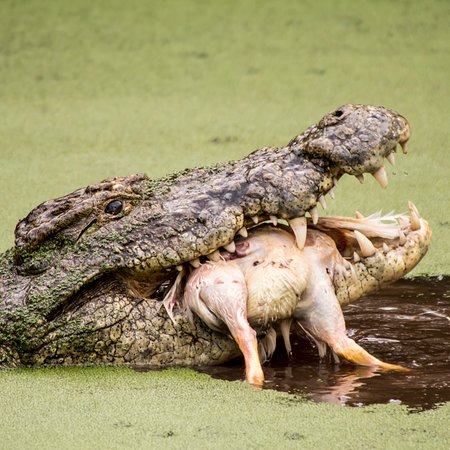
Day 8 -- morning -- Chiratidzo heads down to the river as camp is breaking to wash his face. As he crouches there, he gives a shout--"There's something in the water!"--as what looks like a waterlogged tree drifts toward him and the rest of the party comes nearer. Then the log surges out of the water with a huge splash, and a giant crocodile's jaws close around Chira, snap his back, and the crocodile beings to drag his body back into the river. The rest of the party threw missile weapons at the crocodile, but to no avail, and the reptile and its prey both disappear under the waters of the lake ...
River Mist and Flask of Wine shrug. "The jungle is dangerous," River Mist says, and then she and Flask continue to lead everyone on.
Day 9 -- diseased bite -- Sound of Distant Rain saves
Day 10 -- morning -- the party comes across Quinsela, or "Quin", another druid, now out hunting alone. He agrees to accompany the party, knowing that the crocodiles along the River Tiryki are deadly things to contend with ...
Later, the party comes across a kind of idol rising out of a series of rocks in a kind of calm area of the river. The idol is an obelisk, vaguely carved, dedicated to Olokuna, other than a maze-like vulva and stone phallus rising from near the water line. An altar of flat stone lies just under the water, covered at the moment with worked stone offerings (stones with carvings of hands, crabs, phalluses, mazes, vulvas, etc.); Sound of Distant Rain deposits a flask of palm wine on the altar for deceased Chiratidzo, further offering a prayer to the Cat Lord for the man's dead soul ...
Day 11 -- physical barrier -- the party runs into a cliff blocking their path; they decide to backtrack for a day rather than attempt to climb or circumvent it
Day 13 -- morning -- Flask of Wine calls Sound of Distant Rain forward to look at something--it's a dead body, half-eaten by a mouth-dragon and now abandoned in the bole of mighty tree-roots.
Day 14 -- morning -- The party enters a small mango grove and Flask of Wine (from scouting ahead) comes back with broken fruit on his shoulders. "There are mad apes ahead," he says and brushes himself off; he is immediately backed up by the sound of screaming apes from behind and another thrown fruit. Nugiri steps out and catches some thrown fruit, and also grins broadly at the two apes he can see.
The apes interpret that as a threat and charge into combat. One runs all the way forward while the other throws rocks from behind; but Sound of Distant Rain hates monkeys, as do the rest of the party, and they quickly kill both apes (though one does knock Nugiri out with its fists before dying from other melee attacks)
River Mist then points out that the swamp containing the Sailback Hill/Shrine is within a day's travel, if anyone were interested in checking it out. Everyone agrees that it sounds interesting, and so the party moves to the east bank of the river (they've been hiking down the west bank), and they find a wide swamp with both stork-men and sail-backs lurking in its midst.
 |
| The stork-men with the evil-eyes |
Almost immediately, the party spies a group of stork-men between them and the sail-back hill; Sound of Distant Rain and Flask of Wine sneak out to (bag?) them, but Sound decides to talk instead. Fortunately, one of the several stork-men speaks the Common tongue, though hissing like a swan; "These are our swamps! What do you offer to move through them? Give us shiny things!" The party gave a mirror and a disassembled mess-kit, and I rolled an 11 for reactions, so that was enough. "I am Sssra," the lead stork-man declared. "You may travel our swamp. And let me say, the best place to rest is beneath the banyan outside the mouth of the sailback shrine," it adds.
---
The party deposited the boat in the banyan "grove" matching Sssra's description; they felt a supernatural sense that it would be "good" to camp there, indeed; then they headed for the dungeon in the open mouth of the sailback hill.
The mouth opened onto a stairway down (the gullet); this led down to a three-way fork; the party went west and found themselves in a stairway that ended in water. Nugiri checked under the water and didn't seem to find anything. The party then glanced down the east way, but ultimately went down the south way into a large chamber with stone pillars rising up that look like they support the stone spines of the hill that make it resemble a sailback. There were pit traps around these pillars; then entering the main chamber, the party saw a ruby, pulsing slowly, in the jaws of a small stone sailback on top of an altar against the south wall; the other walls were carved to resemble up-curving ribs. The altar was dedicated to SUCHOS, a god like an animal-headed Egyption god, but with a dimetrodon head.
A small swarm of mosquito-bats attacked the party here, but were easily dispatched ...
Furthermore, there were four other exits from the room ... the party checked one and found a collapsed corridor; checked another and found a closed door; but looking down the south west corridor, they found a series of natural caverns, of which one held a crevice in its floor filled with glittering coin. The party went for the coin, but were surprised by a "nest" of creepy monkeys with blood-red hands hanging from the stalactites on the ceiling of the chamber. Sound of Distant Rain was foremost in the party seeking the coin in the crevice, and he suddenly keeled over dead, clutching his head; Takashi also fell over, blood pooling from his nose, but not quite dead.
 |
| The creepy-monkeys with blood-red hands |
While Nugiri saved Takashi and Flask of Wine ran forward to save his friend's (Sound's) body, the party elected (after a first intuition to run), to fight--and because they killed one monkey and injured two others with a variety of spells and attacks, the creepy monkeys fled deeper into the cave after failing a morale check.
"Let's loot this thing and get the hell out of here!" Nebin cried, and then the party quickly grabbed what they could of the coin (including 2 scrolls) and then fled back to the large room with the pulsing ruby-heart. They pitoned the little sailback statue's mouth open and took the ruby, but heard the grinding of stone nevertheless--the mouth of the cave had closed! Placing the ruby back re-opened the closed jaws. The cat-men thought they might be able to run fast enough to grab the gem and then make it out ahead of the jaws, but the party balked in the end and elected to return later.
So deciding, they checked one more room and found a tomb filled with sarcophagi for sailbacks. Opening the most ornate one, Teran forced open the sarcophagus and breathed in a poisonous cloud, but lived ... inside they found a sailback skeleton plated with gold, which they took ...
With a couple thousand coin (from the monkeys) and a gold-plated skeleton in their possession, the party went straight for the river with their rowboat and began to row their way back down the River Tiryki toward Nyanzaru. On the river, flowing downstream, their movement doubled to 10 miles per day (one hex per day).
---
Day 16 -- evening -- rare plants, zabou, 4 "doses" of zabou mushrooms which the party collects (Quin as an herbalist can pick them without trouble)
Day 20 -- evening -- croaking of giant frogs ahead--the party decides to accept another roll on the encounter die in the future to avoid the frogs now ...
Day 21 -- morning -- as Teran hauls the boat down into the water of the river, a giant crocodile surges out of the water with a high initiative and snaps Teran up in its huge jaws. Teran is instantly killed and dragged away into the water, leaving the party bereft of a third member ...
 |
| Except the hindquarters are Tehran's, not a zebra .... |
Day 22 -- back in town! (now everyone can get XPs)
In Nyanzaru, the party went to Jobal, whom they know collects hunting trophies, to sell the gold-plated skeleton to him. Jobal is sad to hear of Chira's death, but is glad to buy the skeleton off of them for 250 gold. During this conversation, Nebin brings up the mosquito-bats they killed (and the bodies they saved) trying to sell them to him too, but Jobal shows his colors, racist against "lesser" folk by "belittling" Nebin. "What, did you step on that? How cute!"
The party then also sold their 4 "doses" of zabou to Jessamine, who has been interested in rare plants.
And in the end, Nebin and Takashi caroused. Nebin ended up in debt to Jessamine 100 gold and in love with Talara, halfling wife of a local halfling merchant, Haban Widewater; and Takashi ended in debt to Jobal for 400 gold, and furthermore beaten and robbed so that he starts the next adventure slightly injured ...
------
Remembrance for the Dead
Tehran Atzi (human cleric of Ubtao 1), Sound of Distant Rain (cat-man rogue 1), Chiratidzo (human druid 1)
The party then also sold their 4 "doses" of zabou to Jessamine, who has been interested in rare plants.
And in the end, Nebin and Takashi caroused. Nebin ended up in debt to Jessamine 100 gold and in love with Talara, halfling wife of a local halfling merchant, Haban Widewater; and Takashi ended in debt to Jobal for 400 gold, and furthermore beaten and robbed so that he starts the next adventure slightly injured ...
------
Remembrance for the Dead
Tehran Atzi (human cleric of Ubtao 1), Sound of Distant Rain (cat-man rogue 1), Chiratidzo (human druid 1)


