Continuing the "three magic items" theme, esp. those that are not magic swords, have three new scrolls:
Scroll of Tongues
A short vellum scroll; all writing on it disappears after a day, leaving the scroll free for further writings.
The value of this scroll lies not in any permanent record, but rather in the fact that anything written upon it in one language can be read by any literate creature, regardless of their own native language. E.g. a human might write a message on the scroll in the Common tongue, and an Elf might read the same message in Elvish while an orc would read it in Orcish, or a giant in Giantish.
Alas, it is nearly useless for learning new languages, because the reader comprehends whatever was written in his own native tongue ...
Scroll of Spellcatching
Prized especially by spellcasters eager to learn new spells, nevertheless, this scroll is useful to any class of character. It is a blank scroll; when carried upon one's person, it will "catch" the first spell cast against the person, totally negating the spell's effect, and inscribing the spell's formula magically onto the scroll (even a fireball spell would be affected, albeit partially; the carrier of this scroll would be immune to the damage of the spell, and the spell would be inscribed upon the scroll; but the magic would act normally upon all others within the radius of the spell's effect).
Though any spell level may be "caught" and negated in this way, the scroll will only every "catch" one spell. After that, it counts as a spell scroll with that particular spell inscribed upon it (to be used or learned by a magic-user, and unusable by any other class but perhaps a high level thief). Those unable to cast or learn spells from scrolls will find the item useless at this point ...
Scroll of Psalms
A scroll of paeans to the right gods ... only clerics (or other priest-like classes) may use these scrolls, and then only by chanting the psalms or paeans round-by-round.
A character chanting the poetic prayers upon the scroll cannot otherwise act; they are essentially casting a spell, though insofar as they are chanting prayers from the scroll, the effects cannot be fizzled like a spell in melee.
After 1 round of chanting, all allies within 30' gain a +1 to hit; after 2 rounds, allies within 30' gain a +1 to damage; after 3 rounds, allies within 30' gain a bonus of 1 to their armor class; after 4 rounds, allies within 30' receive 1-6 hit points, either as direct healing, or as "temporary hit points". The "chanter" of the scroll must continue to chant each round thereafter for his allies to retain these bonuses; if the chanting ceases, so too do the benefits proffered by the scroll.
Rune Wand
A bonus "scroll" type ... Items of this sort are long wands carved with a series of runes representing a spell; they are functionally identical to spell scrolls (whatever spell is contained within is "used up" when the runes are activated by reading them), and are just a different medium of storage of the magical dweomers.
Showing posts with label my rules. Show all posts
Showing posts with label my rules. Show all posts
Monday, August 20, 2018

DIY 30 #15: Three Potions
Continuing the thought that I tend to think of items as magic swords or magic rings, here are three potions to offset my predilections:
Potion of Elemental Fury
These potions imbue the drinker with the power of one of the four dominant types of elementals (fire, water, earth, air; roll a d4 to randomly determine the type associated with the potion). A fire potion burns as it goes down and fills the drinker with a fiery heat; an earth potion is gritty like thick coffee, and fills the drinker with a sense of gravity and deep connection; a water potion tastes of seawater, but fills the drinker with a sense of liquid grace; an air potion seems but a breath of heavy gas which leaves the drinker light-headed and with a sense of "floating".
All potions of elemental fury cause a creature to fight as a staff elemental of the potion's type (AC 2, HD 8, unarmed damage 1-8), but each potion also grants additional abilities appropriate to its type:
-- fire grants fire immunity, so that even magical fire attacks deal no damage;
-- earth grants regeneration of 1 hit point per round, and poison immunity so that poisons do not affect the drinker;
-- water grants waterbreathing and immunity to any kind of gas-based spell, e.g. cloudkill or stinking cloud;
-- air grants the ability to fly, as well as protection from normal missiles as the spell
Characters affected by a potion of elemental fury are incapable of breaking through a circle of protection against elementals like that created by a scroll of protection versus elementals.
Memory Moss
Not a potion per se, but a "helping" of obliviax (memory moss), this black mold can easily be swallowed over the course of a melee round. It is alive with the "memory" of one spell from 1st to 3rd level (determine level randomly with a d6, so 1-3 is 1st level, 4-5 is 2nd level, 6 is 3rd, and roll the spell randomly once level is determined). The only way to know what spell is contained within is to eat the moss.
A character eating the moss gains the ability to use the spell contained within as if they were a magic-user that had memorized it (i.e. just the once). Even a fighter or a thief could eat the moss and thus be able to cast the spell, but neither such character would be able to cast the spell while wearing armor.
There is, of course, the risk of attaining undesired memories by eating memory moss. A successful save versus spells allows a character to ignore such alien memories, but the referee is free to create new plot hooks or strange behavioral hang-ups for those who fail the save ...
Dweomer Potion
Without access to a good reference library, this potion is night worthless; such a potion, dripped over an enchanted item, throws off certain auras and other magical signs that may be cross-referenced in the correct tomes to identify the magic item's properties. The potion is viscous and tastes vaguely of salts and minerals; anyone with memorized spells will cause it to react as it would to a magic item, such that the dwimmers give off an aura and a slight scent of ozone.
Each potion contains enough material to identify 2-7 items or potions. Characters with extensive libraries for magical research (worth 5000+ gp), or perhaps specific encyclopedias, will have a decent or better chance to succeed with the potion for themselves, using their own reference works.
Sages will always buy these potions, though they will talk the price down as much as possible. It is up to the sellers to determine its real worth for the buyer.
Love Potion
Bonus potion, don't forget love potions. They're good for role-playing, and/or for getting players to come up with creative ways to get past encounters using them.
Potion of Elemental Fury
These potions imbue the drinker with the power of one of the four dominant types of elementals (fire, water, earth, air; roll a d4 to randomly determine the type associated with the potion). A fire potion burns as it goes down and fills the drinker with a fiery heat; an earth potion is gritty like thick coffee, and fills the drinker with a sense of gravity and deep connection; a water potion tastes of seawater, but fills the drinker with a sense of liquid grace; an air potion seems but a breath of heavy gas which leaves the drinker light-headed and with a sense of "floating".
All potions of elemental fury cause a creature to fight as a staff elemental of the potion's type (AC 2, HD 8, unarmed damage 1-8), but each potion also grants additional abilities appropriate to its type:
-- fire grants fire immunity, so that even magical fire attacks deal no damage;
-- earth grants regeneration of 1 hit point per round, and poison immunity so that poisons do not affect the drinker;
-- water grants waterbreathing and immunity to any kind of gas-based spell, e.g. cloudkill or stinking cloud;
-- air grants the ability to fly, as well as protection from normal missiles as the spell
Characters affected by a potion of elemental fury are incapable of breaking through a circle of protection against elementals like that created by a scroll of protection versus elementals.
Memory Moss
Not a potion per se, but a "helping" of obliviax (memory moss), this black mold can easily be swallowed over the course of a melee round. It is alive with the "memory" of one spell from 1st to 3rd level (determine level randomly with a d6, so 1-3 is 1st level, 4-5 is 2nd level, 6 is 3rd, and roll the spell randomly once level is determined). The only way to know what spell is contained within is to eat the moss.
A character eating the moss gains the ability to use the spell contained within as if they were a magic-user that had memorized it (i.e. just the once). Even a fighter or a thief could eat the moss and thus be able to cast the spell, but neither such character would be able to cast the spell while wearing armor.
There is, of course, the risk of attaining undesired memories by eating memory moss. A successful save versus spells allows a character to ignore such alien memories, but the referee is free to create new plot hooks or strange behavioral hang-ups for those who fail the save ...
Dweomer Potion
Without access to a good reference library, this potion is night worthless; such a potion, dripped over an enchanted item, throws off certain auras and other magical signs that may be cross-referenced in the correct tomes to identify the magic item's properties. The potion is viscous and tastes vaguely of salts and minerals; anyone with memorized spells will cause it to react as it would to a magic item, such that the dwimmers give off an aura and a slight scent of ozone.
Each potion contains enough material to identify 2-7 items or potions. Characters with extensive libraries for magical research (worth 5000+ gp), or perhaps specific encyclopedias, will have a decent or better chance to succeed with the potion for themselves, using their own reference works.
Sages will always buy these potions, though they will talk the price down as much as possible. It is up to the sellers to determine its real worth for the buyer.
Love Potion
Bonus potion, don't forget love potions. They're good for role-playing, and/or for getting players to come up with creative ways to get past encounters using them.
DIY 30 #14: Three Staves
Yes "staves" is a correct plural for more than one staff, i.e. walking stick, and the one that I prefer. For multiple groups of employees, "staffs" is correct.
Anyway, these could be staves or rods; but the idea was that I tend to focus on magic rings, magic swords, and miscellaneous magic when I devise new items, and so I should begin expanding my horizon.
Rod of the Gerontes
A short walking-stick, shod in iron, usually topped with a disc bearing the seal of the office the rod was dedicated to (i.e. the mayor of the palace, the high priest of the city-cult, or the head of a particular guild).
This rod grants +1 to all reactions, +3 to reactions with those specifically associated with whatever office it was originally dedicated to (e.g. a harbormaster's rod would grant +3 reactions when dealing with ship captains, rowers, or other seafarers). It may furthermore be used to cast a charm person spell, each use costing 1 charge (and the rod will be found with but 3-30 charges).
Unfortunately, for those who take up this rod, it is a walking stick meant for old oligarchs; merely handling it permanently ages a character 1 year. Bearing it as an item temporarily ages the bearer a further 10 years, thus reducing strength, dexterity, and constitution each by 1-3 points ... one week of rest apart from the staff will restore one ability score back to its "prime/original" score, but no amount of rest will restore the 1 full year first lost when handling the rod--only a wish or similarly powerful spell might restore lost youth.
Flowering Staff
A staff of dead wood that has since sprung into new life, bearing green shoots of new growth and a flower (or more) miraculously blooming at the top. Perhaps the gods themselves have caused it to flower as a sign of forgiveness that was thought impossible (the Pope's staff at the end of the Tannhauser legend); perhaps the life-blood of a god of life and death has washed over it (Jigo's staff at the end of Princess Mononoke).
The staff now has the following powers (and from 3-30 charges):
-- entangle per the spell, costing 1 charge
-- control plant per the ring, costing 2 charges and lasting as long as the user concentrates on the magic
-- animate tree (or similar plant) per the treant ability, costing 3 charges and lasting 7-12 rounds
-- and lastly, the power to absolve a character of major transgressions, per an attonement spell, or to reinvigorate a character of one lost life-energy level, per a restoration spell; use of this power exhausts all remaining charges
A flowering staff may not be recharged, but if one of its green shoots is planted and cared for over the course of a year ,with proper blessings, a new staff of the same type might be grown ...
Thyrsus and Tambor
Staves of this type are long ceremonial staves topped with a pine cone (or representation of one), with tambors that hang down on either side of the pine cone. When shaken, they produce a rattle and a clash of tiny cymbals.
Combined with prayers to the right (Chaotic) gods, the sounding of these staves and their tambors serve as a call to revelry. All creatures within 30' of the chanting must save v. spells or join in the chanting and the enthusiasmus, being essentially charmed by the staff-bearer. If the staff-bearer or her associates are carrying wine, it may be offered out to incur a -2 penalty on the save against the magic of the thyrsus.
_-_Mailice_(1899).jpg)
This charm is not as powerful as the spell; it lasts for 1-3 hours, and those charmed are generally unwilling to join any combat, preferring revelry, song, and the drinking of wine. Calls to fight will be ignored at best (or allow a second saving throw at +2 to throw off the charm!). The bearer of the thyrsus must also remain in the midst of the revelry, egging the party on and indulging in excesses herself, to keep the charm going.
It is of course eminently reasonable that charmed creatures should offer intelligence about the dungeon or situation to the staff-bearer, or be otherwise helpful without directly engaging in combat. Perhaps they have treasure they should wish to share, magical or otherwise; or perhaps they have advice that they can offer. The possibilities should be extensive.
Anyway, these could be staves or rods; but the idea was that I tend to focus on magic rings, magic swords, and miscellaneous magic when I devise new items, and so I should begin expanding my horizon.
Rod of the Gerontes
A short walking-stick, shod in iron, usually topped with a disc bearing the seal of the office the rod was dedicated to (i.e. the mayor of the palace, the high priest of the city-cult, or the head of a particular guild).
This rod grants +1 to all reactions, +3 to reactions with those specifically associated with whatever office it was originally dedicated to (e.g. a harbormaster's rod would grant +3 reactions when dealing with ship captains, rowers, or other seafarers). It may furthermore be used to cast a charm person spell, each use costing 1 charge (and the rod will be found with but 3-30 charges).
Unfortunately, for those who take up this rod, it is a walking stick meant for old oligarchs; merely handling it permanently ages a character 1 year. Bearing it as an item temporarily ages the bearer a further 10 years, thus reducing strength, dexterity, and constitution each by 1-3 points ... one week of rest apart from the staff will restore one ability score back to its "prime/original" score, but no amount of rest will restore the 1 full year first lost when handling the rod--only a wish or similarly powerful spell might restore lost youth.
Flowering Staff
A staff of dead wood that has since sprung into new life, bearing green shoots of new growth and a flower (or more) miraculously blooming at the top. Perhaps the gods themselves have caused it to flower as a sign of forgiveness that was thought impossible (the Pope's staff at the end of the Tannhauser legend); perhaps the life-blood of a god of life and death has washed over it (Jigo's staff at the end of Princess Mononoke).
The staff now has the following powers (and from 3-30 charges):
-- entangle per the spell, costing 1 charge
-- control plant per the ring, costing 2 charges and lasting as long as the user concentrates on the magic
-- animate tree (or similar plant) per the treant ability, costing 3 charges and lasting 7-12 rounds
-- and lastly, the power to absolve a character of major transgressions, per an attonement spell, or to reinvigorate a character of one lost life-energy level, per a restoration spell; use of this power exhausts all remaining charges
A flowering staff may not be recharged, but if one of its green shoots is planted and cared for over the course of a year ,with proper blessings, a new staff of the same type might be grown ...
Thyrsus and Tambor
Staves of this type are long ceremonial staves topped with a pine cone (or representation of one), with tambors that hang down on either side of the pine cone. When shaken, they produce a rattle and a clash of tiny cymbals.
Combined with prayers to the right (Chaotic) gods, the sounding of these staves and their tambors serve as a call to revelry. All creatures within 30' of the chanting must save v. spells or join in the chanting and the enthusiasmus, being essentially charmed by the staff-bearer. If the staff-bearer or her associates are carrying wine, it may be offered out to incur a -2 penalty on the save against the magic of the thyrsus.
This charm is not as powerful as the spell; it lasts for 1-3 hours, and those charmed are generally unwilling to join any combat, preferring revelry, song, and the drinking of wine. Calls to fight will be ignored at best (or allow a second saving throw at +2 to throw off the charm!). The bearer of the thyrsus must also remain in the midst of the revelry, egging the party on and indulging in excesses herself, to keep the charm going.
It is of course eminently reasonable that charmed creatures should offer intelligence about the dungeon or situation to the staff-bearer, or be otherwise helpful without directly engaging in combat. Perhaps they have treasure they should wish to share, magical or otherwise; or perhaps they have advice that they can offer. The possibilities should be extensive.
Friday, August 17, 2018
DIY 30 #13: Three Magic Rings
Dragon Ring
This ring was created by a too-ambitious magic-user hoping to harness the power of the dragons, and though it certainly does benefit its wearer with certain powers, it ultimately comes with a major drawback.
First, the benefits: First, the wearer of the ring is able at will to detect precious metals within 60', able to determine direction, but not precise location. Second, the wearer gains the ability 3 times per day to breathe fire as a dragon. This breath attack extends from the wearer's mouth in a cone, 60' long and 15' wide at its furthest point, and it deals damage equal to the wearer's current hit points. Those caught within the cone are allowed a saving throw versus breath weapons to take half damage. Third and lastly, the wearer gains an aura of dragon awe, so that creatures entering melee against him must succeed in a morale check or forfeit their first attack (but are able to attack normally thereafter).
The wearer of the ring will ultimately discover that it is a curse, however. Immediately putting on the ring, the wearer will find himself unwilling to relinquish any wealth for frivolous purposes (including unwilling to remove the ring or otherwise give it up); this means that gold may be spent for lodgings and food, and to purchase necessary equipment, but for no other purposes: no carousing, no spell research, no wages for hirelings or mercenaries, no magic item creation, etc, etc.
After a month spent wearing the ring, the character's alignment changes to Chaotic as the draconic nature of the ring exerts itself on his spirit. Any class whose powers rely on alignment will suffer the full penalty of losing their class abilities, but be unable to atone without also removing the ring (e.g. a Lawful cleric who changes to Chaotic will lose all spells and undead turning abilities until/unless they atone or confirm their new alignment). It is at this point that the character's skin and eyes really take on a reptillian, draconic cast.
After a full year wearing the ring, a character is actually transformed bodily into a dragon. And no, this is not supposed to be a cool "I get to play a dragon" thing, it is rather at this point that the referee takes the character sheet away and informs the player that the dragon-character has settled down into a long draconic lethargy, sleeping on whatever wealth he has acquired, aroused only in defense of its hoard.
Ring of Cold
This ring is perpetually covered with a dusting of brown mold, which might be mistaken as rust. It is bitingly cold to the touch, and putting it on will reduce the wearer's hit points by one until the ring is removed (and the hp must then be healed back).
It otherwise acts as a ring of fire resistance, so that it grants +4 on saves against fire attacks, allows the wearer to ignore all normal fires, and reduces damage from magical fire attacks by 1 point per damage die (or per hit die of the creature in the case of a dragon's breath, which isn't rolled).
The fire resistance in this case, though, is granted because of the brown mold colony that has been enchanted into the ring. After suffering three major magical fire attacks, e.g. a fireball, dragon's breath, etc., the brown mold explodes forth from the ring, growing over the wearer's body. The mold deals 1d6 cold damage cumulatively for 5 rounds as it grows, after which it continues dealing 5d6 cold damage per round. This damage is also dealt to anyone within melee range. The body of the wearer will quickly be devoured and transformed into a brown mold colony once the character's hp reach 0, and continue to deal 5d6 cold damage every round to those within melee range.
Cold spells will cause the mold to go dormant for a number of rounds equal to the number of damage dice of the spell; and in the case of this ring, the mold is susceptible to acid damage, so that 8 acid damage will cause the colony to discorporate.
Ring of the Skeleton
This ring is formed of pale white bone. It acts essentially as a ring of sustenance or a ring of warmth; the wearer does not need to eat or breathe, and is immune to all kinds of cold damage. It further grants immunity to charm, sleep, and hold spells.
Unfortunately, its use entails certain downsides. The wearer may be turned as an undead creature of hit dice equivalent to the character's level (as close as possible). Furthermore, the wearer's body begins to show the effect of not-eating ... the character's body quickly wastes away until it seems only skin and bones remain. If allowed to continue (and the ring can only be removed with a remove curse spell) in this way, the flesh actually will wither away, leaving the character as only an animated skeletal figure. If the ring is removed at this point, the character will die. The character's charisma is permanently reduced by 6 due to becoming undead and a walking memento mori. As undead, the character will be destroyed by a raise dead spell, and cannot be merely raised from the dead if destroyed; once undead, only a wish spell or something similarly powerful is able to restore such a character.
This ring was created by a too-ambitious magic-user hoping to harness the power of the dragons, and though it certainly does benefit its wearer with certain powers, it ultimately comes with a major drawback.
First, the benefits: First, the wearer of the ring is able at will to detect precious metals within 60', able to determine direction, but not precise location. Second, the wearer gains the ability 3 times per day to breathe fire as a dragon. This breath attack extends from the wearer's mouth in a cone, 60' long and 15' wide at its furthest point, and it deals damage equal to the wearer's current hit points. Those caught within the cone are allowed a saving throw versus breath weapons to take half damage. Third and lastly, the wearer gains an aura of dragon awe, so that creatures entering melee against him must succeed in a morale check or forfeit their first attack (but are able to attack normally thereafter).
The wearer of the ring will ultimately discover that it is a curse, however. Immediately putting on the ring, the wearer will find himself unwilling to relinquish any wealth for frivolous purposes (including unwilling to remove the ring or otherwise give it up); this means that gold may be spent for lodgings and food, and to purchase necessary equipment, but for no other purposes: no carousing, no spell research, no wages for hirelings or mercenaries, no magic item creation, etc, etc.
After a month spent wearing the ring, the character's alignment changes to Chaotic as the draconic nature of the ring exerts itself on his spirit. Any class whose powers rely on alignment will suffer the full penalty of losing their class abilities, but be unable to atone without also removing the ring (e.g. a Lawful cleric who changes to Chaotic will lose all spells and undead turning abilities until/unless they atone or confirm their new alignment). It is at this point that the character's skin and eyes really take on a reptillian, draconic cast.
After a full year wearing the ring, a character is actually transformed bodily into a dragon. And no, this is not supposed to be a cool "I get to play a dragon" thing, it is rather at this point that the referee takes the character sheet away and informs the player that the dragon-character has settled down into a long draconic lethargy, sleeping on whatever wealth he has acquired, aroused only in defense of its hoard.
Ring of Cold
This ring is perpetually covered with a dusting of brown mold, which might be mistaken as rust. It is bitingly cold to the touch, and putting it on will reduce the wearer's hit points by one until the ring is removed (and the hp must then be healed back).
It otherwise acts as a ring of fire resistance, so that it grants +4 on saves against fire attacks, allows the wearer to ignore all normal fires, and reduces damage from magical fire attacks by 1 point per damage die (or per hit die of the creature in the case of a dragon's breath, which isn't rolled).
The fire resistance in this case, though, is granted because of the brown mold colony that has been enchanted into the ring. After suffering three major magical fire attacks, e.g. a fireball, dragon's breath, etc., the brown mold explodes forth from the ring, growing over the wearer's body. The mold deals 1d6 cold damage cumulatively for 5 rounds as it grows, after which it continues dealing 5d6 cold damage per round. This damage is also dealt to anyone within melee range. The body of the wearer will quickly be devoured and transformed into a brown mold colony once the character's hp reach 0, and continue to deal 5d6 cold damage every round to those within melee range.
Cold spells will cause the mold to go dormant for a number of rounds equal to the number of damage dice of the spell; and in the case of this ring, the mold is susceptible to acid damage, so that 8 acid damage will cause the colony to discorporate.
Ring of the Skeleton
This ring is formed of pale white bone. It acts essentially as a ring of sustenance or a ring of warmth; the wearer does not need to eat or breathe, and is immune to all kinds of cold damage. It further grants immunity to charm, sleep, and hold spells.
Unfortunately, its use entails certain downsides. The wearer may be turned as an undead creature of hit dice equivalent to the character's level (as close as possible). Furthermore, the wearer's body begins to show the effect of not-eating ... the character's body quickly wastes away until it seems only skin and bones remain. If allowed to continue (and the ring can only be removed with a remove curse spell) in this way, the flesh actually will wither away, leaving the character as only an animated skeletal figure. If the ring is removed at this point, the character will die. The character's charisma is permanently reduced by 6 due to becoming undead and a walking memento mori. As undead, the character will be destroyed by a raise dead spell, and cannot be merely raised from the dead if destroyed; once undead, only a wish spell or something similarly powerful is able to restore such a character.
Tuesday, August 14, 2018
DIY 30 #12: Harpe of Castration, Ring of Darkness, Shadow Cloak
Three items associated with the cult of Skotia, goddess of darkness, silence, and death, or with goddesses of darkness in general:
Harpe of Castration
A "harpe" is a kind of sickle-sword; the most famous depiction is of Perseus' sword, which resembles a short sword with a hook on the back of one side of the blade--but what is more likely is that a harpe was more of a real sickle-sword, with a curved blade and perhaps with the cutting edge on the inside of the curve.
This particular harpe has been enchanted in imitation of the mythology of Skotia and her emasculation of her son, Ophalle. It is a shortsword +1, +3 vs. men. Additionally to the extra bonus to hit and damage, when a critical hit is rolled against a man in combat (a roll of a 20 on the die without modifiers), the blade threatens the opponent's genital integrity. Whether this actually risks castration or emasculation in such a moment is up to the referee, but the effect of the threat is such that the target of the attack must making a saving throw against fear (or paralysis if there is no particular fear save), or fight at -2 on all dice rolls for the remainder of the combat.
There are tales of priestesses sent out to collect fifties of cut-off phalluses for their goddess, in much the way that David was sent by Saul to collect the foreskins of the Philistines. The reward for such a quest is conjecture, and the truth of such tales is debatable as possible fear-mongering by more male-centric cults.
Ring of Darkness
A thin ring of a dark metal, a ring of darkness is so light that it seems almost nothing in the palm. And yet, worn when under darkness' cloak, the power inherent in the ring is palpable.
A ring of darkness confers several benefits on its wearer while the wearer lurks in shadows. First, the wearer gains the ability to heal through regeneration at the rate of 1 hp per turn. Secondly, the wearer may become invisible at will. Thirdly, rather than becoming invisible, the wearer may become incorporeal, and thus struck only by silver or magical weapons, as well as capable of passing through walls and other solid objects.
However, if the wearer is exposed to sunlight or any other significantly bright light while using the powers of the ring (e.g. the daylight spell, or a chamber filled with bright torches that banish any shadow), the powers immediately cease, revealing the wearer in whatever capacity they were intent upon.
Lastly of note, the use of the powers of invisibility and incorporeality incur a risk with every activation: upon activating the power, the wearer must make a saving throw versus death or suffer one permanent point of Constitution loss (only a wish or some similarly powerful magic might restore it!). If a character is ever brought to 0 Constitution by the invocation of these powers, they immediately fade away into the Shadow Realm, a place from which they can no longer access or affect the Prime Material Plane. This is permanent; though it is left up to the referee to devise some means of restoration from such a fate, if they so desire ...
Shadow Cloak
This cloak is nearly insubstantial and seems to be but an ethereal wisp of shadow that one throws about one's shoulders and secures with a silver cloak pin. The insubstantiallity is no illusion--this cloak is a shadow, literally pinned by the cloak pin.
Any character wearing the cloak while in melee may command the cloak to attack exactly per the description of the shadow creature in the rule book. It attacks on the wearer's initiative.
It is possible for an enemy to strike the cloak pin that binds the shadow, rather than the character wearing it. Only particularly intelligent or aware monsters should generally take the option to do so. The cloak pin has an AC equal to that of the shadow monster, plus any Dexterity bonuses (or penalties) appropriate to the character wearing it. It can sustain 6 hp of damage before breaking; if broken, the pin no longer binds the shadow, and the creature will most likely (1-4 on a d6) attack the wearer of the cloak, or (5-6 on a d6) continue attacking whatever creature it had been commanded to attack, before fleeing away and seeking some dark hole in which to hide and succor itself in shadow and hatred ...
Harpe of Castration
A "harpe" is a kind of sickle-sword; the most famous depiction is of Perseus' sword, which resembles a short sword with a hook on the back of one side of the blade--but what is more likely is that a harpe was more of a real sickle-sword, with a curved blade and perhaps with the cutting edge on the inside of the curve.
This particular harpe has been enchanted in imitation of the mythology of Skotia and her emasculation of her son, Ophalle. It is a shortsword +1, +3 vs. men. Additionally to the extra bonus to hit and damage, when a critical hit is rolled against a man in combat (a roll of a 20 on the die without modifiers), the blade threatens the opponent's genital integrity. Whether this actually risks castration or emasculation in such a moment is up to the referee, but the effect of the threat is such that the target of the attack must making a saving throw against fear (or paralysis if there is no particular fear save), or fight at -2 on all dice rolls for the remainder of the combat.
There are tales of priestesses sent out to collect fifties of cut-off phalluses for their goddess, in much the way that David was sent by Saul to collect the foreskins of the Philistines. The reward for such a quest is conjecture, and the truth of such tales is debatable as possible fear-mongering by more male-centric cults.
Ring of Darkness
A thin ring of a dark metal, a ring of darkness is so light that it seems almost nothing in the palm. And yet, worn when under darkness' cloak, the power inherent in the ring is palpable.
A ring of darkness confers several benefits on its wearer while the wearer lurks in shadows. First, the wearer gains the ability to heal through regeneration at the rate of 1 hp per turn. Secondly, the wearer may become invisible at will. Thirdly, rather than becoming invisible, the wearer may become incorporeal, and thus struck only by silver or magical weapons, as well as capable of passing through walls and other solid objects.
However, if the wearer is exposed to sunlight or any other significantly bright light while using the powers of the ring (e.g. the daylight spell, or a chamber filled with bright torches that banish any shadow), the powers immediately cease, revealing the wearer in whatever capacity they were intent upon.
Lastly of note, the use of the powers of invisibility and incorporeality incur a risk with every activation: upon activating the power, the wearer must make a saving throw versus death or suffer one permanent point of Constitution loss (only a wish or some similarly powerful magic might restore it!). If a character is ever brought to 0 Constitution by the invocation of these powers, they immediately fade away into the Shadow Realm, a place from which they can no longer access or affect the Prime Material Plane. This is permanent; though it is left up to the referee to devise some means of restoration from such a fate, if they so desire ...
Shadow Cloak
This cloak is nearly insubstantial and seems to be but an ethereal wisp of shadow that one throws about one's shoulders and secures with a silver cloak pin. The insubstantiallity is no illusion--this cloak is a shadow, literally pinned by the cloak pin.
Any character wearing the cloak while in melee may command the cloak to attack exactly per the description of the shadow creature in the rule book. It attacks on the wearer's initiative.
It is possible for an enemy to strike the cloak pin that binds the shadow, rather than the character wearing it. Only particularly intelligent or aware monsters should generally take the option to do so. The cloak pin has an AC equal to that of the shadow monster, plus any Dexterity bonuses (or penalties) appropriate to the character wearing it. It can sustain 6 hp of damage before breaking; if broken, the pin no longer binds the shadow, and the creature will most likely (1-4 on a d6) attack the wearer of the cloak, or (5-6 on a d6) continue attacking whatever creature it had been commanded to attack, before fleeing away and seeking some dark hole in which to hide and succor itself in shadow and hatred ...
DIY 30 #11: Vows of Good
One of the ways available for Good characters to "advance" in the Cult of Good is to swear great vows in accordance with the values of the Cult. (using my alignment rules)
These vows are 1) the Vow of Peace, 2) the Vow of Poverty, and 3) the Vow of Purity. Before any of these vows may be sworn by a character, that character must first pay at least 5000 gold for a public liturgy of Good, OR perform such a boon for the Cult of Good that the character is blessed by a leader of the Cult. This blessing (of the liturgy and/or the leader) confers a permanent +1 bonus to all saving throws.
As to the Vows themselves:
To swear the Vow of Peace, a character swears to: 1) always attempt peaceful resolutions for any encounter with "monster", and 2) never to kill, except in extremis in self defense. The benefit of swearing such a Vow is that the character becomes capable of laying on hands for healing like a paladin of equal level, i.e. 2 hp/level.
To swear the Vow of Poverty, a character swears to 1) never own more than one suit of armor, one shield, four weapons, and four other magic items, and just enough gold for day-to-day expenses; 2) all other gold must be donated to the Good Cult, though 20% of such donated counts for bonus experience. The benefit of this Vow is that a character may summon a divine Warhorse (or other servant?) that will serve faithfully unto death, HD 5+5, AC 5. If the Warhorse is slain, another may not be summoned until at least half a year has passed.
To swear the Vow of Purity, a character swears to 1) never again carouse (spending gold on drink and whoring for xp); and 2) never to engage in illicit sex, nor to become inebriated in any manner. The benefit of this Vow is that a character receives +2 on all saves, cumulative with the blessing conferred by the Good Cult before any Vow might be sworn.
(These are, of course, generally the restrictions and benefits of the AD&D Paladin class ... I wrote them for my game when it was strictly B/X D&D, and Paladins were not an available class. Other benefits for taking on these Vows might be negotiated between the character and the leaders of the local Good Cult)
These vows are 1) the Vow of Peace, 2) the Vow of Poverty, and 3) the Vow of Purity. Before any of these vows may be sworn by a character, that character must first pay at least 5000 gold for a public liturgy of Good, OR perform such a boon for the Cult of Good that the character is blessed by a leader of the Cult. This blessing (of the liturgy and/or the leader) confers a permanent +1 bonus to all saving throws.
As to the Vows themselves:
To swear the Vow of Peace, a character swears to: 1) always attempt peaceful resolutions for any encounter with "monster", and 2) never to kill, except in extremis in self defense. The benefit of swearing such a Vow is that the character becomes capable of laying on hands for healing like a paladin of equal level, i.e. 2 hp/level.
To swear the Vow of Poverty, a character swears to 1) never own more than one suit of armor, one shield, four weapons, and four other magic items, and just enough gold for day-to-day expenses; 2) all other gold must be donated to the Good Cult, though 20% of such donated counts for bonus experience. The benefit of this Vow is that a character may summon a divine Warhorse (or other servant?) that will serve faithfully unto death, HD 5+5, AC 5. If the Warhorse is slain, another may not be summoned until at least half a year has passed.
To swear the Vow of Purity, a character swears to 1) never again carouse (spending gold on drink and whoring for xp); and 2) never to engage in illicit sex, nor to become inebriated in any manner. The benefit of this Vow is that a character receives +2 on all saves, cumulative with the blessing conferred by the Good Cult before any Vow might be sworn.
(These are, of course, generally the restrictions and benefits of the AD&D Paladin class ... I wrote them for my game when it was strictly B/X D&D, and Paladins were not an available class. Other benefits for taking on these Vows might be negotiated between the character and the leaders of the local Good Cult)
Monday, August 13, 2018
DIY 30 #10: Six Ways to Redeem Cursed Items
(I'm behind on my DIY 30 thing because I went on a short vacation, so I'm going to try to post a couple a day to catch up ...)
It's been my impression that cursed items--e.g. that sword -2 that your character picked up in the dungeon, and now won't part with barring a cleric's remove curse spell--were originally intended to be redeemed through quests, and to gain a magic bonus commensurate to the penalty of the curse (so that sword -2 would become a sword +2, if only you could figure out how to redeem it!)
I've introduced one item with a clear means of redeeming its curse into my game notes (the players haven't found it yet). I figured I'd share that means, and a few other ideas here, both for myself and for whoever wants to use them (and I intend to come up with more in the future ...):
1) wash the item in the waters of Lethe (the River of Forgetfulness), so that it forgets whatever evil caused it to be cursed, and then have it blessed by a cleric of a reasonable alignment along with a sacrifice of not less than 1000 gold per its magic bonus, i.e. a sword +2 would need a 2000 gp sacrifice
2) (for those of Evil alignment) the item has not yet been finally and completely corrupted. It must be used in the course of three murders (or other serious crimes, like betrayals, or human sacrifices) and then sealed in its new alignment by the "blessing" of an Evil cleric, naturally including a donation of 1000+ gold to the cult of Evil ...
3) the item must receive the Kiss of Peace from the Queen of Elves (or some other magical prince), who cursed the item to begin with. Perhaps it was a sword that stood bare between her and her would-be lover--the wielder--preventing consummation of their affair; or a magical cloak worn by a rival-in-love; regardless, the item will not now return to its former power until "forgiven" by her (or his) kiss
4) a weapon used for evil, armor that shielded a murderer, or an item that aided in some crime--the item must be formally broken and its original purpose renounced, esp. by breaking a sword-blade or spear-shaft. Then the item must be reconsecrated by a Good or Lawful or Clannish cleric with a bless spell and a sacrifice of 1000-6000 gold, and it gains a new and different function. Perhaps the broken sword becomes a virtual staff of healing, or the broken links of a murderer's mail become capable of turning undead and detecting evil
5) the curse is a test of humility, per faerie-story or Arthurian legend. Suffering it out with the item for a year and a day will prove the wielder's character, and the item will reveal itself in its full glory--a glory likely better than a mere reversal of its former penalty!
6) a demon or other spirit dwells within the item. This spirit can be exorcised by the correct cleric or magic-user for the right price, and so becomes a normal item +1 (whatever it may be), OR if the spirit is properly appeased on a regular basis, it may grant some extra power beyond a mere bonus, e.g. a fire spirit may allow the sword's blade to be sheathed in flame, causing 1-6 extra damage per a flaming sword, but only if appeased with burnt offerings of 500 gold per month (and otherwise, the sword functions as a sword -1 which automatically comes to hand in melee, as cursed swords do ...). Even better variations on powers and their costs should be easy to develop per the item and its situation ...
It's been my impression that cursed items--e.g. that sword -2 that your character picked up in the dungeon, and now won't part with barring a cleric's remove curse spell--were originally intended to be redeemed through quests, and to gain a magic bonus commensurate to the penalty of the curse (so that sword -2 would become a sword +2, if only you could figure out how to redeem it!)
I've introduced one item with a clear means of redeeming its curse into my game notes (the players haven't found it yet). I figured I'd share that means, and a few other ideas here, both for myself and for whoever wants to use them (and I intend to come up with more in the future ...):
1) wash the item in the waters of Lethe (the River of Forgetfulness), so that it forgets whatever evil caused it to be cursed, and then have it blessed by a cleric of a reasonable alignment along with a sacrifice of not less than 1000 gold per its magic bonus, i.e. a sword +2 would need a 2000 gp sacrifice
2) (for those of Evil alignment) the item has not yet been finally and completely corrupted. It must be used in the course of three murders (or other serious crimes, like betrayals, or human sacrifices) and then sealed in its new alignment by the "blessing" of an Evil cleric, naturally including a donation of 1000+ gold to the cult of Evil ...
3) the item must receive the Kiss of Peace from the Queen of Elves (or some other magical prince), who cursed the item to begin with. Perhaps it was a sword that stood bare between her and her would-be lover--the wielder--preventing consummation of their affair; or a magical cloak worn by a rival-in-love; regardless, the item will not now return to its former power until "forgiven" by her (or his) kiss
4) a weapon used for evil, armor that shielded a murderer, or an item that aided in some crime--the item must be formally broken and its original purpose renounced, esp. by breaking a sword-blade or spear-shaft. Then the item must be reconsecrated by a Good or Lawful or Clannish cleric with a bless spell and a sacrifice of 1000-6000 gold, and it gains a new and different function. Perhaps the broken sword becomes a virtual staff of healing, or the broken links of a murderer's mail become capable of turning undead and detecting evil
5) the curse is a test of humility, per faerie-story or Arthurian legend. Suffering it out with the item for a year and a day will prove the wielder's character, and the item will reveal itself in its full glory--a glory likely better than a mere reversal of its former penalty!
6) a demon or other spirit dwells within the item. This spirit can be exorcised by the correct cleric or magic-user for the right price, and so becomes a normal item +1 (whatever it may be), OR if the spirit is properly appeased on a regular basis, it may grant some extra power beyond a mere bonus, e.g. a fire spirit may allow the sword's blade to be sheathed in flame, causing 1-6 extra damage per a flaming sword, but only if appeased with burnt offerings of 500 gold per month (and otherwise, the sword functions as a sword -1 which automatically comes to hand in melee, as cursed swords do ...). Even better variations on powers and their costs should be easy to develop per the item and its situation ...
Tuesday, August 7, 2018
DIY 30 #7: Magic of the Star Elves
... or just a taste of the magic, really. I can't go revealing everything to my players on this blog!
But Ikasha is a member of the party of characters adventuring in my Greyhame Game, and she is a Star Elf, clad in a body of flesh fashioned for her by the Goblin King before his demise; and so Ikasha knows a few of the spells of the stars, which I will describe here.
I will note that magic-users are not able to just "come by" these spells as they level up--they must find some means of learning them in-game, perhaps through communication with Star Elves and then spell research, or perhaps through an ancient spellbook secreted away in a dungeon somewhere ...
Cloak of Dust
level 1
range: the caster
duration: permanent until dispelled
A spell used by Star Elves to form a corporeal body for themselves out of star dust. If used in this way, the body has from 1-8 hit points which act as "temporary hit points" for the Star Elf and will be "used up" first. Once the body's hit points are diminished to 0, the body crumbles away, revealing the luminous semi-ethereal body of the Star Elf.
May also be used as "armor" for the caster. This "armor" of dust grants AC 3; the first time the caster is struck in combat, this AC is reduced to 5; after the next hit, AC is reduced to 7; after the next hit, the dust is fully dispersed and the spell dispelled.
Starfires
level 1
range 240', 20' radius
(inspired by a similar spell from Master of Magic)
By means of this spell, the caster throws a portion of the cold fires of the stars against her undead enemies. It will destroy 2-16 hit dice of undead of up to 4 HD, and cause 1-6 damage to any undead of higher HD caught within its radius.
Shine
level 2
range: caster
duration 1 round + 1/level of caster
This spell causes the caster to shine with the brightness of a star.
All who look directly at the shining caster are blinded for 2-5 rounds (at -4 "to hit" and a penalty of +4 to AC); a save versus spells prevents this blindness.
Those who attack the caster but turn their gaze to avoid the brightness attack at -2 to hit, but save against blindness at +2.
Irradiate
level 2
range 240', one object or creature
The target of this spell receives a large dose of radiation. For living creatures, this means 2-12 radiation damage. A save versus death rays will reduce the damage to 1-6.
This is a potentially lethal dose--from 5-12 radiation damage itself forces a save versus poison to avoid immediate incapacitating nausea, and a save versus poison at the end of the session to avoid death.
But Ikasha is a member of the party of characters adventuring in my Greyhame Game, and she is a Star Elf, clad in a body of flesh fashioned for her by the Goblin King before his demise; and so Ikasha knows a few of the spells of the stars, which I will describe here.
I will note that magic-users are not able to just "come by" these spells as they level up--they must find some means of learning them in-game, perhaps through communication with Star Elves and then spell research, or perhaps through an ancient spellbook secreted away in a dungeon somewhere ...
Cloak of Dust
level 1
range: the caster
duration: permanent until dispelled
A spell used by Star Elves to form a corporeal body for themselves out of star dust. If used in this way, the body has from 1-8 hit points which act as "temporary hit points" for the Star Elf and will be "used up" first. Once the body's hit points are diminished to 0, the body crumbles away, revealing the luminous semi-ethereal body of the Star Elf.
May also be used as "armor" for the caster. This "armor" of dust grants AC 3; the first time the caster is struck in combat, this AC is reduced to 5; after the next hit, AC is reduced to 7; after the next hit, the dust is fully dispersed and the spell dispelled.
Starfires
level 1
range 240', 20' radius
(inspired by a similar spell from Master of Magic)
By means of this spell, the caster throws a portion of the cold fires of the stars against her undead enemies. It will destroy 2-16 hit dice of undead of up to 4 HD, and cause 1-6 damage to any undead of higher HD caught within its radius.
Shine
level 2
range: caster
duration 1 round + 1/level of caster
This spell causes the caster to shine with the brightness of a star.
All who look directly at the shining caster are blinded for 2-5 rounds (at -4 "to hit" and a penalty of +4 to AC); a save versus spells prevents this blindness.
Those who attack the caster but turn their gaze to avoid the brightness attack at -2 to hit, but save against blindness at +2.
Irradiate
level 2
range 240', one object or creature
The target of this spell receives a large dose of radiation. For living creatures, this means 2-12 radiation damage. A save versus death rays will reduce the damage to 1-6.
This is a potentially lethal dose--from 5-12 radiation damage itself forces a save versus poison to avoid immediate incapacitating nausea, and a save versus poison at the end of the session to avoid death.
Monday, August 6, 2018
DIY 30 #6: Star Elves
In the depths of space, strange things lurk, things alien and inscrutable to man. When the stars themselves were singing over the world, singing for their lost child, the players in my Greyhame Game came into contact with just a few of these bizarre entities; meanwhile the townsfolk of Brakeridge and its surround were threatened by the slavers of the Star Beasts, who descended in their black ships to carry men and women away to the stars.
But the Star Beasts in their black ships are not the only dwellers in the vast abysses. Shining in the depths, singing their eerie songs, sailing on the solar winds that blow ethereally across the void are luminous beings without body--the Star Elves. Not truly Elves, nevertheless of all terrestrial races they resemble Elves the most, and their language is rooted in the same starsong that sounded over the world when the Elves first stepped down under starlight.
One such of this race of star-beings walks the earth now, clad in flesh and accompanying the Greyhame characters. Ikasha is her name, and she looks like this (of course):

She was lured down from the solar winds by the ancient magic of the Lord of Werewolves, and given a body of flesh by the Goblin King, and then was held in the dungeons of the Greyhame Mountain as the Goblin King and Lord of Werewolves attempted to negotiate some kind of alliance with the star-things. But the stars and the other Star Elves were uninterested in anything terrestrial creatures might attempt to offer them; they only wanted their child back, and so the stars began to sing above the world, calling for her (but she couldn't return to them!) and slowly approaching the world ....
But the characters rescued her from the dungeons beneath the Howling Tower (I don't think I wrote a play report for that session). It turned out that Ikasha loved having the sensations of a corporeal body, and wanted to remain on the earth for a time. The characters had her communicate with the Star Elves on a Throne of Seeing in the dungeon, and the Star Elves agreed that so long as Ikasha was happy with her body and sensations, they would allow her to remain.
And so the doom of the world at the hands of the Star Elves and their fellow alien creatures was averted ...
------
Star Elves
AC 0 (or 9/as-armored when embodied)
HD 1-12 (per level, max level 12 like Elves)
THAC0 per level
damage: touch 1-6 cold fire + 1 radiation damage
irradiating presence -- revealed in their full luminosity, a Star Elf irradiates the area immediately around itself (in melee range), causing 1 radiation damage per round (metal armor is enough to shield against this radiation damage); undead are also affected by this radiation
turn undead -- per a cleric of a level equal to the Star Elf's hit dice
semi-ethereal -- not truly ethereal, Star Elves may pass through anything through which light may pass, e.g. a Star Elf could pass through glass, or through a chink in a door, but would not be able to pass through solid stone
cast spells as an Elf of the same level as their hit dice, though the magic of the Star Elves is alien and unknown to Earthly magic-users
save as Elves
240' ethereal movement, or as an Elf when clad in flesh or otherwise embodied
morale 9
Star Elves are luminous beings, literally shining bodies of coherent light. If they require a body for some reason, they have a kind of magic that allows them to form a body of stardust or nebular material which to inhabit; this body could resemble anything, but the Star Elves tend to prefer a slender Elfin form.
But the Star Beasts in their black ships are not the only dwellers in the vast abysses. Shining in the depths, singing their eerie songs, sailing on the solar winds that blow ethereally across the void are luminous beings without body--the Star Elves. Not truly Elves, nevertheless of all terrestrial races they resemble Elves the most, and their language is rooted in the same starsong that sounded over the world when the Elves first stepped down under starlight.
One such of this race of star-beings walks the earth now, clad in flesh and accompanying the Greyhame characters. Ikasha is her name, and she looks like this (of course):
She was lured down from the solar winds by the ancient magic of the Lord of Werewolves, and given a body of flesh by the Goblin King, and then was held in the dungeons of the Greyhame Mountain as the Goblin King and Lord of Werewolves attempted to negotiate some kind of alliance with the star-things. But the stars and the other Star Elves were uninterested in anything terrestrial creatures might attempt to offer them; they only wanted their child back, and so the stars began to sing above the world, calling for her (but she couldn't return to them!) and slowly approaching the world ....
But the characters rescued her from the dungeons beneath the Howling Tower (I don't think I wrote a play report for that session). It turned out that Ikasha loved having the sensations of a corporeal body, and wanted to remain on the earth for a time. The characters had her communicate with the Star Elves on a Throne of Seeing in the dungeon, and the Star Elves agreed that so long as Ikasha was happy with her body and sensations, they would allow her to remain.
And so the doom of the world at the hands of the Star Elves and their fellow alien creatures was averted ...
------
Star Elves
AC 0 (or 9/as-armored when embodied)
HD 1-12 (per level, max level 12 like Elves)
THAC0 per level
damage: touch 1-6 cold fire + 1 radiation damage
irradiating presence -- revealed in their full luminosity, a Star Elf irradiates the area immediately around itself (in melee range), causing 1 radiation damage per round (metal armor is enough to shield against this radiation damage); undead are also affected by this radiation
turn undead -- per a cleric of a level equal to the Star Elf's hit dice
semi-ethereal -- not truly ethereal, Star Elves may pass through anything through which light may pass, e.g. a Star Elf could pass through glass, or through a chink in a door, but would not be able to pass through solid stone
cast spells as an Elf of the same level as their hit dice, though the magic of the Star Elves is alien and unknown to Earthly magic-users
save as Elves
240' ethereal movement, or as an Elf when clad in flesh or otherwise embodied
morale 9
Star Elves are luminous beings, literally shining bodies of coherent light. If they require a body for some reason, they have a kind of magic that allows them to form a body of stardust or nebular material which to inhabit; this body could resemble anything, but the Star Elves tend to prefer a slender Elfin form.
Sunday, August 5, 2018
DIY 30 #5: Slaves of the Star Beasts
(This post was written several months ago concerning a development in my Greyhame Game in which Star Beasts were descending to terrorize the land; the trouble has since been dealt with, but I haven't written about my Greyhame Game here for a while because the number of games--two per week--got to be too many ... anyway, I'm posting it as DIY 30 to save a bit of time!)
My players ignored the descent of the Black Ships of the Star Monsters three times (session 30, 31, and 32 of the Greyhame Game, none of which really appear on this blog), other than to send hirelings off-screen to aid with the defense (and/or to die, killed by bizarre star-things). In a kind of Blackmoorian fit, they continued to delve into the dungeon, ignoring the crisis in the realm of men, and so a great number of the people of Brakeridge and its nearby towns have now been captured and carried away to the stars as slaves of inhuman monsters ... Well, such is player agency! I figured I'd post this, now that the Star Thing has generally been settled, and there's little chance of encountering them again for some time.
------
The Star Beasts are re-worked Moon Beasts from Pathfinder and from Matt Finch's Swords & Wizardry version of them in the Cyclopean Deeps and its sequel. Likewise their associates, the Denizens of Leng ...
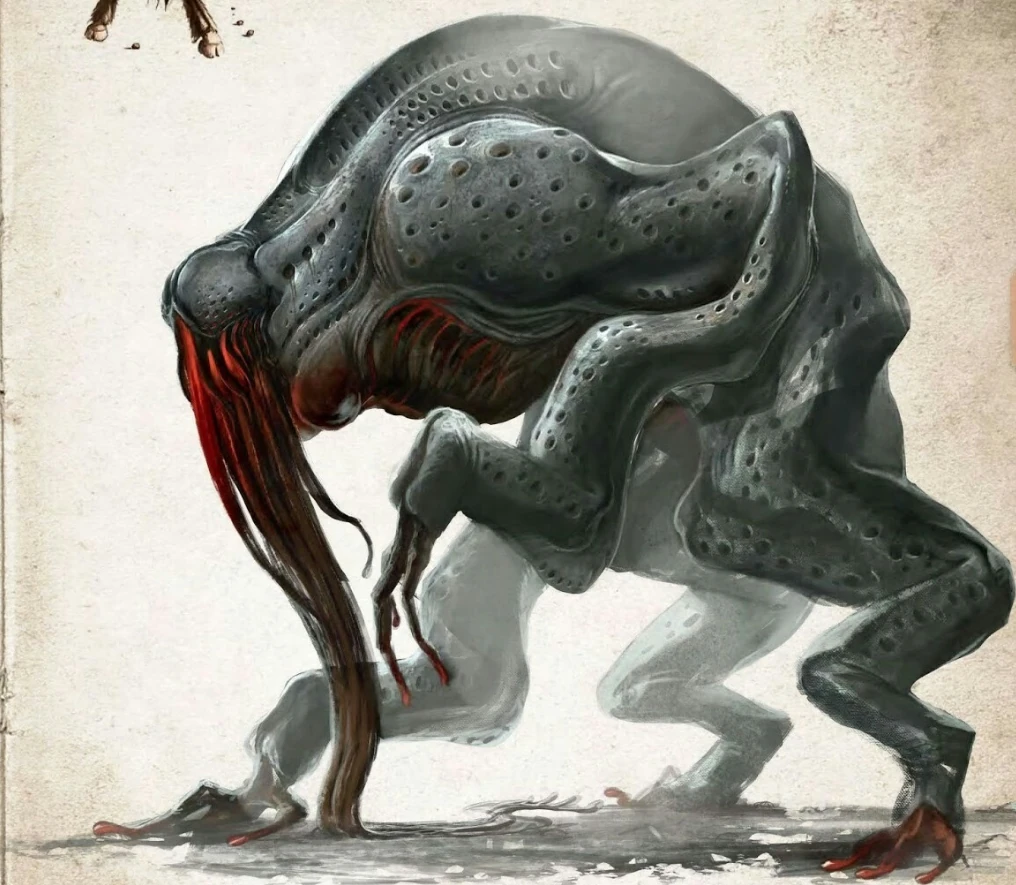
They dwell as parasites on the vast Star-Things that carry the Star Elves here and there across the cosmos, following Solar Winds and Star Seeds, and whatever else may be "Out There". In the way that humans and cats dwell one by another, neither quite subduing the other, never quite communicating, yet nevertheless associated, so the Star Beasts and the Star Elves dwell ... and which is which in the terrestrial analogy??
Regardless, where the Star Elves are content to travel and Sing among the Stars, the Star Beasts descend and take slaves wherever they may, and sell them on the next terrestrial or jovian world, OR across dimensions in some other Place unknown to the ken of those not well versed in the secrets of the universe ...
These Star Beasts descend in Black Ships, preceded by a silvery mist, upon which their black shape may be seen against the starry night; then their slave-contingents and their crew of Beasts and Leng-Denizens descend to round up the next batch of slaves ...
---
Each Black Ship of the Star Beasts carries 1-3 contingents of slaves (d20 roll for each contingent):
1
18 P'wek, tripedal and three-armed creatures from a distant world. They each wield 2 spears with wickedly barbed blades (1-6 damage) and carry a shield; they advance with the shield in front and thrust over it with their spears.
AC 4 / HD 2+2 / THAC0 17 / MV 120' / ATK 1-6/1-6 / Save as Fighter 2 (SF2) / M 8
2
20 Tachii, reptillian creatures with finned heads and without tails. Once per day they can spit up to 10', and the target must save v. breath weapons or be blinded (-4 to attack, +4 to AC) for 1-3 rounds.
AC 6 / HD 1* / THAC0 19 / MV 180' / ATK 1-6 / S F1 / M 7
3
24 Klackons, insectoids with armored carapaces like plate armor and armed with spears. They need never check morale, as they are united in purpose by shared pheromones and consider any individual's life worth only what it offers to the greater good.
AC 3 / HD 1 / THAC0 19 / MV 120' / ATK 1-6 / S F1 / M 12
(source: Master of Orion and Master of Magic games)

4
24 Humans, from another world, pallid and miserable. They speak no known tongue. Four of them are armed with laser wands, which when directed against someone, force the target to save v. death rays or take 2-12 damage, half of which is radiation damage.
AC 7 / HD 1-6 hp / THAC0 20 / MV 120' / ATK 1-6 / S Normal Man / M 6 (8 with leader)
5
24 Sectoids, small humanoids with grey skin, bulbous heads, no nose, and large black eyes. They are armed with light crossbows (1-6 damage); 2 are psionic, and 1/day may mind control (as charm person) or cause panic (as cause fear), and may use ESP within 60' at will.
AC 8 / HD 1-1 / THAC0 20 / MV 120' / ATK 1-6 or psionics / S NM / M 6 (8 with leader)
(source: X-Com games)
6
18 Mutant Humans, taken from a Tomb World from across the stars. 6 have useful mutations (d12): (1) spit acid 20', 2-12 damage (save v. breath for half); (2) third arm, gain second attack; (3) acid blood, causes 1-3 damage to opponent when struck in melee; (4) immune to fire, even fireball-type sells; (5) poisonous bite, 1-3 damage and save v. poison or die in 1 turn; (6) horned skin, AC 5; (7) defensive vomit 1/day, all within melee save v. poison or at -2 to attack for the rest of the melee; (8) psionic, may use ESP 30' at will; (9) third eye, able to see invisible; (10) redundant organs, take only half damage from all attacks; (11) stinking sweat, all in melee save v. poison or nauseated and at -2 to hit and damage; (12) super-chameleonic skin, able to become invisible at will
AC 7 / HD 1 / THAC0 19 / MV 120' / ATK 1-6 / S F1 / M 8
7
8 Kzinti, ferocious bipedal cat-men with naked rat-tails, ears like naked bat-wings, and who only speak the Heroes' Tongue. Each is armed with a wtsai short sword with which he can deal 3-8 damage, in addition to a claw and a bite attack.
AC 6 / HD 3+3 / THAC0 16 / MV 210' / ATK 3-8(wtsai)/2-5(claw)/2-7(bite) / S F4 / M 10
(source: Larry Niven's Known Space stories)

8
24 Alkari, bird/pterasaur men from a low-gravity world. Because of their keen eyesight, they are at +2 to hit with their light crossbows (1-6 damage). They cannot fly in normal gravity.
AC 7 / HD 1-1 / THAC0 18 (ranged) / MV 180' / ATK 1-6 / S NM / M 8
(source: Master of Orion games)
9
12 Synths, synthetic humanoids that are immune to charm person, sleep, illusions, poison, or cold (and maybe some other effects, appropriate to androids). They strike with their fists, each dealing 1-6 damage.
AC 5 / HD 2+2 / THAC0 17 / MV 180' / ATK 1-6/1-6 / S F3 / M 10
10
18 Kuo-Toa, amphibious fish-men ancient enough to evolve in parallel on other worlds. They suffer a -1 "to hit" in direct sunlight, but due to their slippery skin, they are only grappled or affected by a web 25% of the time.
AC 4 / HD 2 / THAC0 18 / MV 90' / ATK 1-6 / S F2 / M 9
11
18 Slug Men, disgusting and slimy slugs with arms that leave trails of slime wherever they go. They have a decent armor class because of the secretions from their skin, and take only half damage from blunt or piercing weapons because of their rubbery make-up.
AC 5 / HD 2 / THAC0 18 / MV 90' / ATK 1-6 / S F2 / M 8
12
8 Green Men of Mars, genetically modified for normal gravity--so, 10' tall and with four arms. They disdain shields, but may fight with up to 4 weapons or 2 two-handed weapons (or 2 normal and 1 two-handed).
AC 7 / HD 3+3 / THAC0 16 / MV 120' / ATK (by weapon) 1-6/1-6/1-6/1-6 / S F3 / M 9
(source: Edgar Rice Burroughs' Barsoom stories)

13
18 Hlaka, grey-furred creatures with 2 leathery wings and 3 eyes on their flattish face. They have a tail with a poison sting (save v. poison or die in 1 turn), and may attack with it (2-in-6 chance) or their weapons (4-in-6).
AC 5 / HD 2 / THAC0 18 / MV 150'/fly 300' / ATK 1-6 or 1-4 plus poison / S F2 / M 6
(source: MAR Barker's Empire of the Petal Throne RPG; same for entries 14, 15, and 16)
14
12 Hlyss, vaguely insectoid creatures with 4 segmented legs, 2 arms, and a chitinous exoskeleton. They have a tail that stings (save v. paralysis or paralyzed for 1 turn). They may attack with both their weapon and sting in the same round.
AC 4 / HD 2 / THAC0 18 / MV 90' / ATK 1-6/paralysis / S F2 / M 9
15
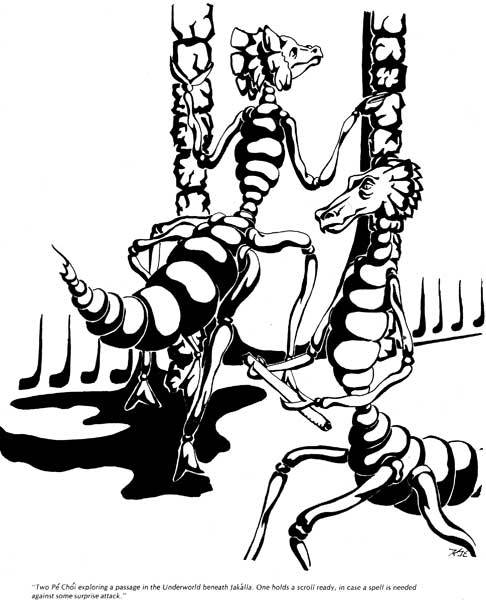
18 Pe Choi, creatures vaguely like man-sized walking sticks with black chitin that provides an armor class like plate+shield. Their broad senses of hearing and vision (which extends beyond the spectrum humans can sense) allows them to see invisible within 200' with a 60% success rate. Furthermore, they are surprised only on a 1 in 10 chance because of their natural ESP.
AC 2 / HD 1+3* / THAC0 18 / MV 120' / ATK 1-6 / S MU2 / M 8
16
12 Shen, black-scaled, dragon-like humanoids with beak-like snouts and glittering crests along their skulls. Their tails have a knobbed, bony appendage with which they strike on a 2-in-6 chance, while they have a 4-in-6 chance of striking with their weapon.
AC 2 / HD 3 / THAC0 17 / MV 90' / ATK 1-6 weapon or 1-4 tail / S F3 / M 9
17
8 Mutons, buff humanoids skinned with green cybernetic and nano-reactive armor. Their muscles are similarly enhanced, and their organs are doubled in order to be redundant, and they take only half damage from any physical attack (even magic weapons). But for all that, they have no mind to themselves and are extra susceptible to mind-influencing effects, saving at -4 vs. charm person, suggestion, illusions, etc.
AC 3 / HD 4+1* / THAC0 15 / MV 210' / ATK 2-7 / S F5 / M 11
(X-Com)
18
12 Silicoids, creatures whose structure is silicon-based. They are essentially rock-men; their outer hides are tougher than plate armor, they are immune to poisons, and any type of fire-damage heals them for a number of hit points equal to the damage that would have been dealt (by a fireball, for instance). And yet, their silicon nature makes them slow so that they automatically lose initiative ...
AC 1 / HD 3+3 / THAC0 16 / MV 30' / ATK 1-8 / S Dwarf 5 / M 9
(Master of Orion games)

19
8 Tentaculats, otherworldly things which resemble nothing so much as brains with a single beak, held up by a fringe of a dozen tentacles. They float through the air rather than supporting themselves upright, and may attack with 4 tentacles, each of which forces a save against paralysis or the target is paralyzed 1-4 rounds, plus 1 bite attack for 1-8 damage.
AC 7 / HD 3 / THAC0 17 / MV 120' / ATK x4 paralysis/bite 1-8 / S MU3 / M 8
(X-Com 2: Terror from the Deep)
20
18 Taxxons, ever-hungry, sapient, centipede-beings. Their soft flesh is easy to cut, but their voracious mouths deal 1-4 damage and may bite twice, and if they strike with both bites, they may seize a character to deal 3-12 damage per round automatically until thrown off some how; moreover, given their hunger, their morale is almost unbreakable as they seek to devour the next creature (unless strongly commanded not to by their masters).
AC 8 / HD 2+2 / THAC0 17 / MV 180' / ATK 1-4/1-4 plus seize 3-12 / S F3 / M 11
(K. A. Applegate's Animorphs series)
My players ignored the descent of the Black Ships of the Star Monsters three times (session 30, 31, and 32 of the Greyhame Game, none of which really appear on this blog), other than to send hirelings off-screen to aid with the defense (and/or to die, killed by bizarre star-things). In a kind of Blackmoorian fit, they continued to delve into the dungeon, ignoring the crisis in the realm of men, and so a great number of the people of Brakeridge and its nearby towns have now been captured and carried away to the stars as slaves of inhuman monsters ... Well, such is player agency! I figured I'd post this, now that the Star Thing has generally been settled, and there's little chance of encountering them again for some time.
------
The Star Beasts are re-worked Moon Beasts from Pathfinder and from Matt Finch's Swords & Wizardry version of them in the Cyclopean Deeps and its sequel. Likewise their associates, the Denizens of Leng ...
They dwell as parasites on the vast Star-Things that carry the Star Elves here and there across the cosmos, following Solar Winds and Star Seeds, and whatever else may be "Out There". In the way that humans and cats dwell one by another, neither quite subduing the other, never quite communicating, yet nevertheless associated, so the Star Beasts and the Star Elves dwell ... and which is which in the terrestrial analogy??
Regardless, where the Star Elves are content to travel and Sing among the Stars, the Star Beasts descend and take slaves wherever they may, and sell them on the next terrestrial or jovian world, OR across dimensions in some other Place unknown to the ken of those not well versed in the secrets of the universe ...
These Star Beasts descend in Black Ships, preceded by a silvery mist, upon which their black shape may be seen against the starry night; then their slave-contingents and their crew of Beasts and Leng-Denizens descend to round up the next batch of slaves ...
---
Each Black Ship of the Star Beasts carries 1-3 contingents of slaves (d20 roll for each contingent):
1
18 P'wek, tripedal and three-armed creatures from a distant world. They each wield 2 spears with wickedly barbed blades (1-6 damage) and carry a shield; they advance with the shield in front and thrust over it with their spears.
AC 4 / HD 2+2 / THAC0 17 / MV 120' / ATK 1-6/1-6 / Save as Fighter 2 (SF2) / M 8
2
20 Tachii, reptillian creatures with finned heads and without tails. Once per day they can spit up to 10', and the target must save v. breath weapons or be blinded (-4 to attack, +4 to AC) for 1-3 rounds.
AC 6 / HD 1* / THAC0 19 / MV 180' / ATK 1-6 / S F1 / M 7
3
24 Klackons, insectoids with armored carapaces like plate armor and armed with spears. They need never check morale, as they are united in purpose by shared pheromones and consider any individual's life worth only what it offers to the greater good.
AC 3 / HD 1 / THAC0 19 / MV 120' / ATK 1-6 / S F1 / M 12
(source: Master of Orion and Master of Magic games)
4
24 Humans, from another world, pallid and miserable. They speak no known tongue. Four of them are armed with laser wands, which when directed against someone, force the target to save v. death rays or take 2-12 damage, half of which is radiation damage.
AC 7 / HD 1-6 hp / THAC0 20 / MV 120' / ATK 1-6 / S Normal Man / M 6 (8 with leader)
5
24 Sectoids, small humanoids with grey skin, bulbous heads, no nose, and large black eyes. They are armed with light crossbows (1-6 damage); 2 are psionic, and 1/day may mind control (as charm person) or cause panic (as cause fear), and may use ESP within 60' at will.
AC 8 / HD 1-1 / THAC0 20 / MV 120' / ATK 1-6 or psionics / S NM / M 6 (8 with leader)
(source: X-Com games)
6
18 Mutant Humans, taken from a Tomb World from across the stars. 6 have useful mutations (d12): (1) spit acid 20', 2-12 damage (save v. breath for half); (2) third arm, gain second attack; (3) acid blood, causes 1-3 damage to opponent when struck in melee; (4) immune to fire, even fireball-type sells; (5) poisonous bite, 1-3 damage and save v. poison or die in 1 turn; (6) horned skin, AC 5; (7) defensive vomit 1/day, all within melee save v. poison or at -2 to attack for the rest of the melee; (8) psionic, may use ESP 30' at will; (9) third eye, able to see invisible; (10) redundant organs, take only half damage from all attacks; (11) stinking sweat, all in melee save v. poison or nauseated and at -2 to hit and damage; (12) super-chameleonic skin, able to become invisible at will
AC 7 / HD 1 / THAC0 19 / MV 120' / ATK 1-6 / S F1 / M 8
7
8 Kzinti, ferocious bipedal cat-men with naked rat-tails, ears like naked bat-wings, and who only speak the Heroes' Tongue. Each is armed with a wtsai short sword with which he can deal 3-8 damage, in addition to a claw and a bite attack.
AC 6 / HD 3+3 / THAC0 16 / MV 210' / ATK 3-8(wtsai)/2-5(claw)/2-7(bite) / S F4 / M 10
(source: Larry Niven's Known Space stories)
8
24 Alkari, bird/pterasaur men from a low-gravity world. Because of their keen eyesight, they are at +2 to hit with their light crossbows (1-6 damage). They cannot fly in normal gravity.
AC 7 / HD 1-1 / THAC0 18 (ranged) / MV 180' / ATK 1-6 / S NM / M 8
(source: Master of Orion games)
9
12 Synths, synthetic humanoids that are immune to charm person, sleep, illusions, poison, or cold (and maybe some other effects, appropriate to androids). They strike with their fists, each dealing 1-6 damage.
AC 5 / HD 2+2 / THAC0 17 / MV 180' / ATK 1-6/1-6 / S F3 / M 10
10
18 Kuo-Toa, amphibious fish-men ancient enough to evolve in parallel on other worlds. They suffer a -1 "to hit" in direct sunlight, but due to their slippery skin, they are only grappled or affected by a web 25% of the time.
AC 4 / HD 2 / THAC0 18 / MV 90' / ATK 1-6 / S F2 / M 9
11
18 Slug Men, disgusting and slimy slugs with arms that leave trails of slime wherever they go. They have a decent armor class because of the secretions from their skin, and take only half damage from blunt or piercing weapons because of their rubbery make-up.
AC 5 / HD 2 / THAC0 18 / MV 90' / ATK 1-6 / S F2 / M 8
12
8 Green Men of Mars, genetically modified for normal gravity--so, 10' tall and with four arms. They disdain shields, but may fight with up to 4 weapons or 2 two-handed weapons (or 2 normal and 1 two-handed).
AC 7 / HD 3+3 / THAC0 16 / MV 120' / ATK (by weapon) 1-6/1-6/1-6/1-6 / S F3 / M 9
(source: Edgar Rice Burroughs' Barsoom stories)

13
18 Hlaka, grey-furred creatures with 2 leathery wings and 3 eyes on their flattish face. They have a tail with a poison sting (save v. poison or die in 1 turn), and may attack with it (2-in-6 chance) or their weapons (4-in-6).
AC 5 / HD 2 / THAC0 18 / MV 150'/fly 300' / ATK 1-6 or 1-4 plus poison / S F2 / M 6
(source: MAR Barker's Empire of the Petal Throne RPG; same for entries 14, 15, and 16)
14
12 Hlyss, vaguely insectoid creatures with 4 segmented legs, 2 arms, and a chitinous exoskeleton. They have a tail that stings (save v. paralysis or paralyzed for 1 turn). They may attack with both their weapon and sting in the same round.
AC 4 / HD 2 / THAC0 18 / MV 90' / ATK 1-6/paralysis / S F2 / M 9
15
18 Pe Choi, creatures vaguely like man-sized walking sticks with black chitin that provides an armor class like plate+shield. Their broad senses of hearing and vision (which extends beyond the spectrum humans can sense) allows them to see invisible within 200' with a 60% success rate. Furthermore, they are surprised only on a 1 in 10 chance because of their natural ESP.
AC 2 / HD 1+3* / THAC0 18 / MV 120' / ATK 1-6 / S MU2 / M 8
16
12 Shen, black-scaled, dragon-like humanoids with beak-like snouts and glittering crests along their skulls. Their tails have a knobbed, bony appendage with which they strike on a 2-in-6 chance, while they have a 4-in-6 chance of striking with their weapon.
AC 2 / HD 3 / THAC0 17 / MV 90' / ATK 1-6 weapon or 1-4 tail / S F3 / M 9
17
8 Mutons, buff humanoids skinned with green cybernetic and nano-reactive armor. Their muscles are similarly enhanced, and their organs are doubled in order to be redundant, and they take only half damage from any physical attack (even magic weapons). But for all that, they have no mind to themselves and are extra susceptible to mind-influencing effects, saving at -4 vs. charm person, suggestion, illusions, etc.
AC 3 / HD 4+1* / THAC0 15 / MV 210' / ATK 2-7 / S F5 / M 11
(X-Com)
18
12 Silicoids, creatures whose structure is silicon-based. They are essentially rock-men; their outer hides are tougher than plate armor, they are immune to poisons, and any type of fire-damage heals them for a number of hit points equal to the damage that would have been dealt (by a fireball, for instance). And yet, their silicon nature makes them slow so that they automatically lose initiative ...
AC 1 / HD 3+3 / THAC0 16 / MV 30' / ATK 1-8 / S Dwarf 5 / M 9
(Master of Orion games)

19
8 Tentaculats, otherworldly things which resemble nothing so much as brains with a single beak, held up by a fringe of a dozen tentacles. They float through the air rather than supporting themselves upright, and may attack with 4 tentacles, each of which forces a save against paralysis or the target is paralyzed 1-4 rounds, plus 1 bite attack for 1-8 damage.
AC 7 / HD 3 / THAC0 17 / MV 120' / ATK x4 paralysis/bite 1-8 / S MU3 / M 8
(X-Com 2: Terror from the Deep)
20
18 Taxxons, ever-hungry, sapient, centipede-beings. Their soft flesh is easy to cut, but their voracious mouths deal 1-4 damage and may bite twice, and if they strike with both bites, they may seize a character to deal 3-12 damage per round automatically until thrown off some how; moreover, given their hunger, their morale is almost unbreakable as they seek to devour the next creature (unless strongly commanded not to by their masters).
AC 8 / HD 2+2 / THAC0 17 / MV 180' / ATK 1-4/1-4 plus seize 3-12 / S F3 / M 11
(K. A. Applegate's Animorphs series)
DIY 30 #4: Wood Wights
Not a form of undead, in this case "wight" is meant in the semi-obsolete sense of "a human being/a living being" (per the dictionary).
the Wood Wight
AC 3 (7 for tree)
HD 5 (8 for tree)
THAC0 15 (12 for tree)
damage: 2 slams 1-6 / 1-6 + petrification (2 slams 2-12 / 2-12 for tree)
petrification -- 3/day may "breathe" a 10' x 10' x 10' cloud of pollen, those within save v. petrification or transform into wood over 2-7 rounds
piercing and missile weapons never deal more than 1 damage to a wood wight or its tree, bludgeoning weapons deal half damage, fire deals double damage
immune to hold, sleep, charm, and other enchantment-type spells
save as a Elf 5, -2 on all saves versus fire or lightning
180' movement (0' for tree)
morale 9
Wood wights are a kind of evil forest spirit, similar to a dyrad, but malicious where a dryad is shy. Like dryads, wood wights are attached to a particular tree in the forest, and will discorporate if that tree is destroyed; unlike dryads, the wight's particular tree is capable of animated movement in defense of itself and its wight (it cannot actually uproot itself, but it strikes with its limbs as a treant). Just what the relation between wood wights and dryads might be scholars are still arguing; and too, it is unknown whether the wight is a spirit that springs up sui generis within a particular tree, perhaps one struck by lightning but still living, or ancient enough to develop a will of its own; or if the wight is rather some wandering form of spirit that alights in a tree when the conditions are right, and thereafter remains attached to it and the woodland around it.
Being suddenly attacked by the tree animated by a wood wight's presence is certainly a fear any seasoned woodsman might have (wood wights and their trees surprise on a 1-4 on a d6); but more fearsome is the wood wight itself, which possesses an ability similar to the gorgon (the iron-scaled bull version), that is, a wood wight is able to "breathe" a cloud of pollen in a 10' x 10' x 10' area three times per day. All who inhale this pollen must make a saving throw versus petrification or begin to stiffen as their limbs and then their entire bodies are transformed into hard wood. This transformation takes from two to seven minutes (2-7 rounds). A cure disease spell cast during the time of transformation will undo the effects; but once the transformation is complete, only a wish or a wood to flesh spell will restore the transmogrified individual. (Magic-users in areas known to be haunted by wood wights will often research wood to flesh as a variant of stone to flesh, which spells will both be of the same level, and may grant access to their spellbooks to those in need ... for a fee; without recourse to that, it is up to a magic-user to research the spell for himself).
The wooden bodies of those transformed by a wood wight's pollen make excellent base-bodies for the creation of wood golems, and can be sold to powerful magic-users for large sums of money. Prudent would-be creators, however, make sure to expel or destroy the life-force remaining within the body (just like in the case of flesh-turned-stone, the spirit of the one transformed is trapped within the unliving body until the body is restored or destroyed ... woe to those ancients petrified by Medusa of old and now forgotten!). For if the spirit is not expelled in some way from the wooden form, there is a significant possibility that a wood golem created therefrom will become self-willed and attack the creator in a berserk rage. Such free-willed golems do not possess any actual memories of their former life; but they are instinctually drawn to familiar things, e.g. family, home, or friends. And drawn there, but incapable of understanding why, it is almost inevitable that the spirit's impotent anger transforms into a berserk rage by the golem!
the Wood Wight
AC 3 (7 for tree)
HD 5 (8 for tree)
THAC0 15 (12 for tree)
damage: 2 slams 1-6 / 1-6 + petrification (2 slams 2-12 / 2-12 for tree)
petrification -- 3/day may "breathe" a 10' x 10' x 10' cloud of pollen, those within save v. petrification or transform into wood over 2-7 rounds
piercing and missile weapons never deal more than 1 damage to a wood wight or its tree, bludgeoning weapons deal half damage, fire deals double damage
immune to hold, sleep, charm, and other enchantment-type spells
save as a Elf 5, -2 on all saves versus fire or lightning
180' movement (0' for tree)
morale 9
Wood wights are a kind of evil forest spirit, similar to a dyrad, but malicious where a dryad is shy. Like dryads, wood wights are attached to a particular tree in the forest, and will discorporate if that tree is destroyed; unlike dryads, the wight's particular tree is capable of animated movement in defense of itself and its wight (it cannot actually uproot itself, but it strikes with its limbs as a treant). Just what the relation between wood wights and dryads might be scholars are still arguing; and too, it is unknown whether the wight is a spirit that springs up sui generis within a particular tree, perhaps one struck by lightning but still living, or ancient enough to develop a will of its own; or if the wight is rather some wandering form of spirit that alights in a tree when the conditions are right, and thereafter remains attached to it and the woodland around it.
 |
| Wasn't sure just what a wood wight looks like until a Google search for "dryad" turned up with this |
Being suddenly attacked by the tree animated by a wood wight's presence is certainly a fear any seasoned woodsman might have (wood wights and their trees surprise on a 1-4 on a d6); but more fearsome is the wood wight itself, which possesses an ability similar to the gorgon (the iron-scaled bull version), that is, a wood wight is able to "breathe" a cloud of pollen in a 10' x 10' x 10' area three times per day. All who inhale this pollen must make a saving throw versus petrification or begin to stiffen as their limbs and then their entire bodies are transformed into hard wood. This transformation takes from two to seven minutes (2-7 rounds). A cure disease spell cast during the time of transformation will undo the effects; but once the transformation is complete, only a wish or a wood to flesh spell will restore the transmogrified individual. (Magic-users in areas known to be haunted by wood wights will often research wood to flesh as a variant of stone to flesh, which spells will both be of the same level, and may grant access to their spellbooks to those in need ... for a fee; without recourse to that, it is up to a magic-user to research the spell for himself).
The wooden bodies of those transformed by a wood wight's pollen make excellent base-bodies for the creation of wood golems, and can be sold to powerful magic-users for large sums of money. Prudent would-be creators, however, make sure to expel or destroy the life-force remaining within the body (just like in the case of flesh-turned-stone, the spirit of the one transformed is trapped within the unliving body until the body is restored or destroyed ... woe to those ancients petrified by Medusa of old and now forgotten!). For if the spirit is not expelled in some way from the wooden form, there is a significant possibility that a wood golem created therefrom will become self-willed and attack the creator in a berserk rage. Such free-willed golems do not possess any actual memories of their former life; but they are instinctually drawn to familiar things, e.g. family, home, or friends. And drawn there, but incapable of understanding why, it is almost inevitable that the spirit's impotent anger transforms into a berserk rage by the golem!
Saturday, July 7, 2018
Rings of Power
"There are many magic rings in this world, Bilbo Baggins, and none of them should be used lightly," says Gandalf when confronting Bilbo at the (for the hobbit-guests) surprising end of his "Long Expected Party".
The Lord of the Rings movies certainly did some tricks of the camera to make the Ring seem bigger and heftier than any ring has any right to be; these, along with tricks to make the hobbits seem shorter, while the men and Elves seemed taller.
And sometimes I look at my wedding ring, and it really is just a thin gold band; it feels like nothing in my hand, and I can easily hear myself quoting Boromir: "Is it not strange that we should suffer so much fear and doubt for so small a thing? So small a thing! ..."
Marriage-jokes aside, it really is a tiny thing, almost weightless in my hand, and yet freighted with such meaning as if it should be heavy to wear. And that's just a wedding ring, no Ring of Power as Galadriel, or Elrond, or Cirdan the Shipwright wear!
Now, the simple gold band of a husband's wedding ring is a perfect image for the metaphor of Sauron's One Ring. First, as I said, it is a tiny, unassuming thing. I've always joked that if I should need to create a "lich's phylactery" or a "horcrux" that the best thing to imbue with a piece of myself would be a pine needle on a forest floor, or a grain of sand on the beach, impossible to differentiate from all the rest. There is an undead creature in one of Lloyd Alexander's Prydain books whose soul is bound up in a finger secreted away inside an unassuming pine tree that the hero just happens to find. The less conspicuous the better! And a simple gold band, rather than something ostentatious with runes and gems and all manner of signs of magic is just the kind of unassuming secret thing that I would pour my power into if I were a Sauron or a lich ...
Secondly, metaphorically, Sauron seeks to overmaster everything, and so could be considered to be a bad husband: a man who seeks to control and dominate, to overmaster everything to his will; a tyrant! This is a metaphor, of course, something to be drawn out of the imagery, not something directly allegorized by Tolkien, who hated allegory. Still, there is much to the image--the ring-wearing man, commanding all others to do as he says, rather than working with them toward the end of real justice for all ...
Okay, but I originally started this post to suggest other kinds of rings of power. The ring I wear is so little, but the oath-rings that the Norsemen and their gods used to lay their hands upon were surely not tiny finger-rings, right? I imagine they were arm-rings or torcs--weighty things upon which a man could lay a hand with a real sense of presence.
So why not sometimes describe magic rings as arm-rings or torcs or key rings, or some other kind of ring? E.g.
1) Arm-Ring of the Serpent: a Celtic-type gold ring formed like a serpent and worn around one's upper arm; when worn, it conveys a +2 bonus on saves v. poison; on command, it becomes a viper per the rules, attacking on the wearer's initiative, and when killed reverts to the arm-ring, to be called into viper-form again after one day; similar Eagle- and Wolf-Torcs exist, which provide different specific bonuses and become the animals they represent until killed ...
2) Knotted Arm-Ring: gold lattice in a Celtic-knot-type pattern, it provides from +1 to +3 protection (to both AC and saves ... 1-3 +1, 4-5 +2, 6 +3)
3) Oath Ring: a heavy iron ring worn around the arm, any oath sworn upon it acts as a geas spell for the swearer
4) Torc of Nobility: a well-made golden or silver torc that provides an air of authority. It grants either a +1 to reactions (1-4) or a +2 (5-6).
5) Torc of Thorns: reduces max hp by 2-7 (roll once; no creature can be reduced to fewer than 1 hp by wearing it); otherwise acts as a Ring of Plant Control; and furthermore, grants the power to animate up to two trees per the Treant ability, and to have them fight while concentration is maintained as if concentrating on a device controlling elementals ...
6) Draupnir: or an imitation; be it a finger-ring, arm-ring, or torc, every ninth night it drops nine copies of itself. 1-3 finger-ring worth 25 gp each; 4-5 an arm-ring worth 50 gp each; 6 a torc worth 100 gp each.
Many other such things are possible--why limit "rings" to finger-rings? One could even include ear-rings, nose-rings, and more!
The Lord of the Rings movies certainly did some tricks of the camera to make the Ring seem bigger and heftier than any ring has any right to be; these, along with tricks to make the hobbits seem shorter, while the men and Elves seemed taller.
And sometimes I look at my wedding ring, and it really is just a thin gold band; it feels like nothing in my hand, and I can easily hear myself quoting Boromir: "Is it not strange that we should suffer so much fear and doubt for so small a thing? So small a thing! ..."
Marriage-jokes aside, it really is a tiny thing, almost weightless in my hand, and yet freighted with such meaning as if it should be heavy to wear. And that's just a wedding ring, no Ring of Power as Galadriel, or Elrond, or Cirdan the Shipwright wear!
Now, the simple gold band of a husband's wedding ring is a perfect image for the metaphor of Sauron's One Ring. First, as I said, it is a tiny, unassuming thing. I've always joked that if I should need to create a "lich's phylactery" or a "horcrux" that the best thing to imbue with a piece of myself would be a pine needle on a forest floor, or a grain of sand on the beach, impossible to differentiate from all the rest. There is an undead creature in one of Lloyd Alexander's Prydain books whose soul is bound up in a finger secreted away inside an unassuming pine tree that the hero just happens to find. The less conspicuous the better! And a simple gold band, rather than something ostentatious with runes and gems and all manner of signs of magic is just the kind of unassuming secret thing that I would pour my power into if I were a Sauron or a lich ...
Secondly, metaphorically, Sauron seeks to overmaster everything, and so could be considered to be a bad husband: a man who seeks to control and dominate, to overmaster everything to his will; a tyrant! This is a metaphor, of course, something to be drawn out of the imagery, not something directly allegorized by Tolkien, who hated allegory. Still, there is much to the image--the ring-wearing man, commanding all others to do as he says, rather than working with them toward the end of real justice for all ...
Okay, but I originally started this post to suggest other kinds of rings of power. The ring I wear is so little, but the oath-rings that the Norsemen and their gods used to lay their hands upon were surely not tiny finger-rings, right? I imagine they were arm-rings or torcs--weighty things upon which a man could lay a hand with a real sense of presence.
So why not sometimes describe magic rings as arm-rings or torcs or key rings, or some other kind of ring? E.g.
1) Arm-Ring of the Serpent: a Celtic-type gold ring formed like a serpent and worn around one's upper arm; when worn, it conveys a +2 bonus on saves v. poison; on command, it becomes a viper per the rules, attacking on the wearer's initiative, and when killed reverts to the arm-ring, to be called into viper-form again after one day; similar Eagle- and Wolf-Torcs exist, which provide different specific bonuses and become the animals they represent until killed ...
2) Knotted Arm-Ring: gold lattice in a Celtic-knot-type pattern, it provides from +1 to +3 protection (to both AC and saves ... 1-3 +1, 4-5 +2, 6 +3)
3) Oath Ring: a heavy iron ring worn around the arm, any oath sworn upon it acts as a geas spell for the swearer
4) Torc of Nobility: a well-made golden or silver torc that provides an air of authority. It grants either a +1 to reactions (1-4) or a +2 (5-6).
5) Torc of Thorns: reduces max hp by 2-7 (roll once; no creature can be reduced to fewer than 1 hp by wearing it); otherwise acts as a Ring of Plant Control; and furthermore, grants the power to animate up to two trees per the Treant ability, and to have them fight while concentration is maintained as if concentrating on a device controlling elementals ...
6) Draupnir: or an imitation; be it a finger-ring, arm-ring, or torc, every ninth night it drops nine copies of itself. 1-3 finger-ring worth 25 gp each; 4-5 an arm-ring worth 50 gp each; 6 a torc worth 100 gp each.
Many other such things are possible--why limit "rings" to finger-rings? One could even include ear-rings, nose-rings, and more!
Saturday, May 19, 2018
They Killed the Goblin King! (Greyhame 30)
They began descending the stair that wound around the shaft down to the third and fourth levels of the dungeon beneath the Howling Tower--the Goblin King's lair lay somewhere below, and within, presumably, the Star Child prisoner ...
The party included:
Baby-Face (thief 6)
Valor Justice (Elf 2)
Aethelwulf (paladin 4)
Ham (cleric 5)
Thaddeus (fighter 3)
Torag (ogre 1)
Blackleaf (Elf 4)
Koko (woman-ape 2)
Little Bob (travelling-man 5)
Maira (magic-user 1)
June (cleric 3)
Able (paladin 1)
(the party was a damned army, alerting everything ahead of them of their coming!)
There were two doors on the landing to the third level. Both were locked. Baby-Face picked one; it opened onto a goblin armory. But he failed to pick the other. The party began to smash it open; the noise attracted attention ...
From below, the party heard a familiar voice raised in anger: "Why do you continue to invade my house?" cried the Goblin King from the bottom of the shaft. And looking over from above, there he was, surrounded by a bodyguard of four spiderlings, and with Calirath, an Elfin-seeming woman with white hair, clad in nothing but her own coal-black skin.
"Well if you weren't such a dick!" Maira called back from above.
"Come and fight me!" the Goblin King answered.
Confusion ensued. Without a caller, the party talked over each other. I want to cast a spell, I want to shoot an arrow, what's going on? I called for initiative without spells--an arrows was loosed, and so battle was joined.
The Goblin King and crew won; the Goblin King himself, a straight-backed, strikingly handsome goblin with a weird Elfin shadow that moved independently, quaffed a potion and grew in size; his djinni, Calirath, began to transform into an aery form and a wind picked up in the room. The four spiderling bodyguards around the king stepped up to the foot of the stair, taking defensive positions. And from the back of the party, the silent demon spider crept down and attacked, but I rolled shit for attacks.
A party of dogs attacked the demon spider, all to no avail despite having silver-lined tine in their mouths--as a demon, it was immune to any attacks except those with a magic weapon. Koko moved back to attack the spider, using her ape ability to kind of climb the wall to get into the melee with the dogs, using her magic sword.
Aethelwulf, Little Bob, Ham, and some dogs moved down the stair to attack the spiderlings, while arrows were cast down around them at the Goblin King, to no avail. But even as Aethelwulf reached the middle point and cast his first javelin, fires lit up from the runic trap on the stair, engulfing all the front rank in fire for 1-6 damage; these fires would cover the entire stair on the next round.
Spells were prepared. The party won initiative, and Ham got hold person off on the Goblin King and his bodyguard. I rolled a 3 for him, but the spiderlings saved (third villain in three villain-encounters to fail his save against hold person, this is getting frustrating); Blackleaf also webbed the King; meanwhile, June attempted to hold person the rising whirlwind, but Calirath not being a "person", she was not affected.
Seeing the fires roaring toward them, several characters jumped. Able, June, and Little Bob each took 1-6 points of damage as they leapt. Meanwhile, Koko used her apish "feat of strength" ability to wrestle the spider off the stair--she tried to throw it at the Goblin King, but didn't quite succeed in that. As the spider was cleared from the back, the rest of the party moved up the stair and away from the rising fires (hmm, I should have dealt fire damage to Ham, Blackleaf, and June, since spells can't be cast if you move, but I didn't--oh well!) Baby-Face meanwhile used his thief "climb sheer surfaces" ability to descend from the stair without harm.
The demon spider was discombobulated for a round, then began to climb back up the wall; the spiderlings stayed where they were, holding the foot of the stair for the entire encounter; Calirath continued to transform into a whirlwind (5 rounds altogether is painfully slow).
Meanwhile, Koko charged back down the stairs through the fire (1-6 damage) to engage the spiderlings in melee alongside Aethelwulf. She managed to kill one, but also received a number of hits, including two critical hits, one of which she warded off by breaking her shield. And I should note that Aethelwulf, wearing his Ring of Fire Resistance was hanging out in the fires, immune to their damage (they were only dealing damage as "normal fires").
Ham, Torag, and Thaddeus all elected to jump off the stairs to take 1-6 falling damage each, and then gang up on the paralyzed Goblin King.
At about this time, the demon spider got back up to the stair and began munching on dogs (rolled randomly, characters or dogs/hirelings). Boar One (Ham's dog) failed his save against poison. Later, Duke (Maira's dog) would be killed by brute damage, while Whesker the Weasel (Baby-Face's snake-killing weasel) also succumbed to poison. And Astix (June's Celtic hireling) was knocked to 0 hp (just knocked out, even for a mere hireling), and made his save exactly to avoid death-by-poison.
Meanwhile, Calirath was finally fully formed into a whirlwind. She moved through Aethelwulf and Koko, dealing 2-12 damage to each, and Koko was KO'd, while Aethelwulf was forced to lay hands upon himself. But!--Valor Justice had a scroll on his character sheet, and nothing to identify it otherwise. He used it, and I rolled its effect randomly from the treasure-tables. Protection from Elementals! And reading the description, it creates a circle of protection 10' into which elementals cannot move or attack. And what's a djinni but a spirit of the air? I judged it effective, and the whirlwind Calirath was unable to affect the party at the top of the stairs with her howling winds.
During these rounds, Torag, Ham, and Thaddeus were beating up the Goblin King (normally I allow automatic kills against held opponents, but in the confusion of this combat, I was just granting +4 to attack) and doing some decent damage to him, but were attacked by his animated shadow; and so Baby-Face and Little Bob began to attack the shadow and deal damage directly to it with their magic weapons, until finally it dissipated (and the Goblin King looked pretty badly injured too).
Around this time, June happened to loose an arrow at the frozen Goblin King--and he rolled a 20! He took the King down to 1 hp; initiative was rolled, and the party won. I let June go first. Another hit, and the Goblin King is dead, slain by an arrow cast by a low level character, his eyes rolling up in his head even as his body is held in a magically rigid paralysis.
The whirlwind howled, moved down to attack those around the Goblin King, and KO'd Ham with the damage dealt. Then she began to wind down, returning to her woman-form.
Only the demon spider and the spiderlings remained ... the spiderlings were quickly dispatched; but the demon spider continued to fight (see casualties above), its armor class and magical nature keeping it proof against most of the creatures it was facing. Until Aethelwulf, Little Bob, and Blackleaf engaged it in melee with their magical swords (the fire had died down by then, but as Little Bob went back up the stairs, they reignited, dealing 1-6 damage to him). The spider managed to KO Little Bob, but the magic swords arrayed against it proved too much, and it expired on their swordpoints.
Lastly, the whirlwind was still winding down; as it did so, Ham attacked it, thinking it still an enemy--but Baby-Face, who had counseled against killing the Goblin King in the midst of the battle, now leapt in the way of the blow. He took the hit, but saved Calirath. And when the djinni had fully reformed, she turned to Baby-Face and declared, "If you can save the Goblin King--if you can get him raised from death--I will give you anything you want."
So the party marched out of the dungeon, Calirath carrying the slain form of the Goblin King--and what wandering monster would dare attack such a procession??
Back in town, the Goblin King was successfully raised by Lailith; and because Baby-Face asked Calirath to serve him, she pointed out the ring on the fallen Goblin King's finger to which her spirit was bound, and bade him wear it ... and now Baby-Face is a Thief 6 with two Rings of the Djinni.
Which means it's time for me to step up the challenge!
We were out of time ... we'll figure out the ramifications of it all next session. But all in all, very fun. There was a lot of nail-biting on behalf of the players, and a lot of me thinking "oh man, I'm going to kill all the low-level characters." But some fortuitous rolls (my bad save, a good roll on the scroll-type) turned the tide of fortune.
The party included:
Baby-Face (thief 6)
Valor Justice (Elf 2)
Aethelwulf (paladin 4)
Ham (cleric 5)
Thaddeus (fighter 3)
Torag (ogre 1)
Blackleaf (Elf 4)
Koko (woman-ape 2)
Little Bob (travelling-man 5)
Maira (magic-user 1)
June (cleric 3)
Able (paladin 1)
(the party was a damned army, alerting everything ahead of them of their coming!)
There were two doors on the landing to the third level. Both were locked. Baby-Face picked one; it opened onto a goblin armory. But he failed to pick the other. The party began to smash it open; the noise attracted attention ...
From below, the party heard a familiar voice raised in anger: "Why do you continue to invade my house?" cried the Goblin King from the bottom of the shaft. And looking over from above, there he was, surrounded by a bodyguard of four spiderlings, and with Calirath, an Elfin-seeming woman with white hair, clad in nothing but her own coal-black skin.
"Well if you weren't such a dick!" Maira called back from above.
"Come and fight me!" the Goblin King answered.
Confusion ensued. Without a caller, the party talked over each other. I want to cast a spell, I want to shoot an arrow, what's going on? I called for initiative without spells--an arrows was loosed, and so battle was joined.
The Goblin King and crew won; the Goblin King himself, a straight-backed, strikingly handsome goblin with a weird Elfin shadow that moved independently, quaffed a potion and grew in size; his djinni, Calirath, began to transform into an aery form and a wind picked up in the room. The four spiderling bodyguards around the king stepped up to the foot of the stair, taking defensive positions. And from the back of the party, the silent demon spider crept down and attacked, but I rolled shit for attacks.
A party of dogs attacked the demon spider, all to no avail despite having silver-lined tine in their mouths--as a demon, it was immune to any attacks except those with a magic weapon. Koko moved back to attack the spider, using her ape ability to kind of climb the wall to get into the melee with the dogs, using her magic sword.
Aethelwulf, Little Bob, Ham, and some dogs moved down the stair to attack the spiderlings, while arrows were cast down around them at the Goblin King, to no avail. But even as Aethelwulf reached the middle point and cast his first javelin, fires lit up from the runic trap on the stair, engulfing all the front rank in fire for 1-6 damage; these fires would cover the entire stair on the next round.
Spells were prepared. The party won initiative, and Ham got hold person off on the Goblin King and his bodyguard. I rolled a 3 for him, but the spiderlings saved (third villain in three villain-encounters to fail his save against hold person, this is getting frustrating); Blackleaf also webbed the King; meanwhile, June attempted to hold person the rising whirlwind, but Calirath not being a "person", she was not affected.
Seeing the fires roaring toward them, several characters jumped. Able, June, and Little Bob each took 1-6 points of damage as they leapt. Meanwhile, Koko used her apish "feat of strength" ability to wrestle the spider off the stair--she tried to throw it at the Goblin King, but didn't quite succeed in that. As the spider was cleared from the back, the rest of the party moved up the stair and away from the rising fires (hmm, I should have dealt fire damage to Ham, Blackleaf, and June, since spells can't be cast if you move, but I didn't--oh well!) Baby-Face meanwhile used his thief "climb sheer surfaces" ability to descend from the stair without harm.
The demon spider was discombobulated for a round, then began to climb back up the wall; the spiderlings stayed where they were, holding the foot of the stair for the entire encounter; Calirath continued to transform into a whirlwind (5 rounds altogether is painfully slow).
Meanwhile, Koko charged back down the stairs through the fire (1-6 damage) to engage the spiderlings in melee alongside Aethelwulf. She managed to kill one, but also received a number of hits, including two critical hits, one of which she warded off by breaking her shield. And I should note that Aethelwulf, wearing his Ring of Fire Resistance was hanging out in the fires, immune to their damage (they were only dealing damage as "normal fires").
Ham, Torag, and Thaddeus all elected to jump off the stairs to take 1-6 falling damage each, and then gang up on the paralyzed Goblin King.
At about this time, the demon spider got back up to the stair and began munching on dogs (rolled randomly, characters or dogs/hirelings). Boar One (Ham's dog) failed his save against poison. Later, Duke (Maira's dog) would be killed by brute damage, while Whesker the Weasel (Baby-Face's snake-killing weasel) also succumbed to poison. And Astix (June's Celtic hireling) was knocked to 0 hp (just knocked out, even for a mere hireling), and made his save exactly to avoid death-by-poison.
Meanwhile, Calirath was finally fully formed into a whirlwind. She moved through Aethelwulf and Koko, dealing 2-12 damage to each, and Koko was KO'd, while Aethelwulf was forced to lay hands upon himself. But!--Valor Justice had a scroll on his character sheet, and nothing to identify it otherwise. He used it, and I rolled its effect randomly from the treasure-tables. Protection from Elementals! And reading the description, it creates a circle of protection 10' into which elementals cannot move or attack. And what's a djinni but a spirit of the air? I judged it effective, and the whirlwind Calirath was unable to affect the party at the top of the stairs with her howling winds.
During these rounds, Torag, Ham, and Thaddeus were beating up the Goblin King (normally I allow automatic kills against held opponents, but in the confusion of this combat, I was just granting +4 to attack) and doing some decent damage to him, but were attacked by his animated shadow; and so Baby-Face and Little Bob began to attack the shadow and deal damage directly to it with their magic weapons, until finally it dissipated (and the Goblin King looked pretty badly injured too).
Around this time, June happened to loose an arrow at the frozen Goblin King--and he rolled a 20! He took the King down to 1 hp; initiative was rolled, and the party won. I let June go first. Another hit, and the Goblin King is dead, slain by an arrow cast by a low level character, his eyes rolling up in his head even as his body is held in a magically rigid paralysis.
The whirlwind howled, moved down to attack those around the Goblin King, and KO'd Ham with the damage dealt. Then she began to wind down, returning to her woman-form.
Only the demon spider and the spiderlings remained ... the spiderlings were quickly dispatched; but the demon spider continued to fight (see casualties above), its armor class and magical nature keeping it proof against most of the creatures it was facing. Until Aethelwulf, Little Bob, and Blackleaf engaged it in melee with their magical swords (the fire had died down by then, but as Little Bob went back up the stairs, they reignited, dealing 1-6 damage to him). The spider managed to KO Little Bob, but the magic swords arrayed against it proved too much, and it expired on their swordpoints.
Lastly, the whirlwind was still winding down; as it did so, Ham attacked it, thinking it still an enemy--but Baby-Face, who had counseled against killing the Goblin King in the midst of the battle, now leapt in the way of the blow. He took the hit, but saved Calirath. And when the djinni had fully reformed, she turned to Baby-Face and declared, "If you can save the Goblin King--if you can get him raised from death--I will give you anything you want."
So the party marched out of the dungeon, Calirath carrying the slain form of the Goblin King--and what wandering monster would dare attack such a procession??
Back in town, the Goblin King was successfully raised by Lailith; and because Baby-Face asked Calirath to serve him, she pointed out the ring on the fallen Goblin King's finger to which her spirit was bound, and bade him wear it ... and now Baby-Face is a Thief 6 with two Rings of the Djinni.
Which means it's time for me to step up the challenge!
We were out of time ... we'll figure out the ramifications of it all next session. But all in all, very fun. There was a lot of nail-biting on behalf of the players, and a lot of me thinking "oh man, I'm going to kill all the low-level characters." But some fortuitous rolls (my bad save, a good roll on the scroll-type) turned the tide of fortune.
Monday, May 7, 2018
Greyhame Mountain Dungeon Expedition 29
Orcs have returned to the caverns of the Glimmervaults ...
the Goblin King and the Lord of Werewolves have renewed their ancient alliance in the dungeons beneath the Howling Tower ...
the secret treasury of the Bronding Kings is said to lie hidden behind the Brokenbrand Falls, haunted by enchanting naiads ...
Jaer the Windlord looks down on the world below from the Eyries of the Eagles atop the Greyhame Mountain itself ...
and the Stars themselves are singing an eerie, eldritch song, night after night ...
16 April's roster:
Aethelwulf (paladin 4)
June (cleric 2)
Able (paladin 1)
Ham (cleric 5)
Thaddeus (fighter 2)
Coball (cleric 1)
(and halfway through the session)
Blackleaf (Elf 3)
Koko (woman-ape 2)
In town, Able, newly arrived paladin, hired two Celtic-type men-at-arms, one Vertix, the other Astix. He also acquired for himself two of the available dogs, a bloodhound and a ghosthound.
Aethelwulf, meanwhile, bought the two unique items available this session, a bottle of what was purported to be mead of poetry, the other the fingerbone of a saint. He placed the fingerbone in the pommel of his life-draining sword Drinker, then took the mead of poetry to Aldir the blacksmith. This Aldir had once had a fling with Blackleaf the Elf, but it had fallen by the wayside when Aldir decided he wanted to convert to the Good cult under Aethelwulf's tutelage; but Aethelwulf was interested in getting them together, because if Blackleaf married Aldir, a Good human, then Blackleaf would receive a human soul from the pairing ....
And so Aethelwulf drank of the mead, and spoke to Aldir at length in verse, describing the basic goodness of marriage, and spinning out the mythic tales of men and Elves marrying; perhaps indeed, he sang the Lay of Lethian! And because of the magic in the mead, he was convincing, and Aldir decided that he must ultimately wed Blackleaf.
Still, Aethelwulf had one further piece of business in town. He and the company had rescued several children from the Goblin King's dungeons last time, and now he kept them at the shrine while trying to figure out how to reverse the changes effected on them by the Goblin King's magic to make them into goblins.
Town business dealt with, the party decided on their next course of action--sneak into Oakridge castle to deal with Morrow, son of Morholt the Usurper! Though Morholt had already been captured and sent north, his son retained control of the castle, and now the party wanted to end the usurpation of Sonora's rightful claim to the seat once and for all.
The party sneaked into the dungeons of the castle through a previously revealed secret-entrance on the north side of the ridge. In one room, they burst in on a pair of guards, surprising them as the guards diced at a table. The party's dogs made short work of the men; and what were they guarding? The prison cells. These were filled with typical rabble--drunkards, petty thieves, and the like, and the party left them there. But through another set of doors and corridor they found a semi-newly installed torture chamber, and beyond that an oubliette from whence came a faint weeping.
The prisoner within was hauled out, one Alira, a young woman of the village. She refused to tell the party what exactly Morrow had done to her, and Aethelwulf had his hirelings Lessing and Aquinas escort her out of the dungeon to safety.
The party then proceeded to explore previously explored territory, robbing a couple more crypts of the dead lords below, until they stumbled through the well room and the wine cellar, and up stairs into the kitchen!
Six servants chopping vegetables were interrupted--they immediately fled at the intrusion of armed men, but Aethelwulf called them back, promising their freedom from Morrow's evil rule.
It was at this point that I remembered I had written a short table for "castle business" that I was supposed to use whenever I used the castle ... roll roll ... a feast! "We were preparing for a feast," the servants tell the party.
The natural plan on hearing that was to make it a Red Feast, and the party convinced the servants to let them hide below, and then come and get them when everyone in the castle had assembled for the feast and were into their cups somewhat.
I rolled a wandering encounter check to see if anything happened in the meantime; nothing; so at the duly appointed time, the servants came and led the armed party up through the kitchen to attack the unarmed Morrow and his men.
In the great hall, Morrow was seated at the high seat with his captain of the guard, his magic-user assistant, and six wild-looking men and women, while two dozen of his men-at-arms feasted in the hall below. During the surprise round, the party got a hold person spell off on Morrow and his magic-user and I rolled ... something like a 3 and a 5. So they were paralyzed; everyone else was unarmed, other than their daggers, and unarmored.
It was a slaughter. Even when the wild-men turned into wolves, they stood no chance; and Blackleaf's and Koko's timely appearance allowed Blackleaf to get a web spell off on the armed reinforcements that attempted to save the life of their lord, immobilizing the entire squad (except the captain, who managed to slay Astix the hireling before himself being felled). The magic-user, too, was easily killed while he sat, paralyzed by the hold person spell, holding up a morsel of venison on his fork, mouth hanging open, ready but unable to bite--he was struck through with several arrows loosed by June and Able, if I recall correctly.
During the melee at the high table, it was revealed that Morrow was a werewolf when a stroke from a normal sword did him no damage, while a silver arrow pierced his shoulder and bright red blood flowed forth.
But in the end, the party agreed that they needed to seize Morrow and haul him away before any more reinforcements showed up. They bound him as well as they could with speed, and then dragged him back down and out through the dungeon and back to town.
Thaddeus caroused, telling everyone this tale, but was able to hold his liquor without shenanigans ensuing. And so Morrow was captured two weeks after his father before him; and within the next weeks, certainly, the men-at-arms that Sonora left behind in Brakeridge hope to be able to take the castle back for their lady!
------
Remembrance for the Fallen:
Astix (Celto hireling), Clara and Ilana (normal women), Marlo and a number of dogs, Gram, Dorcas, Frida, and Johann Haybaler (normal hirelings), Hauka and Wilmerand (weasels), Blade and Boar (boarhounds), Hubert the Peacock and Lysimmachus (normal men), a nameless mastiff, Livy (normal man), Orkie (orc mastiff), Fang (boarhound), Droopy and Snoopy (mastiffs), Dream Destroyer (ghosthound), Arrow (pack dog), Freyja (normal woman), a nameless cur, Hot Dog and Cross (mastiffs), Orion II (lion dog), Bacon (boarhound), Tore (half-orc fighter 1/cleric 1), Jimmy the Snitch (dog), Orion (lion dog), Harambe (man-ape 1)
and for those Enchanted away:
Dol (fyrdman hireling)
the Goblin King and the Lord of Werewolves have renewed their ancient alliance in the dungeons beneath the Howling Tower ...
the secret treasury of the Bronding Kings is said to lie hidden behind the Brokenbrand Falls, haunted by enchanting naiads ...
Jaer the Windlord looks down on the world below from the Eyries of the Eagles atop the Greyhame Mountain itself ...
and the Stars themselves are singing an eerie, eldritch song, night after night ...
16 April's roster:
Aethelwulf (paladin 4)
June (cleric 2)
Able (paladin 1)
Ham (cleric 5)
Thaddeus (fighter 2)
Coball (cleric 1)
(and halfway through the session)
Blackleaf (Elf 3)
Koko (woman-ape 2)
In town, Able, newly arrived paladin, hired two Celtic-type men-at-arms, one Vertix, the other Astix. He also acquired for himself two of the available dogs, a bloodhound and a ghosthound.
Aethelwulf, meanwhile, bought the two unique items available this session, a bottle of what was purported to be mead of poetry, the other the fingerbone of a saint. He placed the fingerbone in the pommel of his life-draining sword Drinker, then took the mead of poetry to Aldir the blacksmith. This Aldir had once had a fling with Blackleaf the Elf, but it had fallen by the wayside when Aldir decided he wanted to convert to the Good cult under Aethelwulf's tutelage; but Aethelwulf was interested in getting them together, because if Blackleaf married Aldir, a Good human, then Blackleaf would receive a human soul from the pairing ....
And so Aethelwulf drank of the mead, and spoke to Aldir at length in verse, describing the basic goodness of marriage, and spinning out the mythic tales of men and Elves marrying; perhaps indeed, he sang the Lay of Lethian! And because of the magic in the mead, he was convincing, and Aldir decided that he must ultimately wed Blackleaf.
Still, Aethelwulf had one further piece of business in town. He and the company had rescued several children from the Goblin King's dungeons last time, and now he kept them at the shrine while trying to figure out how to reverse the changes effected on them by the Goblin King's magic to make them into goblins.
Town business dealt with, the party decided on their next course of action--sneak into Oakridge castle to deal with Morrow, son of Morholt the Usurper! Though Morholt had already been captured and sent north, his son retained control of the castle, and now the party wanted to end the usurpation of Sonora's rightful claim to the seat once and for all.
The party sneaked into the dungeons of the castle through a previously revealed secret-entrance on the north side of the ridge. In one room, they burst in on a pair of guards, surprising them as the guards diced at a table. The party's dogs made short work of the men; and what were they guarding? The prison cells. These were filled with typical rabble--drunkards, petty thieves, and the like, and the party left them there. But through another set of doors and corridor they found a semi-newly installed torture chamber, and beyond that an oubliette from whence came a faint weeping.
The prisoner within was hauled out, one Alira, a young woman of the village. She refused to tell the party what exactly Morrow had done to her, and Aethelwulf had his hirelings Lessing and Aquinas escort her out of the dungeon to safety.
The party then proceeded to explore previously explored territory, robbing a couple more crypts of the dead lords below, until they stumbled through the well room and the wine cellar, and up stairs into the kitchen!
Six servants chopping vegetables were interrupted--they immediately fled at the intrusion of armed men, but Aethelwulf called them back, promising their freedom from Morrow's evil rule.
It was at this point that I remembered I had written a short table for "castle business" that I was supposed to use whenever I used the castle ... roll roll ... a feast! "We were preparing for a feast," the servants tell the party.
The natural plan on hearing that was to make it a Red Feast, and the party convinced the servants to let them hide below, and then come and get them when everyone in the castle had assembled for the feast and were into their cups somewhat.
I rolled a wandering encounter check to see if anything happened in the meantime; nothing; so at the duly appointed time, the servants came and led the armed party up through the kitchen to attack the unarmed Morrow and his men.
In the great hall, Morrow was seated at the high seat with his captain of the guard, his magic-user assistant, and six wild-looking men and women, while two dozen of his men-at-arms feasted in the hall below. During the surprise round, the party got a hold person spell off on Morrow and his magic-user and I rolled ... something like a 3 and a 5. So they were paralyzed; everyone else was unarmed, other than their daggers, and unarmored.
It was a slaughter. Even when the wild-men turned into wolves, they stood no chance; and Blackleaf's and Koko's timely appearance allowed Blackleaf to get a web spell off on the armed reinforcements that attempted to save the life of their lord, immobilizing the entire squad (except the captain, who managed to slay Astix the hireling before himself being felled). The magic-user, too, was easily killed while he sat, paralyzed by the hold person spell, holding up a morsel of venison on his fork, mouth hanging open, ready but unable to bite--he was struck through with several arrows loosed by June and Able, if I recall correctly.
During the melee at the high table, it was revealed that Morrow was a werewolf when a stroke from a normal sword did him no damage, while a silver arrow pierced his shoulder and bright red blood flowed forth.
But in the end, the party agreed that they needed to seize Morrow and haul him away before any more reinforcements showed up. They bound him as well as they could with speed, and then dragged him back down and out through the dungeon and back to town.
Thaddeus caroused, telling everyone this tale, but was able to hold his liquor without shenanigans ensuing. And so Morrow was captured two weeks after his father before him; and within the next weeks, certainly, the men-at-arms that Sonora left behind in Brakeridge hope to be able to take the castle back for their lady!
------
Remembrance for the Fallen:
Astix (Celto hireling), Clara and Ilana (normal women), Marlo and a number of dogs, Gram, Dorcas, Frida, and Johann Haybaler (normal hirelings), Hauka and Wilmerand (weasels), Blade and Boar (boarhounds), Hubert the Peacock and Lysimmachus (normal men), a nameless mastiff, Livy (normal man), Orkie (orc mastiff), Fang (boarhound), Droopy and Snoopy (mastiffs), Dream Destroyer (ghosthound), Arrow (pack dog), Freyja (normal woman), a nameless cur, Hot Dog and Cross (mastiffs), Orion II (lion dog), Bacon (boarhound), Tore (half-orc fighter 1/cleric 1), Jimmy the Snitch (dog), Orion (lion dog), Harambe (man-ape 1)
and for those Enchanted away:
Dol (fyrdman hireling)
Wednesday, May 2, 2018
Days of our Dungeons
I'm going to roll a wandering monster check to see if your wife comes by ...
The look of horror on the player's face when I declared this was wonderful. Her male character has in the past foisted two sexual relationships onto a loyal henchman as marriages (yes, the henchman is indeed bigamous); meanwhile the character has since married "respectfully" and without telling his now-wife the full story of his past.
And an NPC had just shown up with a young child, declaring it either the character's or the henchman's--"And you must now take care of her!" The henchman was away; the character tried to keep the child's appearance secret from his wife to prevent any further frustrations between the two (she had already been angered at the character for some other reason during an earlier session.)
I roll a black die (on a 1, the monster--the wife!--appears), a red die (on a 1 or 2 the monster is surprised--you have a moment to compose yourself), and a white die (on a 1 or 2 the party/character is surprised--you're caught in the act!) ...
Roll roll roll. No wife. Not yet. What do you do, now that you have this child foisted upon you?
------
The exchange struck me as pretty soap-operatic, or picaresque, and wonderful for it.
This was during a game back in March. We don't get to play together too often anymore as we live in different cities (same state, at least!), but we've been playing these characters for about six years now, and each of us has a stronghold of some kind, and we take turns DMing for each other. And after six years, a larger part of the fun with these characters that have grow on us is not tied so entirely to the dungeon or adventure--we've accumulated enough "episodes" and gathered enough of a cast of minor characters around us that a lot of the fun is the soap opera stuff--your wife doesn't know about your sordid past, but your sordid past just showed up looking for you.
What happens next? We'll find out on the next episode ...
-
-
-
(and check out Zak S.' essay about D&D as a picaresque if you want an actual essay about emergent narrative from episodic play; it's always worth another read)
The look of horror on the player's face when I declared this was wonderful. Her male character has in the past foisted two sexual relationships onto a loyal henchman as marriages (yes, the henchman is indeed bigamous); meanwhile the character has since married "respectfully" and without telling his now-wife the full story of his past.
And an NPC had just shown up with a young child, declaring it either the character's or the henchman's--"And you must now take care of her!" The henchman was away; the character tried to keep the child's appearance secret from his wife to prevent any further frustrations between the two (she had already been angered at the character for some other reason during an earlier session.)
I roll a black die (on a 1, the monster--the wife!--appears), a red die (on a 1 or 2 the monster is surprised--you have a moment to compose yourself), and a white die (on a 1 or 2 the party/character is surprised--you're caught in the act!) ...
------
The exchange struck me as pretty soap-operatic, or picaresque, and wonderful for it.
This was during a game back in March. We don't get to play together too often anymore as we live in different cities (same state, at least!), but we've been playing these characters for about six years now, and each of us has a stronghold of some kind, and we take turns DMing for each other. And after six years, a larger part of the fun with these characters that have grow on us is not tied so entirely to the dungeon or adventure--we've accumulated enough "episodes" and gathered enough of a cast of minor characters around us that a lot of the fun is the soap opera stuff--your wife doesn't know about your sordid past, but your sordid past just showed up looking for you.
What happens next? We'll find out on the next episode ...
-
-
-
(and check out Zak S.' essay about D&D as a picaresque if you want an actual essay about emergent narrative from episodic play; it's always worth another read)
Tuesday, May 1, 2018
Greyhame Mountain Dungeon Expedition 28
Orcs have returned to the caverns of the Glimmervaults ...
the Goblin King and the Lord of Werewolves have renewed their ancient alliance in the dungeons beneath the Howling Tower ...
the secret treasury of the Bronding Kings is said to lie hidden behind the Brokenbrand Falls, haunted by enchanting naiads ...
Jaer the Windlord looks down on the world below from the Eyries of the Eagles atop the Greyhame Mountain itself ...
and the Stars themselves are singing an eerie, eldritch song, night after night ...
12 April's roster: (I think? my notes are sketchy)
Blackleaf (Elf)
Koko (woman-ape)
Aethelwulf (paladin)
Astia (hireling raised to 1st level ... I forget her class)
Maira (new magic-user 1)
Little Bob (? was he present?)
Baby Face (? showed up late?)
Following last session's capture of Morholt, usurper of the rightful lordship over Brakeridge, the men-at-arms of Lady Sonora, rightful widow-lady of Brakeridge, took the lone watchtower in town (jokingly nicknamed "the Citadel").
Meanwhile, Sonora, Moria Morholtsdotr, and Morholt-imprisoned set off to the north to seek the judgment of King Vialar the Cruel over Morholt ... Lead (cleric) and Aria (Elf) elected to accompany the party, along with a number of mercenaries hired by Aethelwulf and Baby-Face
Dogs were bought by the characters in town. Blackleaf bought a bloodhound and named it "Droopy", forgetting her other dog already named Droopy and killed; but more excitingly, as Astia, former hireling-woman of Lead, equipped herself for adventuring, she managed to acquire the lone warbat rolled up with my spiffy new table. Named him Wayne, a fitting name.
And to the Howling Tower they all went.
Using the insectoid-tunnel-entrance, they entered into the first dungeon level with only a minor encounter--Koko the ape was paralyzed by the tentacle-attack of an insectoid horror in the tunnels, but the monster managed to escape death by backing off real-fast when the party moved in around it ...
Next in my notes are a series of crossed out numbers; I assume they're slaughtered goblins ... and cornered wolves, as the next textual note is, "Blackleaf throws meat to wolves--wolves snarl defensively, cornered. ... Party continues."
Beyond that, Blackleaf took point ahead of the party and ahead of their light, hoping to use her Elfin infravision to good effect to avoid surprise. The party moved quickly through the first dungeon level seeking the stairs down to the second level. On the second level, they sought out the Goblin-King's quarters about which they had been informed on a previous expedition. On the way, Maira was stopped by party members from "bothering" the pool that opens onto the stars and the vastness of space; and the statue room contained different statues again, this time a statue of a maiden, a dragon, and the Queen of Stars in full regalia.
Entering a room to the south of the statue room, the party found a throne room with a throne on the west side carved from a star-stone. Baby Face sat on it; but whatever happened he did not inform the rest of the party.
Moving on from there, the party found corridors to the west that led to a couple doors. The first door had thoughts behind it, detected courtesy of Blackleaf's medallion of ESP 30'. Thoughts about how best to spin this child up in spider silk?
The door is locked; Baby Face failed to unlock it; Koko used her apish feat of strength to force it, and inside, the party discovered a strangely handsome goblin hard at work sewing a human child into a cocoon of spidersilk. In the room with him were a large spider, and an Elfin woman with coal-black skin, white hair, and who was otherwise nude with the easy pride of a native of Barsoom, or some such.
"Why are you disturbing my work?" the Goblin King intoned as he turned to the party--for surely it was he, finally!
"To destroy your evil!" the party cried. They charged; but the Goblin King won initiative, got his spell off, and the party was webbed. He and his female assistant disappeared the next round with another spell, and disappeared through another door to the north; meanwhile the spider killed the dog Fluffy with poison, but was shortly thereafter killed and the web cleared by the party.
With the spider killed and the others fled, the party freed the child in the middle of the room, and then found six more already cocooned and half-transformed into goblins in the room to the north. Aethelwulf remanded the children to his hirelings, Nietzsche, Lesing, and Aquinas (he named them), and had them exit the dungeon while the party pressed on.
Meanwhile, the party found a secret door back to the star-throne-room. Continuing back out into the corridor south, they found a southern door; ESP revealed a jumble of hostile thinking beyond, and when thrown open, the door revealed a group of goblins being rallied by their King.
The goblins were slaughtered; the Goblin King disappeared again, while the coal-skinned woman stepped up to fight (spells from the party failed to affect the King and his compatriot ...). An inky black monstrous cloud began to appear behind the party, but Blackleaf successfully identified it as an illusion. As the party meleed the goblins and the woman, Aethelwulf demanded her surrender; and she proffered it once the Goblin King was gone.
Questions collated with Blackleaf's ESP established that the woman was Callirath, the djinni spirit who aided the Goblin King's escape from the Elves after he seduced her. The party demanded her knowledge about treasure, and she informed them about the treasure of Lososkelax the Spider, also on the second dungeon level; Blackleaf then attempted to sow unrest with the spirit by implying that the Goblin King, whom Callirath loves/lusts after, was more interested in the Star-Being he had summoned/trapped with his machinations. But Callirath was having none of it.
Lastly, the party swung by the spider's web-filled halls to find Loxoskelax and her treasure. They quickly murdered her 8+ hit dice and helpful smaller spiders and zombies, and then took her treasure. It wasn't of terrible value.
On the way back to town, Callirath turned into a whirlwind and escaped from her "captivity."
------
Remembrance for the Fallen:
Clara and Ilana (normal women), Marlo and a number of dogs, Gram, Dorcas, Frida, and Johann Haybaler (normal hirelings), Hauka and Wilmerand (weasels), Blade and Boar (boarhounds), Hubert the Peacock and Lysimmachus (normal men), a nameless mastiff, Livy (normal man), Orkie (orc mastiff), Fang (boarhound), Droopy and Snoopy (mastiffs), Dream Destroyer (ghosthound), Arrow (pack dog), Freyja (normal woman), a nameless cur, Hot Dog and Cross (mastiffs), Orion II (lion dog), Bacon (boarhound), Tore (half-orc fighter 1/cleric 1), Jimmy the Snitch (dog), Orion (lion dog), Harambe (man-ape 1)
and for those Enchanted away:
Dol (fyrdman hireling)
the Goblin King and the Lord of Werewolves have renewed their ancient alliance in the dungeons beneath the Howling Tower ...
the secret treasury of the Bronding Kings is said to lie hidden behind the Brokenbrand Falls, haunted by enchanting naiads ...
Jaer the Windlord looks down on the world below from the Eyries of the Eagles atop the Greyhame Mountain itself ...
and the Stars themselves are singing an eerie, eldritch song, night after night ...
12 April's roster: (I think? my notes are sketchy)
Blackleaf (Elf)
Koko (woman-ape)
Aethelwulf (paladin)
Astia (hireling raised to 1st level ... I forget her class)
Maira (new magic-user 1)
Little Bob (? was he present?)
Baby Face (? showed up late?)
Following last session's capture of Morholt, usurper of the rightful lordship over Brakeridge, the men-at-arms of Lady Sonora, rightful widow-lady of Brakeridge, took the lone watchtower in town (jokingly nicknamed "the Citadel").
Meanwhile, Sonora, Moria Morholtsdotr, and Morholt-imprisoned set off to the north to seek the judgment of King Vialar the Cruel over Morholt ... Lead (cleric) and Aria (Elf) elected to accompany the party, along with a number of mercenaries hired by Aethelwulf and Baby-Face
Dogs were bought by the characters in town. Blackleaf bought a bloodhound and named it "Droopy", forgetting her other dog already named Droopy and killed; but more excitingly, as Astia, former hireling-woman of Lead, equipped herself for adventuring, she managed to acquire the lone warbat rolled up with my spiffy new table. Named him Wayne, a fitting name.
And to the Howling Tower they all went.
Using the insectoid-tunnel-entrance, they entered into the first dungeon level with only a minor encounter--Koko the ape was paralyzed by the tentacle-attack of an insectoid horror in the tunnels, but the monster managed to escape death by backing off real-fast when the party moved in around it ...
Next in my notes are a series of crossed out numbers; I assume they're slaughtered goblins ... and cornered wolves, as the next textual note is, "Blackleaf throws meat to wolves--wolves snarl defensively, cornered. ... Party continues."
Beyond that, Blackleaf took point ahead of the party and ahead of their light, hoping to use her Elfin infravision to good effect to avoid surprise. The party moved quickly through the first dungeon level seeking the stairs down to the second level. On the second level, they sought out the Goblin-King's quarters about which they had been informed on a previous expedition. On the way, Maira was stopped by party members from "bothering" the pool that opens onto the stars and the vastness of space; and the statue room contained different statues again, this time a statue of a maiden, a dragon, and the Queen of Stars in full regalia.
Entering a room to the south of the statue room, the party found a throne room with a throne on the west side carved from a star-stone. Baby Face sat on it; but whatever happened he did not inform the rest of the party.
Moving on from there, the party found corridors to the west that led to a couple doors. The first door had thoughts behind it, detected courtesy of Blackleaf's medallion of ESP 30'. Thoughts about how best to spin this child up in spider silk?
The door is locked; Baby Face failed to unlock it; Koko used her apish feat of strength to force it, and inside, the party discovered a strangely handsome goblin hard at work sewing a human child into a cocoon of spidersilk. In the room with him were a large spider, and an Elfin woman with coal-black skin, white hair, and who was otherwise nude with the easy pride of a native of Barsoom, or some such.
 |
| Like this except more nude, black skin, white hair |
"Why are you disturbing my work?" the Goblin King intoned as he turned to the party--for surely it was he, finally!
"To destroy your evil!" the party cried. They charged; but the Goblin King won initiative, got his spell off, and the party was webbed. He and his female assistant disappeared the next round with another spell, and disappeared through another door to the north; meanwhile the spider killed the dog Fluffy with poison, but was shortly thereafter killed and the web cleared by the party.
With the spider killed and the others fled, the party freed the child in the middle of the room, and then found six more already cocooned and half-transformed into goblins in the room to the north. Aethelwulf remanded the children to his hirelings, Nietzsche, Lesing, and Aquinas (he named them), and had them exit the dungeon while the party pressed on.
Meanwhile, the party found a secret door back to the star-throne-room. Continuing back out into the corridor south, they found a southern door; ESP revealed a jumble of hostile thinking beyond, and when thrown open, the door revealed a group of goblins being rallied by their King.
The goblins were slaughtered; the Goblin King disappeared again, while the coal-skinned woman stepped up to fight (spells from the party failed to affect the King and his compatriot ...). An inky black monstrous cloud began to appear behind the party, but Blackleaf successfully identified it as an illusion. As the party meleed the goblins and the woman, Aethelwulf demanded her surrender; and she proffered it once the Goblin King was gone.
Questions collated with Blackleaf's ESP established that the woman was Callirath, the djinni spirit who aided the Goblin King's escape from the Elves after he seduced her. The party demanded her knowledge about treasure, and she informed them about the treasure of Lososkelax the Spider, also on the second dungeon level; Blackleaf then attempted to sow unrest with the spirit by implying that the Goblin King, whom Callirath loves/lusts after, was more interested in the Star-Being he had summoned/trapped with his machinations. But Callirath was having none of it.
Lastly, the party swung by the spider's web-filled halls to find Loxoskelax and her treasure. They quickly murdered her 8+ hit dice and helpful smaller spiders and zombies, and then took her treasure. It wasn't of terrible value.
On the way back to town, Callirath turned into a whirlwind and escaped from her "captivity."
------
Remembrance for the Fallen:
Clara and Ilana (normal women), Marlo and a number of dogs, Gram, Dorcas, Frida, and Johann Haybaler (normal hirelings), Hauka and Wilmerand (weasels), Blade and Boar (boarhounds), Hubert the Peacock and Lysimmachus (normal men), a nameless mastiff, Livy (normal man), Orkie (orc mastiff), Fang (boarhound), Droopy and Snoopy (mastiffs), Dream Destroyer (ghosthound), Arrow (pack dog), Freyja (normal woman), a nameless cur, Hot Dog and Cross (mastiffs), Orion II (lion dog), Bacon (boarhound), Tore (half-orc fighter 1/cleric 1), Jimmy the Snitch (dog), Orion (lion dog), Harambe (man-ape 1)
and for those Enchanted away:
Dol (fyrdman hireling)
Friday, April 27, 2018
Fire and Incorporeal Undead
... Immediately [Frodo put on the Ring], though everything else remained as before, dim and dark, the shapes [Ring Wraiths] became terribly clear. He was able to see beneath their black wrappings. ... In their white faces burned keen and merciless eyes; under their mantles were long grey robes; upon their grey hairs were helms of silver; in their haggard hands were swords of steel. ... Desperate, he drew his own sword, and it seemed to him that it flickered red, as if it was a firebrand. Two of the figures halted. The third ... sprang forward and bore down on Frodo.
At that moment Frodo threw himself forward on the ground, and he heard himself crying aloud: O Elbereth! Githoniel! At the same time he struck at the feet of his enemy. A shrill cry rang out in the night; and he felt a pain like a dart of poisoned ice enter his left shoulder. Even as he swooned he caught, as through a swirling mist, a glimpse of Strider leaping out with a brand of flaming wood in either hand. ... (J.R.R Tolkien, "A Knife in the Dark", The Fellowship of the Ring, pp 240-1, Ballantine Books)

------
I was just (on 15 April) playing in Aleksandr Revzin's iteration of Michael Curtis' Stonehell Dungeon in a certain pink-lit, pain-oriented temple-area of the dungeon, and a number of incorporeal undead appeared through the walls to attack our party. I was pretty sure they were wraiths; when they touched and level-drained to death a first level fighter-comrade, I was more sure they were wraiths. Technically I still don't know ...
But when another comrade, using a character who is a droid-body sent down by an orbiting starship, fired a ray gun at one of the wraiths (FLAILSNAILS is weirdsometimes all the time), and Revzin our referee was considering whether it should affect an incorporeal undead, the same question ran through my mind. If I were referee, how would I adjudicate this?
Good thing I've done some thinking about this with my radiation rules. I'd adjudicate that a ray gun, as a kind of Coherent Radiation Emission Weapon System (CREWS for you Iain M. Banks fans), would affect such a creature, given that radiation damage does. So all well and good so far ...
But then I was thinking, what about fire? It's not coherent, but it is kind of a radiation ... or, one could say, it's also incorporeal, and so could affect bodiless things just as it does those embodied in flesh. Either way, it seems to me that open flames and fire in general should definitely affect incorporeal undead, even those "only affected by silver or magical weapons." After all, Aragorn and the hobbits are able to drive back the Ring Wraiths with torches at Weathertop! And fire is one of the main folkloric means of destroying a vampire, another kind of horrible undead ... Why not let miserable first level characters faced with lesser wraiths fight with fire??
------
All of which is a longwinded way of saying that I think torches should deal 1-4 damage against even incorporeal undead, while burning oil (though it cannot "cling" to something incorporeal) can burn from the ground below to cause 1-8 damage against the same.
Which is not to say that extremely cold undead (as many tend to be ...) will not immediately put out a torch or an oil-fire, either by mere presence, or in the course of being affected by it ...
I'm sure others have come to the same conclusions, and others the opposite. But for my game, I think incorporeal undead are affected by silver or magical weapons, or fire.
 |
| Aragorn cautions Frodo not to put on the Ring |
At that moment Frodo threw himself forward on the ground, and he heard himself crying aloud: O Elbereth! Githoniel! At the same time he struck at the feet of his enemy. A shrill cry rang out in the night; and he felt a pain like a dart of poisoned ice enter his left shoulder. Even as he swooned he caught, as through a swirling mist, a glimpse of Strider leaping out with a brand of flaming wood in either hand. ... (J.R.R Tolkien, "A Knife in the Dark", The Fellowship of the Ring, pp 240-1, Ballantine Books)
------
I was just (on 15 April) playing in Aleksandr Revzin's iteration of Michael Curtis' Stonehell Dungeon in a certain pink-lit, pain-oriented temple-area of the dungeon, and a number of incorporeal undead appeared through the walls to attack our party. I was pretty sure they were wraiths; when they touched and level-drained to death a first level fighter-comrade, I was more sure they were wraiths. Technically I still don't know ...
But when another comrade, using a character who is a droid-body sent down by an orbiting starship, fired a ray gun at one of the wraiths (FLAILSNAILS is weird
Good thing I've done some thinking about this with my radiation rules. I'd adjudicate that a ray gun, as a kind of Coherent Radiation Emission Weapon System (CREWS for you Iain M. Banks fans), would affect such a creature, given that radiation damage does. So all well and good so far ...
But then I was thinking, what about fire? It's not coherent, but it is kind of a radiation ... or, one could say, it's also incorporeal, and so could affect bodiless things just as it does those embodied in flesh. Either way, it seems to me that open flames and fire in general should definitely affect incorporeal undead, even those "only affected by silver or magical weapons." After all, Aragorn and the hobbits are able to drive back the Ring Wraiths with torches at Weathertop! And fire is one of the main folkloric means of destroying a vampire, another kind of horrible undead ... Why not let miserable first level characters faced with lesser wraiths fight with fire??
 |
| Viggo Mortensen was good, but Bakshi's Aragorn (top image) just seemed far and away more Aragorn to me |
------
All of which is a longwinded way of saying that I think torches should deal 1-4 damage against even incorporeal undead, while burning oil (though it cannot "cling" to something incorporeal) can burn from the ground below to cause 1-8 damage against the same.
Which is not to say that extremely cold undead (as many tend to be ...) will not immediately put out a torch or an oil-fire, either by mere presence, or in the course of being affected by it ...
I'm sure others have come to the same conclusions, and others the opposite. But for my game, I think incorporeal undead are affected by silver or magical weapons, or fire.
Friday, April 20, 2018
Greyhame Mountain Dungeon Expedition 27
Orcs have returned to the caverns of the Glimmervaults ...
the Goblin King and the Lord of Werewolves have renewed their ancient alliance in the dungeons beneath the Howling Tower ...
the secret treasury of the Bronding Kings is said to lie hidden behind the Brokenbrand Falls, enchanted by haunting naiads ...
Jaer the Windlord looks down on the world below from the Eyries of the Eagles atop the Greyhame Mountain itself ...
and the Stars themselves are singing an eerie, eldritch song, night after night ...
5 April's roster:
June (cleric 1)
July (half-Elf magic-user 1)
Aethelwulf (paladin 4)
Lead (cleric 4)
Blackleaf (Elf 4?)
Koko (woman-ape 2)
Little Bob (travelling-man 5)
Kord (half-orc fighter 4/cleric 4)
Ham (cleric 4)
Thaddeus (fighter 1)
and sundry mercenary hirelings, though no dogs this go-around
In town, Aethelwulf bought a bee-stinger dagger from a passing merchant (from d12 oddments table).
Little Bob hired a merchant to go south to specifically find and bring him snake-killing weasels, spending 300 gold for the service; seeing this, Kord did the same, but spent 600 gold for the fellow to seek out orc mastiffs. The merchants won't return for another two sessions at least (one week travel there, one week back, at minimum).
The party then put their heads together ... and conspired to infiltrate Oakridge Castle to kill/kidnap Morholt, the usurper-lord who had taken power after the late lord Albrecht III died--and to boot, Morholt had taken the widow of Albrecht, Lady Sonora, prisoner and held her with the intent to force marriage upon her--until our heroes put an end to that plot by freeing her!
So, their plan was to repeat the success they had had with the last infiltration mission when they rescued Sonora, except that this time the entire party was going to climb the tower to penetrate the keep. From Sonora, they learned that Morholt's chambers were "down the hall from my prison, and on the right. You can't miss it."
Okay, so the party marched their way out of town and around to the northwest to the north side of the ridge on which the castle of Oakridge overlooks the village of Brakeridge to the south. They kept to the trees; and though the treeline had been cut back from the castle's walls, it turns out that spells like sleep and hold person have a range of 240 yards when outside of dungeons, which is pretty much like a lobbed longbow shot. So the 12 guards on the two turrets of the keep, 6 on the west turret, 6 on the east, were all well within range, even with the characters lurking in the trees.
So Blackleaf cast sleep over the west group, and all of the guards fell into a magical sleep. The guards on the east tower failed to notice; Blackleaf cast another sleep spell sent 4 into a magical sleep. As the last two guards stood by, trying to figure out what just happened, Kord cast a hold person spell at them and they failed their saves.
Koko then used her ape-ness to climb up the keep's walls and cast down ropes, and the party slaughtered all the sleeping and held guards, all without alerting any of the other guards on the other turrets. On the keep, a trap door opened down into the interior; the party dropped through and found themselves in an E-W corridor with a door pretty much in front of them (and down the hall to their left was the door into Sonora's former chambers).
Blackleaf used ESP through the door and detected a human thinking about his lordship and other more alien thoughts. This must be Morholt's room, the party said, but then dithered in the hallway long enough that a hear noise check for those inside the room succeeded. The door cracked open; a large spider peeked out and whispered to Koko, "Go up the ladder and shout."
Koko failed her save against spells and immediately turned to do what was said, but Ham cast a hold person spell on her, and she failed that save too, so she was paralyzed. The party then burst through the door! But the guy on the inside was ready, and initiative was rolled ...
So as Kord burst through the door, he was met by a sword swung by the thickly-muscled arm of a consummate fighting-man, broad-shouldered and narrow hipped, hair dark, face blackened with a fighting-grimace. At his feet were two serpents that also struck out at Kord and Aethelwulf.
Over the next couple rounds, Kord took several hard hits from the man's sword; meanwhile, Kord and Aethelwulf each took a bite from a serpent, and both failed their saves. Both took an antivenin passed forward from those in the back; Kord made his second save, but Aethelwulf failed his, and as the paladin's heart began to palpitate wildly and sweat break out over his pallid skin, he fell over dead the next round.
But then Lead threw a hold person spell at the warrior, and he failed his save, and became suddenly rigid and unable to act. The serpents were both quickly slain, and the party piled into the room.
Blackleaf's ESP established that this man was indeed Morholt. The party disarmed him, and tied him up (as well as they could with him being rigidly paralyzed). Then they heard a knock at the door: "M'lord, are you okay? We heard shouting ..."
"No, no, perfectly fine!" someone in the party shouted back gruffly. "It was nothing--just knocked a desk over!"
A high reaction roll and cowed servants led to the servants slinking away, back down the hallway, leaving the party to do what they might to loot the chambers. They found themselves in a kind of antechamber with tapestries and with shelves of books. Through a second door, they found the master's chambers, with a number of obviously lootable items--a boar-hunting spear on the wall with a hunting horn, robes of fox and ermine furs, etc. etc.
The party grabbed what seemed easily movable and then headed back out to the corridor to go up the trapdoor and escape. But they heard thoughts/talking on the wall above. They almost talked themselves out of going up out of fear, but finally agreed to send someone up the ladder with Morholt and a dagger at his throat to try to get the guards above to surrender.
What ultimately happened, though, is that once the party got up onto the fighting-floor of the keep's roof, they had to fight through six guards, and try to prevent other groups of guards running to intercept them from other turret-tops. Blackleaf poured oil on the stairs and lit it on fire to prevent other guards from getting to the fighting-floor while Kord held the line against the last few guards. Six more guards were killed in the melee, but the party managed to descend their ropes while the oil-fires held the last few guards at bay.
So they had captured Morholt! They agreed to take him to Sonora; and she elected to take him and a number of her loyal fighting-men and go north to the courts of Vialar, the king of this northern kingdom, and to sue Morholt in the king's courts for his injustice in usurping the castle of Oakridge and holding Sonora hostage.
Meanwhile, other party members took Aethelwulf's body to Lailith, local cleric high enough level to raise dead. She raised him, but alas, Aethelwulf came back with heart palpitations left over from the poison's effects, so he heals at half the normal rate from his sickliness. He paid Axxl the Mask 2000 gold to research means of ending these palpitations ...
And lastly, Lead and Astia (Lead's hireling-woman) caroused, and Astia had a wild trip with some powerful drugs so that she feels like she has some kind of insight that she can call up as to the nature of reality, or something! And also, she earned her way out of normal womanness to being a full-fledged character.
------
Remembrance for the Fallen:
Clara and Ilana (normal women), Marlo and a number of dogs, Gram, Dorcas, Frida, and Johann Haybaler (normal hirelings), Hauka and Wilmerand (weasels), Blade and Boar (boarhounds), Hubert the Peacock and Lysimmachus (normal men), a nameless mastiff, Livy (normal man), Orkie (orc mastiff), Fang (boarhound), Droopy and Snoopy (mastiffs), Dream Destroyer (ghosthound), Arrow (pack dog), Freyja (normal woman), a nameless cur, Hot Dog and Cross (mastiffs), Orion II (lion dog), Bacon (boarhound), Tore (half-orc fighter 1/cleric 1), Jimmy the Snitch (dog), Orion (lion dog), Harambe (man-ape 1)
and for those Enchanted away:
Dol (fyrdman hireling)
the Goblin King and the Lord of Werewolves have renewed their ancient alliance in the dungeons beneath the Howling Tower ...
the secret treasury of the Bronding Kings is said to lie hidden behind the Brokenbrand Falls, enchanted by haunting naiads ...
Jaer the Windlord looks down on the world below from the Eyries of the Eagles atop the Greyhame Mountain itself ...
and the Stars themselves are singing an eerie, eldritch song, night after night ...
5 April's roster:
June (cleric 1)
July (half-Elf magic-user 1)
Aethelwulf (paladin 4)
Lead (cleric 4)
Blackleaf (Elf 4?)
Koko (woman-ape 2)
Little Bob (travelling-man 5)
Kord (half-orc fighter 4/cleric 4)
Ham (cleric 4)
Thaddeus (fighter 1)
and sundry mercenary hirelings, though no dogs this go-around
In town, Aethelwulf bought a bee-stinger dagger from a passing merchant (from d12 oddments table).
Little Bob hired a merchant to go south to specifically find and bring him snake-killing weasels, spending 300 gold for the service; seeing this, Kord did the same, but spent 600 gold for the fellow to seek out orc mastiffs. The merchants won't return for another two sessions at least (one week travel there, one week back, at minimum).
The party then put their heads together ... and conspired to infiltrate Oakridge Castle to kill/kidnap Morholt, the usurper-lord who had taken power after the late lord Albrecht III died--and to boot, Morholt had taken the widow of Albrecht, Lady Sonora, prisoner and held her with the intent to force marriage upon her--until our heroes put an end to that plot by freeing her!
So, their plan was to repeat the success they had had with the last infiltration mission when they rescued Sonora, except that this time the entire party was going to climb the tower to penetrate the keep. From Sonora, they learned that Morholt's chambers were "down the hall from my prison, and on the right. You can't miss it."
Okay, so the party marched their way out of town and around to the northwest to the north side of the ridge on which the castle of Oakridge overlooks the village of Brakeridge to the south. They kept to the trees; and though the treeline had been cut back from the castle's walls, it turns out that spells like sleep and hold person have a range of 240 yards when outside of dungeons, which is pretty much like a lobbed longbow shot. So the 12 guards on the two turrets of the keep, 6 on the west turret, 6 on the east, were all well within range, even with the characters lurking in the trees.
So Blackleaf cast sleep over the west group, and all of the guards fell into a magical sleep. The guards on the east tower failed to notice; Blackleaf cast another sleep spell sent 4 into a magical sleep. As the last two guards stood by, trying to figure out what just happened, Kord cast a hold person spell at them and they failed their saves.
Koko then used her ape-ness to climb up the keep's walls and cast down ropes, and the party slaughtered all the sleeping and held guards, all without alerting any of the other guards on the other turrets. On the keep, a trap door opened down into the interior; the party dropped through and found themselves in an E-W corridor with a door pretty much in front of them (and down the hall to their left was the door into Sonora's former chambers).
Blackleaf used ESP through the door and detected a human thinking about his lordship and other more alien thoughts. This must be Morholt's room, the party said, but then dithered in the hallway long enough that a hear noise check for those inside the room succeeded. The door cracked open; a large spider peeked out and whispered to Koko, "Go up the ladder and shout."
Koko failed her save against spells and immediately turned to do what was said, but Ham cast a hold person spell on her, and she failed that save too, so she was paralyzed. The party then burst through the door! But the guy on the inside was ready, and initiative was rolled ...
So as Kord burst through the door, he was met by a sword swung by the thickly-muscled arm of a consummate fighting-man, broad-shouldered and narrow hipped, hair dark, face blackened with a fighting-grimace. At his feet were two serpents that also struck out at Kord and Aethelwulf.
Over the next couple rounds, Kord took several hard hits from the man's sword; meanwhile, Kord and Aethelwulf each took a bite from a serpent, and both failed their saves. Both took an antivenin passed forward from those in the back; Kord made his second save, but Aethelwulf failed his, and as the paladin's heart began to palpitate wildly and sweat break out over his pallid skin, he fell over dead the next round.
But then Lead threw a hold person spell at the warrior, and he failed his save, and became suddenly rigid and unable to act. The serpents were both quickly slain, and the party piled into the room.
Blackleaf's ESP established that this man was indeed Morholt. The party disarmed him, and tied him up (as well as they could with him being rigidly paralyzed). Then they heard a knock at the door: "M'lord, are you okay? We heard shouting ..."
"No, no, perfectly fine!" someone in the party shouted back gruffly. "It was nothing--just knocked a desk over!"
A high reaction roll and cowed servants led to the servants slinking away, back down the hallway, leaving the party to do what they might to loot the chambers. They found themselves in a kind of antechamber with tapestries and with shelves of books. Through a second door, they found the master's chambers, with a number of obviously lootable items--a boar-hunting spear on the wall with a hunting horn, robes of fox and ermine furs, etc. etc.
The party grabbed what seemed easily movable and then headed back out to the corridor to go up the trapdoor and escape. But they heard thoughts/talking on the wall above. They almost talked themselves out of going up out of fear, but finally agreed to send someone up the ladder with Morholt and a dagger at his throat to try to get the guards above to surrender.
What ultimately happened, though, is that once the party got up onto the fighting-floor of the keep's roof, they had to fight through six guards, and try to prevent other groups of guards running to intercept them from other turret-tops. Blackleaf poured oil on the stairs and lit it on fire to prevent other guards from getting to the fighting-floor while Kord held the line against the last few guards. Six more guards were killed in the melee, but the party managed to descend their ropes while the oil-fires held the last few guards at bay.
So they had captured Morholt! They agreed to take him to Sonora; and she elected to take him and a number of her loyal fighting-men and go north to the courts of Vialar, the king of this northern kingdom, and to sue Morholt in the king's courts for his injustice in usurping the castle of Oakridge and holding Sonora hostage.
Meanwhile, other party members took Aethelwulf's body to Lailith, local cleric high enough level to raise dead. She raised him, but alas, Aethelwulf came back with heart palpitations left over from the poison's effects, so he heals at half the normal rate from his sickliness. He paid Axxl the Mask 2000 gold to research means of ending these palpitations ...
And lastly, Lead and Astia (Lead's hireling-woman) caroused, and Astia had a wild trip with some powerful drugs so that she feels like she has some kind of insight that she can call up as to the nature of reality, or something! And also, she earned her way out of normal womanness to being a full-fledged character.
------
Remembrance for the Fallen:
Clara and Ilana (normal women), Marlo and a number of dogs, Gram, Dorcas, Frida, and Johann Haybaler (normal hirelings), Hauka and Wilmerand (weasels), Blade and Boar (boarhounds), Hubert the Peacock and Lysimmachus (normal men), a nameless mastiff, Livy (normal man), Orkie (orc mastiff), Fang (boarhound), Droopy and Snoopy (mastiffs), Dream Destroyer (ghosthound), Arrow (pack dog), Freyja (normal woman), a nameless cur, Hot Dog and Cross (mastiffs), Orion II (lion dog), Bacon (boarhound), Tore (half-orc fighter 1/cleric 1), Jimmy the Snitch (dog), Orion (lion dog), Harambe (man-ape 1)
and for those Enchanted away:
Dol (fyrdman hireling)
Subscribe to:
Posts (Atom)