One of the ways available for Good characters to "advance" in the Cult of Good is to swear great vows in accordance with the values of the Cult. (using my alignment rules)
These vows are 1) the Vow of Peace, 2) the Vow of Poverty, and 3) the Vow of Purity. Before any of these vows may be sworn by a character, that character must first pay at least 5000 gold for a public liturgy of Good, OR perform such a boon for the Cult of Good that the character is blessed by a leader of the Cult. This blessing (of the liturgy and/or the leader) confers a permanent +1 bonus to all saving throws.
As to the Vows themselves:
To swear the Vow of Peace, a character swears to: 1) always attempt peaceful resolutions for any encounter with "monster", and 2) never to kill, except in extremis in self defense. The benefit of swearing such a Vow is that the character becomes capable of laying on hands for healing like a paladin of equal level, i.e. 2 hp/level.
To swear the Vow of Poverty, a character swears to 1) never own more than one suit of armor, one shield, four weapons, and four other magic items, and just enough gold for day-to-day expenses; 2) all other gold must be donated to the Good Cult, though 20% of such donated counts for bonus experience. The benefit of this Vow is that a character may summon a divine Warhorse (or other servant?) that will serve faithfully unto death, HD 5+5, AC 5. If the Warhorse is slain, another may not be summoned until at least half a year has passed.
To swear the Vow of Purity, a character swears to 1) never again carouse (spending gold on drink and whoring for xp); and 2) never to engage in illicit sex, nor to become inebriated in any manner. The benefit of this Vow is that a character receives +2 on all saves, cumulative with the blessing conferred by the Good Cult before any Vow might be sworn.
(These are, of course, generally the restrictions and benefits of the AD&D Paladin class ... I wrote them for my game when it was strictly B/X D&D, and Paladins were not an available class. Other benefits for taking on these Vows might be negotiated between the character and the leaders of the local Good Cult)
Showing posts with label d&d alignment. Show all posts
Showing posts with label d&d alignment. Show all posts
Tuesday, August 14, 2018

Friday, March 16, 2018
the Memory of the Elves
Over at Pits Perilous is a post about "Age and the Elven Character ...", and at Echoes from the Geekcave, a tangentially related post about the Staff of Withering, a magic item that causes accelerated ageing in mortals, but to which Elves and dwarves are less susceptible.
These got me thinking a little about Elf-characters in my game, and what answer I might give to a player if they were suddenly to remember that their character is presumably an ancient being that has existed in the world since the first glimmering of starlight, from the age before the Rainbow Bridge was set against Heaven to join the realms of the gods with those of men below ...
The short answer, to be honest, is that I generally assume that all new characters are foreigners to the particular part of the world I've established as my setting. Like Barker's "Empire of the Petal Throne", new characters are all "fresh off the boat" in a new world--even if the Elves (and dwarves, to a lesser extent) do have long and ancient memories, they're memories concerning some other place in the world. What good will a full knowledge of the history of the Ethiopian kings and queens do you when delving in dungeons in England, really?
Moreover, Elves and men are fundamentally, metaphysically different, a thing which is easy to forget when your character is just some numbers and a list of equipment and spells on a sheet of paper before you. I do emphasize the difference during play--Elves do not have mortal souls in my game, and they do not age, and as such Elves may not be of Good, Lawul, or Evil alignment. But the differences extend beyond that--why do demihumans have level restrictions while humans do not? The old explanation I've always had for that was that Elves (and other demihumans) do not live in the present as well as humans do. Given so much time with which to live, they do not feel the pressing need to always be learning and remembering things--while the humans are all running around gaining experience and leveling up as fast they can, the Elves are dawdling, meditating by the river, learning the names of the trees of the forest and watching them season by season ...
Which is to say, if the Elves are doing such things (and always partying in the perpetual summer of their youth to boot), then their long memories are going to be filled with the songs of the winds, and the names of the trees of the forest, and how the generations of foxes in the woods have developed a new mouse-hunting culture, and all kinds of supremely local but generally useless things. Now, assuming that a first level Elf is one of these forest children who has decided that a life of adventuring would be fine for a while, their entry into human culture is going to be one without any memory of the histories of men. So Thidrek Silverhelm was prince here two hundred years ago?--so what? I was following the otters in the rivers two hundred years ago, and I learned some of the poetry of their folk, and when the best times to fish for trout are versus when to fish for perch. Etc.
On the other hand ... so your Elf character has a long memory and wants to know the kinds of things he or she recalls? One could take the opportunity as referee to respond with an infodump (and to gleefully bore the player to tears until they get back to dungeoneering, if you want!): So there were seventeen princes in the area in the past couple centuries. The first was Born Ironfist, and he ruled the area with his strength until he was overthrown by his treacherous captain of the guard, Baric the Bald. Then Baric had to fight long wars against the other lords who had been subject to Born to maintain his rule, etc. etc. It would be fair to point out that with such a vast memory, it's difficult to remember any particular thing; but that maybe with enough time meditating, the character could remember something relevant to whatever thing in memory he was seeking ...
Going into this, I thought I might ultimately write down some kind of random table of historical facts an Elf (or dwarf, to a lesser extent), might know, but I think I have a better idea for a gameable idea.
------
Elfin Memory
This is a class ability to be added to the other special rules to be used when playing an Elf-class character. (or a Free Goblin character in my game, as goblins and Elves come of the same stock)
Because of their immortal lifespans (barring death by accident, violence, or disease), Elves have deep memories of lore and past things--but very few such memories are retained or called up at any moment by the conscious mind. If an Elf character wishes to remember something in particular--an item of legend, the lyrics of an ancient lay, the proper names and means of address of all the trees of the forest, or any of the myriad details of history--he may go into a kind of meditative trance and "sift" through his memories.
Each day spent doing so allows a cumulative 5% chance of remembering something relevant to the object of thought that the referee may relate, i.e. at the end of three days meditating there is a 15% chance that the Elf has recalled something relevant. It may not be anything obviously or immediately useful--the particulars of the memory are up to the referee to decide.
This is not without a risk, of course. At the end of the trance, the Elf character must make a saving throw against death, and for each day after the first spent "sifting" through memories in this manner the save is made with a cumulative -1 penalty. Success indicates that the Elf returns without any trouble, but a failure means that the Elf has been overcome with nostalgia for the starlit forests of Elfland and/or has touched however briefly the absurdity of eternal thinking existence without a soul. The character must return to Elfland (wherever that may be--could even just be a nearby forest if you're a kind referee) as soon as possible or begin to waste away (losing one level per month, maybe), and must remain in Elfland from 1-6 months to throw off the mental fugue. After that they're free to return to adventure in the mortal world again.
(the player could run another character for the duration, or play could move to Elfland and whatever weird adventures are to be had there, if everyone is amenable ... and time could flow strangely for mortals there as well if one wanted to get crazy and change the mortal world while all are away!)
Dwarven Memory
The same as Elfin Memory, except for a couple of items:
1) Dwarves will only have memories from 0-500 years back (1d6-1 x 100)--as dwarves are not immortal, just extremely long-lived by mortal standards.
2) Dwarves receive a +5% bonus to any attempt to remember details about architecture, caves, stoneworking, crafted items, etc.--the kinds of things dwarves should stereotypically know anyway.
3) Dwarf saving throws nicely model the fact that dwarves are already more in line with human society anyway, and so "sifting" through their memories will be less likely to drive them back to their halls of stone (because of their good saves) than an Elf of the same level.
These got me thinking a little about Elf-characters in my game, and what answer I might give to a player if they were suddenly to remember that their character is presumably an ancient being that has existed in the world since the first glimmering of starlight, from the age before the Rainbow Bridge was set against Heaven to join the realms of the gods with those of men below ...
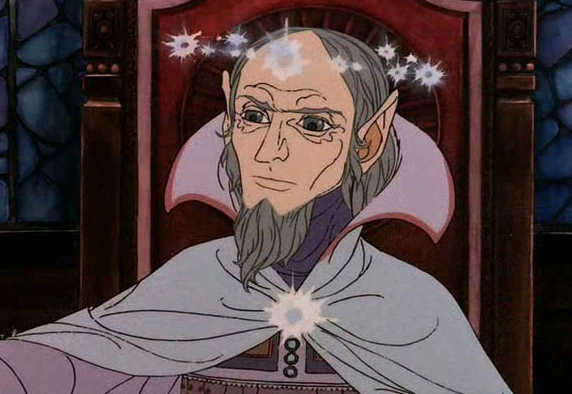 |
| "I was there, Gandalf ... I was there three thousand years ago ..." |
The short answer, to be honest, is that I generally assume that all new characters are foreigners to the particular part of the world I've established as my setting. Like Barker's "Empire of the Petal Throne", new characters are all "fresh off the boat" in a new world--even if the Elves (and dwarves, to a lesser extent) do have long and ancient memories, they're memories concerning some other place in the world. What good will a full knowledge of the history of the Ethiopian kings and queens do you when delving in dungeons in England, really?
Moreover, Elves and men are fundamentally, metaphysically different, a thing which is easy to forget when your character is just some numbers and a list of equipment and spells on a sheet of paper before you. I do emphasize the difference during play--Elves do not have mortal souls in my game, and they do not age, and as such Elves may not be of Good, Lawul, or Evil alignment. But the differences extend beyond that--why do demihumans have level restrictions while humans do not? The old explanation I've always had for that was that Elves (and other demihumans) do not live in the present as well as humans do. Given so much time with which to live, they do not feel the pressing need to always be learning and remembering things--while the humans are all running around gaining experience and leveling up as fast they can, the Elves are dawdling, meditating by the river, learning the names of the trees of the forest and watching them season by season ...
Which is to say, if the Elves are doing such things (and always partying in the perpetual summer of their youth to boot), then their long memories are going to be filled with the songs of the winds, and the names of the trees of the forest, and how the generations of foxes in the woods have developed a new mouse-hunting culture, and all kinds of supremely local but generally useless things. Now, assuming that a first level Elf is one of these forest children who has decided that a life of adventuring would be fine for a while, their entry into human culture is going to be one without any memory of the histories of men. So Thidrek Silverhelm was prince here two hundred years ago?--so what? I was following the otters in the rivers two hundred years ago, and I learned some of the poetry of their folk, and when the best times to fish for trout are versus when to fish for perch. Etc.
On the other hand ... so your Elf character has a long memory and wants to know the kinds of things he or she recalls? One could take the opportunity as referee to respond with an infodump (and to gleefully bore the player to tears until they get back to dungeoneering, if you want!): So there were seventeen princes in the area in the past couple centuries. The first was Born Ironfist, and he ruled the area with his strength until he was overthrown by his treacherous captain of the guard, Baric the Bald. Then Baric had to fight long wars against the other lords who had been subject to Born to maintain his rule, etc. etc. It would be fair to point out that with such a vast memory, it's difficult to remember any particular thing; but that maybe with enough time meditating, the character could remember something relevant to whatever thing in memory he was seeking ...
Going into this, I thought I might ultimately write down some kind of random table of historical facts an Elf (or dwarf, to a lesser extent), might know, but I think I have a better idea for a gameable idea.
------
Elfin Memory
This is a class ability to be added to the other special rules to be used when playing an Elf-class character. (or a Free Goblin character in my game, as goblins and Elves come of the same stock)
Because of their immortal lifespans (barring death by accident, violence, or disease), Elves have deep memories of lore and past things--but very few such memories are retained or called up at any moment by the conscious mind. If an Elf character wishes to remember something in particular--an item of legend, the lyrics of an ancient lay, the proper names and means of address of all the trees of the forest, or any of the myriad details of history--he may go into a kind of meditative trance and "sift" through his memories.
Each day spent doing so allows a cumulative 5% chance of remembering something relevant to the object of thought that the referee may relate, i.e. at the end of three days meditating there is a 15% chance that the Elf has recalled something relevant. It may not be anything obviously or immediately useful--the particulars of the memory are up to the referee to decide.
This is not without a risk, of course. At the end of the trance, the Elf character must make a saving throw against death, and for each day after the first spent "sifting" through memories in this manner the save is made with a cumulative -1 penalty. Success indicates that the Elf returns without any trouble, but a failure means that the Elf has been overcome with nostalgia for the starlit forests of Elfland and/or has touched however briefly the absurdity of eternal thinking existence without a soul. The character must return to Elfland (wherever that may be--could even just be a nearby forest if you're a kind referee) as soon as possible or begin to waste away (losing one level per month, maybe), and must remain in Elfland from 1-6 months to throw off the mental fugue. After that they're free to return to adventure in the mortal world again.
(the player could run another character for the duration, or play could move to Elfland and whatever weird adventures are to be had there, if everyone is amenable ... and time could flow strangely for mortals there as well if one wanted to get crazy and change the mortal world while all are away!)
Dwarven Memory
The same as Elfin Memory, except for a couple of items:
1) Dwarves will only have memories from 0-500 years back (1d6-1 x 100)--as dwarves are not immortal, just extremely long-lived by mortal standards.
2) Dwarves receive a +5% bonus to any attempt to remember details about architecture, caves, stoneworking, crafted items, etc.--the kinds of things dwarves should stereotypically know anyway.
3) Dwarf saving throws nicely model the fact that dwarves are already more in line with human society anyway, and so "sifting" through their memories will be less likely to drive them back to their halls of stone (because of their good saves) than an Elf of the same level.
Sunday, November 26, 2017
the Cult of the Beautiful Life -- Worshiping Ke$ha
I've been kicking this idea around in my head for a while, to create a religion using Kesha's lyrics as the sacred texts, but tonight on the drive back up from Boise, Kesha blaring from the CD player, some ideas finally clicked. So here goes ... (all the links except the last about the "Otter Bacchanalia" are links to Kesha's songs on YouTube)
On a certain summer night, when the moon is heavy with light, and the star winds blow and scatter their glimmerings in a great river of light across the sky, the clashing of timbrels and the cries of women in ekstasis will arise in the city. On this night, the central mystery of the Beautiful Life will once more be ritually played out atop the highest hill, in full view of the stars, as it is done every year, and ever has been, and ever shall be.
The women of the city who are members of the cult--they call themselves the Beautiful--will gather in the the market in answer to the cries and the clash of the timbrels. Others will come as well; Elves, as fellow star-children, will be found in their midst; hangers-on who know of the revelry to come, will wait nearby to follow the procession and join in the celebrations after the mystery ritual is complete; and some few men who have been selected to join in the ritual and the revelry, and who are already swaying, drunk from wine, will have already gathered in the square with the priestesses.
Thus assembled, the entire group will process forth through the city, led by priestesses raising the thyrsus-staves, accompanied by girls bearing jars of wine and of water, all chanting incantations to the Star Goddess and her lover, and banging their timbrels and drums. Any who are to be initiated that night go silently, draped in heavy black robes that hide their features, while those who are already initiated have painted themselves with vibrant colors, and adorned their wrists, arms, ankles and waists with silver and gold while their bodies are decked with robes and dresses of every hue.
"We R Who We R!" sings the procession, proclaiming to themselves and to the world their intent to live to the fullest, to fulfill their own desires, and to love themselves as they are. "Got that glitter on our eyes, stockings all ripped up the sides, looking sick and sexified! ... We're dancing like we're dumb, bodies going numb, we'll be forever young ..."
That, and "Take It Off", singing, "There's a place downtown where the freaks all come around, there's a hole in the wall, it's a dirty free for all ... When the dark of the night comes around, that's the time that the animal comes alive looking for something wild ..."
Singing all the way, the procession of the Beautiful march and dance and sway in wine-drunkenness out from the city, marching through half the night until they come to the place of their secret and sacred rites. This is a hill somewhere in the hinterlands, high enough to be close to the stars, and broad enough at its crest thereon to hold a wild revelry. In the days before, a great bonfire has been built up by the women of the cult; but it remains unlit yet, as the cult gathers atop the hill, and the hangers-on wait beneath the crest, afraid of the consequences of profaning the mysteries with uninitiated eyes. (For indeed, they have heard what happens to those who are too eager to join ... "Cannibal" -- "I eat boys up, breakfast and lunch, then when I'm thirsty, I'll drink their blood ... Carnivore, animal, I am a cannibal, I eat boys up, you better run")
------
The first thing that must be done is the initiation of new members. Before the pyre is lit, in the darkness that represents the darkness of death whence the Star Goddess was born, and shall ever be born again and again until the end of all things, the initiates are brought forward in their black robes. The priestess sings to them ("Rainbow"), singing about needing to emerge from the darkness--"I used to live in the darkness, dress in black, act so heartless; but now I see that colors are everything; got kaleidoscopes in my hairdo, got back the stars in my eyes, too, and now I see the magic inside of me."
In the process of this chant, the priestess removes the black robes, until the initiates stand naked before the cult; then, as the pyre is lit, the Beautiful step forward to paint the initiates' skin with paints of red and blue and every hue, and to adorn them with silver and gold, and to wrap their bodies in brilliant robes, which will all stand forth in full color as the pyrelight climbs higher. The initiates are asked to recite the tenets of the Star Goddess and the Beautiful Life--the answers to these questions are found in a number of songs they would have learned back in the city, and sung to themselves to retain their mysteries.

The tenets are:
First, all that matters is the Beautiful Life--life should be a striving toward transcendence, especially through drinking, dancing, and sex, but really through any activity that fills a body with joy. ("All That Matters (The Beautiful Life")
Secondly, be an Animal and a Warrior--love yourself for who you are, not for who you "should" be (this is essentially a basic tenet of Chaos, so it should be obvious at this point that this is a Chaos cult)
Thirdly, the fulfillment of the Beautiful Life is to find and join with the Lover. There are entire myth and poetic cycles of the Star Goddess and her Lover, reincarnated over and over again through vast epochs, ever seeking each other out. This Lover is usually depicted as a man (or especially as a dragon when the Joy he/it represents is more metaphorical), but sometimes the sexes are reversed, and the Star Goddess is a kind of king over the stars, and her lover is the female moon, pregnant with light ... essentially, any imagery can stand in here; the point is that a soul is reincarnated over and over again until it can finally fulfill itself in the Beautiful Life ... "Past Lives" is the best articulation of this idea ("We were lovers in a past life, I can see it in your green eyes; maybe you were one of my wives in a long lost tribe ...")
Lastly, that fulfillment is in the return to the Stars (whence all souls are born) and thence the rebirth of the Star Goddess and another cycle of new souls seeking the Beautiful Life, best expressed in the song "Spaceship" ("I'm waiting for my spaceship to come back for me ... look up in the sky and there they'll be, I bet you'll think of me ...")
------
Once the initiates have sufficiently expressed their understanding of these mysteries, they step back and join the rest of the Beautiful, and join them in two songs, one "Praying," a prayer that is a rejection of the dominance of the Lawful cults, which they see as constricting the ability of human souls to fulfill the Beautiful Life with all their emphasis on duties, self-restraint, marriage, etc. And then they sing a "Hymn" for themselves, which is a full exaltation in their own Beauty and perfectness as they are, and in their seeking for their own ultimate fulfillment.
And then, of course, they TAKE IT OFF! Wine flows, and is cast into the fire as a sacrifice to the Star Goddess, who looks down in gladness from the stars above; incense is burned, and cannabis and opium imbibed; clothes come off, the drums beat to the beat of the heart, bodies writhe, cries of ekstasis and enthusiasmus are raised to the stars and their eternal light. All inhibitions are forgot. All that occurs here is sanctioned by the Star Goddess; taboos are overturned; only excess is sacred.

It is this point at which the hangers-on ascend to the hilltop, to partake in the revelry, which continues until morning, or even well into the next day and evening. Naturally, there are consequences--legendary hang-overs; men and women dead or mad from wine-sickness; unintended pregnancies. But though Lawful authorities hate these revels, they fear to punish those who return, for fear of the anger of the Goddess and her maenads ... certain tyrants in the past have sought to quash the secret rites, and have then ended up in the midst of the revelries themselves, wine-mad, and finally torn limb from limb by the ekstatic Beautiful ...
This cult being Chaotic, it is entirely reasonable for non-initiated but Chaotic characters to act as hangers-on, to follow the procession out into the hills, and to wait until the mysteries are completed, but then to join in the wild revelry thereafter. I would treat this as carousing, but at double or triple the normal xp for the normal cost, and probably come up with a unique table to roll for failures ... sounds like a future blog post, anyway.
Chaotic women may, of course, also just join the cult as initiates. If they do so, they may attend the revelry, gain triple xp, and not suffer any mishaps (not the first time, at least ...)--and yes, this is a female-only cult. In the future, I may write a secondary male cult--or write up rules for male priests like those of Cybele who would castrate themselves--but for now, the Cult of the Beautiful is women-only.
And obviously, attending these rites in any matter as a non-Chaotic comes with consequences. A character neutral in regard to Law and Chaos who joins in the revelry must thereafter be considered Chaotic--they have fully engaged with the raw energy of Chaos, and though they may not be of the Beautiful, they are now aligned against the Lawful cults. As for Lawfuls to attend the revels and enjoy themselves, that is a serious breach of their own alignment, and they must seek atonement from some character of higher rank within the Lawful cults--and they gain no xp bonuses or alignment benefits from Lawfulness until they atone, as well as some other appropriate penalty, e.g. clerics losing their spells, or a curse laid upon a fighter by his god for his failure.
------
Lastly, I should mention that there is another, rival cult, the House of Gog, whose members call themselves Monsters ... I have little to say concerning this cult at the moment ...
... and there are a couple lesser disciples of such Dionysian revelries and lyric poetry--Katherine of Perrin, and Cyris of Milyta--who are semi-Sapphic, and whose lyrics echo both cults (of the Beautiful Life, and of the House of Gog); and yet neither of which have quite the same following ...
------
I'll probably be coming up with some kind of random table for things one might see/find at a bacchanal of the Cult of the Beautiful, probably along the lines of Jesse Goldshear's Otter Bacchanalia, which is great, and you should check it out! ... but piecing together the tenets of this Ke$ha cult has taken up too much space yet.
 |
| The Star Goddess |
On a certain summer night, when the moon is heavy with light, and the star winds blow and scatter their glimmerings in a great river of light across the sky, the clashing of timbrels and the cries of women in ekstasis will arise in the city. On this night, the central mystery of the Beautiful Life will once more be ritually played out atop the highest hill, in full view of the stars, as it is done every year, and ever has been, and ever shall be.
The women of the city who are members of the cult--they call themselves the Beautiful--will gather in the the market in answer to the cries and the clash of the timbrels. Others will come as well; Elves, as fellow star-children, will be found in their midst; hangers-on who know of the revelry to come, will wait nearby to follow the procession and join in the celebrations after the mystery ritual is complete; and some few men who have been selected to join in the ritual and the revelry, and who are already swaying, drunk from wine, will have already gathered in the square with the priestesses.
Thus assembled, the entire group will process forth through the city, led by priestesses raising the thyrsus-staves, accompanied by girls bearing jars of wine and of water, all chanting incantations to the Star Goddess and her lover, and banging their timbrels and drums. Any who are to be initiated that night go silently, draped in heavy black robes that hide their features, while those who are already initiated have painted themselves with vibrant colors, and adorned their wrists, arms, ankles and waists with silver and gold while their bodies are decked with robes and dresses of every hue.
"We R Who We R!" sings the procession, proclaiming to themselves and to the world their intent to live to the fullest, to fulfill their own desires, and to love themselves as they are. "Got that glitter on our eyes, stockings all ripped up the sides, looking sick and sexified! ... We're dancing like we're dumb, bodies going numb, we'll be forever young ..."
That, and "Take It Off", singing, "There's a place downtown where the freaks all come around, there's a hole in the wall, it's a dirty free for all ... When the dark of the night comes around, that's the time that the animal comes alive looking for something wild ..."
Singing all the way, the procession of the Beautiful march and dance and sway in wine-drunkenness out from the city, marching through half the night until they come to the place of their secret and sacred rites. This is a hill somewhere in the hinterlands, high enough to be close to the stars, and broad enough at its crest thereon to hold a wild revelry. In the days before, a great bonfire has been built up by the women of the cult; but it remains unlit yet, as the cult gathers atop the hill, and the hangers-on wait beneath the crest, afraid of the consequences of profaning the mysteries with uninitiated eyes. (For indeed, they have heard what happens to those who are too eager to join ... "Cannibal" -- "I eat boys up, breakfast and lunch, then when I'm thirsty, I'll drink their blood ... Carnivore, animal, I am a cannibal, I eat boys up, you better run")
------
The first thing that must be done is the initiation of new members. Before the pyre is lit, in the darkness that represents the darkness of death whence the Star Goddess was born, and shall ever be born again and again until the end of all things, the initiates are brought forward in their black robes. The priestess sings to them ("Rainbow"), singing about needing to emerge from the darkness--"I used to live in the darkness, dress in black, act so heartless; but now I see that colors are everything; got kaleidoscopes in my hairdo, got back the stars in my eyes, too, and now I see the magic inside of me."
In the process of this chant, the priestess removes the black robes, until the initiates stand naked before the cult; then, as the pyre is lit, the Beautiful step forward to paint the initiates' skin with paints of red and blue and every hue, and to adorn them with silver and gold, and to wrap their bodies in brilliant robes, which will all stand forth in full color as the pyrelight climbs higher. The initiates are asked to recite the tenets of the Star Goddess and the Beautiful Life--the answers to these questions are found in a number of songs they would have learned back in the city, and sung to themselves to retain their mysteries.
The tenets are:
First, all that matters is the Beautiful Life--life should be a striving toward transcendence, especially through drinking, dancing, and sex, but really through any activity that fills a body with joy. ("All That Matters (The Beautiful Life")
Secondly, be an Animal and a Warrior--love yourself for who you are, not for who you "should" be (this is essentially a basic tenet of Chaos, so it should be obvious at this point that this is a Chaos cult)
Thirdly, the fulfillment of the Beautiful Life is to find and join with the Lover. There are entire myth and poetic cycles of the Star Goddess and her Lover, reincarnated over and over again through vast epochs, ever seeking each other out. This Lover is usually depicted as a man (or especially as a dragon when the Joy he/it represents is more metaphorical), but sometimes the sexes are reversed, and the Star Goddess is a kind of king over the stars, and her lover is the female moon, pregnant with light ... essentially, any imagery can stand in here; the point is that a soul is reincarnated over and over again until it can finally fulfill itself in the Beautiful Life ... "Past Lives" is the best articulation of this idea ("We were lovers in a past life, I can see it in your green eyes; maybe you were one of my wives in a long lost tribe ...")
Lastly, that fulfillment is in the return to the Stars (whence all souls are born) and thence the rebirth of the Star Goddess and another cycle of new souls seeking the Beautiful Life, best expressed in the song "Spaceship" ("I'm waiting for my spaceship to come back for me ... look up in the sky and there they'll be, I bet you'll think of me ...")
------
Once the initiates have sufficiently expressed their understanding of these mysteries, they step back and join the rest of the Beautiful, and join them in two songs, one "Praying," a prayer that is a rejection of the dominance of the Lawful cults, which they see as constricting the ability of human souls to fulfill the Beautiful Life with all their emphasis on duties, self-restraint, marriage, etc. And then they sing a "Hymn" for themselves, which is a full exaltation in their own Beauty and perfectness as they are, and in their seeking for their own ultimate fulfillment.
And then, of course, they TAKE IT OFF! Wine flows, and is cast into the fire as a sacrifice to the Star Goddess, who looks down in gladness from the stars above; incense is burned, and cannabis and opium imbibed; clothes come off, the drums beat to the beat of the heart, bodies writhe, cries of ekstasis and enthusiasmus are raised to the stars and their eternal light. All inhibitions are forgot. All that occurs here is sanctioned by the Star Goddess; taboos are overturned; only excess is sacred.
It is this point at which the hangers-on ascend to the hilltop, to partake in the revelry, which continues until morning, or even well into the next day and evening. Naturally, there are consequences--legendary hang-overs; men and women dead or mad from wine-sickness; unintended pregnancies. But though Lawful authorities hate these revels, they fear to punish those who return, for fear of the anger of the Goddess and her maenads ... certain tyrants in the past have sought to quash the secret rites, and have then ended up in the midst of the revelries themselves, wine-mad, and finally torn limb from limb by the ekstatic Beautiful ...
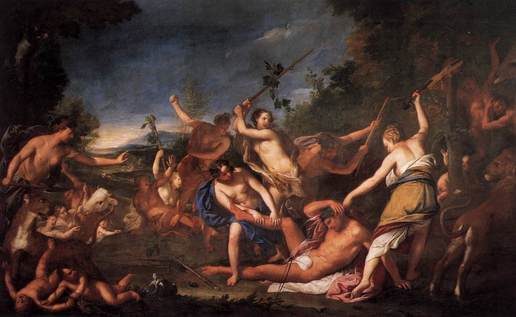 |
| A man being torn apart by bacchantes (Tiresias, actually) |
This cult being Chaotic, it is entirely reasonable for non-initiated but Chaotic characters to act as hangers-on, to follow the procession out into the hills, and to wait until the mysteries are completed, but then to join in the wild revelry thereafter. I would treat this as carousing, but at double or triple the normal xp for the normal cost, and probably come up with a unique table to roll for failures ... sounds like a future blog post, anyway.
Chaotic women may, of course, also just join the cult as initiates. If they do so, they may attend the revelry, gain triple xp, and not suffer any mishaps (not the first time, at least ...)--and yes, this is a female-only cult. In the future, I may write a secondary male cult--or write up rules for male priests like those of Cybele who would castrate themselves--but for now, the Cult of the Beautiful is women-only.
And obviously, attending these rites in any matter as a non-Chaotic comes with consequences. A character neutral in regard to Law and Chaos who joins in the revelry must thereafter be considered Chaotic--they have fully engaged with the raw energy of Chaos, and though they may not be of the Beautiful, they are now aligned against the Lawful cults. As for Lawfuls to attend the revels and enjoy themselves, that is a serious breach of their own alignment, and they must seek atonement from some character of higher rank within the Lawful cults--and they gain no xp bonuses or alignment benefits from Lawfulness until they atone, as well as some other appropriate penalty, e.g. clerics losing their spells, or a curse laid upon a fighter by his god for his failure.
------
Lastly, I should mention that there is another, rival cult, the House of Gog, whose members call themselves Monsters ... I have little to say concerning this cult at the moment ...
... and there are a couple lesser disciples of such Dionysian revelries and lyric poetry--Katherine of Perrin, and Cyris of Milyta--who are semi-Sapphic, and whose lyrics echo both cults (of the Beautiful Life, and of the House of Gog); and yet neither of which have quite the same following ...
------
I'll probably be coming up with some kind of random table for things one might see/find at a bacchanal of the Cult of the Beautiful, probably along the lines of Jesse Goldshear's Otter Bacchanalia, which is great, and you should check it out! ... but piecing together the tenets of this Ke$ha cult has taken up too much space yet.
Saturday, October 14, 2017
Love At First Sight
Once upon a time I was infatuated with the new idea of random tables, and I thought it would be fun to write one about "falling in love at first sight" or ... infatuation. Despite the fact that D&D Basic/Expert already has something kind of representing this with the "reactions roll" (2-12 on 2d6, 2-5 is bad, 6-8 is uncertain, 9-12 is good). No, I wanted a percentile dice table with little fiddly bits for various things.
Well, I'm still infatuated with random tables, especially now that I understand better how to write them, even on the fly (e.g. my d12 secret resurrection table, my d12 secret eating a dragon heart table, the d12 oddments for sale tables posted earlier, my various wilderness encounter tables, etc.). But this table, written at the beginning of my (so far comparatively short) Old School D&D stint, still has a place in my heart. And in the hearts of one of the first players of my Old School game, apparently, as he asked me if I still had it for the game today (Storming Mobrai Castle).
Infatuation in this case doesn't really have any "mechanical" game value. I would roll it once, when characters first meet, to see if there's some kind of "spark" for one or the other individual (and it's explicitly not mutual, just like you can have a crush on someone and they totally don't think you're hot or interesting at all). I don't do it all the time, but it can be nice to roll when you save a prince or princess, or when first meeting a sage or business proprietor to maybe get something extra out of the exchange. I've also used it personally for my own characters to see if they're especially attracted to other PCs or NPCs, to inform my "role playing" and which characters my own pay special attention to.
That is, it's only as "binding" as any one player decides it is, but it can add a fun element of surprise to the game in the form of character attachments and love triangles.
So, without further ado:
With d% dice...
Base chance to fall for someone is 10%
All modifiers are in +/-1% increments.
Charisma:
3 -3
4-5 -2
6-8 -1
9-12 0
13-15 +1
16-17 +2
18 +3
if your race is ...
Human
+1 humans, half elves; +2 elves; -1 halfling, man-ape; -2 dwarf; -3 half orcs
Half Elf
+1 humans, elves; +2 half elves; -1 man-apes, -2 dwarves; -3 half orcs
Elf
+1 elves; -1 humans, halflings, man-apes; -3 dwarves; -4 half orcs
Halfling
+1 elves, halflings, dwarves; -1 man-apes, -3 half orcs
Dwarf
+1 dwarves; -1 humans, halflings; -2 half elves, half orcs, man-apes; -3 elves
Half Orc
+1 humans, man-apes; -1 half elves, half orcs, halflings; -3 elves
Free Goblin
+1 half-orcs, man-apes, -1 halflings, -2 dwarves, -3 half-elves, -6 elves
Man-Ape
+1 apes, humans, half-elves, half-orcs, elves
if your Alignment is ...
Lawful
+1 lawful, +1 clannish, -1 arcane, -1 chaotic, -1 natural
Chaotic
+1 chaotic, +1 arcane, -1 lawful, -1 clannish
Good
+1 good, +1 neutral, -1 evil
Neutral
+1 good, +1 natural
Evil
-1 good
Arcane
+1 chaotic, -1 lawful, -1 natural, -1 clannish
Clannish
+1 lawful, -1 chaotic, -1 natural, -1 arcane
No gnomes? I greatly dislike gnomes as presented as a player class. Gnomes in my game are creepy underground/forest dwellers that eat teeth stolen from children and do other weird things.
Plus, obviously, this table reflects a 1E AD&D world with half-elves and half-orcs. I'll have to come up with classes for them for my B/X game. And free goblins? That's a class I'll post about soon.
Well, I'm still infatuated with random tables, especially now that I understand better how to write them, even on the fly (e.g. my d12 secret resurrection table, my d12 secret eating a dragon heart table, the d12 oddments for sale tables posted earlier, my various wilderness encounter tables, etc.). But this table, written at the beginning of my (so far comparatively short) Old School D&D stint, still has a place in my heart. And in the hearts of one of the first players of my Old School game, apparently, as he asked me if I still had it for the game today (Storming Mobrai Castle).
Infatuation in this case doesn't really have any "mechanical" game value. I would roll it once, when characters first meet, to see if there's some kind of "spark" for one or the other individual (and it's explicitly not mutual, just like you can have a crush on someone and they totally don't think you're hot or interesting at all). I don't do it all the time, but it can be nice to roll when you save a prince or princess, or when first meeting a sage or business proprietor to maybe get something extra out of the exchange. I've also used it personally for my own characters to see if they're especially attracted to other PCs or NPCs, to inform my "role playing" and which characters my own pay special attention to.
That is, it's only as "binding" as any one player decides it is, but it can add a fun element of surprise to the game in the form of character attachments and love triangles.
So, without further ado:
With d% dice...
Base chance to fall for someone is 10%
All modifiers are in +/-1% increments.
Charisma:
3 -3
4-5 -2
6-8 -1
9-12 0
13-15 +1
16-17 +2
18 +3
if your race is ...
Human
+1 humans, half elves; +2 elves; -1 halfling, man-ape; -2 dwarf; -3 half orcs
Half Elf
+1 humans, elves; +2 half elves; -1 man-apes, -2 dwarves; -3 half orcs
Elf
+1 elves; -1 humans, halflings, man-apes; -3 dwarves; -4 half orcs
Halfling
+1 elves, halflings, dwarves; -1 man-apes, -3 half orcs
Dwarf
+1 dwarves; -1 humans, halflings; -2 half elves, half orcs, man-apes; -3 elves
Half Orc
+1 humans, man-apes; -1 half elves, half orcs, halflings; -3 elves
Free Goblin
+1 half-orcs, man-apes, -1 halflings, -2 dwarves, -3 half-elves, -6 elves
Man-Ape
+1 apes, humans, half-elves, half-orcs, elves
if your Alignment is ...
Lawful
+1 lawful, +1 clannish, -1 arcane, -1 chaotic, -1 natural
Chaotic
+1 chaotic, +1 arcane, -1 lawful, -1 clannish
Good
+1 good, +1 neutral, -1 evil
Neutral
+1 good, +1 natural
Evil
-1 good
Arcane
+1 chaotic, -1 lawful, -1 natural, -1 clannish
Clannish
+1 lawful, -1 chaotic, -1 natural, -1 arcane
No gnomes? I greatly dislike gnomes as presented as a player class. Gnomes in my game are creepy underground/forest dwellers that eat teeth stolen from children and do other weird things.
Plus, obviously, this table reflects a 1E AD&D world with half-elves and half-orcs. I'll have to come up with classes for them for my B/X game. And free goblins? That's a class I'll post about soon.
Sunday, October 1, 2017
Alignment in my game
[alignment rules at the bottom, alignment rant here]
I'm sure most regular players of D&D could recite one or more anecdotes of arguments over whether a character of that alignment would really act in such a way, or of the party's "Lawful Good" paladin policing other characters' actions like an authoritarian/officious dick (after which the other characters then go behind the paladin's back when the orc-prisoner requires "special" incentive to talk, but the paladin won't allow "torture").
I know I've had my fair share of such arguments (and I've been both the paladin policing others' behavior and the thief sneaking a few extra gps from a newly discovered treasure). When refereeing, I even used to try to dutifully track characters' drifts in alignment per Gygax's suggestion, despite the fact that the changing "alignment" didn't affect anyone who wasn't a paladin, ranger, or druid.
Then, several years ago, I got into a particularly egregious argument that laid bare to me the paucity of the whole learned tradition of writing "Chaotic Neutral" (or "True Neutral" or "Lawful Evil") on a character as if it determined anything. The argument was over what to do about some gnoll children (re: orc children) left in the gnoll-fortress after we killed the adults. My "evil" character was arguing to save the gnoll children (to sell into slavery, sure, but still, not kill them), and a "good" fellow-adventurer wanted to exterminate them all because they were future threats to "Goodness".
It wasn't the proposed fate of the imagined monster-children that got to me, but that anyone could associate the word "good" with an idea that seems to me self-evidently evil, or at best morally grey--and yet, no one else at the table even flinched at the idea that a "good" character could propose such a thing in the fiction and still be considered "good". And thus I learned--if people at the table have different notions of what "good" is metaphysically, and how characters can "be good" in the shared fiction, then alignment as a traditionally included character element is empty and pointless.
So I worked up my own rules for alignment, rules for my own games when I run them, and which would be explicit as to what any particular "alignment" required of its adherents. The group within which the argument arose balked at these rules--"I don't want to have to join a club to be good," said one--but subsequent groups I've formed/played with have used them without problem, and even adapted them further with new alignments.
In my game, "alignments" are mystery cults in the best tradition of the classical world, requiring initiation, and with initiation into higher "circles" revealing certain "truths" about the world. Each has its own "tongue" of metaphors and imagery that can be used to convey one's identity within the cult, or to convey certain truths ungraspable by non-initiates.
I ultimately retained the terms Lawful and Chaotic, Good and Evil, because they're familiar and easy to use. Characters can even be "Lawful Good" still, because any character can join up to two cults (but not mutually exclusive cults, e.g. no "Lawful Chaotics"). I've also added a few new alignments with my constant tinkering (Arcane, Clannish, and Natural); and, because Gygax's AD&D Player's Handbook is close to my heart, I restricted the demi-humans in my games from certain alignments.
So:
Characters may not begin play as Evil
Humans may not be of Clannish alignment; only Magic-Users may begin play as Arcane
Halflings and Dwarves may not be Lawful, nor may they begin play as Arcane
Elves and Free Goblins nay not be Good, Evil, or Lawful
Man-Apes may not be Lawful or Clannish, and may not begin play as Arcane
Good characters may not initiate combat, nor may they take any part in the slave trade (except perhaps to buy slaves for the purpose of freeing them). Furthermore, on returning from an expedition, a Good character may donate up to 10% of treasure earned from that expedition to the local Good cult to receive a commensurate bonus in xp (1 xp :: 1 gp)
Lawful characters must carry dead comrades out of the dungeon for proper burial. Like Good characters, Lawful characters may donate up to 10% of earned treasure to a Lawful cult to gain a commensurate xp bonus
Clannish characters are Dwarves or Halflings. They must carry their fallen comrades out of the dungeon for burial, and may send a stipend of up to 10% of earned treasure to the Clan for commensurate bonus xp (yep, this is just "Lawful" for demi-humans, and still needs tinkering ... but every Halfling character who has come through my game has been either unaligned or some species of Chaotic asshole)
Chaotic characters may not let an insult go without responding to it in kind. They earn 5% bonus xp for three conditions, 1) earning the most treasure from the dungeon, 2) killing the most monsters, 3) surviving where another player-character died, all for a cumulative maximum of +15%
Arcane characters may not sell, lend, or give away magic items that are useful to themselves. They gain 5% extra xp from any expedition on which they acquire any magic item, and also earn 50 xp per spell level of any new spell learned (excluding those learned from character advancement)
Natural characters may not allow the unnatural destruction of any natural wonder (e.g. the Great Barrier Reef, or the Grove of the Silver Unicorn), and they must attempt to destroy or drive off any undead encountered. Per expedition, Natural characters may cumulatively earn 5% extra xp for destroying undead, 5% extra for aiding any nature spirit encountered in some way (e.g. naiads, dryads, woodland-Elves, etc.), and 5% extra xp for overcoming natural encounters (with wolves, plants, insects, etc.) without combat, for a +15% maximum
Evil cults are rumored to exist, but must be discovered through interactions in play. Evil characters insist that "evil" is an unfair appellation, that rumors of human sacrifices to Evil powers are distortions of cultic metaphors, and that all these restrictions on behaviors propounded by other cults just restrict the pursuit of human pleasure. Everyone agrees, however, that the best way to find one's way into the mysteries of Evil is to be nice to cats.
Finally, beyond this baseline restrictions and bonuses, there are means by which characters may advance into the higher circles of initiation for each cult ... but I've rambled on long enough, so I'll detail such things, and the benefits thereby gained another time.
I'm sure most regular players of D&D could recite one or more anecdotes of arguments over whether a character of that alignment would really act in such a way, or of the party's "Lawful Good" paladin policing other characters' actions like an authoritarian/officious dick (after which the other characters then go behind the paladin's back when the orc-prisoner requires "special" incentive to talk, but the paladin won't allow "torture").
I know I've had my fair share of such arguments (and I've been both the paladin policing others' behavior and the thief sneaking a few extra gps from a newly discovered treasure). When refereeing, I even used to try to dutifully track characters' drifts in alignment per Gygax's suggestion, despite the fact that the changing "alignment" didn't affect anyone who wasn't a paladin, ranger, or druid.
Then, several years ago, I got into a particularly egregious argument that laid bare to me the paucity of the whole learned tradition of writing "Chaotic Neutral" (or "True Neutral" or "Lawful Evil") on a character as if it determined anything. The argument was over what to do about some gnoll children (re: orc children) left in the gnoll-fortress after we killed the adults. My "evil" character was arguing to save the gnoll children (to sell into slavery, sure, but still, not kill them), and a "good" fellow-adventurer wanted to exterminate them all because they were future threats to "Goodness".
It wasn't the proposed fate of the imagined monster-children that got to me, but that anyone could associate the word "good" with an idea that seems to me self-evidently evil, or at best morally grey--and yet, no one else at the table even flinched at the idea that a "good" character could propose such a thing in the fiction and still be considered "good". And thus I learned--if people at the table have different notions of what "good" is metaphysically, and how characters can "be good" in the shared fiction, then alignment as a traditionally included character element is empty and pointless.
So I worked up my own rules for alignment, rules for my own games when I run them, and which would be explicit as to what any particular "alignment" required of its adherents. The group within which the argument arose balked at these rules--"I don't want to have to join a club to be good," said one--but subsequent groups I've formed/played with have used them without problem, and even adapted them further with new alignments.
In my game, "alignments" are mystery cults in the best tradition of the classical world, requiring initiation, and with initiation into higher "circles" revealing certain "truths" about the world. Each has its own "tongue" of metaphors and imagery that can be used to convey one's identity within the cult, or to convey certain truths ungraspable by non-initiates.
I ultimately retained the terms Lawful and Chaotic, Good and Evil, because they're familiar and easy to use. Characters can even be "Lawful Good" still, because any character can join up to two cults (but not mutually exclusive cults, e.g. no "Lawful Chaotics"). I've also added a few new alignments with my constant tinkering (Arcane, Clannish, and Natural); and, because Gygax's AD&D Player's Handbook is close to my heart, I restricted the demi-humans in my games from certain alignments.
So:
Characters may not begin play as Evil
Humans may not be of Clannish alignment; only Magic-Users may begin play as Arcane
Halflings and Dwarves may not be Lawful, nor may they begin play as Arcane
Elves and Free Goblins nay not be Good, Evil, or Lawful
Man-Apes may not be Lawful or Clannish, and may not begin play as Arcane
Good characters may not initiate combat, nor may they take any part in the slave trade (except perhaps to buy slaves for the purpose of freeing them). Furthermore, on returning from an expedition, a Good character may donate up to 10% of treasure earned from that expedition to the local Good cult to receive a commensurate bonus in xp (1 xp :: 1 gp)
Lawful characters must carry dead comrades out of the dungeon for proper burial. Like Good characters, Lawful characters may donate up to 10% of earned treasure to a Lawful cult to gain a commensurate xp bonus
Clannish characters are Dwarves or Halflings. They must carry their fallen comrades out of the dungeon for burial, and may send a stipend of up to 10% of earned treasure to the Clan for commensurate bonus xp (yep, this is just "Lawful" for demi-humans, and still needs tinkering ... but every Halfling character who has come through my game has been either unaligned or some species of Chaotic asshole)
Chaotic characters may not let an insult go without responding to it in kind. They earn 5% bonus xp for three conditions, 1) earning the most treasure from the dungeon, 2) killing the most monsters, 3) surviving where another player-character died, all for a cumulative maximum of +15%
Arcane characters may not sell, lend, or give away magic items that are useful to themselves. They gain 5% extra xp from any expedition on which they acquire any magic item, and also earn 50 xp per spell level of any new spell learned (excluding those learned from character advancement)
Natural characters may not allow the unnatural destruction of any natural wonder (e.g. the Great Barrier Reef, or the Grove of the Silver Unicorn), and they must attempt to destroy or drive off any undead encountered. Per expedition, Natural characters may cumulatively earn 5% extra xp for destroying undead, 5% extra for aiding any nature spirit encountered in some way (e.g. naiads, dryads, woodland-Elves, etc.), and 5% extra xp for overcoming natural encounters (with wolves, plants, insects, etc.) without combat, for a +15% maximum
Evil cults are rumored to exist, but must be discovered through interactions in play. Evil characters insist that "evil" is an unfair appellation, that rumors of human sacrifices to Evil powers are distortions of cultic metaphors, and that all these restrictions on behaviors propounded by other cults just restrict the pursuit of human pleasure. Everyone agrees, however, that the best way to find one's way into the mysteries of Evil is to be nice to cats.
Finally, beyond this baseline restrictions and bonuses, there are means by which characters may advance into the higher circles of initiation for each cult ... but I've rambled on long enough, so I'll detail such things, and the benefits thereby gained another time.
Subscribe to:
Posts (Atom)