One of the ways available for Good characters to "advance" in the Cult of Good is to swear great vows in accordance with the values of the Cult. (using my alignment rules)
These vows are 1) the Vow of Peace, 2) the Vow of Poverty, and 3) the Vow of Purity. Before any of these vows may be sworn by a character, that character must first pay at least 5000 gold for a public liturgy of Good, OR perform such a boon for the Cult of Good that the character is blessed by a leader of the Cult. This blessing (of the liturgy and/or the leader) confers a permanent +1 bonus to all saving throws.
As to the Vows themselves:
To swear the Vow of Peace, a character swears to: 1) always attempt peaceful resolutions for any encounter with "monster", and 2) never to kill, except in extremis in self defense. The benefit of swearing such a Vow is that the character becomes capable of laying on hands for healing like a paladin of equal level, i.e. 2 hp/level.
To swear the Vow of Poverty, a character swears to 1) never own more than one suit of armor, one shield, four weapons, and four other magic items, and just enough gold for day-to-day expenses; 2) all other gold must be donated to the Good Cult, though 20% of such donated counts for bonus experience. The benefit of this Vow is that a character may summon a divine Warhorse (or other servant?) that will serve faithfully unto death, HD 5+5, AC 5. If the Warhorse is slain, another may not be summoned until at least half a year has passed.
To swear the Vow of Purity, a character swears to 1) never again carouse (spending gold on drink and whoring for xp); and 2) never to engage in illicit sex, nor to become inebriated in any manner. The benefit of this Vow is that a character receives +2 on all saves, cumulative with the blessing conferred by the Good Cult before any Vow might be sworn.
(These are, of course, generally the restrictions and benefits of the AD&D Paladin class ... I wrote them for my game when it was strictly B/X D&D, and Paladins were not an available class. Other benefits for taking on these Vows might be negotiated between the character and the leaders of the local Good Cult)
Showing posts with label cults. Show all posts
Showing posts with label cults. Show all posts
Tuesday, August 14, 2018

Wednesday, August 8, 2018
DIY 30 #8: the Mourners -- Cult of the Dead God
To the east and south, on a peninsula far and away where the tribes of the Druugii, Dravidians, Aldacians, and Cassites now dwell in dominion under the Cytherean Kingdom, the Good God himself once stepped down to the world, incarnated in flesh, to teach mortals how to love one another.
Born to a virgin shepherd-girl, Tumuzid was raised as a shepherd himself, and his childhood was marked with the little miracles of enlightenment that usually accompany miraculous births; but it was not until his full manhood that he was called to the wilderness to dwell in a cave as an anchorite, from thence to return to civilization revealed in his glory as the Good God made flesh.
He wandered the wilderness and the little towns, preaching love and simplicity and mortification of the flesh to turn to higher virtues, and crowds gathered round him, and many miracles were performed by him and his followers. And in the cities, he disputed with the priests of the Lawful city cults, the priests of Bel, the philosophers of Zalmoxis, and the priestesses of Cytherea, and too rebuked the Snake-Handlers for their evil ways.
But all this earned Tumuzid the hatred and envy of the priestly sects, and they complained to the Four Kings that the shepherd-prophet was slandering the gods and teaching people to turn away from anything but their own selfish salvation, and refusing to give money for the liturgies of the city-gods. So Tumuzid was arrested by the Four Kings; each questioned him, and disputed with him as to the nature of virtue, and he bested each in his knowledge and personal piety. But though the other Kings would have released him, the King of the Druugii was ashamed of his failure, and acting alone without the consent of the others of the Four Kings, he had Tumuzid scourged at a pillar and crucified in the wilderness.
Then all the land was aggrieved; calamities were reported for and wide, of storms suddenly blown up, of the earth cracking open, of plagues descending on cities. The followers of Tumuzid took down his body and washed him and buried him, and prayed for his return--but he did not return. He lay dead in his tomb, cold and unmoving.
So this is how the cult of Mourning sprang up; the followers of Tumuzid, who saw that the Good God was dead, put on their mourning black, cut their hair and flagellated themselves in anguish, and refused to touch good things to eat or wine to drink. They held a funeral game for Tumuzid, in which the most wretched among them took up swords and in pairs plunged the blade into their partners' bellies to die alongside the Dead God. And though is is not mete for the mourning period for a mortal to last more than a year, the Mourners did not put off their black cloaks, and still refused good things even after thirty years, still waiting for the return of their god.
Two major sects arose out of this Mourning: 1) those who believed that because the divine Good had died, then mortals must perforce resurrect the Good in themselves; and 2) those who believed that because the divine Good had died, that all Goodness was gone, and that therefore all moral strictures and boundaries are henceforth broken. Needless to say, there is much bad blood between these two sects ...
Unfortunately, for those not well versed in the intricacies of Mourning theodicy, the two sects can be difficult to distinguish. Both go about in robes and cloaks of black, shave their hair, and mutilate their flesh, all in accordance with public displays of mourning. They are to be found in their places of worship keening and wailing, and each sect holds regular funereal games in which men and women are encouraged to kill one another. And both sects advocate the abandonment of the traditional city-cults--though the former because they wish for people to turn toward righteousness and salvation, while the latter ridicule the other gods as upholding a meaningless facade of "order".
The clearest distinction between sects is whether they allow the drinking of wine or not--those who seek righteousness tend to abstain completely from any wine, preferring milk as it is the traditional libation for the dead. Those who flout strictures, however, prefer wine at their funereal games.
And the games themselves are another way to distinguish the Good sect from the Evil sect, for the Mourners of the former hold austere games with sober food, simple wrestling-matches, and simultaneous dispatch of the death-seekers. The latter, meanwhile, often throw elaborate games that for all intents and purposes resemble great gladiatorial games, sometimes with slaves forced to fight one another, sometimes with trained gladiators dueling in earnest before the assembled Mourners (and perhaps other citizens attracted to the sport of blood ...).
Because of their excessive mourning practices and because of the unclear mingling of Good and Evil philosophies, the Mourners are often reviled by other cults, and must practice their cult on the outskirts of civilization. Nevertheless, many slaves and others who are downtrodden are attracted to the philosophies, be it the promise of salvation for all men, regardless of status--or the promised transgression of the boundaries established by Lawful and aristocratic elites.
As a final note, the cult of Tumuzid the Dead God is often confused with the cult of the God of Shepherds, Aristios, who also performed miracles for herdsmen and rustics, and who also died. But Aristios died because he gave himself up as a sacrifice, and when he died his gut split open with good crops and good things to eat, given of himself for the people; and in the hollow breast of his corpse, a tribe of bees built their hive, and from the honeycomb of the bees, Aristios himself was reborn, to walk the earth again.
Born to a virgin shepherd-girl, Tumuzid was raised as a shepherd himself, and his childhood was marked with the little miracles of enlightenment that usually accompany miraculous births; but it was not until his full manhood that he was called to the wilderness to dwell in a cave as an anchorite, from thence to return to civilization revealed in his glory as the Good God made flesh.
He wandered the wilderness and the little towns, preaching love and simplicity and mortification of the flesh to turn to higher virtues, and crowds gathered round him, and many miracles were performed by him and his followers. And in the cities, he disputed with the priests of the Lawful city cults, the priests of Bel, the philosophers of Zalmoxis, and the priestesses of Cytherea, and too rebuked the Snake-Handlers for their evil ways.
But all this earned Tumuzid the hatred and envy of the priestly sects, and they complained to the Four Kings that the shepherd-prophet was slandering the gods and teaching people to turn away from anything but their own selfish salvation, and refusing to give money for the liturgies of the city-gods. So Tumuzid was arrested by the Four Kings; each questioned him, and disputed with him as to the nature of virtue, and he bested each in his knowledge and personal piety. But though the other Kings would have released him, the King of the Druugii was ashamed of his failure, and acting alone without the consent of the others of the Four Kings, he had Tumuzid scourged at a pillar and crucified in the wilderness.
Then all the land was aggrieved; calamities were reported for and wide, of storms suddenly blown up, of the earth cracking open, of plagues descending on cities. The followers of Tumuzid took down his body and washed him and buried him, and prayed for his return--but he did not return. He lay dead in his tomb, cold and unmoving.
So this is how the cult of Mourning sprang up; the followers of Tumuzid, who saw that the Good God was dead, put on their mourning black, cut their hair and flagellated themselves in anguish, and refused to touch good things to eat or wine to drink. They held a funeral game for Tumuzid, in which the most wretched among them took up swords and in pairs plunged the blade into their partners' bellies to die alongside the Dead God. And though is is not mete for the mourning period for a mortal to last more than a year, the Mourners did not put off their black cloaks, and still refused good things even after thirty years, still waiting for the return of their god.
Two major sects arose out of this Mourning: 1) those who believed that because the divine Good had died, then mortals must perforce resurrect the Good in themselves; and 2) those who believed that because the divine Good had died, that all Goodness was gone, and that therefore all moral strictures and boundaries are henceforth broken. Needless to say, there is much bad blood between these two sects ...
Unfortunately, for those not well versed in the intricacies of Mourning theodicy, the two sects can be difficult to distinguish. Both go about in robes and cloaks of black, shave their hair, and mutilate their flesh, all in accordance with public displays of mourning. They are to be found in their places of worship keening and wailing, and each sect holds regular funereal games in which men and women are encouraged to kill one another. And both sects advocate the abandonment of the traditional city-cults--though the former because they wish for people to turn toward righteousness and salvation, while the latter ridicule the other gods as upholding a meaningless facade of "order".
The clearest distinction between sects is whether they allow the drinking of wine or not--those who seek righteousness tend to abstain completely from any wine, preferring milk as it is the traditional libation for the dead. Those who flout strictures, however, prefer wine at their funereal games.
And the games themselves are another way to distinguish the Good sect from the Evil sect, for the Mourners of the former hold austere games with sober food, simple wrestling-matches, and simultaneous dispatch of the death-seekers. The latter, meanwhile, often throw elaborate games that for all intents and purposes resemble great gladiatorial games, sometimes with slaves forced to fight one another, sometimes with trained gladiators dueling in earnest before the assembled Mourners (and perhaps other citizens attracted to the sport of blood ...).
Because of their excessive mourning practices and because of the unclear mingling of Good and Evil philosophies, the Mourners are often reviled by other cults, and must practice their cult on the outskirts of civilization. Nevertheless, many slaves and others who are downtrodden are attracted to the philosophies, be it the promise of salvation for all men, regardless of status--or the promised transgression of the boundaries established by Lawful and aristocratic elites.
As a final note, the cult of Tumuzid the Dead God is often confused with the cult of the God of Shepherds, Aristios, who also performed miracles for herdsmen and rustics, and who also died. But Aristios died because he gave himself up as a sacrifice, and when he died his gut split open with good crops and good things to eat, given of himself for the people; and in the hollow breast of his corpse, a tribe of bees built their hive, and from the honeycomb of the bees, Aristios himself was reborn, to walk the earth again.
Saturday, August 4, 2018
DIY 30 #3: Skotia, Goddess of Darkness and Death
She is the darkness. And out of the darkness of her womb sprang Mother-born Ophalle, who has no father. And Ophalle walked the earth, planting his seed in the fields that they might grow thick with good crops, and filling women and animals with children, so that all the earth teemed with living things. Where sheep and cattle were, he learned from the shepherds and kine-herds how to increase their flocks; and where wheat grew, he learned how to reap it, and where grapes grew, he learned how to press them, and he gave seed to the mash so that it fermented and so wine was made. And when the darkness of night came again, Ophalle was delighted that men and women would pair off and go into the darkness of their rooms to lose themselves in sleep, or the little deaths of love.
But in the darkness Skotia came, and Ophalle saw her and was smitten, but he knew her not. He called to her and she did not answer, for she is the Silent One. He gave her wine, and she drank it, but she did not laugh for she was silent. Then he came to her, and together they lay down in the darkness, and the night lasted for many days, until she got up again from his couch and went away; but she was ever silent.
And she was his mother, so she was wroth that they had lain together; and when she came again and found that Ophalle was asleep, she took up his sickle for reaping, and she reaped the hair from his head, and it was wheat, and it wilted in her hand. And she raised the sickle again, and she reaped off his phallus, and it was a gourd that she devoured. Then she raised the sickle a third time, and now she cut apart his body, limb from limb, bone from bone, and she scattered the pieces across the earth and buried them.
Then winter was upon the world, and crops died, and the animals starved, and the people shivered. The sun himself was wan, for he feared the anger of Skotia, and the heat of the world had gone out of it when Ophalle's life-source was cut from his trunk; and the winter was dark.
But Skotia is the darkness, and in her belly Ophalle grew again. And out of the darkness again sprang Mother-born Ophalle, and again he walked the earth, and filled it with his seed and with growing things.
------
Skotia, that is, Σκότια,
She is the Darkness, the Silent One, the Destroyer, She of the Long Sleep
She is the Darkness (to quote Glen Cook), the darkness that was before the world, and which some believe comes with death, or will come after the crack of doom. Her shrines are either secreted in necropolises, or hidden away in unlooked-for places, and always shrouded in shadow. Her visage is fearsome: skin black as obsidian, she dances with her six arms upraised, each bearing a sickle, a harpe-sword, a kris-knife, and other symbols of her godhead--including the phallus of her son Ophalle, a Priapus-like god of sex and fertility, whom she castrated for the sin of seducing her.
Not specifically a goddess of the night, nevertheless she is associated with that darkness; and because she is Death, and sleep is a presage of death, and orgasm is metaphorically the "little death", so she is also a goddess of sleep and a fertility goddess in her own right. But ever is she silent, never revealing what happens to those who enter her embrace in the long sleep; not even her priestesses (and few priests) have ever received an answer from her after their most strenuous prayers--nothing but the vaguest of omens are offered to her followers.
This silence has allowed for a great schism to arise in her cult, and differences in the particular interpretation of her place in the cosmology are as myriad as the priestesses who serve her. Most devotees fall into one of the two major cults (and the majority of all devotees fall into the first): 1) the Silent Sisters, and 2) the Death Cult.
------
The Silent Sisters do not exactly worship Skotia, so much as recognize her embrace as the ultimate destination for all mortals, and so do what they can to aid the passage into the Long Sleep. They do this primarily by accepting the bodies of those who are too poor for proper funereal preparations, or those who have no family and so have no family tombs in which to be interred; these bodies the Sisters wash and prepare for burial, and then inter in their necropolis-shrines. The Sisters also take in and care for those who are too poor or downtrodden to receive proper care otherwise--beggars, lepers, plague-victims, etc. are received into their shrines to receive care under the Sisters until such a time as they are healed, or have passed on in Skotia's embrace, thence to be interred like the others ...
Most people understand Skotia in this light, that of an embodiment of a natural inevitability. Her footstep is feared as the tread of doom, but she is certainly not seen as any kind of demon or moral evil--all men die, and so all men must eventually come face to face with Skotia.
------
Some, however, would use Skotia as an idol and object of a Death Cult whose members revel in spreading death and destruction in imitation of the goddess' avatar as the Destroyer. These Death Cults of Skotia are some of the secret Evil cults that plague the world; and sometimes those who worship the Destroyer intermix secretly within the cults of the Silent Sisters, making their detection even more difficult.
The cultic imagery of the Death Cults is virtually the same as that of the Silent Sisters, including an idol of the goddess, six-armed and dancing, shrouded in shadow (sometimes magical, sometimes not); but the rites include monthly blood sacrifice, of kine or swine at least, but preferably human or demi-human, be they slaves, prisoners, or free and willing. Such rites take place only at night, in utter darkness and utmost secrecy; and those initiated into the higher mysteries of the Death Cult are often tasked with further secret rites.
Priestesses who worship the Destroyer are often accompanied by undead, which they raise as walking avatars of the end that comes to all mortals, and high priestesses are also often served by demons, much as any Evil cult might be. The Spiders of Darkness, those silent and implacable hunters, are their preferred servants.
Most of those initiated into the higher mysteries of Skotia tend to be women and priestesses; nevertheless, males are not excluded from the priesthood, and many do rise to power. Of these, however, many priests are self-made eunuchs! For in their enthusiasm in the greater rites, it is common for men to emasculate themselves in imitation of the myth of Ophalle or to become more feminine like Skotia (similar to the Galli, priests of Cybele and Attis, who castrated themselves during a certain holiday, and thereafter went about dressed as women)
------
She is the darkness. Out of the darkness of her womb sprang Seed-sowing Ophalle, who took the earth as his bride, and forced her to bear his myriad children.
The earth groaned with the pangs of her labor, and in her despair, she cried out to the gods to relieve her of her woes, but the gods denied her. "We have built our kingdom over your children," they said. "Shall we give up everything we have made?"
And the earth groaned, for her pains were great, and she called out to the sun. But he turned his face from her, saying, "Do not ask this thing of me. I would help if I could, but the gods have set me here to light their kingdom, and they would destroy me if I desert my place." So it was night because his face was turned.
Then the earth called out to the stars, whose children are the Elves, because she was wracked with the hurt of her labors. But stars only shone and laughed among themselves. "It is absurd," they said. "What do we, who are so high above you, care for your pains?"
"Will no one aid me?" the earth cried at last.
But Skotia had heard, and so she stepped down. In silence did she walk, and in the night Ophalle saw her, and was smitten. And he went to her, and he asked her name, but she was silent. And he gave her wine, and she drank it, but she did not laugh, for she was silent. Then she took his hand and led him to lay down, and he laughed, but she was silent.
And when Ophalle slept beside her after his exertion, Skotia rose up, and she took his sword, called Harpe, so that he would go unarmed at the final battle when the Gjallarhorn is sounded. And with Harpe she cut his hair so that she might bind him with it, there and thereafter; for witches often use the hair of their victims in rituals of binding and unbinding, and so Skotia would do at Gjallarhorn's winding. And raising Harpe again, Skotia unmanned Ophale a third time, cutting off source and member; these she took, and holds them yet.
So, taking Harpe, hair, and phallus, Skotia went her way again, and Seed-sowing Ophalle was left unmanned in his pain. And when Gjallarhorn sounds, he will try to rise up; but he will be weaponless, for his sword is gone; and his limbs will be bound with the magic of Skotia; and his blood will be cold for the lack of his life-source, and all things will pass again into darkness, and the earth will groan no more, but will know peace in oblivion.
But in the darkness Skotia came, and Ophalle saw her and was smitten, but he knew her not. He called to her and she did not answer, for she is the Silent One. He gave her wine, and she drank it, but she did not laugh for she was silent. Then he came to her, and together they lay down in the darkness, and the night lasted for many days, until she got up again from his couch and went away; but she was ever silent.
And she was his mother, so she was wroth that they had lain together; and when she came again and found that Ophalle was asleep, she took up his sickle for reaping, and she reaped the hair from his head, and it was wheat, and it wilted in her hand. And she raised the sickle again, and she reaped off his phallus, and it was a gourd that she devoured. Then she raised the sickle a third time, and now she cut apart his body, limb from limb, bone from bone, and she scattered the pieces across the earth and buried them.
Then winter was upon the world, and crops died, and the animals starved, and the people shivered. The sun himself was wan, for he feared the anger of Skotia, and the heat of the world had gone out of it when Ophalle's life-source was cut from his trunk; and the winter was dark.
But Skotia is the darkness, and in her belly Ophalle grew again. And out of the darkness again sprang Mother-born Ophalle, and again he walked the earth, and filled it with his seed and with growing things.
------
Skotia, that is, Σκότια,
She is the Darkness, the Silent One, the Destroyer, She of the Long Sleep
She is the Darkness (to quote Glen Cook), the darkness that was before the world, and which some believe comes with death, or will come after the crack of doom. Her shrines are either secreted in necropolises, or hidden away in unlooked-for places, and always shrouded in shadow. Her visage is fearsome: skin black as obsidian, she dances with her six arms upraised, each bearing a sickle, a harpe-sword, a kris-knife, and other symbols of her godhead--including the phallus of her son Ophalle, a Priapus-like god of sex and fertility, whom she castrated for the sin of seducing her.
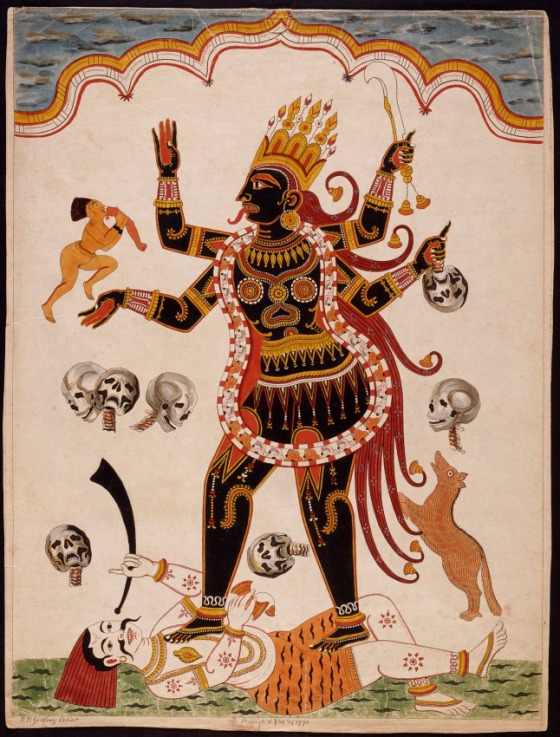 |
| Yep, I just based Skotia on images of the goddess Kali ... a many-armed goddess of darkness was a fixture in my dungeons well before I codified her as Skotia. Also, notice the harpe (sickle-sword) in the top-right corner ... |
Not specifically a goddess of the night, nevertheless she is associated with that darkness; and because she is Death, and sleep is a presage of death, and orgasm is metaphorically the "little death", so she is also a goddess of sleep and a fertility goddess in her own right. But ever is she silent, never revealing what happens to those who enter her embrace in the long sleep; not even her priestesses (and few priests) have ever received an answer from her after their most strenuous prayers--nothing but the vaguest of omens are offered to her followers.
This silence has allowed for a great schism to arise in her cult, and differences in the particular interpretation of her place in the cosmology are as myriad as the priestesses who serve her. Most devotees fall into one of the two major cults (and the majority of all devotees fall into the first): 1) the Silent Sisters, and 2) the Death Cult.
------
The Silent Sisters do not exactly worship Skotia, so much as recognize her embrace as the ultimate destination for all mortals, and so do what they can to aid the passage into the Long Sleep. They do this primarily by accepting the bodies of those who are too poor for proper funereal preparations, or those who have no family and so have no family tombs in which to be interred; these bodies the Sisters wash and prepare for burial, and then inter in their necropolis-shrines. The Sisters also take in and care for those who are too poor or downtrodden to receive proper care otherwise--beggars, lepers, plague-victims, etc. are received into their shrines to receive care under the Sisters until such a time as they are healed, or have passed on in Skotia's embrace, thence to be interred like the others ...
Most people understand Skotia in this light, that of an embodiment of a natural inevitability. Her footstep is feared as the tread of doom, but she is certainly not seen as any kind of demon or moral evil--all men die, and so all men must eventually come face to face with Skotia.
------
Some, however, would use Skotia as an idol and object of a Death Cult whose members revel in spreading death and destruction in imitation of the goddess' avatar as the Destroyer. These Death Cults of Skotia are some of the secret Evil cults that plague the world; and sometimes those who worship the Destroyer intermix secretly within the cults of the Silent Sisters, making their detection even more difficult.
The cultic imagery of the Death Cults is virtually the same as that of the Silent Sisters, including an idol of the goddess, six-armed and dancing, shrouded in shadow (sometimes magical, sometimes not); but the rites include monthly blood sacrifice, of kine or swine at least, but preferably human or demi-human, be they slaves, prisoners, or free and willing. Such rites take place only at night, in utter darkness and utmost secrecy; and those initiated into the higher mysteries of the Death Cult are often tasked with further secret rites.
Priestesses who worship the Destroyer are often accompanied by undead, which they raise as walking avatars of the end that comes to all mortals, and high priestesses are also often served by demons, much as any Evil cult might be. The Spiders of Darkness, those silent and implacable hunters, are their preferred servants.
Most of those initiated into the higher mysteries of Skotia tend to be women and priestesses; nevertheless, males are not excluded from the priesthood, and many do rise to power. Of these, however, many priests are self-made eunuchs! For in their enthusiasm in the greater rites, it is common for men to emasculate themselves in imitation of the myth of Ophalle or to become more feminine like Skotia (similar to the Galli, priests of Cybele and Attis, who castrated themselves during a certain holiday, and thereafter went about dressed as women)
------
She is the darkness. Out of the darkness of her womb sprang Seed-sowing Ophalle, who took the earth as his bride, and forced her to bear his myriad children.
The earth groaned with the pangs of her labor, and in her despair, she cried out to the gods to relieve her of her woes, but the gods denied her. "We have built our kingdom over your children," they said. "Shall we give up everything we have made?"
And the earth groaned, for her pains were great, and she called out to the sun. But he turned his face from her, saying, "Do not ask this thing of me. I would help if I could, but the gods have set me here to light their kingdom, and they would destroy me if I desert my place." So it was night because his face was turned.
Then the earth called out to the stars, whose children are the Elves, because she was wracked with the hurt of her labors. But stars only shone and laughed among themselves. "It is absurd," they said. "What do we, who are so high above you, care for your pains?"
"Will no one aid me?" the earth cried at last.
But Skotia had heard, and so she stepped down. In silence did she walk, and in the night Ophalle saw her, and was smitten. And he went to her, and he asked her name, but she was silent. And he gave her wine, and she drank it, but she did not laugh, for she was silent. Then she took his hand and led him to lay down, and he laughed, but she was silent.
And when Ophalle slept beside her after his exertion, Skotia rose up, and she took his sword, called Harpe, so that he would go unarmed at the final battle when the Gjallarhorn is sounded. And with Harpe she cut his hair so that she might bind him with it, there and thereafter; for witches often use the hair of their victims in rituals of binding and unbinding, and so Skotia would do at Gjallarhorn's winding. And raising Harpe again, Skotia unmanned Ophale a third time, cutting off source and member; these she took, and holds them yet.
So, taking Harpe, hair, and phallus, Skotia went her way again, and Seed-sowing Ophalle was left unmanned in his pain. And when Gjallarhorn sounds, he will try to rise up; but he will be weaponless, for his sword is gone; and his limbs will be bound with the magic of Skotia; and his blood will be cold for the lack of his life-source, and all things will pass again into darkness, and the earth will groan no more, but will know peace in oblivion.
Tuesday, January 9, 2018
the Cult of the White Dragon
"... Two or three years ago it was just another snake cult ..."
(a black lotus peddler telling of the cult of Set to Conan and Subotai, in Conan (1982))
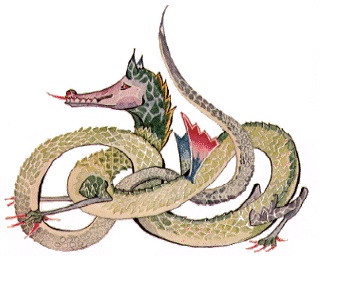
Two or three years ago, the Cult of the White Dragon was just another dragon cult trying to worm its way into the territory of Calpurnia, one of the great trade cities in the middle stretch of the King's Highway. Dragon cults are always popular with Chaotics--the Cult of the Black Dragon, the Cult of the Gold Dragon, the Fighting Society of the Red Dragon, the Followers of the River Dragon, the Storm Dragon, etc. etc. Sure, the Giants are the sons of Chaos, ever warring against the Gods of Law in the great battles of heaven--but Dragons are Chaos. Tiamat whose womb is the salt-sea, Echidna the mother of monsters, Nidhogg gnawing at the world's roots ...
And what vision better sums up the glories of Chaos than the Dragon, vast and beautiful and invincible, coiled around a gleaming hoard that could ransom kingdoms?
Anyway, these Cultists of the White Dragon sought to take advantage of the rising of Chaos in the world--as the Elves put out their strength from the Dwimmerholt, as the Giants come down from the mountains to the north, and as the Dread Wolves of Drand are heard to howl again, so too, men have turned to the promises of Dragons and Dragon-Gods that to serve them is the means to wealth and power. With whispers of power, they gathered a Cult-following from among the disaffected and the adventurous in Calpurnia, and established a secret strong place in the woods to the north wherein to worship, and from whence they began a campaign of brigandage and raiding.
Because of their brazenness, the Cult was easily discovered in their secret place by scouts sent out by the city, and then Calpurnia's senate hired and outfitted a force of mercenary fighting-men who were thence dispatched to root out and destroy the Cult. The mercenaries routed the Cult in battle and claimed much treasure that had been taken through brigandage as their right of plunder (much to the merchant princes' displeasure), but the Cult of the White Dragon was largely thought to have been destroyed by this action, and much energy was then wasted on lawsuits between merchants, senators, and fighting-men all clamoring for their proper shares.
Some time passed; banditry continued along the northern roads, sometimes perpetrated by human brigands, sometimes by orc warbands; and then about a year and a half ago, a band of adventurers ventured into the Old Forest Keep northeast of Calpurnia and returned much the richer, claiming to have found a new White Dragon Cult, but to have wiped it out. This rumor was quickly quashed, however, as the band's continued expeditions into the Keep continued to run into groups of fighting-men and priests wearing conspicuous white armbands or intricate insignia of a white worm ... all the while, banditry has continued to increase along the northern road until it is impossible for trade to continue by independent wagoner, except at great risk--all trade along the King's Highway north is now conducted in large caravans guarded by veritable armies of guards--and still, many merchants come away ruined, their fortunes looted by brigands!
And so it seems, the Cult continues to grow in secret, in the dark places under the earth.
------
As to the god of the White Dragon Cult, they worship Leukeragz-Who-Sleeps, the White Worm, the World Serpent, less a literal dragon in the world than a literary dragon, or a mythical one (or mytho-typical). This worm is said to slumber in the roots of the world, or perhaps along the floor of world-circling Ocean, and that his waking will be death--the Gods will be overthrown, and the Giants, and all Creation itself; but in his own death, slain in the struggle against the Gods, Leukeragz's flesh will split and corrupt and a new world will spring from its corruption.

These stories are well enough known through lays, poetry, and folklore that non-initiates recognize Leukeragz as the White Dragon worshiped by the Cult, but as to the meanings of the lore or the deeper mysteries of the cult (why would a cultist worship a dragon whose waking will destroy the world??)--one must be initiated into said mysteries to understand!
(a black lotus peddler telling of the cult of Set to Conan and Subotai, in Conan (1982))
Two or three years ago, the Cult of the White Dragon was just another dragon cult trying to worm its way into the territory of Calpurnia, one of the great trade cities in the middle stretch of the King's Highway. Dragon cults are always popular with Chaotics--the Cult of the Black Dragon, the Cult of the Gold Dragon, the Fighting Society of the Red Dragon, the Followers of the River Dragon, the Storm Dragon, etc. etc. Sure, the Giants are the sons of Chaos, ever warring against the Gods of Law in the great battles of heaven--but Dragons are Chaos. Tiamat whose womb is the salt-sea, Echidna the mother of monsters, Nidhogg gnawing at the world's roots ...
And what vision better sums up the glories of Chaos than the Dragon, vast and beautiful and invincible, coiled around a gleaming hoard that could ransom kingdoms?
Anyway, these Cultists of the White Dragon sought to take advantage of the rising of Chaos in the world--as the Elves put out their strength from the Dwimmerholt, as the Giants come down from the mountains to the north, and as the Dread Wolves of Drand are heard to howl again, so too, men have turned to the promises of Dragons and Dragon-Gods that to serve them is the means to wealth and power. With whispers of power, they gathered a Cult-following from among the disaffected and the adventurous in Calpurnia, and established a secret strong place in the woods to the north wherein to worship, and from whence they began a campaign of brigandage and raiding.
Because of their brazenness, the Cult was easily discovered in their secret place by scouts sent out by the city, and then Calpurnia's senate hired and outfitted a force of mercenary fighting-men who were thence dispatched to root out and destroy the Cult. The mercenaries routed the Cult in battle and claimed much treasure that had been taken through brigandage as their right of plunder (much to the merchant princes' displeasure), but the Cult of the White Dragon was largely thought to have been destroyed by this action, and much energy was then wasted on lawsuits between merchants, senators, and fighting-men all clamoring for their proper shares.
Some time passed; banditry continued along the northern roads, sometimes perpetrated by human brigands, sometimes by orc warbands; and then about a year and a half ago, a band of adventurers ventured into the Old Forest Keep northeast of Calpurnia and returned much the richer, claiming to have found a new White Dragon Cult, but to have wiped it out. This rumor was quickly quashed, however, as the band's continued expeditions into the Keep continued to run into groups of fighting-men and priests wearing conspicuous white armbands or intricate insignia of a white worm ... all the while, banditry has continued to increase along the northern road until it is impossible for trade to continue by independent wagoner, except at great risk--all trade along the King's Highway north is now conducted in large caravans guarded by veritable armies of guards--and still, many merchants come away ruined, their fortunes looted by brigands!
And so it seems, the Cult continues to grow in secret, in the dark places under the earth.
------
As to the god of the White Dragon Cult, they worship Leukeragz-Who-Sleeps, the White Worm, the World Serpent, less a literal dragon in the world than a literary dragon, or a mythical one (or mytho-typical). This worm is said to slumber in the roots of the world, or perhaps along the floor of world-circling Ocean, and that his waking will be death--the Gods will be overthrown, and the Giants, and all Creation itself; but in his own death, slain in the struggle against the Gods, Leukeragz's flesh will split and corrupt and a new world will spring from its corruption.
These stories are well enough known through lays, poetry, and folklore that non-initiates recognize Leukeragz as the White Dragon worshiped by the Cult, but as to the meanings of the lore or the deeper mysteries of the cult (why would a cultist worship a dragon whose waking will destroy the world??)--one must be initiated into said mysteries to understand!
Tuesday, December 26, 2017
Expedition to the Shrine of Aesclepius-Apollo
(don't know what was wrong with the format, but I fixed it)
SEEK OUT the shrine of Aesclepius-Apollo, dual deity of HEALING and WISDOM to help Emma Brighteyes sacrifice there and regain her drained level!
In NEED of healing? Add your sacrifice to Aesclepius alongside Emma's and cast off diseases, deadly wounds, terrible curses, or lost levels ... hopefully!
In NEED of an oracle or some kind of insight? Delve into the shrine of Apollo to seek for ancient diviniatory magics!
The Party:
Barnabus Sleet (muscle wizard)
Emma Brighteyes, Sharene, Rakka (the "witchlings", human, Elf, and orc--all Sleet's apprentices)
Dale the Valet (Sleet's fighting-man follower)
Magic Meryl (halfling, former magic-user)
Pitwin Spryneedle (gnome orphan, Meryl's semi-apprentice)
Galahad (newly acquired orc mastiff)
Mario de Parma (fighting-man)
Brutal Pete (insane dwarf)
Fulvia (NPC cleric)
Livia (NPC animal herder)
and two dogs and rather a large number of goats and such headed for the dungeon for sacrifice ...
The party FLAILSNAILED into Sweetwater, a town about a week southwest of my "regular game" set in the city of Calpurnia. To the northwest of Sweetwater, about a week's travel into the wilderness, lay the old shrine of Aesclepius-Apollo, once a pilgrimage destination for those seeking healing or wisdom from the dual Lawful Good deity. Emma had previously been drained of a level of life energy during a delve into the Vaults of Vyzor (when she unwisely wrestled an orc-succubus), and now the party had gathered to help her regain said level in the healing shrine of Aesclepius.
To that end, Emma and company (Sleet, Sharene, Rakka, Dale) acquired the required means for a sacrifice--incense, wine, animals (goats), an offering represented whatever healing was needed, and a Good cleric who could perform the sacrifice properly. They spent the minimum of one thousand gold on it all--more might have guaranteed the favor of the god, but Emma didn't have enough money.
Meanwhile, Magic Meryl was interested in seeking wisdom from Apollo, and heard that if one sacrificed the right animals at his altar, their entrails and livers could be read with the help of certain divination charts and thus answer questions posed to the god. To that end, she acquired several excellent, single-colored goats and then paid a fair amount to copy the local Law cult's divination charts, a certain scroll of Vegoia's Hepotomancy.
The party then bought some of the war dogs ubiquitously for sale along the north-south trade road on which Sweetwater lies, hired Livia to herd their animals, and then set out.
I rolled truncated wilderness encounters--just one per day--and the only thing that molested them on their way out descended on great scalloped wings that overshadowed the road--a dragon! Pretty much everyone ducked for cover as it landed before them, terrible and majestic, but Barnabus strode boldly forward to converse with the worm.
It declared itself to be Ekleriath, and expressed an especial interest in the feast of goats trailing the party. Barnabus bought time by flattering the dragon, which responded by preening and showing off its magnificence; then Barnabus brightly asked if it was strong enough to lift a cow.
Lift a cow? the dragon bellowed. You think I can't, with these huge wings? Ekleriath can lift a cow as well as any roc! With that, the dragon spread its vasts wings, blew up a cloud of dust and took off, circling through the sky looking for cattle, muttering to itself, Lift a cow! Hmmph, I'll show him!
Barnabus then cast invisibility 10' on the party (everyone crammed in close), and they all proceeded invisibly for the remainder of the journey.
The shrine itself is mostly underground, a double shrine with the western half dedicated to Apollo and the eastern to Aesclepius. An above ground temple exists, built in a Greco-Roman style with great columns and a roof, but the place is a ruin--the columns and the roof barely stand. Inside, one finds staircases down, one to the east and one to the west. The party went down the eastern stair first, finding themselves in a chamber with a southern corridor and a stream flowing across it, east to west.
They were wary of the stream, but unnecessarily--though knee deep (Pitwin had to be carried by Mario), the water was otherwise harmless. The corridor led into another chamber with three further exits, with mists rolling lightly from south and east; but the party spied a number of still stone figures in the room, all finely detailed and seemingly caught in a moment of surprise or horror--worried about medusas, the party got out mirrors and continued to the east.
Following the mists east, hoping for hot springs, the party indeed found a large room with a bath fed by hot springs taking up the center. A number of doors stood along the walls--one on the west had scorch marks on the floor around it--and another corridor opened east into a chamber with an idol of a god bearing a snake-twined staff over the altar before him, which was engraved, AEΣΚΛΕΠΙΟΣ.
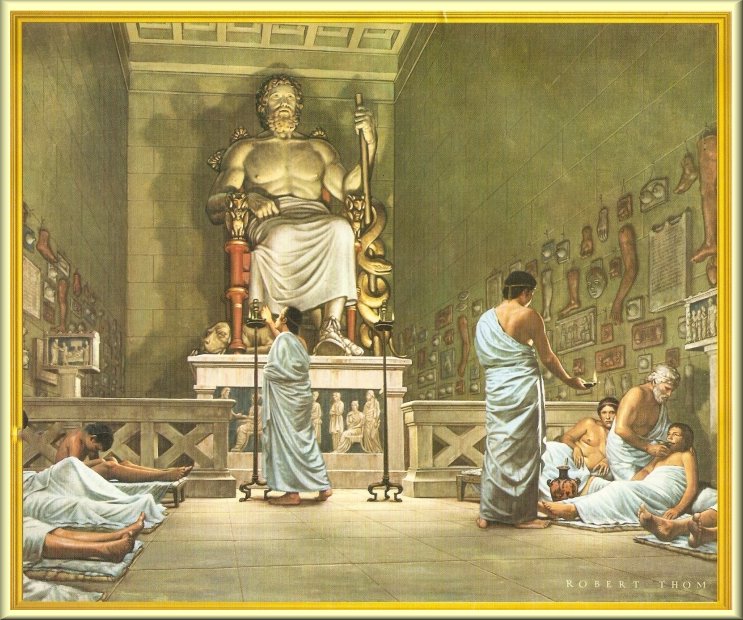
The lead woman introduced herself as Meledeia ... I fumbled through the dialogue of her trying to ascertain the party, but ultimately she zeroed in on Emma Brighteyes and rubbed up against her seductively, from which Emma lost a point of Wisdom permanently. (meanwhile, Meledeia's followers were happy to partake of the wine, though they weren't much into conversation)
Seeing Emma a bit befuddled, and he being rather protective of his apprentices, Barnabus Sleet stepped in and turned Meledeia around to face him. She wanted to feel up his muscles, but he suggested they go out alone to the other room (reactions roll) ... Oh yes, let's! she answered.
Barnabus had Meledeia stand on one side of the hot spring and told her that he was going to leap into her arms from the other side; but what he was really doing was an Anime Leap Attack, some FLAILSNAILS shenanigans that lets him do excessive damage on an attack from thirty feet away--and he hit Meledeia with a good wallop, and then was a little concerned when I informed him that she'd taken the damage, but was not only not dead, but now shedding half of her human form.
Indeed, the illusion around Meledeia dropped, revealing the lower body of a scorpion topped by her here-to-for attractive female human top. She attacked Sleet with scorpion claws and sting, but wasn't able to pin nor poison him.
 Magic Meryl got the drop on the humans and slept the lot of them, and then Mario and Brutal Pete charged out to join the melee against Meledeia. Between that round, a critical hit from Pete, and a winning initiative the next round, the party managed to slaughter poor Meledeia, cutting her fully in half, and she died with a wail, scorpion-half writhing, and then lay still.
Then the sacrifice continued, while Magic Meryl tied up the sleeping followers.
Nothing else bothered the party until the rites were complete, and then Emma had to "incubate" in the healing airs of the hot springs for a while (until the end of the session, I ruled), and so the party briefly looked into the doors around the springs. They found yellow-moldy robes behind some, and behind the scorched door, several chests full of treasure (lots of gold, plus a tafl board and pieces). The treasure also included a suit of mail, which Mario hastily donned, and immediately regretted it as it shrank over his frame, becoming heavy, tight, and awkward.
Everyone then agreed to head to the western shrine to help Magic Meryl find some oracular answers from the wisdom god. They went back up the first stair and then down the western stair, and immediately found a chamber with four exits (N, E, S, and W), and decorated with images of a lyre-playing god, one image of him riddling a sphinx, the other playing for animals.
They went north and found a room with a sphinx statue. At its base was an inscription: "Reaching stiffly for the sky, I bare my fingers when its cold, in warmth I wear an emerald glove, and in between I dress in gold." Tree! Barnabus blurted immediately (and correctly), but nothing happened. The party got a leaf and touched it to the statue, but to no avail.
It's probably some sphinx that got stoned by a medusa here, and then some adventurers carved a riddle into it for fun, Brutal Pete opined.
With a shrug, the group continued. Inside a room that was once a barracks, they found an old chest with a music book inside; then, at the door back to the corridor, they heard voices speaking in orc ...
They agreed to send Rakka out to talk (she's an orc), and when she stepped out, she heard the orc-voices complaining about some Werewolf-Lord taking their loot from their raids as "tribute" and how mad it makes them. There were eight of them, not quite orcs, but with horny, calloused fists and thick hides. Rakka hailed them and talked them into letting her companions help them destroy the werewolves. The orc-things were taken aback by Rakka's comrades, but the ever useful reactions dice suggested helpfulness on the orcs' part, and so they gladly led the party south.
There, they passed through a large chamber with a pipe organ along the west wall, and intrigued, the party stopped to play it. Pete set out the music book and tried to play a song, but he couldn't make sense of the notation (and no yellow mold came out of the wheezing organ, to everyone's relief). Meanwhile, Magic Meryl and Dale positioned themselves in the middle of the room in a good vantage to magic anything coming up the hallways--and lo! from the south came four figures, wondering about the noise of the organ.
That's them! the orc-things hissed, and Meryl and Dale blasted the four oncoming figures with a lightning bolt each. The poor creatures were instantly killed; the man-skins they were wearing split open, and out spilled four cooked and very dead wolves.
Inspecting the chamber whence they'd come, the party found some more loot (a gilded chariot among other things); but the Lord of Werewolves was out, it seemed, so the orcs were cajoled into leading the party to the shrine of Apollo (after a brief confusion that led to the fabled Well of Memory).
This shrine was similar to the one to Aesclepius, except it lacked a hot spring; rather, the ceiling was worked with images of constellations, and the inscriptions on the lyre-holding idol read, AΠΟΛΛΩN
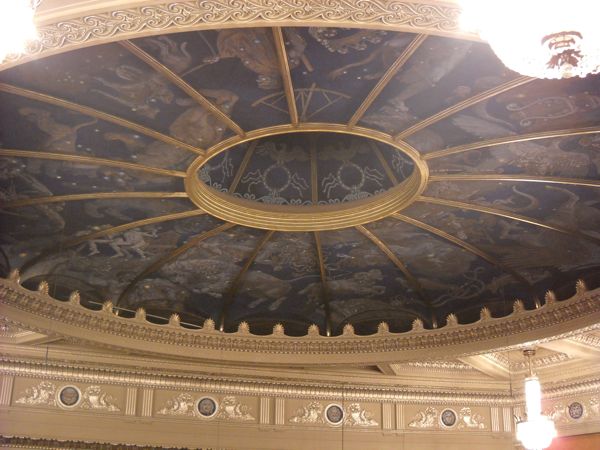
Fulvia again sacrificed some goats, thought it was a much shorter ritual as she only needed to look at their entrails and the lobes of the livers and to cross-reference their appearance with Meryl's copied charts--thus to answer the questions brought by Meryl and Pete.
Asked Meryl, How might I regain the full magical powers I lost when I was reincarnated as a halfling?
And Pete, How might I escape the curse laid on me by the armor and warped soul of Ule Oakenballs, to go mad when I reach my limit of experience as a dwarf?
(the answers to these questions need deeper thought, and I a still mulling them over)
Their goals all met and our time nearly out, the party then set out for Sweetwater once more, not neglecting to collect Emma and to haul out their lucre. Emma rolled a success on regaining her level and her lost Wisdom; six of the eight orc-things agreed to accompany the party back to Vyzor, to avoid the wrath of the Werewolf-Lord; and the party led the erstwhile followers of Meledeia back to town, once they ascertained that they had been her slaves (and they found on the way back, moreover, that these individuals can barely take care of themselves and seem as naive as children and muddled in their thinking--it seems all of them had their Wisdom drained pretty badly).
They went invisibly as before, and managed to avoid any further encounters--though they did note a number of wolves howling in the distance, and coursing their trail (to no avail). Finally back in town, they sold their loot, and set the former slaves up with the local Lawful Good Cult of St. Ursula (founded not long ago by Lailith, a character from my "regular game"), with Pete giving a "bounty" of 500 gold for whichever adventurers are willing to take the five back to the temple to be healed by Aesclepius, while Meryl donated money for their care until then.
All in all, a rather successful expedition ...
SEEK OUT the shrine of Aesclepius-Apollo, dual deity of HEALING and WISDOM to help Emma Brighteyes sacrifice there and regain her drained level!
In NEED of healing? Add your sacrifice to Aesclepius alongside Emma's and cast off diseases, deadly wounds, terrible curses, or lost levels ... hopefully!
In NEED of an oracle or some kind of insight? Delve into the shrine of Apollo to seek for ancient diviniatory magics!
The Party:
Barnabus Sleet (muscle wizard)
Emma Brighteyes, Sharene, Rakka (the "witchlings", human, Elf, and orc--all Sleet's apprentices)
Dale the Valet (Sleet's fighting-man follower)
Magic Meryl (halfling, former magic-user)
Pitwin Spryneedle (gnome orphan, Meryl's semi-apprentice)
Galahad (newly acquired orc mastiff)
Mario de Parma (fighting-man)
Brutal Pete (insane dwarf)
Fulvia (NPC cleric)
Livia (NPC animal herder)
and two dogs and rather a large number of goats and such headed for the dungeon for sacrifice ...
The party FLAILSNAILED into Sweetwater, a town about a week southwest of my "regular game" set in the city of Calpurnia. To the northwest of Sweetwater, about a week's travel into the wilderness, lay the old shrine of Aesclepius-Apollo, once a pilgrimage destination for those seeking healing or wisdom from the dual Lawful Good deity. Emma had previously been drained of a level of life energy during a delve into the Vaults of Vyzor (when she unwisely wrestled an orc-succubus), and now the party had gathered to help her regain said level in the healing shrine of Aesclepius.
To that end, Emma and company (Sleet, Sharene, Rakka, Dale) acquired the required means for a sacrifice--incense, wine, animals (goats), an offering represented whatever healing was needed, and a Good cleric who could perform the sacrifice properly. They spent the minimum of one thousand gold on it all--more might have guaranteed the favor of the god, but Emma didn't have enough money.
Meanwhile, Magic Meryl was interested in seeking wisdom from Apollo, and heard that if one sacrificed the right animals at his altar, their entrails and livers could be read with the help of certain divination charts and thus answer questions posed to the god. To that end, she acquired several excellent, single-colored goats and then paid a fair amount to copy the local Law cult's divination charts, a certain scroll of Vegoia's Hepotomancy.
The party then bought some of the war dogs ubiquitously for sale along the north-south trade road on which Sweetwater lies, hired Livia to herd their animals, and then set out.
I rolled truncated wilderness encounters--just one per day--and the only thing that molested them on their way out descended on great scalloped wings that overshadowed the road--a dragon! Pretty much everyone ducked for cover as it landed before them, terrible and majestic, but Barnabus strode boldly forward to converse with the worm.
It declared itself to be Ekleriath, and expressed an especial interest in the feast of goats trailing the party. Barnabus bought time by flattering the dragon, which responded by preening and showing off its magnificence; then Barnabus brightly asked if it was strong enough to lift a cow.
Lift a cow? the dragon bellowed. You think I can't, with these huge wings? Ekleriath can lift a cow as well as any roc! With that, the dragon spread its vasts wings, blew up a cloud of dust and took off, circling through the sky looking for cattle, muttering to itself, Lift a cow! Hmmph, I'll show him!
Barnabus then cast invisibility 10' on the party (everyone crammed in close), and they all proceeded invisibly for the remainder of the journey.
The shrine itself is mostly underground, a double shrine with the western half dedicated to Apollo and the eastern to Aesclepius. An above ground temple exists, built in a Greco-Roman style with great columns and a roof, but the place is a ruin--the columns and the roof barely stand. Inside, one finds staircases down, one to the east and one to the west. The party went down the eastern stair first, finding themselves in a chamber with a southern corridor and a stream flowing across it, east to west.
They were wary of the stream, but unnecessarily--though knee deep (Pitwin had to be carried by Mario), the water was otherwise harmless. The corridor led into another chamber with three further exits, with mists rolling lightly from south and east; but the party spied a number of still stone figures in the room, all finely detailed and seemingly caught in a moment of surprise or horror--worried about medusas, the party got out mirrors and continued to the east.
Following the mists east, hoping for hot springs, the party indeed found a large room with a bath fed by hot springs taking up the center. A number of doors stood along the walls--one on the west had scorch marks on the floor around it--and another corridor opened east into a chamber with an idol of a god bearing a snake-twined staff over the altar before him, which was engraved, AEΣΚΛΕΠΙΟΣ.
The lead woman introduced herself as Meledeia ... I fumbled through the dialogue of her trying to ascertain the party, but ultimately she zeroed in on Emma Brighteyes and rubbed up against her seductively, from which Emma lost a point of Wisdom permanently. (meanwhile, Meledeia's followers were happy to partake of the wine, though they weren't much into conversation)
Seeing Emma a bit befuddled, and he being rather protective of his apprentices, Barnabus Sleet stepped in and turned Meledeia around to face him. She wanted to feel up his muscles, but he suggested they go out alone to the other room (reactions roll) ... Oh yes, let's! she answered.
Barnabus had Meledeia stand on one side of the hot spring and told her that he was going to leap into her arms from the other side; but what he was really doing was an Anime Leap Attack, some FLAILSNAILS shenanigans that lets him do excessive damage on an attack from thirty feet away--and he hit Meledeia with a good wallop, and then was a little concerned when I informed him that she'd taken the damage, but was not only not dead, but now shedding half of her human form.
Indeed, the illusion around Meledeia dropped, revealing the lower body of a scorpion topped by her here-to-for attractive female human top. She attacked Sleet with scorpion claws and sting, but wasn't able to pin nor poison him.
Then the sacrifice continued, while Magic Meryl tied up the sleeping followers.
Nothing else bothered the party until the rites were complete, and then Emma had to "incubate" in the healing airs of the hot springs for a while (until the end of the session, I ruled), and so the party briefly looked into the doors around the springs. They found yellow-moldy robes behind some, and behind the scorched door, several chests full of treasure (lots of gold, plus a tafl board and pieces). The treasure also included a suit of mail, which Mario hastily donned, and immediately regretted it as it shrank over his frame, becoming heavy, tight, and awkward.
Everyone then agreed to head to the western shrine to help Magic Meryl find some oracular answers from the wisdom god. They went back up the first stair and then down the western stair, and immediately found a chamber with four exits (N, E, S, and W), and decorated with images of a lyre-playing god, one image of him riddling a sphinx, the other playing for animals.
They went north and found a room with a sphinx statue. At its base was an inscription: "Reaching stiffly for the sky, I bare my fingers when its cold, in warmth I wear an emerald glove, and in between I dress in gold." Tree! Barnabus blurted immediately (and correctly), but nothing happened. The party got a leaf and touched it to the statue, but to no avail.
It's probably some sphinx that got stoned by a medusa here, and then some adventurers carved a riddle into it for fun, Brutal Pete opined.
With a shrug, the group continued. Inside a room that was once a barracks, they found an old chest with a music book inside; then, at the door back to the corridor, they heard voices speaking in orc ...
They agreed to send Rakka out to talk (she's an orc), and when she stepped out, she heard the orc-voices complaining about some Werewolf-Lord taking their loot from their raids as "tribute" and how mad it makes them. There were eight of them, not quite orcs, but with horny, calloused fists and thick hides. Rakka hailed them and talked them into letting her companions help them destroy the werewolves. The orc-things were taken aback by Rakka's comrades, but the ever useful reactions dice suggested helpfulness on the orcs' part, and so they gladly led the party south.
There, they passed through a large chamber with a pipe organ along the west wall, and intrigued, the party stopped to play it. Pete set out the music book and tried to play a song, but he couldn't make sense of the notation (and no yellow mold came out of the wheezing organ, to everyone's relief). Meanwhile, Magic Meryl and Dale positioned themselves in the middle of the room in a good vantage to magic anything coming up the hallways--and lo! from the south came four figures, wondering about the noise of the organ.
That's them! the orc-things hissed, and Meryl and Dale blasted the four oncoming figures with a lightning bolt each. The poor creatures were instantly killed; the man-skins they were wearing split open, and out spilled four cooked and very dead wolves.
Inspecting the chamber whence they'd come, the party found some more loot (a gilded chariot among other things); but the Lord of Werewolves was out, it seemed, so the orcs were cajoled into leading the party to the shrine of Apollo (after a brief confusion that led to the fabled Well of Memory).
This shrine was similar to the one to Aesclepius, except it lacked a hot spring; rather, the ceiling was worked with images of constellations, and the inscriptions on the lyre-holding idol read, AΠΟΛΛΩN
Fulvia again sacrificed some goats, thought it was a much shorter ritual as she only needed to look at their entrails and the lobes of the livers and to cross-reference their appearance with Meryl's copied charts--thus to answer the questions brought by Meryl and Pete.
Asked Meryl, How might I regain the full magical powers I lost when I was reincarnated as a halfling?
And Pete, How might I escape the curse laid on me by the armor and warped soul of Ule Oakenballs, to go mad when I reach my limit of experience as a dwarf?
(the answers to these questions need deeper thought, and I a still mulling them over)
Their goals all met and our time nearly out, the party then set out for Sweetwater once more, not neglecting to collect Emma and to haul out their lucre. Emma rolled a success on regaining her level and her lost Wisdom; six of the eight orc-things agreed to accompany the party back to Vyzor, to avoid the wrath of the Werewolf-Lord; and the party led the erstwhile followers of Meledeia back to town, once they ascertained that they had been her slaves (and they found on the way back, moreover, that these individuals can barely take care of themselves and seem as naive as children and muddled in their thinking--it seems all of them had their Wisdom drained pretty badly).
They went invisibly as before, and managed to avoid any further encounters--though they did note a number of wolves howling in the distance, and coursing their trail (to no avail). Finally back in town, they sold their loot, and set the former slaves up with the local Lawful Good Cult of St. Ursula (founded not long ago by Lailith, a character from my "regular game"), with Pete giving a "bounty" of 500 gold for whichever adventurers are willing to take the five back to the temple to be healed by Aesclepius, while Meryl donated money for their care until then.
All in all, a rather successful expedition ...
Thursday, December 14, 2017
New Class: the High Orc
A friend at work was telling me about his playing of the game Shadow of War (2017) a couple weeks back, and regaling me with all the variety of orc nemeses he'd run into (sounds like the game has a pretty cool means of randomly generating orc NPCs that recur and actually try to hunt you down as you play). "The Rhymer", "the Singer", "the Deranged", etc.--it all sounds immensely amusing--but it got me thinking about orcs ... and if there are High Elves as well as wood Elves and dark Elves; and High Men, as well as barbarians and nomads; why not have High Orcs, civilized a notch above the rest? And why not write them into a new B/X class?
So after a while sitting on this and letting ideas do their distillation, it's time to give this a shot.
Far to the east under the great mountains, those ramparts raised against heaven like the Kush or the Himalayas, great cities of orcs have been carved through the hearts of the hills. These are no simple orc-holes, but full cities, vaster than even the greatest of dwarf-holds, cruder in craft, but sublime, perhaps, for the brute functionality of their forms. The orcs that built these cities are the High Orcs--civilized and even Lawful of alignment--and they maintain empires of tribute from the seats of their power, demanding goods, wealth, and slaves from their subjects in return for the lawful protection of the orc Sârs and their armies.
Slaves? Of course--these orcs may be civilized and Lawful, but many Lawful human societies maintain slaves, including of course the Roman and Persian empires. And these are the best analogs to consider when thinking about the orc empires, especially Rome because the orcs can furnish armies of orcs (attended by multi-national/racial auxiliaries) with the same war-furor as the Romans, using similar legal systems to ensure/enforce conscription of orc-citizens.
Even High Orcs, being orcs, hate the sun and fight at -1 "to hit" beneath its relentless light, so one might well wonder how an orc empire can exert its power over a surface realm of subject-kingdoms. First, and more simply, the multi-national face of their empire, in which the High Orcs can conscript legions of men or hordes of gnolls to fight their wars, or hire mercenary companies of dwarf halberdiers and halfling slingers. Secondly, perhaps more importantly, the High Orcs are excellent miners and machinists, and this makes them unstoppable siege engineers. Not only do High Orcs have an affinity for machines--crossbows, ballistae, catapults, trebuchets, etc.--which allows them to construct city-destroyers (helepolises); but being superb miners, it is a simple task for a team of orc sappers to dig mines beneath the walls of a city, fire them, and thus collapse the walls, allowing their armies to easily storm the city.

But how did an entire empire of orcs turn to Law, when almost all their brethren of raiding warbands are Chaotic of alignment? (forget about the 2E Monstrous Manual entry for "Orcs" unless you want to read Lawful Evil orcs as High Orcs ...)
The civilization of the High Orcs and their empire is obsessed with the power of Law which they saw in human societies ... Whereas most orcs, confronted with the demand to give up some portion of their wealth, would say, "Come and get it!" so that only the strongest orc could take his fellows' gold, and then only as long as he maintains a coalition of support within the tribe/warband ... the first High Orcs became enamored of Law when they witnessed a human tax-farmer demand gold from a human community subject to the King-of-Kings--and when the tax-farmer produced a sign of the King, the community, without a struggle, offered up tribute which was then taken back to the court of the King!
What wondrous power this Law must have!--and so a number of orcs from an entrepreneurial tribe were sent to the court of the King as "hostages" to learn the ways and means of human Law, and then brought back rituals and philosophies with which to enforce Law upon their fellows. A great war among orcs followed between the Lawful and Chaotic tribes, in which the Lawful tribes managed to drive out the Chaotics and to establish their own empire within the mountain caves, and thus was the beginning of the empire of the High Orcs.
--Chaotic orcs, of course, remember this ancient war, and hate the High Orcs as traitors, hating them more fiercely, perhaps, than even their hatred of Elves or dwarves ...--
------
That's the backstory, so what about the class?
The HIGH ORC
Strength is the prime requisite of the High Orc, with a 13+ STR earning 5% extra experience, and a 16+ STR earning 10% more experience (non-cumulatively). High Orcs should be of Lawful alignment, and may not be of Arcane or Natural alignment ("should" means that High Orcs can be of other alignments, but that they won't gain their full class abilities otherwise). (and this intending my alignment rules)
Level 1 -- Foulspawn -- 1d6 HD -- 0 XP
Level 2 -- Gargun -- 2d6 HD -- 2200 XP
Level 3 -- Orc -- 3d6 HD -- 4400 XP
Level 4 -- Uruk -- 4d6 HD -- 8800 XP
Level 5 -- Orog -- 5d6 HD -- 17,000 XP
Level 6 -- Olog-Hai -- 6d6 HD -- 35,000 XP
Level 7 -- Satrap -- 7d6 HD -- 70,000 XP
Level 8 -- Warlord -- 8d6 HD -- 140,000 XP
Level 9 -- Sâr -- 9d6 HD -- 270,000 XP
Level 10-- 10th Level Sâr -- 9d6 +2 hp -- 400,000 XP
Level 11-- 11th Level Sâr -- 9d6 +4 hp -- 530,000 XP
Level 12-- 12th Level Sâr -- 9d6 +6 hp -- 660,000 XP
High Orcs may advance no higher than 12th level.
High Orcs fight and save as fighters of the same level. They may use any weapon, armor, or shield, and any magic items that fighters may use.
Moreover, High Orcs, given their affinity for machinery, receive a +1 "to hit" with crossbows (and guns, if your game includes them), as well as a +1 "to hit" or otherwise operate any type of siege engine. AND, presented with any kind of machinery, High Orcs may tinker with it to fix what's broken, to break what works, or to change its function in reasonable ways. This tinkering takes 1 ten-minute turn at minimum, but likely more depending on the complexity of the machine, or the extent of the tinkering.
As orcs, High Orcs have infravision out to 90 feet underground; but in direct sunlight, they suffer a -1 penalty to all "to hit" rolls, and to any kind of save against fear effects. Also, given their expertise in mining and tunneling, High Orcs have abilities equivalent to dwarves to detect sloping passages, new construction, etc.
Finally, Lawful High Orcs are initiated into the mysteries of Law, and through those mysteries learn how to command their lesser brethren with special signs, words of power, lawful formulae, and other such esoteric rituals. It is by these formulae that the High Orcs subject various other tribes of orcs, goblins, gnolls, etc. to accede to their imperium, to join their legions as auxiliaries, and to offer them tribute ...
A High Orc, presenting a Lawful symbol and uttering a Lawful formula, may compel one HD of "giant" class creatures per his level per day (e.g. 3 HD at level 3; which could be 3 orcs in one room, or 2 in the first room and a hobgoblin in the next, etc.) to do his bidding, per a command spell (save at -2), per a charm spell, or per a suggestion spell (save at +2).
"Giant" class creatures are per 1E AD&D rangers, so bugbears, ettins, giants, gnolls, goblins, hobgoblins, kobolds, ogres, ogre-magi, orcs, and trolls--plus or minus whatever seems appropriate to the referee
At Name Level, i.e. 9th or Sâr, a High Orc may establish a stronghold and begin to carve out his own domain of Lawful orcs. When he establishes his stronghold, he attracts a body of 10-60 orcs who will fight for him and serve him, enamored of his wealth. These orcs will likely require slaves, wealth, and constant reminders of the power of Law to remain loyal; otherwise, they might seek the aid of the nearest Chaotic orc warband to overthrow their Sâr and take his wealth for themselves ...
------
Just a last thought--I know representations of orcs have grown to bizarre proportions (literally) in recent years, with orcs becoming giant greenskinned berserks half again the height of a man ... but my own understanding of orcs is that they're weak, crooked folk, going about with bandied legs and awkwardly long arms. Stooped at the shoulders, an orc's head should be no higher than an average man's breast--and as for High Orcs, who stand up just a little straighter than their crooked Chaotic brethren, even they do not raise their faces higher than a man's shoulder, on average.
For all the faults I may find with the Peter Jackson Lord of the Rings movies, the Mordor orcs were always a redeeming factor--they're almost exactly the way I picture orcs, with grey skin and stooping gaits. I don't give a damn about his Uruk-Hai, but the Mordor orcs in The Two Towers were spot on.
So after a while sitting on this and letting ideas do their distillation, it's time to give this a shot.
Far to the east under the great mountains, those ramparts raised against heaven like the Kush or the Himalayas, great cities of orcs have been carved through the hearts of the hills. These are no simple orc-holes, but full cities, vaster than even the greatest of dwarf-holds, cruder in craft, but sublime, perhaps, for the brute functionality of their forms. The orcs that built these cities are the High Orcs--civilized and even Lawful of alignment--and they maintain empires of tribute from the seats of their power, demanding goods, wealth, and slaves from their subjects in return for the lawful protection of the orc Sârs and their armies.
Slaves? Of course--these orcs may be civilized and Lawful, but many Lawful human societies maintain slaves, including of course the Roman and Persian empires. And these are the best analogs to consider when thinking about the orc empires, especially Rome because the orcs can furnish armies of orcs (attended by multi-national/racial auxiliaries) with the same war-furor as the Romans, using similar legal systems to ensure/enforce conscription of orc-citizens.
Even High Orcs, being orcs, hate the sun and fight at -1 "to hit" beneath its relentless light, so one might well wonder how an orc empire can exert its power over a surface realm of subject-kingdoms. First, and more simply, the multi-national face of their empire, in which the High Orcs can conscript legions of men or hordes of gnolls to fight their wars, or hire mercenary companies of dwarf halberdiers and halfling slingers. Secondly, perhaps more importantly, the High Orcs are excellent miners and machinists, and this makes them unstoppable siege engineers. Not only do High Orcs have an affinity for machines--crossbows, ballistae, catapults, trebuchets, etc.--which allows them to construct city-destroyers (helepolises); but being superb miners, it is a simple task for a team of orc sappers to dig mines beneath the walls of a city, fire them, and thus collapse the walls, allowing their armies to easily storm the city.
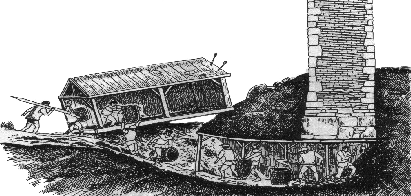
But how did an entire empire of orcs turn to Law, when almost all their brethren of raiding warbands are Chaotic of alignment? (forget about the 2E Monstrous Manual entry for "Orcs" unless you want to read Lawful Evil orcs as High Orcs ...)
The civilization of the High Orcs and their empire is obsessed with the power of Law which they saw in human societies ... Whereas most orcs, confronted with the demand to give up some portion of their wealth, would say, "Come and get it!" so that only the strongest orc could take his fellows' gold, and then only as long as he maintains a coalition of support within the tribe/warband ... the first High Orcs became enamored of Law when they witnessed a human tax-farmer demand gold from a human community subject to the King-of-Kings--and when the tax-farmer produced a sign of the King, the community, without a struggle, offered up tribute which was then taken back to the court of the King!
What wondrous power this Law must have!--and so a number of orcs from an entrepreneurial tribe were sent to the court of the King as "hostages" to learn the ways and means of human Law, and then brought back rituals and philosophies with which to enforce Law upon their fellows. A great war among orcs followed between the Lawful and Chaotic tribes, in which the Lawful tribes managed to drive out the Chaotics and to establish their own empire within the mountain caves, and thus was the beginning of the empire of the High Orcs.
--Chaotic orcs, of course, remember this ancient war, and hate the High Orcs as traitors, hating them more fiercely, perhaps, than even their hatred of Elves or dwarves ...--
------
That's the backstory, so what about the class?
The HIGH ORC
Strength is the prime requisite of the High Orc, with a 13+ STR earning 5% extra experience, and a 16+ STR earning 10% more experience (non-cumulatively). High Orcs should be of Lawful alignment, and may not be of Arcane or Natural alignment ("should" means that High Orcs can be of other alignments, but that they won't gain their full class abilities otherwise). (and this intending my alignment rules)
Level 1 -- Foulspawn -- 1d6 HD -- 0 XP
Level 2 -- Gargun -- 2d6 HD -- 2200 XP
Level 3 -- Orc -- 3d6 HD -- 4400 XP
Level 4 -- Uruk -- 4d6 HD -- 8800 XP
Level 5 -- Orog -- 5d6 HD -- 17,000 XP
Level 6 -- Olog-Hai -- 6d6 HD -- 35,000 XP
Level 7 -- Satrap -- 7d6 HD -- 70,000 XP
Level 8 -- Warlord -- 8d6 HD -- 140,000 XP
Level 9 -- Sâr -- 9d6 HD -- 270,000 XP
Level 10-- 10th Level Sâr -- 9d6 +2 hp -- 400,000 XP
Level 11-- 11th Level Sâr -- 9d6 +4 hp -- 530,000 XP
Level 12-- 12th Level Sâr -- 9d6 +6 hp -- 660,000 XP
High Orcs may advance no higher than 12th level.
High Orcs fight and save as fighters of the same level. They may use any weapon, armor, or shield, and any magic items that fighters may use.
Moreover, High Orcs, given their affinity for machinery, receive a +1 "to hit" with crossbows (and guns, if your game includes them), as well as a +1 "to hit" or otherwise operate any type of siege engine. AND, presented with any kind of machinery, High Orcs may tinker with it to fix what's broken, to break what works, or to change its function in reasonable ways. This tinkering takes 1 ten-minute turn at minimum, but likely more depending on the complexity of the machine, or the extent of the tinkering.
As orcs, High Orcs have infravision out to 90 feet underground; but in direct sunlight, they suffer a -1 penalty to all "to hit" rolls, and to any kind of save against fear effects. Also, given their expertise in mining and tunneling, High Orcs have abilities equivalent to dwarves to detect sloping passages, new construction, etc.
Finally, Lawful High Orcs are initiated into the mysteries of Law, and through those mysteries learn how to command their lesser brethren with special signs, words of power, lawful formulae, and other such esoteric rituals. It is by these formulae that the High Orcs subject various other tribes of orcs, goblins, gnolls, etc. to accede to their imperium, to join their legions as auxiliaries, and to offer them tribute ...
A High Orc, presenting a Lawful symbol and uttering a Lawful formula, may compel one HD of "giant" class creatures per his level per day (e.g. 3 HD at level 3; which could be 3 orcs in one room, or 2 in the first room and a hobgoblin in the next, etc.) to do his bidding, per a command spell (save at -2), per a charm spell, or per a suggestion spell (save at +2).
"Giant" class creatures are per 1E AD&D rangers, so bugbears, ettins, giants, gnolls, goblins, hobgoblins, kobolds, ogres, ogre-magi, orcs, and trolls--plus or minus whatever seems appropriate to the referee
At Name Level, i.e. 9th or Sâr, a High Orc may establish a stronghold and begin to carve out his own domain of Lawful orcs. When he establishes his stronghold, he attracts a body of 10-60 orcs who will fight for him and serve him, enamored of his wealth. These orcs will likely require slaves, wealth, and constant reminders of the power of Law to remain loyal; otherwise, they might seek the aid of the nearest Chaotic orc warband to overthrow their Sâr and take his wealth for themselves ...
------
Just a last thought--I know representations of orcs have grown to bizarre proportions (literally) in recent years, with orcs becoming giant greenskinned berserks half again the height of a man ... but my own understanding of orcs is that they're weak, crooked folk, going about with bandied legs and awkwardly long arms. Stooped at the shoulders, an orc's head should be no higher than an average man's breast--and as for High Orcs, who stand up just a little straighter than their crooked Chaotic brethren, even they do not raise their faces higher than a man's shoulder, on average.
For all the faults I may find with the Peter Jackson Lord of the Rings movies, the Mordor orcs were always a redeeming factor--they're almost exactly the way I picture orcs, with grey skin and stooping gaits. I don't give a damn about his Uruk-Hai, but the Mordor orcs in The Two Towers were spot on.
 |
| By the Lawful power of the Red Eye, I conjure thee not to touch the halflings! |
Sunday, November 26, 2017
the Cult of the Beautiful Life -- Worshiping Ke$ha
I've been kicking this idea around in my head for a while, to create a religion using Kesha's lyrics as the sacred texts, but tonight on the drive back up from Boise, Kesha blaring from the CD player, some ideas finally clicked. So here goes ... (all the links except the last about the "Otter Bacchanalia" are links to Kesha's songs on YouTube)
On a certain summer night, when the moon is heavy with light, and the star winds blow and scatter their glimmerings in a great river of light across the sky, the clashing of timbrels and the cries of women in ekstasis will arise in the city. On this night, the central mystery of the Beautiful Life will once more be ritually played out atop the highest hill, in full view of the stars, as it is done every year, and ever has been, and ever shall be.
The women of the city who are members of the cult--they call themselves the Beautiful--will gather in the the market in answer to the cries and the clash of the timbrels. Others will come as well; Elves, as fellow star-children, will be found in their midst; hangers-on who know of the revelry to come, will wait nearby to follow the procession and join in the celebrations after the mystery ritual is complete; and some few men who have been selected to join in the ritual and the revelry, and who are already swaying, drunk from wine, will have already gathered in the square with the priestesses.
Thus assembled, the entire group will process forth through the city, led by priestesses raising the thyrsus-staves, accompanied by girls bearing jars of wine and of water, all chanting incantations to the Star Goddess and her lover, and banging their timbrels and drums. Any who are to be initiated that night go silently, draped in heavy black robes that hide their features, while those who are already initiated have painted themselves with vibrant colors, and adorned their wrists, arms, ankles and waists with silver and gold while their bodies are decked with robes and dresses of every hue.
"We R Who We R!" sings the procession, proclaiming to themselves and to the world their intent to live to the fullest, to fulfill their own desires, and to love themselves as they are. "Got that glitter on our eyes, stockings all ripped up the sides, looking sick and sexified! ... We're dancing like we're dumb, bodies going numb, we'll be forever young ..."
That, and "Take It Off", singing, "There's a place downtown where the freaks all come around, there's a hole in the wall, it's a dirty free for all ... When the dark of the night comes around, that's the time that the animal comes alive looking for something wild ..."
Singing all the way, the procession of the Beautiful march and dance and sway in wine-drunkenness out from the city, marching through half the night until they come to the place of their secret and sacred rites. This is a hill somewhere in the hinterlands, high enough to be close to the stars, and broad enough at its crest thereon to hold a wild revelry. In the days before, a great bonfire has been built up by the women of the cult; but it remains unlit yet, as the cult gathers atop the hill, and the hangers-on wait beneath the crest, afraid of the consequences of profaning the mysteries with uninitiated eyes. (For indeed, they have heard what happens to those who are too eager to join ... "Cannibal" -- "I eat boys up, breakfast and lunch, then when I'm thirsty, I'll drink their blood ... Carnivore, animal, I am a cannibal, I eat boys up, you better run")
------
The first thing that must be done is the initiation of new members. Before the pyre is lit, in the darkness that represents the darkness of death whence the Star Goddess was born, and shall ever be born again and again until the end of all things, the initiates are brought forward in their black robes. The priestess sings to them ("Rainbow"), singing about needing to emerge from the darkness--"I used to live in the darkness, dress in black, act so heartless; but now I see that colors are everything; got kaleidoscopes in my hairdo, got back the stars in my eyes, too, and now I see the magic inside of me."
In the process of this chant, the priestess removes the black robes, until the initiates stand naked before the cult; then, as the pyre is lit, the Beautiful step forward to paint the initiates' skin with paints of red and blue and every hue, and to adorn them with silver and gold, and to wrap their bodies in brilliant robes, which will all stand forth in full color as the pyrelight climbs higher. The initiates are asked to recite the tenets of the Star Goddess and the Beautiful Life--the answers to these questions are found in a number of songs they would have learned back in the city, and sung to themselves to retain their mysteries.

The tenets are:
First, all that matters is the Beautiful Life--life should be a striving toward transcendence, especially through drinking, dancing, and sex, but really through any activity that fills a body with joy. ("All That Matters (The Beautiful Life")
Secondly, be an Animal and a Warrior--love yourself for who you are, not for who you "should" be (this is essentially a basic tenet of Chaos, so it should be obvious at this point that this is a Chaos cult)
Thirdly, the fulfillment of the Beautiful Life is to find and join with the Lover. There are entire myth and poetic cycles of the Star Goddess and her Lover, reincarnated over and over again through vast epochs, ever seeking each other out. This Lover is usually depicted as a man (or especially as a dragon when the Joy he/it represents is more metaphorical), but sometimes the sexes are reversed, and the Star Goddess is a kind of king over the stars, and her lover is the female moon, pregnant with light ... essentially, any imagery can stand in here; the point is that a soul is reincarnated over and over again until it can finally fulfill itself in the Beautiful Life ... "Past Lives" is the best articulation of this idea ("We were lovers in a past life, I can see it in your green eyes; maybe you were one of my wives in a long lost tribe ...")
Lastly, that fulfillment is in the return to the Stars (whence all souls are born) and thence the rebirth of the Star Goddess and another cycle of new souls seeking the Beautiful Life, best expressed in the song "Spaceship" ("I'm waiting for my spaceship to come back for me ... look up in the sky and there they'll be, I bet you'll think of me ...")
------
Once the initiates have sufficiently expressed their understanding of these mysteries, they step back and join the rest of the Beautiful, and join them in two songs, one "Praying," a prayer that is a rejection of the dominance of the Lawful cults, which they see as constricting the ability of human souls to fulfill the Beautiful Life with all their emphasis on duties, self-restraint, marriage, etc. And then they sing a "Hymn" for themselves, which is a full exaltation in their own Beauty and perfectness as they are, and in their seeking for their own ultimate fulfillment.
And then, of course, they TAKE IT OFF! Wine flows, and is cast into the fire as a sacrifice to the Star Goddess, who looks down in gladness from the stars above; incense is burned, and cannabis and opium imbibed; clothes come off, the drums beat to the beat of the heart, bodies writhe, cries of ekstasis and enthusiasmus are raised to the stars and their eternal light. All inhibitions are forgot. All that occurs here is sanctioned by the Star Goddess; taboos are overturned; only excess is sacred.

It is this point at which the hangers-on ascend to the hilltop, to partake in the revelry, which continues until morning, or even well into the next day and evening. Naturally, there are consequences--legendary hang-overs; men and women dead or mad from wine-sickness; unintended pregnancies. But though Lawful authorities hate these revels, they fear to punish those who return, for fear of the anger of the Goddess and her maenads ... certain tyrants in the past have sought to quash the secret rites, and have then ended up in the midst of the revelries themselves, wine-mad, and finally torn limb from limb by the ekstatic Beautiful ...
This cult being Chaotic, it is entirely reasonable for non-initiated but Chaotic characters to act as hangers-on, to follow the procession out into the hills, and to wait until the mysteries are completed, but then to join in the wild revelry thereafter. I would treat this as carousing, but at double or triple the normal xp for the normal cost, and probably come up with a unique table to roll for failures ... sounds like a future blog post, anyway.
Chaotic women may, of course, also just join the cult as initiates. If they do so, they may attend the revelry, gain triple xp, and not suffer any mishaps (not the first time, at least ...)--and yes, this is a female-only cult. In the future, I may write a secondary male cult--or write up rules for male priests like those of Cybele who would castrate themselves--but for now, the Cult of the Beautiful is women-only.
And obviously, attending these rites in any matter as a non-Chaotic comes with consequences. A character neutral in regard to Law and Chaos who joins in the revelry must thereafter be considered Chaotic--they have fully engaged with the raw energy of Chaos, and though they may not be of the Beautiful, they are now aligned against the Lawful cults. As for Lawfuls to attend the revels and enjoy themselves, that is a serious breach of their own alignment, and they must seek atonement from some character of higher rank within the Lawful cults--and they gain no xp bonuses or alignment benefits from Lawfulness until they atone, as well as some other appropriate penalty, e.g. clerics losing their spells, or a curse laid upon a fighter by his god for his failure.
------
Lastly, I should mention that there is another, rival cult, the House of Gog, whose members call themselves Monsters ... I have little to say concerning this cult at the moment ...
... and there are a couple lesser disciples of such Dionysian revelries and lyric poetry--Katherine of Perrin, and Cyris of Milyta--who are semi-Sapphic, and whose lyrics echo both cults (of the Beautiful Life, and of the House of Gog); and yet neither of which have quite the same following ...
------
I'll probably be coming up with some kind of random table for things one might see/find at a bacchanal of the Cult of the Beautiful, probably along the lines of Jesse Goldshear's Otter Bacchanalia, which is great, and you should check it out! ... but piecing together the tenets of this Ke$ha cult has taken up too much space yet.
 |
| The Star Goddess |
On a certain summer night, when the moon is heavy with light, and the star winds blow and scatter their glimmerings in a great river of light across the sky, the clashing of timbrels and the cries of women in ekstasis will arise in the city. On this night, the central mystery of the Beautiful Life will once more be ritually played out atop the highest hill, in full view of the stars, as it is done every year, and ever has been, and ever shall be.
The women of the city who are members of the cult--they call themselves the Beautiful--will gather in the the market in answer to the cries and the clash of the timbrels. Others will come as well; Elves, as fellow star-children, will be found in their midst; hangers-on who know of the revelry to come, will wait nearby to follow the procession and join in the celebrations after the mystery ritual is complete; and some few men who have been selected to join in the ritual and the revelry, and who are already swaying, drunk from wine, will have already gathered in the square with the priestesses.
Thus assembled, the entire group will process forth through the city, led by priestesses raising the thyrsus-staves, accompanied by girls bearing jars of wine and of water, all chanting incantations to the Star Goddess and her lover, and banging their timbrels and drums. Any who are to be initiated that night go silently, draped in heavy black robes that hide their features, while those who are already initiated have painted themselves with vibrant colors, and adorned their wrists, arms, ankles and waists with silver and gold while their bodies are decked with robes and dresses of every hue.
"We R Who We R!" sings the procession, proclaiming to themselves and to the world their intent to live to the fullest, to fulfill their own desires, and to love themselves as they are. "Got that glitter on our eyes, stockings all ripped up the sides, looking sick and sexified! ... We're dancing like we're dumb, bodies going numb, we'll be forever young ..."
That, and "Take It Off", singing, "There's a place downtown where the freaks all come around, there's a hole in the wall, it's a dirty free for all ... When the dark of the night comes around, that's the time that the animal comes alive looking for something wild ..."
Singing all the way, the procession of the Beautiful march and dance and sway in wine-drunkenness out from the city, marching through half the night until they come to the place of their secret and sacred rites. This is a hill somewhere in the hinterlands, high enough to be close to the stars, and broad enough at its crest thereon to hold a wild revelry. In the days before, a great bonfire has been built up by the women of the cult; but it remains unlit yet, as the cult gathers atop the hill, and the hangers-on wait beneath the crest, afraid of the consequences of profaning the mysteries with uninitiated eyes. (For indeed, they have heard what happens to those who are too eager to join ... "Cannibal" -- "I eat boys up, breakfast and lunch, then when I'm thirsty, I'll drink their blood ... Carnivore, animal, I am a cannibal, I eat boys up, you better run")
------
The first thing that must be done is the initiation of new members. Before the pyre is lit, in the darkness that represents the darkness of death whence the Star Goddess was born, and shall ever be born again and again until the end of all things, the initiates are brought forward in their black robes. The priestess sings to them ("Rainbow"), singing about needing to emerge from the darkness--"I used to live in the darkness, dress in black, act so heartless; but now I see that colors are everything; got kaleidoscopes in my hairdo, got back the stars in my eyes, too, and now I see the magic inside of me."
In the process of this chant, the priestess removes the black robes, until the initiates stand naked before the cult; then, as the pyre is lit, the Beautiful step forward to paint the initiates' skin with paints of red and blue and every hue, and to adorn them with silver and gold, and to wrap their bodies in brilliant robes, which will all stand forth in full color as the pyrelight climbs higher. The initiates are asked to recite the tenets of the Star Goddess and the Beautiful Life--the answers to these questions are found in a number of songs they would have learned back in the city, and sung to themselves to retain their mysteries.
The tenets are:
First, all that matters is the Beautiful Life--life should be a striving toward transcendence, especially through drinking, dancing, and sex, but really through any activity that fills a body with joy. ("All That Matters (The Beautiful Life")
Secondly, be an Animal and a Warrior--love yourself for who you are, not for who you "should" be (this is essentially a basic tenet of Chaos, so it should be obvious at this point that this is a Chaos cult)
Thirdly, the fulfillment of the Beautiful Life is to find and join with the Lover. There are entire myth and poetic cycles of the Star Goddess and her Lover, reincarnated over and over again through vast epochs, ever seeking each other out. This Lover is usually depicted as a man (or especially as a dragon when the Joy he/it represents is more metaphorical), but sometimes the sexes are reversed, and the Star Goddess is a kind of king over the stars, and her lover is the female moon, pregnant with light ... essentially, any imagery can stand in here; the point is that a soul is reincarnated over and over again until it can finally fulfill itself in the Beautiful Life ... "Past Lives" is the best articulation of this idea ("We were lovers in a past life, I can see it in your green eyes; maybe you were one of my wives in a long lost tribe ...")
Lastly, that fulfillment is in the return to the Stars (whence all souls are born) and thence the rebirth of the Star Goddess and another cycle of new souls seeking the Beautiful Life, best expressed in the song "Spaceship" ("I'm waiting for my spaceship to come back for me ... look up in the sky and there they'll be, I bet you'll think of me ...")
------
Once the initiates have sufficiently expressed their understanding of these mysteries, they step back and join the rest of the Beautiful, and join them in two songs, one "Praying," a prayer that is a rejection of the dominance of the Lawful cults, which they see as constricting the ability of human souls to fulfill the Beautiful Life with all their emphasis on duties, self-restraint, marriage, etc. And then they sing a "Hymn" for themselves, which is a full exaltation in their own Beauty and perfectness as they are, and in their seeking for their own ultimate fulfillment.
And then, of course, they TAKE IT OFF! Wine flows, and is cast into the fire as a sacrifice to the Star Goddess, who looks down in gladness from the stars above; incense is burned, and cannabis and opium imbibed; clothes come off, the drums beat to the beat of the heart, bodies writhe, cries of ekstasis and enthusiasmus are raised to the stars and their eternal light. All inhibitions are forgot. All that occurs here is sanctioned by the Star Goddess; taboos are overturned; only excess is sacred.
It is this point at which the hangers-on ascend to the hilltop, to partake in the revelry, which continues until morning, or even well into the next day and evening. Naturally, there are consequences--legendary hang-overs; men and women dead or mad from wine-sickness; unintended pregnancies. But though Lawful authorities hate these revels, they fear to punish those who return, for fear of the anger of the Goddess and her maenads ... certain tyrants in the past have sought to quash the secret rites, and have then ended up in the midst of the revelries themselves, wine-mad, and finally torn limb from limb by the ekstatic Beautiful ...
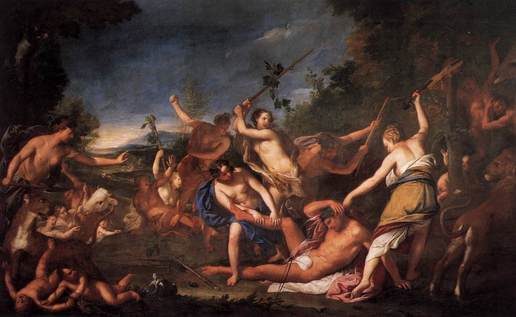 |
| A man being torn apart by bacchantes (Tiresias, actually) |
This cult being Chaotic, it is entirely reasonable for non-initiated but Chaotic characters to act as hangers-on, to follow the procession out into the hills, and to wait until the mysteries are completed, but then to join in the wild revelry thereafter. I would treat this as carousing, but at double or triple the normal xp for the normal cost, and probably come up with a unique table to roll for failures ... sounds like a future blog post, anyway.
Chaotic women may, of course, also just join the cult as initiates. If they do so, they may attend the revelry, gain triple xp, and not suffer any mishaps (not the first time, at least ...)--and yes, this is a female-only cult. In the future, I may write a secondary male cult--or write up rules for male priests like those of Cybele who would castrate themselves--but for now, the Cult of the Beautiful is women-only.
And obviously, attending these rites in any matter as a non-Chaotic comes with consequences. A character neutral in regard to Law and Chaos who joins in the revelry must thereafter be considered Chaotic--they have fully engaged with the raw energy of Chaos, and though they may not be of the Beautiful, they are now aligned against the Lawful cults. As for Lawfuls to attend the revels and enjoy themselves, that is a serious breach of their own alignment, and they must seek atonement from some character of higher rank within the Lawful cults--and they gain no xp bonuses or alignment benefits from Lawfulness until they atone, as well as some other appropriate penalty, e.g. clerics losing their spells, or a curse laid upon a fighter by his god for his failure.
------
Lastly, I should mention that there is another, rival cult, the House of Gog, whose members call themselves Monsters ... I have little to say concerning this cult at the moment ...
... and there are a couple lesser disciples of such Dionysian revelries and lyric poetry--Katherine of Perrin, and Cyris of Milyta--who are semi-Sapphic, and whose lyrics echo both cults (of the Beautiful Life, and of the House of Gog); and yet neither of which have quite the same following ...
------
I'll probably be coming up with some kind of random table for things one might see/find at a bacchanal of the Cult of the Beautiful, probably along the lines of Jesse Goldshear's Otter Bacchanalia, which is great, and you should check it out! ... but piecing together the tenets of this Ke$ha cult has taken up too much space yet.
Subscribe to:
Posts (Atom)