One of the ways available for Good characters to "advance" in the Cult of Good is to swear great vows in accordance with the values of the Cult. (using my alignment rules)
These vows are 1) the Vow of Peace, 2) the Vow of Poverty, and 3) the Vow of Purity. Before any of these vows may be sworn by a character, that character must first pay at least 5000 gold for a public liturgy of Good, OR perform such a boon for the Cult of Good that the character is blessed by a leader of the Cult. This blessing (of the liturgy and/or the leader) confers a permanent +1 bonus to all saving throws.
As to the Vows themselves:
To swear the Vow of Peace, a character swears to: 1) always attempt peaceful resolutions for any encounter with "monster", and 2) never to kill, except in extremis in self defense. The benefit of swearing such a Vow is that the character becomes capable of laying on hands for healing like a paladin of equal level, i.e. 2 hp/level.
To swear the Vow of Poverty, a character swears to 1) never own more than one suit of armor, one shield, four weapons, and four other magic items, and just enough gold for day-to-day expenses; 2) all other gold must be donated to the Good Cult, though 20% of such donated counts for bonus experience. The benefit of this Vow is that a character may summon a divine Warhorse (or other servant?) that will serve faithfully unto death, HD 5+5, AC 5. If the Warhorse is slain, another may not be summoned until at least half a year has passed.
To swear the Vow of Purity, a character swears to 1) never again carouse (spending gold on drink and whoring for xp); and 2) never to engage in illicit sex, nor to become inebriated in any manner. The benefit of this Vow is that a character receives +2 on all saves, cumulative with the blessing conferred by the Good Cult before any Vow might be sworn.
(These are, of course, generally the restrictions and benefits of the AD&D Paladin class ... I wrote them for my game when it was strictly B/X D&D, and Paladins were not an available class. Other benefits for taking on these Vows might be negotiated between the character and the leaders of the local Good Cult)
Showing posts with label ad&d. Show all posts
Showing posts with label ad&d. Show all posts
Tuesday, August 14, 2018

Wednesday, April 11, 2018
Skills in My Game
Over at "The Retired Adventurer" is a wonderful post about character backstory for an OSR type game where the characters explicitly don't have backstory: "The Pack of Lies: Backstory as Equipment and Resource" (with the opening counterpart being a 3.5 game with a great deal of backstory).
The basic idea is that there are several items a character could have in one's inventory that imply backstory (a diary, a published personal memoir, ingredients for s'mores that inspire campfireside stories, or a lucky charm), and that a player-character could invoke one of these items by telling those at the table an anecdote about their backstory (true or not) to justify why they're "Good At ..." something. This trait for being Good At ... lasts for but a session with most of these items/invocations, which is an elegant mechanic for allowing otherwise skill-less OSR characters to take on some kind of mechanical skill while still keeping their character sheets and home rules uncluttered with miscellaneous entries.
I'm tempted to nab this idea entirely for use in my games (especially the 5e Jungles of Chult game, given that 5e explicitly includes a random table of weird charms/things a character can start with--a perfect random lucky charm table).
Still, I'll have to think it over; my game already has a homebrewed rule for character "skills" and their acquisition. It was formed in the rough-hewn origins when I was trying to navigate the space between player skills and game mechanics ... especially for certain situations that would have used an opposed roll in 3.5, which we were used to, but which I didn't want to fall back to.
For example, say the party has captured an orc and want to tie him up securely (while I, nefarious referee, planned secretly for the orc to attempt escape to warn his fellows deeper in the dungeon). In 3e I would have asked for a Use Rope skill from the players, and compared their roll against the orc's Escape Artist roll; but this is B/X! I don't want to have to enumerate all the potential skills and have players select from among them, that would defeat the purpose of playing B/X to escape the rules. Still, I wanted a means of random adjudication ...
So the new skill rule was instituted. "We tie up the orc!" the players say. "Roll a d6," I answer. "On a 1, your character is skilled with ropes, the orc is firmly secured, and you can note your skill with ropes on your character sheet. In the future, you may invoke that note for any plan involving ropes, and I'll give you better odds for it working or just adjudicate success."
This followed from two sources, 1) Jeff Rients' general rule that any action may be attempted with a roll of a d6, with a 1 being definite success and a 6 being definite failure (and with further gradations according to referee consideration); and 2) adapted from the 1e Dungeon Master's Guide page 60, "LISTENING AT DOORS ... Keen-eared individuals will gain a bonus [to their "hear-noise" roll] ... Use the chance of hearing a noise to determine if a character is keen-eared the first time he or she listens at a door, and if it is indicated, tell the player to note the fact for his or her character. ..." (modified to use the B/X rules rather than 1e, so a keen-eared demi-human "hears-noise" on a 1-3 on a d6 rather than a 1-2, while a keen-eared human "hears" on a 1-2 rather than a 1)
At any time in the game, a player may ask if they can invoke a kind of "skill" regarding a task or plan in which they're engaged. On a 1 on the die, they may note that their character is skilled in whatever task it was. This has resulted in some great "skills"--a friend of mine has a fighting-man who is an Art Critic, who can judge the value of obscure art; another has a character who is a Religious Scholar, who can identify various details about obscure cults, their symbols, and theological minutiae. There are, of course, a number of characters who are skilled rope-users, appraisers of treasure, or other more usefully banal skills, but the openness of the rule allows for surprising and strange skill-sets that make a character just that much richer.
I don't have a hard limit on the number of "skills" a character can have noted on their sheet, but three seems like a good boundary beyond which something more would be required than just a d6 roll (like maybe going to a sage/expert and paying them to teach you over the course of several months/years ...). Plus, the rule doesn't usually get invoked often enough for characters in my game to have more than one or two skills yet.
As a final note, a further de facto rule that has arisen is that characters don't roll for the same skill twice ... except I don't have players note that on their character sheet because I've never actually ruled against it. Players just assume that they can't and leave it at that. I mean, I probably would rule that within a single session, only one roll per "skill" would be allowed, but other than that I'm open. Maybe the character learned it during downtime?
Well, those are my rules for "skills". I really do like the item => background => "good at" idea, though, so I'm considering adding it to my repertoire of home rules. Maybe even just as an alternative to my own skills-rule.
The basic idea is that there are several items a character could have in one's inventory that imply backstory (a diary, a published personal memoir, ingredients for s'mores that inspire campfireside stories, or a lucky charm), and that a player-character could invoke one of these items by telling those at the table an anecdote about their backstory (true or not) to justify why they're "Good At ..." something. This trait for being Good At ... lasts for but a session with most of these items/invocations, which is an elegant mechanic for allowing otherwise skill-less OSR characters to take on some kind of mechanical skill while still keeping their character sheets and home rules uncluttered with miscellaneous entries.
I'm tempted to nab this idea entirely for use in my games (especially the 5e Jungles of Chult game, given that 5e explicitly includes a random table of weird charms/things a character can start with--a perfect random lucky charm table).
Still, I'll have to think it over; my game already has a homebrewed rule for character "skills" and their acquisition. It was formed in the rough-hewn origins when I was trying to navigate the space between player skills and game mechanics ... especially for certain situations that would have used an opposed roll in 3.5, which we were used to, but which I didn't want to fall back to.
For example, say the party has captured an orc and want to tie him up securely (while I, nefarious referee, planned secretly for the orc to attempt escape to warn his fellows deeper in the dungeon). In 3e I would have asked for a Use Rope skill from the players, and compared their roll against the orc's Escape Artist roll; but this is B/X! I don't want to have to enumerate all the potential skills and have players select from among them, that would defeat the purpose of playing B/X to escape the rules. Still, I wanted a means of random adjudication ...
So the new skill rule was instituted. "We tie up the orc!" the players say. "Roll a d6," I answer. "On a 1, your character is skilled with ropes, the orc is firmly secured, and you can note your skill with ropes on your character sheet. In the future, you may invoke that note for any plan involving ropes, and I'll give you better odds for it working or just adjudicate success."
This followed from two sources, 1) Jeff Rients' general rule that any action may be attempted with a roll of a d6, with a 1 being definite success and a 6 being definite failure (and with further gradations according to referee consideration); and 2) adapted from the 1e Dungeon Master's Guide page 60, "LISTENING AT DOORS ... Keen-eared individuals will gain a bonus [to their "hear-noise" roll] ... Use the chance of hearing a noise to determine if a character is keen-eared the first time he or she listens at a door, and if it is indicated, tell the player to note the fact for his or her character. ..." (modified to use the B/X rules rather than 1e, so a keen-eared demi-human "hears-noise" on a 1-3 on a d6 rather than a 1-2, while a keen-eared human "hears" on a 1-2 rather than a 1)
At any time in the game, a player may ask if they can invoke a kind of "skill" regarding a task or plan in which they're engaged. On a 1 on the die, they may note that their character is skilled in whatever task it was. This has resulted in some great "skills"--a friend of mine has a fighting-man who is an Art Critic, who can judge the value of obscure art; another has a character who is a Religious Scholar, who can identify various details about obscure cults, their symbols, and theological minutiae. There are, of course, a number of characters who are skilled rope-users, appraisers of treasure, or other more usefully banal skills, but the openness of the rule allows for surprising and strange skill-sets that make a character just that much richer.
I don't have a hard limit on the number of "skills" a character can have noted on their sheet, but three seems like a good boundary beyond which something more would be required than just a d6 roll (like maybe going to a sage/expert and paying them to teach you over the course of several months/years ...). Plus, the rule doesn't usually get invoked often enough for characters in my game to have more than one or two skills yet.
As a final note, a further de facto rule that has arisen is that characters don't roll for the same skill twice ... except I don't have players note that on their character sheet because I've never actually ruled against it. Players just assume that they can't and leave it at that. I mean, I probably would rule that within a single session, only one roll per "skill" would be allowed, but other than that I'm open. Maybe the character learned it during downtime?
Well, those are my rules for "skills". I really do like the item => background => "good at" idea, though, so I'm considering adding it to my repertoire of home rules. Maybe even just as an alternative to my own skills-rule.
Tuesday, March 20, 2018
When an Elf gains a Soul ...
As I've mentioned before, Elves in my game do not have souls in the same way that humans do; Elves are immortal so long as their bodies live--and they do not age or experience time--but when their bodies are slain by violence, accident, or disease, they die permanently. (Actually, they can still be raised from the dead with magic, but that just restores them to bodily life)
So what would it mean for an Elf to attain the kind of soul that a human has? Such an event is attested in old tales, chief among them the tale of Undine, though arguably the Tale of Beren and Luthien in which the Elf-woman Luthien Tinuviel is granted the Doom of death to join her human love Beren in death also entails an Elf attaining a soul. There is also the song of the Cup of Lethe and the White Sword, which involves a half-Elfin maid giving up her Elfin nature to join human society (yeah, yeah, shameless on my part, I wrote that epic).
In my current Greyhame game, the Elfin character Blackleaf is engaged in a quest to attain a soul for herself, in which she generally ineffectually attempts to win the true love of local blacksmith Aldir. The lore is that an Elf would gain a soul if married to a Good human, because of the union of flesh and all that which marriage entails; and so Blackleaf, after having a drunken fling with Aldir, encouraged the paladin Aethelwulf to convert Aldir to Goodness. But alas for Blackleaf, when Aldir listened to Aethelwulf, he was so impressed with the tenets of Goodness that he abandoned his illicit relationship with the Elf-woman and devoted himself entirely to the Good cult and its tenets of sinless living! Now Blackleaf hangs around and tries to impress him, but he generally turns his nose up at her because of poor reactions rolls.
Still, perhaps Blackleaf could someday win back Aldir's affections and attain a soul through marriage to him. Or through some other means, like a wish spell, or some other miracle.
------
So what would happen then?
My current inclination would be to adapt the rules for dual-classing from 1e AD&D. An Elf, e.g. Blackleaf, who attained an immortal soul would forever turn their back on the "class" of Elf. No more could she advance as a kind of fighter/magic-user, and no more would she be able to cast spells and fight while wearing armor. Instead, an Elf with a soul would have to choose a new class--fighter, thief, magic-user, or cleric (or paladin, ranger, or illusionist), and advance as such for the rest of her days. (Assassin and Druid would be denied as class options here, because an Elf with a soul must be Good, as the soul that was attained was through the union in flesh to a Good human ... I suppose a soul gained another way, i.e. through wish might align differently).
Per dual-classing, the Elf would start over at first level of experience in her new class, though retaining her hit points as already accrued, and taking the better saves and THAC0 between the new class and her current class. Otherwise, she must act within the abilities of her new class, or forfeit any experience gained during the session/expedition, i.e. an Elf that dual-classes to magic-user that nevertheless takes to wearing armor during an adventure would receive no experience at the end of that adventure.
As class options, fighter and magic-user would both be immediately available for the former-Elf to dual class into, as those are the classes most similar to an Elf's proclivities anyway. As a fighter, she would not be able to cast spells until attaining a level in fighter equal to her level in the Elf class; as a magic-user, she would not be able to wear any armor or wield any weapons other than a dagger, but could still cast all of the spells known to her from her levels as an Elf.
The other classes would be available, but would require a human sponsor who could train the Elf-cum-human in the particulars of her new-chosen class. Honestly, this shouldn't be much of a roadblock to selection; either the character should know another PC of the chosen class who can sponsor them, or it involves the introduction of a new NPC who can do the same. At the most, this might involve a session's worth of gaming/role playing to find an NPC who could sponsor the Elf in their chosen class.
So that's my initial thoughts on what it means for an Elf to gain a soul in my game. I can already see that I need to relax the alignment thing I mentioned above--just because an Elf married a Good human and received a soul doesn't mean that she doesn't immediately use that soul to turn to Evil. The whole point of a soul is to be able to choose!
Still, this will be my basis as things continue. Perhaps Blackleaf will be successful in her machinations with Aldir. Ultimately, I expect she'll find a means to attain a soul one way or the other, regardless, and we'll move forward from there!
So what would it mean for an Elf to attain the kind of soul that a human has? Such an event is attested in old tales, chief among them the tale of Undine, though arguably the Tale of Beren and Luthien in which the Elf-woman Luthien Tinuviel is granted the Doom of death to join her human love Beren in death also entails an Elf attaining a soul. There is also the song of the Cup of Lethe and the White Sword, which involves a half-Elfin maid giving up her Elfin nature to join human society (yeah, yeah, shameless on my part, I wrote that epic).
.jpg) |
| Alas for Undine, she is actually rejected by Huldbrand and so is doomed to return to the waters as mere seafoam ... |
In my current Greyhame game, the Elfin character Blackleaf is engaged in a quest to attain a soul for herself, in which she generally ineffectually attempts to win the true love of local blacksmith Aldir. The lore is that an Elf would gain a soul if married to a Good human, because of the union of flesh and all that which marriage entails; and so Blackleaf, after having a drunken fling with Aldir, encouraged the paladin Aethelwulf to convert Aldir to Goodness. But alas for Blackleaf, when Aldir listened to Aethelwulf, he was so impressed with the tenets of Goodness that he abandoned his illicit relationship with the Elf-woman and devoted himself entirely to the Good cult and its tenets of sinless living! Now Blackleaf hangs around and tries to impress him, but he generally turns his nose up at her because of poor reactions rolls.
Still, perhaps Blackleaf could someday win back Aldir's affections and attain a soul through marriage to him. Or through some other means, like a wish spell, or some other miracle.
------
So what would happen then?
My current inclination would be to adapt the rules for dual-classing from 1e AD&D. An Elf, e.g. Blackleaf, who attained an immortal soul would forever turn their back on the "class" of Elf. No more could she advance as a kind of fighter/magic-user, and no more would she be able to cast spells and fight while wearing armor. Instead, an Elf with a soul would have to choose a new class--fighter, thief, magic-user, or cleric (or paladin, ranger, or illusionist), and advance as such for the rest of her days. (Assassin and Druid would be denied as class options here, because an Elf with a soul must be Good, as the soul that was attained was through the union in flesh to a Good human ... I suppose a soul gained another way, i.e. through wish might align differently).
Per dual-classing, the Elf would start over at first level of experience in her new class, though retaining her hit points as already accrued, and taking the better saves and THAC0 between the new class and her current class. Otherwise, she must act within the abilities of her new class, or forfeit any experience gained during the session/expedition, i.e. an Elf that dual-classes to magic-user that nevertheless takes to wearing armor during an adventure would receive no experience at the end of that adventure.
As class options, fighter and magic-user would both be immediately available for the former-Elf to dual class into, as those are the classes most similar to an Elf's proclivities anyway. As a fighter, she would not be able to cast spells until attaining a level in fighter equal to her level in the Elf class; as a magic-user, she would not be able to wear any armor or wield any weapons other than a dagger, but could still cast all of the spells known to her from her levels as an Elf.
The other classes would be available, but would require a human sponsor who could train the Elf-cum-human in the particulars of her new-chosen class. Honestly, this shouldn't be much of a roadblock to selection; either the character should know another PC of the chosen class who can sponsor them, or it involves the introduction of a new NPC who can do the same. At the most, this might involve a session's worth of gaming/role playing to find an NPC who could sponsor the Elf in their chosen class.
So that's my initial thoughts on what it means for an Elf to gain a soul in my game. I can already see that I need to relax the alignment thing I mentioned above--just because an Elf married a Good human and received a soul doesn't mean that she doesn't immediately use that soul to turn to Evil. The whole point of a soul is to be able to choose!
Still, this will be my basis as things continue. Perhaps Blackleaf will be successful in her machinations with Aldir. Ultimately, I expect she'll find a means to attain a soul one way or the other, regardless, and we'll move forward from there!
Sunday, March 4, 2018
A2 Secret of the Slavers' Stockade: After-action Review
"Module A2: Secret of the Slavers' Stockade" is part of the A-series of modules, later compiled into the super adventure "A1-4: Scourge of the Slave Lords." The A-series modules were originally a set of tournament modules for GenCon XIII which were later expanded by TSR into full dungeon modules with a little more meat and a little less linearity.
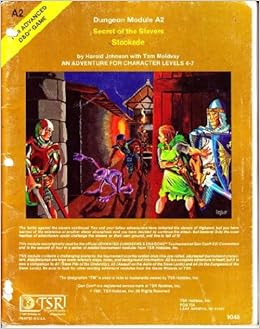
A while back I cajoled a friend of mine to run the A-series for our group so that I could experience them as a player before I run them myself ... our group usually plays 5e (it's the Jungles of Chult group, and we also crawl in this referee-friends homebrew dungeon with a different set of characters), so we don't do the A-series games often, but we did finally do the first half of A2 last night (A1 we did last year some time ...).
In A2, the characters, having dealt with the temple and "undercity slave pits" detailed in "A1: Slave Pits of the Undercity", move on to deal with the slavers' fortress-stockade in the hills above the city of Highport. The first half of the module A2 deals with the fortress itself, while the second half deals with the dungeons beneath (they were originally separate parts of the first round of the tournament at GenCon XIII).
------
So last night we tackled the upper stockade, which is basically a fortress full of hobgoblins. The walls are manned by regular posts of guards, there's a full roster of hobgoblins in the barracks (which number we learned about partway into our foray), and it generally seems like a tough nut to crack for players trying to infiltrate their way in. We were given a couple goals: 1) free the slaves (for a pittance per freed slave or a major boon for all of them freed), 2) a bounty for each hobgoblin killed, and 3) a serious bounty for proof that the slaver leadership was dealt with.
Given those goals and looking up at the blank face of the walls ... we were paralyzed by a lack of information. We searched the dry moat around the fortress for secret entrances to no avail (and magically slept some guard dogs along the way), and ultimately decided to climb our way up into the gatehouse with a thief with a rope.
We managed to distract guards on the walls with an illusion of apes attacking the walls (supported by another attack of real apes elsewhere on the walls) and make our way to the nearest door ... and heard voices behind it. Still wanting to be sneaky, we went around to the other side of the gatehouse, and there ambushed a couple of door guards and a "squelcher", a goblin thing that left behind oily black footprints (turns out it was a "boggle"). We killed them under a silence spell; then dithered long enough that more guards showed up and we had to fight them, and then they went to ring a gong.
This almost alerted the entire fortress, except my Elf character knows the hobgoblin tongue, and she called out that it was all a false alarm, and our referee was generous with the reactions that he rolled.
Ultimately, we managed to capture a few hobgoblins, and another character of mine, a thief/magic-user, charmed one of them with a spell. This was our breakthrough; we talked the fellow into taking us to the leadership so that we could talk through a business deal, and he went for it. While he led his one friend along seeking the leaders, the rest of the party followed behind under cover of invisibility 10'.'
Finally, we found ourselves in a courtyard with a fountain; a number of clearly badass NPCs showed up wondering who we were. A brief parlay ensued (actually, they offered to join my main character's chaotic cult with an absurdly high reactions roll ... but the rest of the party wanted to kill, and so they fireballed the bad guys while my guy's tears of failure and loss turned into steam from the fireball in front of him). And with that show of force and murdering of the leadership, we impressed the hobgoblins into surrendering the slaves to us and possibly hiring themselves out as mercenaries for my cult.
Whenever we play again, we'll be tackling the dungeon ...
------
Long story short, we didn't actually interact with very much of the module. We interacted with maybe half a dozen of 39 or so keyed locations on the map for the stockade. So from a player side I can't speak to the wealth or dearth of good material ...
What I can say is that I seem to recall reading somewhere (can't find it now) that A2's stockade was a notoriously difficult module to tackle for players, given that it's a fortress full of alert guards, and without much information where to aim a decapitation strike or to seek for treasure. It seemed to live up to that trouble in our play-through--sure, we had a generous DM who allowed our pathetic attempts to call off the alarm work, but if we hadn't done that, we'd have faced the entire garrison of hobgoblins, and even the -2 AC of our pregen ranger might not have saved her skin. Plus, one of my characters has a ring of invisibility, which is about the most useful thing ever for sneaking and all.
On the flipside, though, we dealt with the leadership easily once we got them out into the open where we could fireball them from surprise (hold person knocked another badass NPC out too). So the session was also a reminder that player chutzpah is probably more important a thing than any character's attribute scores ...
But the REAL thing I wanted to comment on was ease of use at the table--because it was clearly NOT easy to use at all, and made it clear to me that I'll have to do a lot of prep work with this module before I actually run it. Our game ran for maybe five hours, but the amount of material we covered could probably have been done in three. Our poor referee had to keep flipping back and forth through the book, digging through the room descriptions for key information.
The map of the stockade is split with two different color-codes. Half is shaded blue, the other half left white; we originally thought that must mean that a space is open to the air or not, but in retrospect I suspect it actually delineates tournament areas from module areas. In A1, at least, the module declares which areas are which; but A2 has no such delineation, letting the referee muddle through on his own (unless I'm blind and it does say it somewhere in the description).
Beyond that, it seemed like several rooms involved his checking the map several times for orientation, and checking the description to make sure he had everything prepped in his head. And still sometimes he had to go back ... e.g. the module is "supposed" to open with the characters climbing a rope up the wall left behind by an escaped slave; but our referee, reading that a rope hung below a guard post, assumed that each guard post must have a rope hanging from it. Only later did he redact it (fortunately without us having climbed any yet), when he finally read the relevant information that it was the escaped slave's rope.
All in all, it was a fun adventure--infiltrating a fortress was definitely a test of our wits! And it seems like the information within was solid, just not well-presented. Perhaps with a little more preparation (or editing), this module could be run smoothly and would provide a great challenge for characters who think they can solve every problem ...
A while back I cajoled a friend of mine to run the A-series for our group so that I could experience them as a player before I run them myself ... our group usually plays 5e (it's the Jungles of Chult group, and we also crawl in this referee-friends homebrew dungeon with a different set of characters), so we don't do the A-series games often, but we did finally do the first half of A2 last night (A1 we did last year some time ...).
In A2, the characters, having dealt with the temple and "undercity slave pits" detailed in "A1: Slave Pits of the Undercity", move on to deal with the slavers' fortress-stockade in the hills above the city of Highport. The first half of the module A2 deals with the fortress itself, while the second half deals with the dungeons beneath (they were originally separate parts of the first round of the tournament at GenCon XIII).
------
So last night we tackled the upper stockade, which is basically a fortress full of hobgoblins. The walls are manned by regular posts of guards, there's a full roster of hobgoblins in the barracks (which number we learned about partway into our foray), and it generally seems like a tough nut to crack for players trying to infiltrate their way in. We were given a couple goals: 1) free the slaves (for a pittance per freed slave or a major boon for all of them freed), 2) a bounty for each hobgoblin killed, and 3) a serious bounty for proof that the slaver leadership was dealt with.
Given those goals and looking up at the blank face of the walls ... we were paralyzed by a lack of information. We searched the dry moat around the fortress for secret entrances to no avail (and magically slept some guard dogs along the way), and ultimately decided to climb our way up into the gatehouse with a thief with a rope.
We managed to distract guards on the walls with an illusion of apes attacking the walls (supported by another attack of real apes elsewhere on the walls) and make our way to the nearest door ... and heard voices behind it. Still wanting to be sneaky, we went around to the other side of the gatehouse, and there ambushed a couple of door guards and a "squelcher", a goblin thing that left behind oily black footprints (turns out it was a "boggle"). We killed them under a silence spell; then dithered long enough that more guards showed up and we had to fight them, and then they went to ring a gong.
This almost alerted the entire fortress, except my Elf character knows the hobgoblin tongue, and she called out that it was all a false alarm, and our referee was generous with the reactions that he rolled.
Ultimately, we managed to capture a few hobgoblins, and another character of mine, a thief/magic-user, charmed one of them with a spell. This was our breakthrough; we talked the fellow into taking us to the leadership so that we could talk through a business deal, and he went for it. While he led his one friend along seeking the leaders, the rest of the party followed behind under cover of invisibility 10'.'
Finally, we found ourselves in a courtyard with a fountain; a number of clearly badass NPCs showed up wondering who we were. A brief parlay ensued (actually, they offered to join my main character's chaotic cult with an absurdly high reactions roll ... but the rest of the party wanted to kill, and so they fireballed the bad guys while my guy's tears of failure and loss turned into steam from the fireball in front of him). And with that show of force and murdering of the leadership, we impressed the hobgoblins into surrendering the slaves to us and possibly hiring themselves out as mercenaries for my cult.
Whenever we play again, we'll be tackling the dungeon ...
------
Long story short, we didn't actually interact with very much of the module. We interacted with maybe half a dozen of 39 or so keyed locations on the map for the stockade. So from a player side I can't speak to the wealth or dearth of good material ...
What I can say is that I seem to recall reading somewhere (can't find it now) that A2's stockade was a notoriously difficult module to tackle for players, given that it's a fortress full of alert guards, and without much information where to aim a decapitation strike or to seek for treasure. It seemed to live up to that trouble in our play-through--sure, we had a generous DM who allowed our pathetic attempts to call off the alarm work, but if we hadn't done that, we'd have faced the entire garrison of hobgoblins, and even the -2 AC of our pregen ranger might not have saved her skin. Plus, one of my characters has a ring of invisibility, which is about the most useful thing ever for sneaking and all.
On the flipside, though, we dealt with the leadership easily once we got them out into the open where we could fireball them from surprise (hold person knocked another badass NPC out too). So the session was also a reminder that player chutzpah is probably more important a thing than any character's attribute scores ...
But the REAL thing I wanted to comment on was ease of use at the table--because it was clearly NOT easy to use at all, and made it clear to me that I'll have to do a lot of prep work with this module before I actually run it. Our game ran for maybe five hours, but the amount of material we covered could probably have been done in three. Our poor referee had to keep flipping back and forth through the book, digging through the room descriptions for key information.
The map of the stockade is split with two different color-codes. Half is shaded blue, the other half left white; we originally thought that must mean that a space is open to the air or not, but in retrospect I suspect it actually delineates tournament areas from module areas. In A1, at least, the module declares which areas are which; but A2 has no such delineation, letting the referee muddle through on his own (unless I'm blind and it does say it somewhere in the description).
Beyond that, it seemed like several rooms involved his checking the map several times for orientation, and checking the description to make sure he had everything prepped in his head. And still sometimes he had to go back ... e.g. the module is "supposed" to open with the characters climbing a rope up the wall left behind by an escaped slave; but our referee, reading that a rope hung below a guard post, assumed that each guard post must have a rope hanging from it. Only later did he redact it (fortunately without us having climbed any yet), when he finally read the relevant information that it was the escaped slave's rope.
All in all, it was a fun adventure--infiltrating a fortress was definitely a test of our wits! And it seems like the information within was solid, just not well-presented. Perhaps with a little more preparation (or editing), this module could be run smoothly and would provide a great challenge for characters who think they can solve every problem ...
Subscribe to:
Posts (Atom)