Several weeks ago (both real-time and game-time) a couple players in the Greyhame Game helped Einan Wife-Lover and his band of dwarves reclaim the old dwarf-hold of Khundrukar (from the 3e module Forge of Fury). The dwarves wanted to assault the front themselves to see firsthand how the defenses worked (or not), they wanted a band of adventurers to infiltrate through a secret way through the side of the mountain and to come up and destroy the orcs inside from behind. They offered a good percentage of the treasure recovered from within as payment.
This assault went off so well that the dwarves, in the same session, asked for help clearing the lower levels. While Einan and company dealt with the duergar on the third level, the adventurers (Baby Face, Ikasha the Starchild, Valor Justice, Little Bob, and Rolf Rolfson) descended all the way to the black lake in the depths to deal with the dragon there. The dragon killed Baby Face and Valor Justice with its first breath attack, but was ultimately overwhelmed when it got a whiff of dragonrose that put it to sleep, and then the party murdered it. Poor dragon.
All of this is a preamble to the fact that now there is a colony of dwarves about three days' travel away from Brakeridge, in the mountains just east of the walled town of Bardastead (which lies due north of Brakeridge). Dwarves who feel, perhaps, that they owe something to the characters who helped them, and also that they have a new market of men to whom to sell their wares, and from whom to buy foodstuffs.
So dwarf items are going to enter into the market at the game table. Especially when Einan Wife-Lover and company build a trading post just outside of Brakeridge ... Anyway, these are the items that are potentially available at Einan's Trading Post:
------
1 - a bearded helm, i.e. a helm with joined cheek-plates formed in imitation of a dwarf's long beard. Forged with superior dwarvish iron and steel, and covering the entire face, these helms grant a bonus of -1 to AC when worn ... though being so enclosed, they make it difficult for clerics or Elves wearing them to cast spells (1 in 6 chance of a spell fizzling), and make hearing for any character significantly more difficult (1 in 10 chance rather than 1 in 6).
2 - a suit of dwarf articulated plate armor is available--or a fitting for it, rather, as a dwarf armorer is in town and willing to get the measurements for one individual for whom he will build a suit of this excellent armor (AC 2). The armor will be ready one month from the time of the measurements. It is made specifically for the person fitted--anyone else attempting to wear it will have an AC of 5 instead, until it is refitted (costs three quarters as much as the armor, requires a separate fitting session, 2 in 6 chance it doesn't work anyway)
3 - a goldsniffer, that is, a little ferret-like creature with golden fur and eight legs. It can detect metal (gold only) at will within 60', even through rock (so it can smell ore veins), and will beg and whine to be fed gold. "Do not under any circumstances feed it gold!" the seller will admonish prospective buyers. (Goldsniffer -- HD 1-1, AC 5, attacks 1-2/1-2/1-3, M7, saves F1)
4 - a matching set of dwarvish had and boots; the boots will of course have to be fitted and cobbled, which will take a week, but you can wear the hat now. The hat comes in two styles, the high stiff conical style of the gnomes, or the long floppy tasseled style of the dwarves. The boots, once broken in, allow a person to travel/hike 25% farther than otherwise because of their sturdy nature. But woe to he who wears the boots without the hat--dwarves will consider it a grave insult to their culture, and reactions will be surly and unpleasant.
5 - hallucinogenic mushrooms that, when eaten, cause intense hallucinations and a usually euphoric high, though the "trip" could turn into a nightmare under threatening circumstances. The eater is confused as the spell for 1-3 hours per dose (though unless the trip has turned ugly, treat "attacks others" as feeling them up, or talking to them as if they're a disembodied mouth or something)
6 - a set of jewelers' eyes, which are eye glasses with multiple lenses of varying magnification for use in appraising and cutting gemstones of various size. Thieves may use them too, however, gaining a +10% to their ability to find/remove traps, and to their open locks ability. They are glasses, however, and easily broken if not stored properly!
7 - 1-3 bee bombs are for sale. These clay globes contain a dozen or so wasps or bees, kept in an enchanted sleep by runes etched inside the globe. To "prime" it, first it must be shaken, to waken and anger the bees; then hurl it at a foe and laugh as they're tormented by a cloud of stinging insects for 2-4 rounds, dealing 1 damage each round, causing the target to take a -1 penalty to hit and to saves, and preventing spellcasting
8 - a beard-care kit, which includes a variety of small scissors, a hand mirror, beard combs, beard oils, beard-ties, etc. An individual who has a beard, and who uses this kit continually each week will gain +1 reactions with other humans and demi-humans
9 - a linden shield which is constructed of a softer wood than most shields, and built in such a way that it can be used to bind a bladed or piercing weapon by catching the blade deep in the wood. That is, in lieu of an attack, a character may destroy the shield to bind the weapon of an enemy in melee and then attempt to rip that weapon out of the enemy's hands. The shield is useless after this
10 - a sevenfold shield, which is so heavily built that it provides a bonus of -2 to AC, but being so heavy, it cannot be "splintered" to block a successful attack like other shields in my game.
11 - a runic weapon, its metallic blade or head traced with semi-magical dwarvish runes. The small amount of magic in the runes can only be used once per day, by reading the runes aloud, and the effect lasts from 1-10 rounds. It allows the weapon to strike creatures hit only by silver or magical weapons, though it does no extra damage.
12 - a dark flower ... suffused with arcane power, these flowers grow in the deep places of the world where ley lines run and cross. Eating one causes the body to become magical for 1-6 turns, able to detect magic 30' at will, +1 to hit and to damage, +1 to saves, and -1 bonus to AC.
BUT, magic-users or Elves with spells memorized who eat a darkflower will spontaneously cast one memorized spell at random, and they then suffer a major migraine (-1 to all rolls) for the duration of the effect.
At the end of the effects, any character who ate of a darkflower will be drained fro 1-3 hours, at -1 penalty on all rolls, and must save v. poison to resist becoming addicted.
Showing posts with label dwarves. Show all posts
Showing posts with label dwarves. Show all posts
Monday, June 18, 2018

Friday, March 16, 2018
the Memory of the Elves
Over at Pits Perilous is a post about "Age and the Elven Character ...", and at Echoes from the Geekcave, a tangentially related post about the Staff of Withering, a magic item that causes accelerated ageing in mortals, but to which Elves and dwarves are less susceptible.
These got me thinking a little about Elf-characters in my game, and what answer I might give to a player if they were suddenly to remember that their character is presumably an ancient being that has existed in the world since the first glimmering of starlight, from the age before the Rainbow Bridge was set against Heaven to join the realms of the gods with those of men below ...
The short answer, to be honest, is that I generally assume that all new characters are foreigners to the particular part of the world I've established as my setting. Like Barker's "Empire of the Petal Throne", new characters are all "fresh off the boat" in a new world--even if the Elves (and dwarves, to a lesser extent) do have long and ancient memories, they're memories concerning some other place in the world. What good will a full knowledge of the history of the Ethiopian kings and queens do you when delving in dungeons in England, really?
Moreover, Elves and men are fundamentally, metaphysically different, a thing which is easy to forget when your character is just some numbers and a list of equipment and spells on a sheet of paper before you. I do emphasize the difference during play--Elves do not have mortal souls in my game, and they do not age, and as such Elves may not be of Good, Lawul, or Evil alignment. But the differences extend beyond that--why do demihumans have level restrictions while humans do not? The old explanation I've always had for that was that Elves (and other demihumans) do not live in the present as well as humans do. Given so much time with which to live, they do not feel the pressing need to always be learning and remembering things--while the humans are all running around gaining experience and leveling up as fast they can, the Elves are dawdling, meditating by the river, learning the names of the trees of the forest and watching them season by season ...
Which is to say, if the Elves are doing such things (and always partying in the perpetual summer of their youth to boot), then their long memories are going to be filled with the songs of the winds, and the names of the trees of the forest, and how the generations of foxes in the woods have developed a new mouse-hunting culture, and all kinds of supremely local but generally useless things. Now, assuming that a first level Elf is one of these forest children who has decided that a life of adventuring would be fine for a while, their entry into human culture is going to be one without any memory of the histories of men. So Thidrek Silverhelm was prince here two hundred years ago?--so what? I was following the otters in the rivers two hundred years ago, and I learned some of the poetry of their folk, and when the best times to fish for trout are versus when to fish for perch. Etc.
On the other hand ... so your Elf character has a long memory and wants to know the kinds of things he or she recalls? One could take the opportunity as referee to respond with an infodump (and to gleefully bore the player to tears until they get back to dungeoneering, if you want!): So there were seventeen princes in the area in the past couple centuries. The first was Born Ironfist, and he ruled the area with his strength until he was overthrown by his treacherous captain of the guard, Baric the Bald. Then Baric had to fight long wars against the other lords who had been subject to Born to maintain his rule, etc. etc. It would be fair to point out that with such a vast memory, it's difficult to remember any particular thing; but that maybe with enough time meditating, the character could remember something relevant to whatever thing in memory he was seeking ...
Going into this, I thought I might ultimately write down some kind of random table of historical facts an Elf (or dwarf, to a lesser extent), might know, but I think I have a better idea for a gameable idea.
------
Elfin Memory
This is a class ability to be added to the other special rules to be used when playing an Elf-class character. (or a Free Goblin character in my game, as goblins and Elves come of the same stock)
Because of their immortal lifespans (barring death by accident, violence, or disease), Elves have deep memories of lore and past things--but very few such memories are retained or called up at any moment by the conscious mind. If an Elf character wishes to remember something in particular--an item of legend, the lyrics of an ancient lay, the proper names and means of address of all the trees of the forest, or any of the myriad details of history--he may go into a kind of meditative trance and "sift" through his memories.
Each day spent doing so allows a cumulative 5% chance of remembering something relevant to the object of thought that the referee may relate, i.e. at the end of three days meditating there is a 15% chance that the Elf has recalled something relevant. It may not be anything obviously or immediately useful--the particulars of the memory are up to the referee to decide.
This is not without a risk, of course. At the end of the trance, the Elf character must make a saving throw against death, and for each day after the first spent "sifting" through memories in this manner the save is made with a cumulative -1 penalty. Success indicates that the Elf returns without any trouble, but a failure means that the Elf has been overcome with nostalgia for the starlit forests of Elfland and/or has touched however briefly the absurdity of eternal thinking existence without a soul. The character must return to Elfland (wherever that may be--could even just be a nearby forest if you're a kind referee) as soon as possible or begin to waste away (losing one level per month, maybe), and must remain in Elfland from 1-6 months to throw off the mental fugue. After that they're free to return to adventure in the mortal world again.
(the player could run another character for the duration, or play could move to Elfland and whatever weird adventures are to be had there, if everyone is amenable ... and time could flow strangely for mortals there as well if one wanted to get crazy and change the mortal world while all are away!)
Dwarven Memory
The same as Elfin Memory, except for a couple of items:
1) Dwarves will only have memories from 0-500 years back (1d6-1 x 100)--as dwarves are not immortal, just extremely long-lived by mortal standards.
2) Dwarves receive a +5% bonus to any attempt to remember details about architecture, caves, stoneworking, crafted items, etc.--the kinds of things dwarves should stereotypically know anyway.
3) Dwarf saving throws nicely model the fact that dwarves are already more in line with human society anyway, and so "sifting" through their memories will be less likely to drive them back to their halls of stone (because of their good saves) than an Elf of the same level.
These got me thinking a little about Elf-characters in my game, and what answer I might give to a player if they were suddenly to remember that their character is presumably an ancient being that has existed in the world since the first glimmering of starlight, from the age before the Rainbow Bridge was set against Heaven to join the realms of the gods with those of men below ...
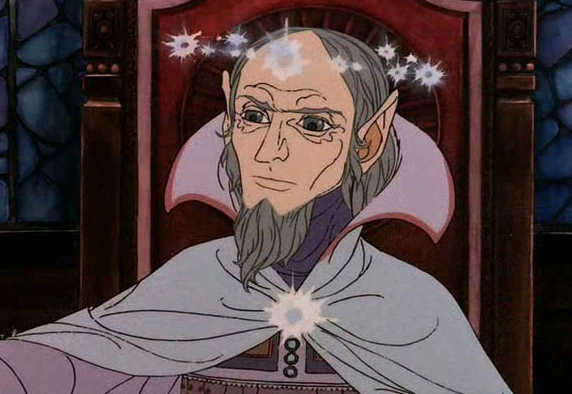 |
| "I was there, Gandalf ... I was there three thousand years ago ..." |
The short answer, to be honest, is that I generally assume that all new characters are foreigners to the particular part of the world I've established as my setting. Like Barker's "Empire of the Petal Throne", new characters are all "fresh off the boat" in a new world--even if the Elves (and dwarves, to a lesser extent) do have long and ancient memories, they're memories concerning some other place in the world. What good will a full knowledge of the history of the Ethiopian kings and queens do you when delving in dungeons in England, really?
Moreover, Elves and men are fundamentally, metaphysically different, a thing which is easy to forget when your character is just some numbers and a list of equipment and spells on a sheet of paper before you. I do emphasize the difference during play--Elves do not have mortal souls in my game, and they do not age, and as such Elves may not be of Good, Lawul, or Evil alignment. But the differences extend beyond that--why do demihumans have level restrictions while humans do not? The old explanation I've always had for that was that Elves (and other demihumans) do not live in the present as well as humans do. Given so much time with which to live, they do not feel the pressing need to always be learning and remembering things--while the humans are all running around gaining experience and leveling up as fast they can, the Elves are dawdling, meditating by the river, learning the names of the trees of the forest and watching them season by season ...
Which is to say, if the Elves are doing such things (and always partying in the perpetual summer of their youth to boot), then their long memories are going to be filled with the songs of the winds, and the names of the trees of the forest, and how the generations of foxes in the woods have developed a new mouse-hunting culture, and all kinds of supremely local but generally useless things. Now, assuming that a first level Elf is one of these forest children who has decided that a life of adventuring would be fine for a while, their entry into human culture is going to be one without any memory of the histories of men. So Thidrek Silverhelm was prince here two hundred years ago?--so what? I was following the otters in the rivers two hundred years ago, and I learned some of the poetry of their folk, and when the best times to fish for trout are versus when to fish for perch. Etc.
On the other hand ... so your Elf character has a long memory and wants to know the kinds of things he or she recalls? One could take the opportunity as referee to respond with an infodump (and to gleefully bore the player to tears until they get back to dungeoneering, if you want!): So there were seventeen princes in the area in the past couple centuries. The first was Born Ironfist, and he ruled the area with his strength until he was overthrown by his treacherous captain of the guard, Baric the Bald. Then Baric had to fight long wars against the other lords who had been subject to Born to maintain his rule, etc. etc. It would be fair to point out that with such a vast memory, it's difficult to remember any particular thing; but that maybe with enough time meditating, the character could remember something relevant to whatever thing in memory he was seeking ...
Going into this, I thought I might ultimately write down some kind of random table of historical facts an Elf (or dwarf, to a lesser extent), might know, but I think I have a better idea for a gameable idea.
------
Elfin Memory
This is a class ability to be added to the other special rules to be used when playing an Elf-class character. (or a Free Goblin character in my game, as goblins and Elves come of the same stock)
Because of their immortal lifespans (barring death by accident, violence, or disease), Elves have deep memories of lore and past things--but very few such memories are retained or called up at any moment by the conscious mind. If an Elf character wishes to remember something in particular--an item of legend, the lyrics of an ancient lay, the proper names and means of address of all the trees of the forest, or any of the myriad details of history--he may go into a kind of meditative trance and "sift" through his memories.
Each day spent doing so allows a cumulative 5% chance of remembering something relevant to the object of thought that the referee may relate, i.e. at the end of three days meditating there is a 15% chance that the Elf has recalled something relevant. It may not be anything obviously or immediately useful--the particulars of the memory are up to the referee to decide.
This is not without a risk, of course. At the end of the trance, the Elf character must make a saving throw against death, and for each day after the first spent "sifting" through memories in this manner the save is made with a cumulative -1 penalty. Success indicates that the Elf returns without any trouble, but a failure means that the Elf has been overcome with nostalgia for the starlit forests of Elfland and/or has touched however briefly the absurdity of eternal thinking existence without a soul. The character must return to Elfland (wherever that may be--could even just be a nearby forest if you're a kind referee) as soon as possible or begin to waste away (losing one level per month, maybe), and must remain in Elfland from 1-6 months to throw off the mental fugue. After that they're free to return to adventure in the mortal world again.
(the player could run another character for the duration, or play could move to Elfland and whatever weird adventures are to be had there, if everyone is amenable ... and time could flow strangely for mortals there as well if one wanted to get crazy and change the mortal world while all are away!)
Dwarven Memory
The same as Elfin Memory, except for a couple of items:
1) Dwarves will only have memories from 0-500 years back (1d6-1 x 100)--as dwarves are not immortal, just extremely long-lived by mortal standards.
2) Dwarves receive a +5% bonus to any attempt to remember details about architecture, caves, stoneworking, crafted items, etc.--the kinds of things dwarves should stereotypically know anyway.
3) Dwarf saving throws nicely model the fact that dwarves are already more in line with human society anyway, and so "sifting" through their memories will be less likely to drive them back to their halls of stone (because of their good saves) than an Elf of the same level.
Subscribe to:
Posts (Atom)