Several weeks ago (both real-time and game-time) a couple players in the Greyhame Game helped Einan Wife-Lover and his band of dwarves reclaim the old dwarf-hold of Khundrukar (from the 3e module Forge of Fury). The dwarves wanted to assault the front themselves to see firsthand how the defenses worked (or not), they wanted a band of adventurers to infiltrate through a secret way through the side of the mountain and to come up and destroy the orcs inside from behind. They offered a good percentage of the treasure recovered from within as payment.
This assault went off so well that the dwarves, in the same session, asked for help clearing the lower levels. While Einan and company dealt with the duergar on the third level, the adventurers (Baby Face, Ikasha the Starchild, Valor Justice, Little Bob, and Rolf Rolfson) descended all the way to the black lake in the depths to deal with the dragon there. The dragon killed Baby Face and Valor Justice with its first breath attack, but was ultimately overwhelmed when it got a whiff of dragonrose that put it to sleep, and then the party murdered it. Poor dragon.
All of this is a preamble to the fact that now there is a colony of dwarves about three days' travel away from Brakeridge, in the mountains just east of the walled town of Bardastead (which lies due north of Brakeridge). Dwarves who feel, perhaps, that they owe something to the characters who helped them, and also that they have a new market of men to whom to sell their wares, and from whom to buy foodstuffs.
So dwarf items are going to enter into the market at the game table. Especially when Einan Wife-Lover and company build a trading post just outside of Brakeridge ... Anyway, these are the items that are potentially available at Einan's Trading Post:
------
1 - a bearded helm, i.e. a helm with joined cheek-plates formed in imitation of a dwarf's long beard. Forged with superior dwarvish iron and steel, and covering the entire face, these helms grant a bonus of -1 to AC when worn ... though being so enclosed, they make it difficult for clerics or Elves wearing them to cast spells (1 in 6 chance of a spell fizzling), and make hearing for any character significantly more difficult (1 in 10 chance rather than 1 in 6).
2 - a suit of dwarf articulated plate armor is available--or a fitting for it, rather, as a dwarf armorer is in town and willing to get the measurements for one individual for whom he will build a suit of this excellent armor (AC 2). The armor will be ready one month from the time of the measurements. It is made specifically for the person fitted--anyone else attempting to wear it will have an AC of 5 instead, until it is refitted (costs three quarters as much as the armor, requires a separate fitting session, 2 in 6 chance it doesn't work anyway)
3 - a goldsniffer, that is, a little ferret-like creature with golden fur and eight legs. It can detect metal (gold only) at will within 60', even through rock (so it can smell ore veins), and will beg and whine to be fed gold. "Do not under any circumstances feed it gold!" the seller will admonish prospective buyers. (Goldsniffer -- HD 1-1, AC 5, attacks 1-2/1-2/1-3, M7, saves F1)
4 - a matching set of dwarvish had and boots; the boots will of course have to be fitted and cobbled, which will take a week, but you can wear the hat now. The hat comes in two styles, the high stiff conical style of the gnomes, or the long floppy tasseled style of the dwarves. The boots, once broken in, allow a person to travel/hike 25% farther than otherwise because of their sturdy nature. But woe to he who wears the boots without the hat--dwarves will consider it a grave insult to their culture, and reactions will be surly and unpleasant.
5 - hallucinogenic mushrooms that, when eaten, cause intense hallucinations and a usually euphoric high, though the "trip" could turn into a nightmare under threatening circumstances. The eater is confused as the spell for 1-3 hours per dose (though unless the trip has turned ugly, treat "attacks others" as feeling them up, or talking to them as if they're a disembodied mouth or something)
6 - a set of jewelers' eyes, which are eye glasses with multiple lenses of varying magnification for use in appraising and cutting gemstones of various size. Thieves may use them too, however, gaining a +10% to their ability to find/remove traps, and to their open locks ability. They are glasses, however, and easily broken if not stored properly!
7 - 1-3 bee bombs are for sale. These clay globes contain a dozen or so wasps or bees, kept in an enchanted sleep by runes etched inside the globe. To "prime" it, first it must be shaken, to waken and anger the bees; then hurl it at a foe and laugh as they're tormented by a cloud of stinging insects for 2-4 rounds, dealing 1 damage each round, causing the target to take a -1 penalty to hit and to saves, and preventing spellcasting
8 - a beard-care kit, which includes a variety of small scissors, a hand mirror, beard combs, beard oils, beard-ties, etc. An individual who has a beard, and who uses this kit continually each week will gain +1 reactions with other humans and demi-humans
9 - a linden shield which is constructed of a softer wood than most shields, and built in such a way that it can be used to bind a bladed or piercing weapon by catching the blade deep in the wood. That is, in lieu of an attack, a character may destroy the shield to bind the weapon of an enemy in melee and then attempt to rip that weapon out of the enemy's hands. The shield is useless after this
10 - a sevenfold shield, which is so heavily built that it provides a bonus of -2 to AC, but being so heavy, it cannot be "splintered" to block a successful attack like other shields in my game.
11 - a runic weapon, its metallic blade or head traced with semi-magical dwarvish runes. The small amount of magic in the runes can only be used once per day, by reading the runes aloud, and the effect lasts from 1-10 rounds. It allows the weapon to strike creatures hit only by silver or magical weapons, though it does no extra damage.
12 - a dark flower ... suffused with arcane power, these flowers grow in the deep places of the world where ley lines run and cross. Eating one causes the body to become magical for 1-6 turns, able to detect magic 30' at will, +1 to hit and to damage, +1 to saves, and -1 bonus to AC.
BUT, magic-users or Elves with spells memorized who eat a darkflower will spontaneously cast one memorized spell at random, and they then suffer a major migraine (-1 to all rolls) for the duration of the effect.
At the end of the effects, any character who ate of a darkflower will be drained fro 1-3 hours, at -1 penalty on all rolls, and must save v. poison to resist becoming addicted.
Showing posts with label d12 table. Show all posts
Showing posts with label d12 table. Show all posts
Monday, June 18, 2018

Sunday, February 4, 2018
Alternative Treasure -- Value as Experience, not Gold
I sometimes daydream about writing my own treasure tables ... tables in which the category of "Jewelry" is not merely a number of items whose value is each 3d6 x 100 gp, but which includes a wider variety of values, and a number of specific and evocative items that are valuable, though not necessarily obviously so.
I dream of such things, but I tend to put my mind to other uses for the game, like designing new dungeons, new monsters, and new tricks; for treasure, I usually faithfully roll out the percentages per "treasure type", adjusting on the fly as seems to be needed. If I'm really motivated, I'll describe the pieces of jewelry--a gilded panoply, or a golden death mask, etc.--or replace the 1000s of gold or silver pieces with some other form of wealth, like ingots of copper or crates of trade goods.
So I was recently looking through a dungeon of mine, its hoards rolled up faithfully according to the B/X treasure charts, and I saw an excess of pieces of jewelry, all notated as JEWELRY: (1000) (600) (1400) (1300) etc. according to gp value rolled on 3d6 ... and a thought came to me as I tried to imagine what these pieces were--what if some of them were in fact not worth that amount of gold, but could be donated to the right cult or other party for their value in experience instead (as a limiting factor in the amount of gold I'm giving out ...)? I suppose these are basically "quest" items that grant "quest" xp--except their use would be to reduce "excessive" wealth from a rolled up hoard, yet to still grant xp for those characters willing to do a little extra leg work outside the dungeon.
Here are a few examples I came up with for a d12 roll--obviously just scratching the surface of what could be:
1) an altar service of wood and ceramic plates, cups, platters, etc. These humble items are of little value on the open market (maybe 25 gp if you're fortunate), but their very humbleness is sacred and symbolic to the Good cults. Returning these items to a local Good cult will net 3d6 x 100 experience
2) an oriflamme of Law, topped with a bronze Hand of Sabazios. Though interesting enough to be sold for half of its value (3d6 x 100), returning this battle standard to a local Law cult of Sabazios will earn its full value in experience for the party

3) a lead-lined cloak of penance, of literally no value on the open market (who wants a cape that literally weighs you down?), it can be turned over to the Good cult for a full 3d6 x 100 experience.
4) --slightly different--a charter of incorporation or a grant of monopoly over certain goods, unfortunately dedicated to some defunct guild or party, or otherwise outdated so that it has no market value. Nevertheless, it is of recent enough vintage that a Thieves' Guild or other such nefarious organization would be willing to buy it for 3d6 x 100 gold in order to use it as a basic standard for forging such documents for their own use
5) the acorn of a dryad's oak, or a sapling/clone of an Elfin aspen grove. It might have some gold value to certain individuals, decided by referee fiat, but otherwise it could be given over to a local Nature cult for a full 3d6 x 100 experience reward (yeah, I played Baldur's Gate II)
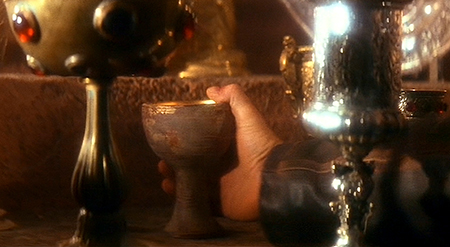
6) a simple wooden or ceramic chalice, a relic of a humble Good saint; perhaps surrounded by gaudy gold and jeweled chalices purporting to be the actual relic, but which are really all trapped with contact poison or a magical curse a la Indiana Jones; regardless, the chalice itself is worth next to nothing except to its relevant cult, earning 3d6 x 100 experience--OR to one who knows its value, in that it fills with water as good as a potion of cure light wounds 1/day when filled with simple water and blessed by a Good cleric

7) a sword of blood (or other metal-dependent weapon, like an axe or mace)--it's a +1 weapon, but because of its origins from iron drawn from the blood of sacrificial victims, Good characters wield it as a -1 weapon instead; but if a character decides to turn it over to the Good cult to redeem the item's inherent evil, they will receive at least 2500 experience
8) a trivial magic item--a cloak of minor comfort or a pot of cleanliness that cleans itself, or maybe a singing candlestick; such an item could be sold as a curio for 2d6 x 100 gold, but if turned over to the Arcane cult, will net the same gold plus 2d6 x 100 experience, or a cool 4d6 x 100 experience if given freely
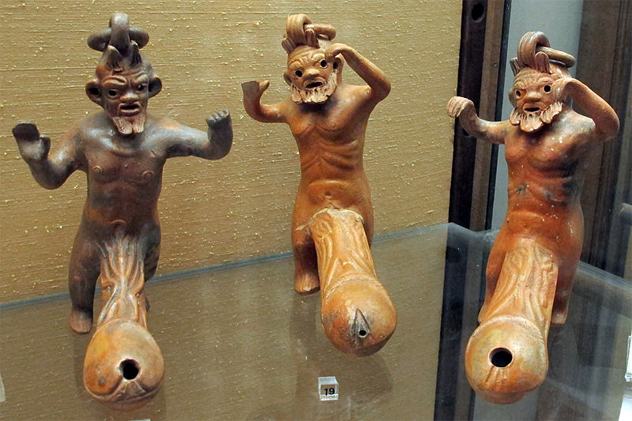
9) a leathern, earthenware, bronze, or smoothed-stone phallus; if you know the right people, the Evil cult will gladly accept it as a "relic" and invite you to an orgy and a mockery of another cult's ritual practices, possibly involving said "relic". The "relic" alone nets 3d6 x 100 experience, but attending the orgy doubles the experience and initiates you into the Evil cult. They'll even let you pet the cat.
10) a collection of river rocks or smoothed over stones. Not just lying around--these are in a chest or some other vessel, clearly important in some way, clearly organized with some sense of size and color, none of them magical or remarkable in any other way. They are the "grok rocks" of the local dwarven Clannish cult (they use them for divination by casting stones, playing marbles, etc.); there are 2-7 of them, each worth 1d4 x 100 experience, not depending on color or size, but on something ineffable about the stone itself
11) any holy symbol or other piece of religious imagery from another cult--rather than sell these for half their value in gold you can remand them to your own cult for the full value in experience instead (100 gold maximum--higher value pieces should be treated as "jewelry", saleable as close to cost as the referee allows, no bonus if given to your cult); Chaotic characters receive double this bonus
12) a ceremonial two-handed sword or other exaggerated weapon, so large and "intimidating" in its construction that it's worthless in battle. Because of the fine materials used in its construction, it can be sold as a typical piece of jewelry (3d6 x 100 gold), but if a Chaotic character takes it to their cult and offers it to their god, they gain 3d6+6 x 100 experience
------
The placement of such items in a treasure to replace those worth gold AND experience is, of course, rooted in that age-old advice of Gygax to limit the amount of gold to which players have access. I don't tend to be anywhere as extreme as his advice suggests one be, but I do worry sometimes about being a kind of monty-haul referee if I'm not careful (exacerbated, no doubt, by the fact that I've played in a few monty-haul type games where I've gotten vast sums for next to no work)
I dream of such things, but I tend to put my mind to other uses for the game, like designing new dungeons, new monsters, and new tricks; for treasure, I usually faithfully roll out the percentages per "treasure type", adjusting on the fly as seems to be needed. If I'm really motivated, I'll describe the pieces of jewelry--a gilded panoply, or a golden death mask, etc.--or replace the 1000s of gold or silver pieces with some other form of wealth, like ingots of copper or crates of trade goods.
So I was recently looking through a dungeon of mine, its hoards rolled up faithfully according to the B/X treasure charts, and I saw an excess of pieces of jewelry, all notated as JEWELRY: (1000) (600) (1400) (1300) etc. according to gp value rolled on 3d6 ... and a thought came to me as I tried to imagine what these pieces were--what if some of them were in fact not worth that amount of gold, but could be donated to the right cult or other party for their value in experience instead (as a limiting factor in the amount of gold I'm giving out ...)? I suppose these are basically "quest" items that grant "quest" xp--except their use would be to reduce "excessive" wealth from a rolled up hoard, yet to still grant xp for those characters willing to do a little extra leg work outside the dungeon.
Here are a few examples I came up with for a d12 roll--obviously just scratching the surface of what could be:
1) an altar service of wood and ceramic plates, cups, platters, etc. These humble items are of little value on the open market (maybe 25 gp if you're fortunate), but their very humbleness is sacred and symbolic to the Good cults. Returning these items to a local Good cult will net 3d6 x 100 experience
2) an oriflamme of Law, topped with a bronze Hand of Sabazios. Though interesting enough to be sold for half of its value (3d6 x 100), returning this battle standard to a local Law cult of Sabazios will earn its full value in experience for the party
3) a lead-lined cloak of penance, of literally no value on the open market (who wants a cape that literally weighs you down?), it can be turned over to the Good cult for a full 3d6 x 100 experience.
4) --slightly different--a charter of incorporation or a grant of monopoly over certain goods, unfortunately dedicated to some defunct guild or party, or otherwise outdated so that it has no market value. Nevertheless, it is of recent enough vintage that a Thieves' Guild or other such nefarious organization would be willing to buy it for 3d6 x 100 gold in order to use it as a basic standard for forging such documents for their own use
5) the acorn of a dryad's oak, or a sapling/clone of an Elfin aspen grove. It might have some gold value to certain individuals, decided by referee fiat, but otherwise it could be given over to a local Nature cult for a full 3d6 x 100 experience reward (yeah, I played Baldur's Gate II)
6) a simple wooden or ceramic chalice, a relic of a humble Good saint; perhaps surrounded by gaudy gold and jeweled chalices purporting to be the actual relic, but which are really all trapped with contact poison or a magical curse a la Indiana Jones; regardless, the chalice itself is worth next to nothing except to its relevant cult, earning 3d6 x 100 experience--OR to one who knows its value, in that it fills with water as good as a potion of cure light wounds 1/day when filled with simple water and blessed by a Good cleric
7) a sword of blood (or other metal-dependent weapon, like an axe or mace)--it's a +1 weapon, but because of its origins from iron drawn from the blood of sacrificial victims, Good characters wield it as a -1 weapon instead; but if a character decides to turn it over to the Good cult to redeem the item's inherent evil, they will receive at least 2500 experience
8) a trivial magic item--a cloak of minor comfort or a pot of cleanliness that cleans itself, or maybe a singing candlestick; such an item could be sold as a curio for 2d6 x 100 gold, but if turned over to the Arcane cult, will net the same gold plus 2d6 x 100 experience, or a cool 4d6 x 100 experience if given freely
9) a leathern, earthenware, bronze, or smoothed-stone phallus; if you know the right people, the Evil cult will gladly accept it as a "relic" and invite you to an orgy and a mockery of another cult's ritual practices, possibly involving said "relic". The "relic" alone nets 3d6 x 100 experience, but attending the orgy doubles the experience and initiates you into the Evil cult. They'll even let you pet the cat.
10) a collection of river rocks or smoothed over stones. Not just lying around--these are in a chest or some other vessel, clearly important in some way, clearly organized with some sense of size and color, none of them magical or remarkable in any other way. They are the "grok rocks" of the local dwarven Clannish cult (they use them for divination by casting stones, playing marbles, etc.); there are 2-7 of them, each worth 1d4 x 100 experience, not depending on color or size, but on something ineffable about the stone itself
11) any holy symbol or other piece of religious imagery from another cult--rather than sell these for half their value in gold you can remand them to your own cult for the full value in experience instead (100 gold maximum--higher value pieces should be treated as "jewelry", saleable as close to cost as the referee allows, no bonus if given to your cult); Chaotic characters receive double this bonus
12) a ceremonial two-handed sword or other exaggerated weapon, so large and "intimidating" in its construction that it's worthless in battle. Because of the fine materials used in its construction, it can be sold as a typical piece of jewelry (3d6 x 100 gold), but if a Chaotic character takes it to their cult and offers it to their god, they gain 3d6+6 x 100 experience
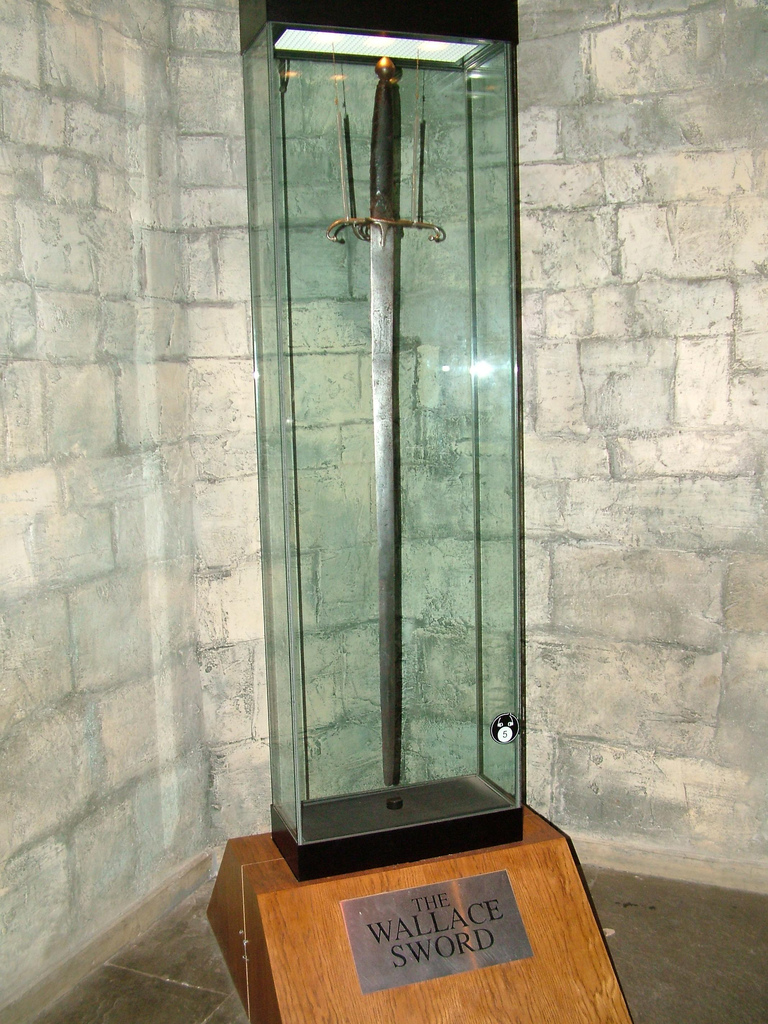 |
| "It's definitely a giant's sword ... Yeah, I definitely killed it single-handedly ... now I'm dedicating it to the Chaotic Temple of Self-Glorification with a memorial plaque dedicated to me for sweet, sweet XPs ..." |
The placement of such items in a treasure to replace those worth gold AND experience is, of course, rooted in that age-old advice of Gygax to limit the amount of gold to which players have access. I don't tend to be anywhere as extreme as his advice suggests one be, but I do worry sometimes about being a kind of monty-haul referee if I'm not careful (exacerbated, no doubt, by the fact that I've played in a few monty-haul type games where I've gotten vast sums for next to no work)
Friday, December 1, 2017
Charisma ... is it Comeliness, Fame, or Both?
... or something else entirely?
I actually dislike the idea that Charisma represents "Comeliness" or physical beauty, and that is explicitly not what it is in my game. I've had this discussion a couple times at the table to address the assumption that Charisma =/= beauty, but of course it always crops up here and there in offhand assumptions. Not that beauty doesn't play into Charisma, but it is neither necessary or sufficient for high Charisma.
My basic take on Charisma is that it is "charm." Handsome people of course have a natural kind of charm--but it's not difficult to imagine a beautiful person who is so awkward and difficult to get along with that their Charisma actually comes off as "average" right? Likewise, is it difficult to consider a person who would not be considered generically beautiful, and yet when they speak, people are magnetically attracted to their sense of humor, of comedic timing, or just sheer energy? (Hence the table-conversations, pointing out that high Charisma is not just beauty, low Charisma not just ugliness).
(I recently found The Hall of Blue Illumination, a podcast about the setting/game Tekumel/Empire of the Petal Throne, and on Episode 6, around the 16:20 mark, is a discussion of Comeliness in the rules. ... Now, apparently, according to Victor J. Raymond, Comeliness (replacing Charisma in Empire of the Petal Throne) was not original to the rules; and M.A.R Barker, the game creator, did not think that Charisma should be a character abstraction, but should be an outgrowth of actual play; but that Comeliness, as a physical measure of beauty, was an objective thing that a character could possess regardless of the player, like Strength or Constitution. There's something to this as an explanation of the stat ... and I really enjoyed the discussion on the podcast about what Comeliness could do for a game, i.e. slavers or priests hunting for an exceptionally beautiful character ... but for my B/X game I think I still prefer Charisma as something less concrete than mere physical beauty).
Some years ago, I found a post somewhere in the OSR blogosphere (alas, I have no idea where I found it, and I can't give credit where it's due!) discussing Charisma as a measure of fame or reputation. The post suggested that perhaps Charisma should be malleable according to success or failure on dungeon expeditions, to represent Charisma as fame rather than personal charm. I took this and ran with it; so for several years, characters that ran through my dungeons gained 1 point of Charisma (max 18) for every successful expedition (no character deaths, big haul), lost 1 point of Charisma (min 3) for every failure (no wealth, several character deaths), or no change for a wash (good haul and several deaths, or no deaths but no haul). This counted only for "lead" characters--henchmen didn't gain or lose charisma.
I like this rule because it represents well what I think of Charisma, but it has ultimately flattened a part of the game--whenever I turn to certain "old-hand" characters these days to ask for Charisma, I get the same answer: "18". Furthermore, I haven't been using this rule at all in the Greyhame Game ... and that's actually why I'm posting this, because I had a question from one of my old-hand players as to whether I would boost certain recent good hauls with higher Charisma? He offered a suggestion to look at it as fame or renown, a something separate from the attribute as Charisma, and I thought I'd hash something out here.
------
Local Reputation (as local as your referee wants it, be it per bar, per neighborhood, per town, per region, etc.)--roll only for the "captain" of the expedition, if any was elected; otherwise, roll once for one random character who participated
Returning from a Successful Expedition (no character deaths && good haul):
1 - reactions +1 (+4 max)
2 - retainer morale +1 (11 max)
3 - no. retainers +1
4 - basic equipment costs -5% (-50% max)
5 - major services cost -10% (e.g. hiring sages or armorers ... -25% max)
6 - owed one favor (referee discretion, not "worth" more than 1000 gp)
7 - infatuation (someone in town falls for you, for good or ill)
8 - gain attention of Thieves' Guild (referee discretion!)
9 - debt forgiven (1000-6000 gp; OR reactions +1 if no debt owed)
10 - attentions of a patron (referee discretion, but it should be positive)
11 - awesome parties (x2 xp from carousing)
12 - life of the party (x2 gp cost for carousing)
Returning from a Failed Expedition (1+ character deaths && poor or worse haul of loot):
1 - reactions -1 (-4 min)
2 - retainer morale -1 (4 min)
3 - no. retainers -1 (0 min)
4 - basic equipment costs +5% (+50% max)
5 - major services cost +10% (+25% max)
6 - evil reputation (would-be hirelings must roll "accept" twice before taking on with you)
7 - disinterest (someone who was interested in you moves on / you get snubbed in some way)
8 - lose attention of Thieves' Guild / gain attention of loan shark
9 - debt exacerbated--pay now, or owe an extra 50%, and if you don't pay up soon, to jail with you! (if no debt, -1 reactions)
10 - lose patron (if you don't have a patron, gain a bad reputation, e.g. patrons think twice before taking you on as a client)
11 - shunned (1/2 xp from carousing)
12 - ostracized (can't carouse at all!)
This is a rough draft, of course. Is granting it to just the captain too limited? Do d12 rolls offer too many options? Is adding yet another thing to the game too complicating (I would hope that d12 rolls granting 1 addition to a character sheet is better than coming up with some new score to keep track of ... but I don't know.)
Anyway, I'll likely try this out the next Greyhame Game in some way
I actually dislike the idea that Charisma represents "Comeliness" or physical beauty, and that is explicitly not what it is in my game. I've had this discussion a couple times at the table to address the assumption that Charisma =/= beauty, but of course it always crops up here and there in offhand assumptions. Not that beauty doesn't play into Charisma, but it is neither necessary or sufficient for high Charisma.
My basic take on Charisma is that it is "charm." Handsome people of course have a natural kind of charm--but it's not difficult to imagine a beautiful person who is so awkward and difficult to get along with that their Charisma actually comes off as "average" right? Likewise, is it difficult to consider a person who would not be considered generically beautiful, and yet when they speak, people are magnetically attracted to their sense of humor, of comedic timing, or just sheer energy? (Hence the table-conversations, pointing out that high Charisma is not just beauty, low Charisma not just ugliness).
(I recently found The Hall of Blue Illumination, a podcast about the setting/game Tekumel/Empire of the Petal Throne, and on Episode 6, around the 16:20 mark, is a discussion of Comeliness in the rules. ... Now, apparently, according to Victor J. Raymond, Comeliness (replacing Charisma in Empire of the Petal Throne) was not original to the rules; and M.A.R Barker, the game creator, did not think that Charisma should be a character abstraction, but should be an outgrowth of actual play; but that Comeliness, as a physical measure of beauty, was an objective thing that a character could possess regardless of the player, like Strength or Constitution. There's something to this as an explanation of the stat ... and I really enjoyed the discussion on the podcast about what Comeliness could do for a game, i.e. slavers or priests hunting for an exceptionally beautiful character ... but for my B/X game I think I still prefer Charisma as something less concrete than mere physical beauty).
Some years ago, I found a post somewhere in the OSR blogosphere (alas, I have no idea where I found it, and I can't give credit where it's due!) discussing Charisma as a measure of fame or reputation. The post suggested that perhaps Charisma should be malleable according to success or failure on dungeon expeditions, to represent Charisma as fame rather than personal charm. I took this and ran with it; so for several years, characters that ran through my dungeons gained 1 point of Charisma (max 18) for every successful expedition (no character deaths, big haul), lost 1 point of Charisma (min 3) for every failure (no wealth, several character deaths), or no change for a wash (good haul and several deaths, or no deaths but no haul). This counted only for "lead" characters--henchmen didn't gain or lose charisma.
I like this rule because it represents well what I think of Charisma, but it has ultimately flattened a part of the game--whenever I turn to certain "old-hand" characters these days to ask for Charisma, I get the same answer: "18". Furthermore, I haven't been using this rule at all in the Greyhame Game ... and that's actually why I'm posting this, because I had a question from one of my old-hand players as to whether I would boost certain recent good hauls with higher Charisma? He offered a suggestion to look at it as fame or renown, a something separate from the attribute as Charisma, and I thought I'd hash something out here.
------
Local Reputation (as local as your referee wants it, be it per bar, per neighborhood, per town, per region, etc.)--roll only for the "captain" of the expedition, if any was elected; otherwise, roll once for one random character who participated
Returning from a Successful Expedition (no character deaths && good haul):
1 - reactions +1 (+4 max)
2 - retainer morale +1 (11 max)
3 - no. retainers +1
4 - basic equipment costs -5% (-50% max)
5 - major services cost -10% (e.g. hiring sages or armorers ... -25% max)
6 - owed one favor (referee discretion, not "worth" more than 1000 gp)
7 - infatuation (someone in town falls for you, for good or ill)
8 - gain attention of Thieves' Guild (referee discretion!)
9 - debt forgiven (1000-6000 gp; OR reactions +1 if no debt owed)
10 - attentions of a patron (referee discretion, but it should be positive)
11 - awesome parties (x2 xp from carousing)
12 - life of the party (x2 gp cost for carousing)
Returning from a Failed Expedition (1+ character deaths && poor or worse haul of loot):
1 - reactions -1 (-4 min)
2 - retainer morale -1 (4 min)
3 - no. retainers -1 (0 min)
4 - basic equipment costs +5% (+50% max)
5 - major services cost +10% (+25% max)
6 - evil reputation (would-be hirelings must roll "accept" twice before taking on with you)
7 - disinterest (someone who was interested in you moves on / you get snubbed in some way)
8 - lose attention of Thieves' Guild / gain attention of loan shark
9 - debt exacerbated--pay now, or owe an extra 50%, and if you don't pay up soon, to jail with you! (if no debt, -1 reactions)
10 - lose patron (if you don't have a patron, gain a bad reputation, e.g. patrons think twice before taking you on as a client)
11 - shunned (1/2 xp from carousing)
12 - ostracized (can't carouse at all!)
This is a rough draft, of course. Is granting it to just the captain too limited? Do d12 rolls offer too many options? Is adding yet another thing to the game too complicating (I would hope that d12 rolls granting 1 addition to a character sheet is better than coming up with some new score to keep track of ... but I don't know.)
Anyway, I'll likely try this out the next Greyhame Game in some way
Tuesday, November 21, 2017
Eating a Dragon Heart
 |
| Sigurd/Siegfried sucks his thumb after burning it while cooking Fafnir's heart--he is about to understand birdspeech ... |
[after slaying the dragon Fafnir] ... Therewith Sigurd cut out the heart of the worm with the sword called Ridil; but Regin drank of Fafnir's blood, and spake, "Grant me a boon, and do a thing little for thee to do. Bear the heart to the fire, and roast it, and give me thereof to eat."
Then Sigurd went his ways and roasted it on a rod; and when the blood bubbled out he laid his finger thereon to essay it, if it were fully done; and then he set his finger in his mouth, and lo, when the heart-blood of the worm touched his tongue, straightway he knew the voice of all fowls, and heard withal how the wood-peckers chattered in the brake beside him--
"There sittest thou, Sigurd, roasting Fafnir's heart for another, that thou shouldest eat thine ownself, and then thou shouldest become the wisest of all men."
And another spake: "There lies Regin, minded to beguile the man who trusts in him."
But yet again said the third, "Let him smite the head from off him then, and be only lord of all that gold."
And once more the fourth spake and said, "Ah, the wiser were he if he followed after that good counsel, and rode thereafter to Fafnir's lair, and took to him that mighty treasure that lieth there, and then rode over Hindfell, whereas sleeps Brynhild; for there would he get great wisdom. Ah, wise he were, if he did after your redes, and bethought him of his own weal; 'for where wolf's ears are, wolf's teeth are near.'"
Then cried the fifth: "Yea, yea, not so wise is he as I deem him, if he spareth him whose brother he hath slain already."
At last spake the sixth: "Handy and good rede to slay him, and be lord of the treasure!"
Then said Sigurd, "The time is unborn wherein Regin shall be my bane; nay, rather one road shall both these brothers fare."
And therewith he drew his sword Gram and struck off Regin's head. ...
("Chapter XIX: Of the Slaying of Regin, Son of Hreidmar", The Volsung Saga, translated by William Morris and Eirikr Magnusson, 1888, retrieved online from Sacred Texts)
------
Drawing from this instance of Sigurd/Siegfried gaining magical knowledge from the heart of Fafnir (not a true dragon, you might say, being a dwarf transformed by curse into a worm, but bah! a dragon I call him) ... and also from the parallel story of Finn cooking the Salmon of Knowledge, burning his thumb on it, sucking his thumb, and thus gaining knowledge ... in my game, eating the heart of a dragon earns a character magical wisdom, strength, lore, or other strange powers.
Several dragons have been killed over the course of the years, and several hearts eaten, and several powers/advantages gained ... and once I even got a player (my wife!) rolling her eyes at bonuses to her character's attributes, a most coveted use of the wish spell in the ancient days--and she just rolled her eyes! D&D players--you just can't please 'em.
Anyway, for dragon hearts I use a d12 table, because I like the variety without it being overboard. A friend of mine who took to B/X D&D with alacrity and who has hosted a longstanding campaign when I wish to play, took my table and ran with it, adding all kinds of bells and whistles, with saves, percentile dice, etc.--and my characters have taken advantage, believe it well, when we have slain dragons in his game--but I retain the simple d12 table for my game. (Actually, several ... I keep losing them)
So here's the current incarnation:
Eating a Dragon Heart
1 - comprehend languages at will
2 - 1 first level spell, determined at random; can be used even by a character in armor, like an Elf
3 - 1 second level spell, determined at random; can be used even by a character in armor
4 - (1-2) +1 Strength, (3-4) +1 Dexterity, (5-6) +1 Constitution
5 - (1-2) +1 Intelligence, (3-4) +1 Wisdom, (5) +1 INT, +1 Charisma, (6) +1 WIS, +1 CHA
6 - dragon skin, -1 AC, -1 reactions
7 - dragon awe, +1 reactions, enemy Morale -1
8 - dragon power, +1 to hit, +1 to damage
9 - dragon eyes, +1 reactions, charm person 1/day
10 - +1 STR, DEX, CON, max 18
11 - +1 INT, WIS, CHA, max 18
12 - 1 first and 1 second level spell, determined randomly, may be cast by armored characters
Monday, October 9, 2017
d12 More Oddments for Sale
I thought up a few more things than could fit on a d12 roll last night, and I filled in enough for a second table today at work while otherwise stocking shelves mindlessly. I was thinking each session that I would roll 2d12 and take one item from each table for sale that session. Again (per last night's post), these are items that are not regulated by any guild (sages' or magic-users' or any other), nor common enough to have a "market price", so players/characters will have to name a price and either get a reactions-roll as to whether it's enough, or actually role-play some haggling. The general asking price should be at least 100 gp.
Also, again, there's a chance that any item isn't really what the seller says it is, possibly just because the item is some bone claimed to be a saint's bone or a sending bone; or possibly, the item is essentially as-advertised, but defective in a serious way. So:
1 - a dagger fashioned from a killer bee's stinger--essentially a pixie's crysknife--it does 1-3 damage, has enough of the poison sac left for one hit to force a save against poison or die (at +2 on the save), and even if the poison fails, the stinger's barbs force it ever deeper into the wound for 1 additional damage every round, unless an entire round is spent digging it out
2 - a large egg; laid by what, the seller doesn't know, though he probably has some kind of pitch. It might be the egg of an owlbear, a gryphon, a giant eagle, a moa bird, a deinonychus, a demi-dragon, etc. (but it's not reptilian--reptile eggs are soft-shelled and this one is hard-shelled; and yes, a dinosaur is perfectly reasonable, dinosaurs are more birdlike than reptilian, they had feathers dammit). There is a 2 in 6 chance that the egg is inert because it wasn't incubated properly, but would still be worth something as a giant omelet or a sweet painted egg or something
3 - a troll's finger, the largest remaining piece of a destroyed troll, carefully and continuously carved to remain merely a regenerating finger. Sold by an ancient mountain man with an iron stomach who wants to retire--he used the finger as "emergency rations", cutting off a piece here or there to supplement meager rations with protein (no worries, stomach acids denature even troll proteins ...). If not properly carved for a week, it grows into an entire hand that seeks to strangle the character holding it, and then escape into the wilderness to regrow
4 - a vial of green slime; can be thrown like a flask of oil, and if it strikes and breaks on a creature, it begins its process of dissolving armor and clothes and turning flesh into another green slime colony; the colony within the vial is small, and so it only has 1 HD, and it takes twice as long (e.g. 2-8 rds) to do its slime thing
5 - 50% chance, either a piece of smoked salmon of knowledge OR fermented sleeper shark; the salmon of knowledge grants a single use of a random spell, magic-user or clerical; the sleeper shark grants a single use of contact higher plane as the magic-user spell (including esp. the insanity chance!)--those sharks have been around since the beginning of the world, and spoken with ancient aboleths and other strange things.
6 - a ghost pepper, so powerfully spicy that it allows contact with the spirit realm. It's unclear whether this means that eating the pepper raises one to a spiritual plane because of the pain (so like to death), or whether the oils within the pepper are so efficacious that even spirits might be affected by a sword smeared with their residue. That, or both might be possible. Regardless, eating the pepper raw causes 1-4 damage from sheer misery.
7 - the fingerbone (or other like, small remains) of a Good saint, Lawful holy man, or Natural mystic; incorporating it into a holy symbol grants +1 on the roll for number of hit dice affected by a turn undead attempt; possibly it could also be incorporated into a weapon (in the hilts of a sword, for instance, or a mace's head) to allow that weapon to strike undead otherwise struck only by silver or magical weapons
8 - a nosegay of dragonrose; ("dragonrose" is lifted from the animated film "The Flight of Dragons" (1982), a late Rankin & Bass project, and one of my favorite movies from my childhood; this clip has nothing to do with dragronrose, but is indicative of the film's imaginative nature) anyway, dragonrose has a pungent scent, and properties that put even dragons to sleep (given enough quantity); its effect on other creatures, even those of serpentine or lizardlike nature, might be comparable; the nosegay lasts 1-3 weeks before withering away
9 - a sending bone--some kind of spirit has been trapped within this bone (likely smaller than a femur, but larger than a knucklebone), and not necessarily the original owner of the bone. The spirit can be sent with a message to any creature whose name is known, and collect a short response. Unfortunately, such things are finicky creatures, and there is a 1 in 20 chance that the spirit goes berserk and attacks the named individual. Treat it as a shadow
10 - a roll of bark from an Elvish willow grove; it may be chewed directly, brewed into a tea, or worked into a poultice and applied directly to a wound; chewing it cures 1-2 hp of wounds, the tea cures 2-4 hp of wounds but requires a fire and a skin of water, and takes 1 turn to brew, while the poultice must be made over the course of a day, but can be applied to conscious or unconscious characters' wounds to cure 2-4 hp of wounds.
11 - a rowan shield; it performs as a normal shield (-1 AC, may be broken to prevent a "hit" from dealing damage)--but, rowan has a special magical property too. A rowan shield may be "broken" by a character to automatically save on one save against spells ("broken" in that it is sapped of vital forces and left as a brittle husk with no serious protective powers)
12 - a Ring of Unseen Servant OR Referee's Choice; the Ring produces an unseen servant on command (invisible spirit that can do simple things like sweep the floor, do dishes, take arrows out of an enemy's quiver, etc.--but any attack against it dispels it, and it cannot itself attack)--but, there is a distinct possibility that the Ring is actually a Djinni Ring, and that, as an heirloom passed down over several generations, its real power has been forgotten. The Djinni is happy to maintain the charade, masquerading as an unseen servant to quickly complete easy tasks and then return to its own leisure; it would of course be displeased to be discovered, but would have little legitimate pushback against the Ring's owner ... If this item is rolled, I would suggest a new item be created for future rolls, or that the referee pick an item from this or the previous list that seem particularly appropriate to the moment of the campaign (be that best served by usefulness or hilarity or otherwise ...)
Also, again, there's a chance that any item isn't really what the seller says it is, possibly just because the item is some bone claimed to be a saint's bone or a sending bone; or possibly, the item is essentially as-advertised, but defective in a serious way. So:
1 - a dagger fashioned from a killer bee's stinger--essentially a pixie's crysknife--it does 1-3 damage, has enough of the poison sac left for one hit to force a save against poison or die (at +2 on the save), and even if the poison fails, the stinger's barbs force it ever deeper into the wound for 1 additional damage every round, unless an entire round is spent digging it out
2 - a large egg; laid by what, the seller doesn't know, though he probably has some kind of pitch. It might be the egg of an owlbear, a gryphon, a giant eagle, a moa bird, a deinonychus, a demi-dragon, etc. (but it's not reptilian--reptile eggs are soft-shelled and this one is hard-shelled; and yes, a dinosaur is perfectly reasonable, dinosaurs are more birdlike than reptilian, they had feathers dammit). There is a 2 in 6 chance that the egg is inert because it wasn't incubated properly, but would still be worth something as a giant omelet or a sweet painted egg or something
3 - a troll's finger, the largest remaining piece of a destroyed troll, carefully and continuously carved to remain merely a regenerating finger. Sold by an ancient mountain man with an iron stomach who wants to retire--he used the finger as "emergency rations", cutting off a piece here or there to supplement meager rations with protein (no worries, stomach acids denature even troll proteins ...). If not properly carved for a week, it grows into an entire hand that seeks to strangle the character holding it, and then escape into the wilderness to regrow
4 - a vial of green slime; can be thrown like a flask of oil, and if it strikes and breaks on a creature, it begins its process of dissolving armor and clothes and turning flesh into another green slime colony; the colony within the vial is small, and so it only has 1 HD, and it takes twice as long (e.g. 2-8 rds) to do its slime thing
5 - 50% chance, either a piece of smoked salmon of knowledge OR fermented sleeper shark; the salmon of knowledge grants a single use of a random spell, magic-user or clerical; the sleeper shark grants a single use of contact higher plane as the magic-user spell (including esp. the insanity chance!)--those sharks have been around since the beginning of the world, and spoken with ancient aboleths and other strange things.
6 - a ghost pepper, so powerfully spicy that it allows contact with the spirit realm. It's unclear whether this means that eating the pepper raises one to a spiritual plane because of the pain (so like to death), or whether the oils within the pepper are so efficacious that even spirits might be affected by a sword smeared with their residue. That, or both might be possible. Regardless, eating the pepper raw causes 1-4 damage from sheer misery.
7 - the fingerbone (or other like, small remains) of a Good saint, Lawful holy man, or Natural mystic; incorporating it into a holy symbol grants +1 on the roll for number of hit dice affected by a turn undead attempt; possibly it could also be incorporated into a weapon (in the hilts of a sword, for instance, or a mace's head) to allow that weapon to strike undead otherwise struck only by silver or magical weapons
8 - a nosegay of dragonrose; ("dragonrose" is lifted from the animated film "The Flight of Dragons" (1982), a late Rankin & Bass project, and one of my favorite movies from my childhood; this clip has nothing to do with dragronrose, but is indicative of the film's imaginative nature) anyway, dragonrose has a pungent scent, and properties that put even dragons to sleep (given enough quantity); its effect on other creatures, even those of serpentine or lizardlike nature, might be comparable; the nosegay lasts 1-3 weeks before withering away
9 - a sending bone--some kind of spirit has been trapped within this bone (likely smaller than a femur, but larger than a knucklebone), and not necessarily the original owner of the bone. The spirit can be sent with a message to any creature whose name is known, and collect a short response. Unfortunately, such things are finicky creatures, and there is a 1 in 20 chance that the spirit goes berserk and attacks the named individual. Treat it as a shadow
10 - a roll of bark from an Elvish willow grove; it may be chewed directly, brewed into a tea, or worked into a poultice and applied directly to a wound; chewing it cures 1-2 hp of wounds, the tea cures 2-4 hp of wounds but requires a fire and a skin of water, and takes 1 turn to brew, while the poultice must be made over the course of a day, but can be applied to conscious or unconscious characters' wounds to cure 2-4 hp of wounds.
11 - a rowan shield; it performs as a normal shield (-1 AC, may be broken to prevent a "hit" from dealing damage)--but, rowan has a special magical property too. A rowan shield may be "broken" by a character to automatically save on one save against spells ("broken" in that it is sapped of vital forces and left as a brittle husk with no serious protective powers)
12 - a Ring of Unseen Servant OR Referee's Choice; the Ring produces an unseen servant on command (invisible spirit that can do simple things like sweep the floor, do dishes, take arrows out of an enemy's quiver, etc.--but any attack against it dispels it, and it cannot itself attack)--but, there is a distinct possibility that the Ring is actually a Djinni Ring, and that, as an heirloom passed down over several generations, its real power has been forgotten. The Djinni is happy to maintain the charade, masquerading as an unseen servant to quickly complete easy tasks and then return to its own leisure; it would of course be displeased to be discovered, but would have little legitimate pushback against the Ring's owner ... If this item is rolled, I would suggest a new item be created for future rolls, or that the referee pick an item from this or the previous list that seem particularly appropriate to the moment of the campaign (be that best served by usefulness or hilarity or otherwise ...)
d12 Semi-Magical Items For Sale at the Local Market
These are the kinds of items that aren't quite controlled by sages' or magic-users' guilds. They don't require a Wizard or Wizard-Lord to create, or they can be found/uncovered locally, or they're the kind of thing that adventurers might sell in local markets to be resold to other adventurers. There are no set "market prices" for these goods because they're too rare for any kind of "secure" price/profit. Rather, they must be haggled over (whether that be offer a price and roll a reactions roll, OR actually going through the motions of haggling with price/counter-price until both parties are satisfied or mutually incompatible). I would definitely not allow offers below 100 gp for any of these things, however (unless, perhaps, they're counterfeit ...)
Because these are being sold by free yeomen, traveling men, hunters, etc. at the local market--and not vetted by any sage or magic-users' guild--there is no guarantee that any particular item is actually what it's advertised as. The root of bryony, for instance, might actually be a human-like root of ginger; or it might even be an insidious imp, hoping to tempt some poor buyer down the path to Evil. Likewise, the memory moss might be exactly as advertised, or in fact be some kind of dark moss that is deadly-poisonous when eaten. Once acquired, they may, of course, be taken to a sage to be certainly identified--but the sage will likely charge the usual rate of 2000 gp/month of investigation!
1 - a giant-killer-bee honeycomb, which, if eaten all at once, cures 1-4 hit points; regardless of whether this is the promised killer bee honey, there is a 25% chance that the honey was made by bees with access to opium, lotus, or another like drug, and that it causes mild hallucinations when ingested
2 - part of a dragon's heart; normally dragon hearts are things of power that, when eaten by mortals, imbue the eater with something of the dragon's majesty (like the speech of birds or snakes, access to a single spell, or improved attributes, etc.). This particular item, being only a part, will grant the ability to comprehend languages for 2-12 turns (e.g. Siegfried sucking his thumb, burned on Fafnir's heart, which grants him comprehension of birdsong)
3 - keeping with dragons for a moment, a vial of dragon's blood is being hawked here. Everyone knows that dragon's blood is deadly poisonous, so that merely touching it can kill a man (or is that just a legend?); regardless, this vial, if poured over a weapon, should allow a single hit to poison an enemy so that they die immediately if they fail a save vs. poison. Where this vial really contains dragon's blood or not, there is a 10% chance that when applying it to a weapon, a character accidentally poisons him/herself (unless the character is an Assassin, or in some other way a qualified poisoner)--moreover, the sale of this deadly poison is, naturally, very illegal, and its price will be higher than other items, and its sale and possession must be kept in strictest secrecy
4 - a quill pen cut from the feather of an ancient raven; the magic inherent in the raven and crow tribes is such that a spellcaster (magic-user, elf, cleric, etc.) may use this quill to pen one scroll of one spell from first to third level, spending only 100 gp per level of the spell--and may do so without being the minimum level normally needed to scribe scrolls (e.g. 5th for ACKS, 9th for B/X, etc.)
5 - a handful of memory moss ("obliviax"); assuming this really is what is being sold, a character who eats it entirely will be granted a single use of a random spell from first through fourth level (regardless of being a magic-user or not), but will also be inflicted with some of the memories of the individual brain-drained by the moss. Such memories may be traumatic, or a kind of treasure map, or anything, really.
6 - a lantern with treated fire beetle glands which, if shaken, will shine as a lantern for 24 turns (duration of a lantern) because of the alchemical processes used to preserve the fire beetle glands' light-emitting properties. Assuming this is not a huckster selling you an accidental shake-em-up alchemists' fire bomb, it will have from 2 to 8 "charges" before the reagents within cease to react.
7 - a bottle of Laurantha's Enchanted Mead (or some imitator's knock-off); the bottle contains enough mead or wine to pour four goblets-worth of drink. Drinking any one goblet is enough to knock a sober man to drunkenness (save vs. poison to negate, -1 cumulative penalty and a new save per goblet drunk). A bad knock-off might leave a man blind for drinking it ...
OR
a bottle of the Mead of Poetry--if drunk in its entirety by one character, that character gains a +1 Charisma (even beyond 18), has a knack for verse forevermore (regardless of the player's ability, the character may speak poetically whenever they wish), and once over the next year may utter a doom (this can be a geas, a prophecy, some kind of unique boon tied to a nickname, etc., along the lines of what a skald or bard might proclaim)
8 - not done with dragons, apparently, a dragon's tooth which, if planted, will sprout a fully armed warrior which will either (on a good reactions roll) swear loyalty to the planting character, or (on a bad reactions roll) go berserk and attack the nearest creature. Legends tell that throwing a stone at a creature near it will force the earth-sprung warrior to attack that creature--but such tales are garbled things of old wives' tales and half-remembered epics from an earlier age
9 - a unicorn's horn, which will act as a wand of poison detection with 3-10 (d8+2) charges; OR, using up 3 charges by grinding up part of the horn and dissolving it in water or wine, one may make a potion of neutralize poison that most assuredly neutralizes all poisons. Given the unicorn's status as a symbol of innocence and purity, a Good character may not participate in the commodification of a unicorn without the express purpose of putting the horn to rest, without any benefit from its uses as a panacea.
10 - a root of bryony, properly harvested and trimmed on the days of the moon; the sages say that if it is buried in a graveyard and fed milk for 30 days, and then dug up and wound with a dead man's winding sheet, the root should become a Mandragora (a kind of familiar spirit); this root-spirit must be kept at the side of its creator. Whenever the creator is affected by something requiring a saving throw, he may choose to succeed automatically in a process that destroys the Mandragora. Furthermore, if the Mandragora is separated from its creator by more than 60 feet, it utters a death shriek forcing everyone within 60 feet to save vs. death or die, the creator included.
11 - a sprig of nightshade, properly harvested; the ancient Masters of Magic assure us of nightshade's use as a protection against enchantments, and so wearing a sprig of its flowers grants a +1 on all saves against hostile magic--assuming the blooms really are nightshade. The flowers last 1-4 weeks before crumbling into dust.
12 - a vial of water from the Well of Forgetfulness, of from the Well of Memory (50% chance for either, no guarantee the seller remembers which it is); one erases memories, leaving a character "catatonic" and inactive for 1-3 turns, and erasing one random spell from memory for the day if the drinker is a spellcaster; the other causes memories to surge forth, leaving a character overwhelmed by memory and confused (as the spell) for 2-7 rounds, though it does "re-memorize" one random spell for a spellcaster, from those already cast for the day. Other things beyond spells may be "forgotten" or "remembered" per referee fiat, though it should only be one "item" per vial.
Because these are being sold by free yeomen, traveling men, hunters, etc. at the local market--and not vetted by any sage or magic-users' guild--there is no guarantee that any particular item is actually what it's advertised as. The root of bryony, for instance, might actually be a human-like root of ginger; or it might even be an insidious imp, hoping to tempt some poor buyer down the path to Evil. Likewise, the memory moss might be exactly as advertised, or in fact be some kind of dark moss that is deadly-poisonous when eaten. Once acquired, they may, of course, be taken to a sage to be certainly identified--but the sage will likely charge the usual rate of 2000 gp/month of investigation!
1 - a giant-killer-bee honeycomb, which, if eaten all at once, cures 1-4 hit points; regardless of whether this is the promised killer bee honey, there is a 25% chance that the honey was made by bees with access to opium, lotus, or another like drug, and that it causes mild hallucinations when ingested
2 - part of a dragon's heart; normally dragon hearts are things of power that, when eaten by mortals, imbue the eater with something of the dragon's majesty (like the speech of birds or snakes, access to a single spell, or improved attributes, etc.). This particular item, being only a part, will grant the ability to comprehend languages for 2-12 turns (e.g. Siegfried sucking his thumb, burned on Fafnir's heart, which grants him comprehension of birdsong)
3 - keeping with dragons for a moment, a vial of dragon's blood is being hawked here. Everyone knows that dragon's blood is deadly poisonous, so that merely touching it can kill a man (or is that just a legend?); regardless, this vial, if poured over a weapon, should allow a single hit to poison an enemy so that they die immediately if they fail a save vs. poison. Where this vial really contains dragon's blood or not, there is a 10% chance that when applying it to a weapon, a character accidentally poisons him/herself (unless the character is an Assassin, or in some other way a qualified poisoner)--moreover, the sale of this deadly poison is, naturally, very illegal, and its price will be higher than other items, and its sale and possession must be kept in strictest secrecy
4 - a quill pen cut from the feather of an ancient raven; the magic inherent in the raven and crow tribes is such that a spellcaster (magic-user, elf, cleric, etc.) may use this quill to pen one scroll of one spell from first to third level, spending only 100 gp per level of the spell--and may do so without being the minimum level normally needed to scribe scrolls (e.g. 5th for ACKS, 9th for B/X, etc.)
5 - a handful of memory moss ("obliviax"); assuming this really is what is being sold, a character who eats it entirely will be granted a single use of a random spell from first through fourth level (regardless of being a magic-user or not), but will also be inflicted with some of the memories of the individual brain-drained by the moss. Such memories may be traumatic, or a kind of treasure map, or anything, really.
6 - a lantern with treated fire beetle glands which, if shaken, will shine as a lantern for 24 turns (duration of a lantern) because of the alchemical processes used to preserve the fire beetle glands' light-emitting properties. Assuming this is not a huckster selling you an accidental shake-em-up alchemists' fire bomb, it will have from 2 to 8 "charges" before the reagents within cease to react.
7 - a bottle of Laurantha's Enchanted Mead (or some imitator's knock-off); the bottle contains enough mead or wine to pour four goblets-worth of drink. Drinking any one goblet is enough to knock a sober man to drunkenness (save vs. poison to negate, -1 cumulative penalty and a new save per goblet drunk). A bad knock-off might leave a man blind for drinking it ...
OR
a bottle of the Mead of Poetry--if drunk in its entirety by one character, that character gains a +1 Charisma (even beyond 18), has a knack for verse forevermore (regardless of the player's ability, the character may speak poetically whenever they wish), and once over the next year may utter a doom (this can be a geas, a prophecy, some kind of unique boon tied to a nickname, etc., along the lines of what a skald or bard might proclaim)
8 - not done with dragons, apparently, a dragon's tooth which, if planted, will sprout a fully armed warrior which will either (on a good reactions roll) swear loyalty to the planting character, or (on a bad reactions roll) go berserk and attack the nearest creature. Legends tell that throwing a stone at a creature near it will force the earth-sprung warrior to attack that creature--but such tales are garbled things of old wives' tales and half-remembered epics from an earlier age
9 - a unicorn's horn, which will act as a wand of poison detection with 3-10 (d8+2) charges; OR, using up 3 charges by grinding up part of the horn and dissolving it in water or wine, one may make a potion of neutralize poison that most assuredly neutralizes all poisons. Given the unicorn's status as a symbol of innocence and purity, a Good character may not participate in the commodification of a unicorn without the express purpose of putting the horn to rest, without any benefit from its uses as a panacea.
10 - a root of bryony, properly harvested and trimmed on the days of the moon; the sages say that if it is buried in a graveyard and fed milk for 30 days, and then dug up and wound with a dead man's winding sheet, the root should become a Mandragora (a kind of familiar spirit); this root-spirit must be kept at the side of its creator. Whenever the creator is affected by something requiring a saving throw, he may choose to succeed automatically in a process that destroys the Mandragora. Furthermore, if the Mandragora is separated from its creator by more than 60 feet, it utters a death shriek forcing everyone within 60 feet to save vs. death or die, the creator included.
11 - a sprig of nightshade, properly harvested; the ancient Masters of Magic assure us of nightshade's use as a protection against enchantments, and so wearing a sprig of its flowers grants a +1 on all saves against hostile magic--assuming the blooms really are nightshade. The flowers last 1-4 weeks before crumbling into dust.
12 - a vial of water from the Well of Forgetfulness, of from the Well of Memory (50% chance for either, no guarantee the seller remembers which it is); one erases memories, leaving a character "catatonic" and inactive for 1-3 turns, and erasing one random spell from memory for the day if the drinker is a spellcaster; the other causes memories to surge forth, leaving a character overwhelmed by memory and confused (as the spell) for 2-7 rounds, though it does "re-memorize" one random spell for a spellcaster, from those already cast for the day. Other things beyond spells may be "forgotten" or "remembered" per referee fiat, though it should only be one "item" per vial.
Subscribe to:
Posts (Atom)