Showing posts with label monsters. Show all posts

Monday, August 6, 2018

DIY 30 #6: Star Elves

In the depths of space, strange things lurk, things alien and inscrutable to man. When the stars themselves were singing over the world, singing for their lost child, the players in my Greyhame Game came into contact with just a few of these bizarre entities; meanwhile the townsfolk of Brakeridge and its surround were threatened by the slavers of the Star Beasts, who descended in their black ships to carry men and women away to the stars.

But the Star Beasts in their black ships are not the only dwellers in the vast abysses. Shining in the depths, singing their eerie songs, sailing on the solar winds that blow ethereally across the void are luminous beings without body--the Star Elves. Not truly Elves, nevertheless of all terrestrial races they resemble Elves the most, and their language is rooted in the same starsong that sounded over the world when the Elves first stepped down under starlight.

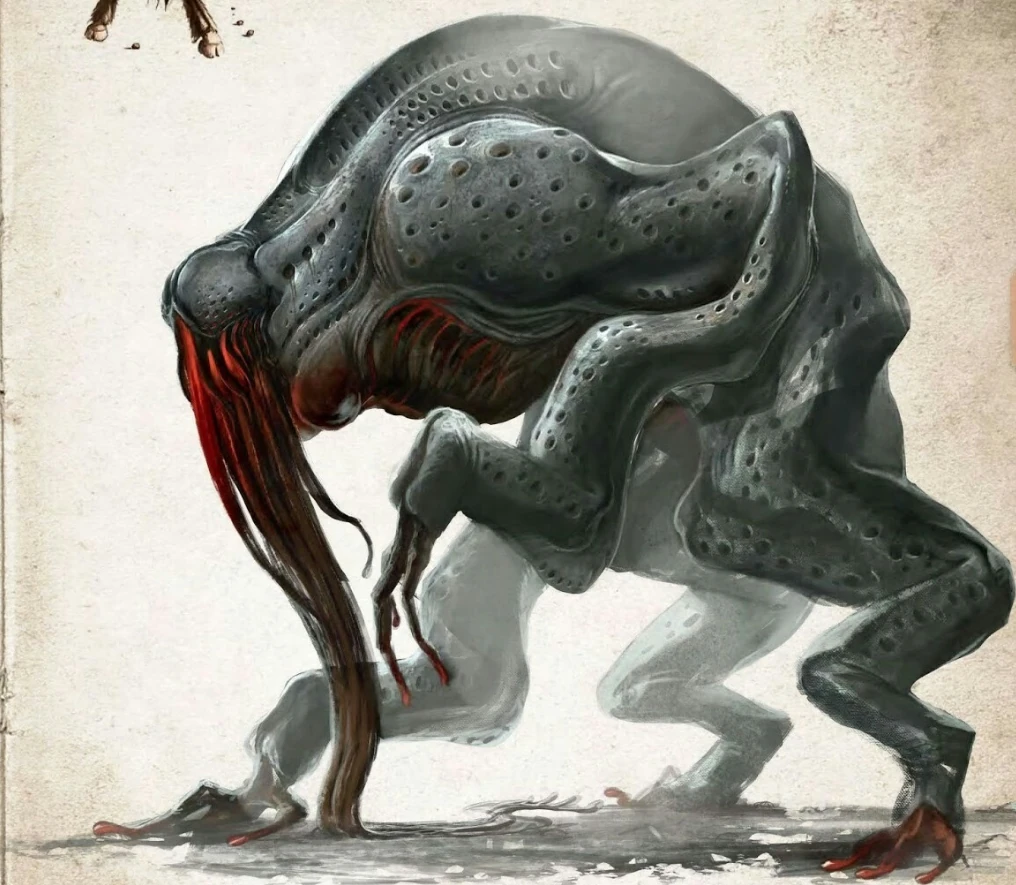
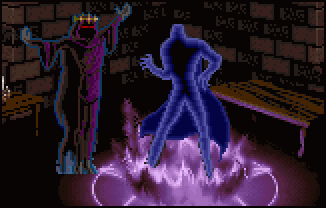
One such of this race of star-beings walks the earth now, clad in flesh and accompanying the Greyhame characters. Ikasha is her name, and she looks like this (of course):


She was lured down from the solar winds by the ancient magic of the Lord of Werewolves, and given a body of flesh by the Goblin King, and then was held in the dungeons of the Greyhame Mountain as the Goblin King and Lord of Werewolves attempted to negotiate some kind of alliance with the star-things. But the stars and the other Star Elves were uninterested in anything terrestrial creatures might attempt to offer them; they only wanted their child back, and so the stars began to sing above the world, calling for her (but she couldn't return to them!) and slowly approaching the world ....

But the characters rescued her from the dungeons beneath the Howling Tower (I don't think I wrote a play report for that session). It turned out that Ikasha loved having the sensations of a corporeal body, and wanted to remain on the earth for a time. The characters had her communicate with the Star Elves on a Throne of Seeing in the dungeon, and the Star Elves agreed that so long as Ikasha was happy with her body and sensations, they would allow her to remain.

And so the doom of the world at the hands of the Star Elves and their fellow alien creatures was averted ...

------

Star Elves
AC 0 (or 9/as-armored when embodied)
HD 1-12 (per level, max level 12 like Elves)
THAC0 per level
damage: touch 1-6 cold fire + 1 radiation damage

irradiating presence -- revealed in their full luminosity, a Star Elf irradiates the area immediately around itself (in melee range), causing 1 radiation damage per round (metal armor is enough to shield against this radiation damage); undead are also affected by this radiation

turn undead -- per a cleric of a level equal to the Star Elf's hit dice

semi-ethereal -- not truly ethereal, Star Elves may pass through anything through which light may pass, e.g. a Star Elf could pass through glass, or through a chink in a door, but would not be able to pass through solid stone

cast spells as an Elf of the same level as their hit dice, though the magic of the Star Elves is alien and unknown to Earthly magic-users

save as Elves
240' ethereal movement, or as an Elf when clad in flesh or otherwise embodied
morale 9

Star Elves are luminous beings, literally shining bodies of coherent light. If they require a body for some reason, they have a kind of magic that allows them to form a body of stardust or nebular material which to inhabit; this body could resemble anything, but the Star Elves tend to prefer a slender Elfin form.


Sunday, August 5, 2018

DIY 30 #5: Slaves of the Star Beasts

(This post was written several months ago concerning a development in my Greyhame Game in which Star Beasts were descending to terrorize the land; the trouble has since been dealt with, but I haven't written about my Greyhame Game here for a while because the number of games--two per week--got to be too many ... anyway, I'm posting it as DIY 30 to save a bit of time!)

My players ignored the descent of the Black Ships of the Star Monsters three times (session 30, 31, and 32 of the Greyhame Game, none of which really appear on this blog), other than to send hirelings off-screen to aid with the defense (and/or to die, killed by bizarre star-things). In a kind of Blackmoorian fit, they continued to delve into the dungeon, ignoring the crisis in the realm of men, and so a great number of the people of Brakeridge and its nearby towns have now been captured and carried away to the stars as slaves of inhuman monsters ... Well, such is player agency! I figured I'd post this, now that the Star Thing has generally been settled, and there's little chance of encountering them again for some time.

------

The Star Beasts are re-worked Moon Beasts from Pathfinder and from Matt Finch's Swords & Wizardry version of them in the Cyclopean Deeps and its sequel. Likewise their associates, the Denizens of Leng ...


They dwell as parasites on the vast Star-Things that carry the Star Elves here and there across the cosmos, following Solar Winds and Star Seeds, and whatever else may be "Out There". In the way that humans and cats dwell one by another, neither quite subduing the other, never quite communicating, yet nevertheless associated, so the Star Beasts and the Star Elves dwell ... and which is which in the terrestrial analogy??

Regardless, where the Star Elves are content to travel and Sing among the Stars, the Star Beasts descend and take slaves wherever they may, and sell them on the next terrestrial or jovian world, OR across dimensions in some other Place unknown to the ken of those not well versed in the secrets of the universe ...

These Star Beasts descend in Black Ships, preceded by a silvery mist, upon which their black shape may be seen against the starry night; then their slave-contingents and their crew of Beasts and Leng-Denizens descend to round up the next batch of slaves ...

---

Each Black Ship of the Star Beasts carries 1-3 contingents of slaves (d20 roll for each contingent):

1
18 P'wek, tripedal and three-armed creatures from a distant world. They each wield 2 spears with wickedly barbed blades (1-6 damage) and carry a shield; they advance with the shield in front and thrust over it with their spears.
AC 4 / HD 2+2 / THAC0 17 / MV 120' / ATK 1-6/1-6 / Save as Fighter 2 (SF2) / M 8

2
20 Tachii, reptillian creatures with finned heads and without tails. Once per day they can spit up to 10', and the target must save v. breath weapons or be blinded (-4 to attack, +4 to AC) for 1-3 rounds.
AC 6 / HD 1* / THAC0 19 / MV 180' / ATK 1-6 / S F1 / M 7

3
24 Klackons, insectoids with armored carapaces like plate armor and armed with spears. They need never check morale, as they are united in purpose by shared pheromones and consider any individual's life worth only what it offers to the greater good.
AC 3 / HD 1 / THAC0 19 / MV 120' / ATK 1-6 / S F1 / M 12
(source: Master of Orion and Master of Magic games)


4
24 Humans, from another world, pallid and miserable. They speak no known tongue. Four of them are armed with laser wands, which when directed against someone, force the target to save v. death rays or take 2-12 damage, half of which is radiation damage.
AC 7 / HD 1-6 hp / THAC0 20 / MV 120' / ATK 1-6 / S Normal Man / M 6 (8 with leader)

5
24 Sectoids, small humanoids with grey skin, bulbous heads, no nose, and large black eyes. They are armed with light crossbows (1-6 damage); 2 are psionic, and 1/day may mind control (as charm person) or cause panic (as cause fear), and may use ESP within 60' at will.
AC 8 / HD 1-1 / THAC0 20 / MV 120' / ATK 1-6 or psionics / S NM / M 6 (8 with leader)
(source: X-Com games)

6
18 Mutant Humans, taken from a Tomb World from across the stars. 6 have useful mutations (d12): (1) spit acid 20', 2-12 damage (save v. breath for half); (2) third arm, gain second attack; (3) acid blood, causes 1-3 damage to opponent when struck in melee; (4) immune to fire, even fireball-type sells; (5) poisonous bite, 1-3 damage and save v. poison or die in 1 turn; (6) horned skin, AC 5; (7) defensive vomit 1/day, all within melee save v. poison or at -2 to attack for the rest of the melee; (8) psionic, may use ESP 30' at will; (9) third eye, able to see invisible; (10) redundant organs, take only half damage from all attacks; (11) stinking sweat, all in melee save v. poison or nauseated and at -2 to hit and damage; (12) super-chameleonic skin, able to become invisible at will
AC 7 / HD 1 / THAC0 19 / MV 120' / ATK 1-6 / S F1 / M 8

7
8 Kzinti, ferocious bipedal cat-men with naked rat-tails, ears like naked bat-wings, and who only speak the Heroes' Tongue. Each is armed with a wtsai short sword with which he can deal 3-8 damage, in addition to a claw and a bite attack.
AC 6 / HD 3+3 / THAC0 16 / MV 210' / ATK 3-8(wtsai)/2-5(claw)/2-7(bite) / S F4 / M 10
(source: Larry Niven's Known Space stories)


8
24 Alkari, bird/pterasaur men from a low-gravity world. Because of their keen eyesight, they are at +2 to hit with their light crossbows (1-6 damage). They cannot fly in normal gravity.
AC 7 / HD 1-1 / THAC0 18 (ranged) / MV 180' / ATK 1-6 / S NM / M 8
(source: Master of Orion games)

9
12 Synths, synthetic humanoids that are immune to charm person, sleep, illusions, poison, or cold (and maybe some other effects, appropriate to androids). They strike with their fists, each dealing 1-6 damage.
AC 5 / HD 2+2 / THAC0 17 / MV 180' / ATK 1-6/1-6 / S F3 / M 10

10
18 Kuo-Toa, amphibious fish-men ancient enough to evolve in parallel on other worlds. They suffer a -1 "to hit" in direct sunlight, but due to their slippery skin, they are only grappled or affected by a web 25% of the time.
AC 4 / HD 2 / THAC0 18 / MV 90' / ATK 1-6 / S F2 / M 9

11
18 Slug Men, disgusting and slimy slugs with arms that leave trails of slime wherever they go. They have a decent armor class because of the secretions from their skin, and take only half damage from blunt or piercing weapons because of their rubbery make-up.
AC 5 / HD 2 / THAC0 18 / MV 90' / ATK 1-6 / S F2 / M 8

12
Green Men of Mars, genetically modified for normal gravity--so, 10' tall and with four arms. They disdain shields, but may fight with up to 4 weapons or 2 two-handed weapons (or 2 normal and 1 two-handed).
AC 7 / HD 3+3 / THAC0 16 / MV 120' / ATK (by weapon) 1-6/1-6/1-6/1-6 / S F3 / M 9
(source: Edgar Rice Burroughs' Barsoom stories)


13
18 Hlaka, grey-furred creatures with 2 leathery wings and 3 eyes on their flattish face. They have a tail with a poison sting (save v. poison or die in 1 turn), and may attack with it (2-in-6 chance) or their weapons (4-in-6).
AC 5 / HD 2 / THAC0 18 / MV 150'/fly 300' / ATK 1-6 or 1-4 plus poison / S F2 / M 6
(source: MAR Barker's Empire of the Petal Throne RPG; same for entries 14, 15, and 16)

14
12 Hlyss, vaguely insectoid creatures with 4 segmented legs, 2 arms, and a chitinous exoskeleton. They have a tail that stings (save v. paralysis or paralyzed for 1 turn). They may attack with both their weapon and sting in the same round.
AC 4 / HD 2 / THAC0 18 / MV 90' / ATK 1-6/paralysis / S F2 / M 9

15
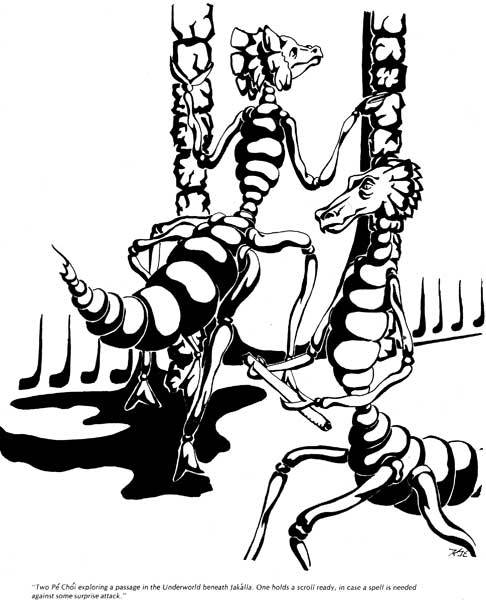
18 Pe Choi, creatures vaguely like man-sized walking sticks with black chitin that provides an armor class like plate+shield. Their broad senses of hearing and vision (which extends beyond the spectrum humans can sense) allows them to see invisible within 200' with a 60% success rate. Furthermore, they are surprised only on a 1 in 10 chance because of their natural ESP.
AC 2 / HD 1+3* / THAC0 18 / MV 120' / ATK 1-6 / S MU2 / M 8


16
12 Shen, black-scaled, dragon-like humanoids with beak-like snouts and glittering crests along their skulls. Their tails have a knobbed, bony appendage with which they strike on a 2-in-6 chance, while they have a 4-in-6 chance of striking with their weapon.
AC 2 / HD 3 / THAC0 17 / MV 90' / ATK 1-6 weapon or 1-4 tail / S F3 / M 9

17
8 Mutons, buff humanoids skinned with green cybernetic and nano-reactive armor. Their muscles are similarly enhanced, and their organs are doubled in order to be redundant, and they take only half damage from any physical attack (even magic weapons). But for all that, they have no mind to themselves and are extra susceptible to mind-influencing effects, saving at -4 vs. charm person, suggestion, illusions, etc.
AC 3 / HD 4+1* / THAC0 15 / MV 210' / ATK 2-7 / S F5 / M 11
(X-Com)

18
12 Silicoids, creatures whose structure is silicon-based. They are essentially rock-men; their outer hides are tougher than plate armor, they are immune to poisons, and any type of fire-damage heals them for a number of hit points equal to the damage that would have been dealt (by a fireball, for instance). And yet, their silicon nature makes them slow so that they automatically lose initiative ...
AC 1 / HD 3+3 / THAC0 16 / MV 30' / ATK 1-8 / S Dwarf 5 / M 9
(Master of Orion games)


19
8 Tentaculats, otherworldly things which resemble nothing so much as brains with a single beak, held up by a fringe of a dozen tentacles. They float through the air rather than supporting themselves upright, and may attack with 4 tentacles, each of which forces a save against paralysis or the target is paralyzed 1-4 rounds, plus 1 bite attack for 1-8 damage.
AC 7 / HD 3 / THAC0 17 / MV 120' / ATK x4 paralysis/bite 1-8 / S MU3 / M 8
(X-Com 2: Terror from the Deep)

20
18 Taxxons, ever-hungry, sapient, centipede-beings. Their soft flesh is easy to cut, but their voracious mouths deal 1-4 damage and may bite twice, and if they strike with both bites, they may seize a character to deal 3-12 damage per round automatically until thrown off some how; moreover, given their hunger, their morale is almost unbreakable as they seek to devour the next creature (unless strongly commanded not to by their masters).
AC 8 / HD 2+2 / THAC0 17 / MV 180' / ATK 1-4/1-4 plus seize 3-12 / S F3 / M 11
(K. A. Applegate's Animorphs series)


Wednesday, January 24, 2018

Are Goblins Just the Worst?

On Monday, Kotaku published an article by Cecilia D'Anastasio entitled, "Goblin Fights In D&D Are The Worst," in which the author argues just that--that in D&D, goblins are just low-level mooks arrayed before low-level characters just so that the characters/players can have what is essentially a no-risk fight and means of gaining experience: "Repeat [to hit rolls] ad nauseum until, huzzah!, the goblins have died. Your dungeon master ... informs you that you have been awarded some experience points. Your party licks their wounds and continues on their journey."

She claims that these goblin fights are boring, standing as stagnant interludes between moments of what the game is really about, i.e. (asking ironically), "How am I supposed to break up long periods of players developing their characters, puzzle-solving, discovering lore and fighting magical monsters?" It's strange to me that D'Anastasio doesn't see that goblins are magical monsters, and doesn't conceive of the possibility that the presence of goblins and whether they fight might be a means of puzzle-solving ...

My attention to this article was directed by David Rollins at blog Searching for Magic in his post "The Ecology of My Goblins or, How to Make Goblins Fun!" He takes issue with D'Anastasio's characterization of goblins, and I agree wholeheartedly with his rebuttal.


...
But I must admit--I do actually agree with D'Anastasio to a large degree. Battles without stakes are boring, and I don't play D&D just for the visceral joy of seeing dice roll across the table--I play for the visceral joy that a character's survival depends on that die roll! If goblins are being used by a referee just to be a no-risk fight, and I'm forced to slog through every round of it, and the goblins fight to the death, and none of it matters, I tune out. I've played in games like this; I played in a Pathfinder game where my paladin was blinded, but I refused the possibility to have him cured and had him run into the vanguard of every fight against Orcs just to test how far the referee would bend the rules not to kill him (he survived every fight; the absurdity was the only reason I was entertained).

This article piqued my interest because the last two games I've run in my Greyhame Dungeon Game have both involved goblins (Expedition 16 and Expedition 17; I haven't yet written up the latter). Expedition 16 involved what was basically a massacre of goblins; the characters entered the dungeon with a veritable army of wardogs and hirelings, and all together slaughtered some thirty goblins--but this was not "I miss," "I hit," "I miss," "I hit," ad nauseum, this was a running battle with groups of goblins panicking from bad morale rolls, running to the next goblin post for reinforcements, and/or going through side corridors in attempts to outflank the party. Nothing worked--the goblins were just too weak.

Expedition 17, meanwhile, involved only a couple of characters and their few hirelings and wardogs. During their first entrance into the dungeon, the party was overwhelmed by a large number of goblins, and after both dogs and one of the hirelings were killed, the party had to retreat. Outside the dungeon, they regrouped with a couple more dogs; then, going back into the dungeon, they were ambushed by the same large force of goblins. Another dog and the other hireling were killed, and it looked like the survivors would soon be goblin-arrow pincushions; but to my surprise, the two characters and their last dog fled downstairs to the next level of the dungeon, only escaping by lighting oil on fire behind them on the stair. After that, it was only by good luck that they found another exit from the dungeon so that they didn't have to face the goblins again.

I recite these examples as clear counterexamples to D'Anastasio's claim that goblin-fights are the worst. Both of these games were exciting--for different reasons!--and both involved goblins.

a couple of Free Goblins

So I agree with D'Anastasio in a general way that pointless fights are boring--but on the point of goblins I completely disagree, because the presence of goblins do not a pointless fight make. Goblins can be as boring as the Orcs that my blind paladin fought in that Pathfinder game, or as interesting as Rollins' weird hive-goblins, Jeff Rients' goblins with their goblin-doors (I keep forgetting to use these), or my own goblins who are certainly easily routed cowards, but who can also overwhelm and kill foolhardy adventurers (and they can cast magic and do other things too ...).

The relevant question to ask is not "Are there goblins?" but "Why are there goblins?" If the answer to the why of goblins is just to have no-risk fights for low-level characters, then fighting them is bound to become boring (but honestly, if that's the goblins' only point, if you're playing D&D, the game of tactical infinity, why don't you avoid fighting the goblins?).

What if the goblins are the type that steal children, and the fight
against the goblins determines whether you save the kids or not?

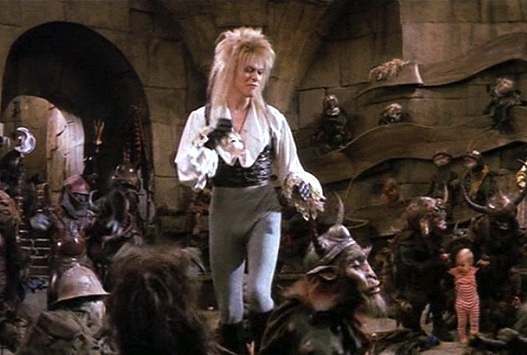
But in my game (and in Rollins' game, and in Rients' game, etc. etc.) goblins have probably been chosen because they specifically interest the referee. I know in my game, that's the case. I use goblins for a variety of reasons: goblins kidnap children (adventure hook--save the children!); goblins are the friends of wolves and werewolves (another hook in the monsters they associate with); goblins are either the slaves of Elves (and maybe sympathetic to the PCs?), or Free Goblins (both a player class, and a further adventure hook in that goblins hate Elves); higher level goblins cast weird magic (including goblin doors, probably); goblin kings are strange and powerful and as beautiful as Elves (or at least David Bowie); and let's be honest, fighting goblins in an old school game where a referee is willing to see characters die is just not boring!

the Goblin King

Goblins are great! Use them, please, in great numbers and in great varieties. Make them interesting, and make sure interactions with them (fights and otherwise) matter.

Goblins are incredibly versatile monsters, by the way; I've seen lots of different goblins in modules, including fungus-goblins (Tomb of the Serpent Kings) and blue goblins (Mortzengursturm the Mad Manticore of the Prismatic Peak) and Batiri jungle goblins (Tomb of Annihilation); and don't forget the goblins of other media, especially Labyrinth, and even Blix from Legend.


Gnolls: Followers of the Phallus

In the dark of a catacombs in deepest night one might hear them: laughing wildly, raucously, yellow eyes flashing in the night, teeth cracking and grinding the bones of the dead. The gnolls have gathered for a feast of bones, and only the stalwart or the foolhardy can hear their weird laughter without the catch of terror in his heart.

(those who hear the "laughter" of gnolls must make a morale check, results appropriate to the situation--i.e. panic and flee if in combat, or become shaken and suffering -1 to all rolls, etc.)

Slaughtered animals lie in the fields, killed for sport and stinking of blood, but otherwise untouched; meanwhile, the gnolls that hunted, killed, and ignored them gather now in the graveyards of other races, digging up bodies long dead to crush the bones of corpses between their teeth. Laughing and hyena-headed, gnolls are creatures of perversity, servants of Evil who make a mockery of every philosophy and religion.

My first D&D book was the 2e Monstrous Manual, whence
this image is take; it's still my favorite depiction of a gnoll

------

As scavengers, gnolls prefer to eat that which is already dead. They kill for sport, but prefer to eat that which is long dead, or which is killed by the hands of another. To this end, they prefer corpses dug up from necropolises and graveyards (which they can easily crush between their teeth, and which provide the added pleasure of enraging certain sects who believe that the buried dead are sacrosant); OR to eat of flesh killed by the hands of the slaves they keep--and because a slave killed it, the gnoll is glad to "scavenge" it by bullying the slave into surrendering the kill.

Gnolls draw dicks on everything ... and then build dick-idols!
Gnolls' obsession with phalluses is well recorded. Certain scholars identify their main deity as Priapus, god of fertility and sexuality, traditionally depicted with an enormous erection; but this identification is weak at best, as the erection-wielding deity of the gnolls is generally androgynous, or perhaps indeed a goddess with an enormous phallus--or literally just an enormous phallus without other context, probably carved of appropriately-shaped hardwood. Not that identification of a gnoll's sex is easy--many sources attest that every single gnoll is male and that the specie's propagation is a mystery, while other scholars argue that female gnolls are actually possessed of a huge clitoral pseudo-penis, generally functional as both a male and female organ.

On the left, a hyena penis; on the right, a hyena female's pseudo-penis
Because every member (ahem) of the species possesses a significant erectile organ, the gnolls' obsession with phallic art is perhaps understandable. Wherever gnolls gather, phallic graffiti will adorn the walls, and altars will be raised before idols either bearing huge erections, or seeming merely to be erect phalluses themselves. Native gnollish religious rites involve feast-orgies in which the strong bully the weak into feeding and sexually pleasuring them; and among those tribes which have large contingents of Lawful or Good slaves, gnolls tend to take a perverse pleasure in mocking the rites of those religions, especially by dressing up a donkey in a priest's robes (calling it a "priest-ass" if they have any sense of the Common language and the nature of puns), and forcing all to do obeisance to it as it brays the eternal "Yee-AH! Yee-Ah!" (check out Nietzsche's Thus Spake Zarathustra for the joke ...)

Seeing this mockery of Lawful and Good religious rites, presided over by an ass, the gnolls fall among themselves laughing horribly into the night. They demand ever more elaborate "rites" and protestations of faith from the slaves/prisoners they wish to abuse by forcing them to take part in these abominations of religious ritual; whether the "rites" end up killing the slave(s), or the gnolls find the joke good enough to spare their slave(s) for the night is up to the whim of the gnolls and whether they can control themselves amidst their fits of laughter. (Once the mockery gets going and the gnolls begin really to laugh themselves wild, they should make a saving throw against paralysis at +2 each round to act; otherwise they continue to laugh uproariously, pounding the ground in their perverse mirth, though still able to defend themselves ably if attacked).


Wednesday, January 3, 2018

the Strangler Fig

I was in Panama for Christmas with my dad, uncle, and granddad (Granddaddy was stationed in the canal zone during the 70's, so my dad went to high school here and it definitely captured the family imagination), so I thought I'd try to come up with some D&D stuff related to Panama or tropical environments in general.

To that end, the other day I saw some pretty cool banyan trees, aerial prop roots hanging down from above, stretching for the ground, ready to create more and more trunks in an ultimate banyan grove all centered around a single huge trunk of intertwined trunks. Some quick Wikipedia research informed me that banyans are sometimes called "strangler figs" for the way that they grow around a victim tree and "strangle" it with their roots; and further that, as a fig tree, they are home to fig wasps, which developed symbiotically and cospecialized with fig trees, the fig providing the wasp a place to lay eggs and mate, the wasp pollinating the fig.

Hence the double feature of Strangler Figs and Fig Wasps ... Today, the Strangler Fig:


or Banyan Tree ...

Called a "strangler fig" because it is a parasitic organism that "strangles" its host--the banyan tree actually grows atop another tree, its seed having landed somewhere in the host's upper branches, and grown like a vegetative octopus from there. Early on, the banyan actually looks like tree roots growing down around the trunk of the host tree; later, as the banyan swallows or "strangles" the host and sends out limbs of its own, these down-growing roots actually become almost trunks themselves, creating the illusion of a small grove where the reality is one large down-growing organism (as opposed to an aspen grove, all one organism, but growing upwards).

After enough time, the banyan actually kills its host (after it has grown large enough to sustain itself), and as the host tree decays within the banyan's central trunk, it leaves behind a hollow space, perfect for any variety of spirits, jungle-creatures, or bandits to dwell within or inside which to store their valuables ...

And so, to D&D-ize the banyan tree ...


Strangler Fig
No. Appearing 1 (1-6)
AC 0
HD 8-12
THAC0 per HD, e.g. 12-10
attacks: suggestion or 7-12 roots
damage: 2-7 or charm
no movement
treasure: F

A strangler fig large enough to attack a party of humanoids has grown into a veritable grove of its own, with prop-roots resembling entire trees and aerial roots hanging down from the canopy throughout the "grove"--hence its hit dice of 8 to 12; feel free to shrink or expand the number according to the age/size of the "grove".

The grove feels to be a place of peace, which is the will of the fig attempting to lull prey into a sense of security. There is a 1 in 3 chance that from 1-4 animals of various kinds (e.g. monkeys, lions, agouti, etc. etc.) are resting beneath the banyan's limbs, subtly tapped by its roots, charmed, and succumbing to its appetite. These animals may be used by the banyan to attack intruders if the intruders are hostile.

Suggestion: All those who enter the grove (i.e. pass into the shadow beneath its canopy) must save against spells (or a make Will/WIS save), or they find the grove to be a perfect place to make camp, and make an argument for settling down for the day, or at least for returning before day's end ("Look at how peaceful the animals are here--lions and monkeys lying down together!").

The banyan being a slow-moving tree, creatures must spend at least 10 minutes under its canopy before its roots can act. At that point, those beneath must make a save against paralysis or be tapped by an aerial root. After that, 7-12 roots may act each turn, either directly attacking characters or charming them.

A root that attempts to charm a person descends and rests on their body, attempting to "tap" into them; the character must make a save against paralysis (fortitude or reflex? constitution or dexterity? choose what you want in newer editions). Characters who fail are "tapped" and cannot leave the vicinity of the grove, and can be compelled to fight against hostile intruders. Over the course of the root's accelerated growth, they become part of the banyan in 1-6 days, entombed within a new root-trunk. A cure disease spell will dissolve the root's connections inside the body, though a character thus freed will suffer 3-18 damage from separation.

Otherwise, the roots attack with slams like treant-limbs, dealing 2-7 damage per blow.

Any treasure is to be found within the main "trunk" (which may be hollow), or embedded in the down-growing aerial roots, in either case being the treasure of those entombed within--which will, of course, entail 10 minutes or more work to extract ...


Parasitic though they be, banyans are also often symbiotic homes to other creatures as well.

One half of banyan trees are home to a swarm of Fig Wasps, insects that co-developed with fig trees in a relationship even closer than that of the normal process of bees pollinating flowers.

One in three banyan trees is also home to a dryad, a bisan (from Oriental Adventures), or some other tree spirit; these are (1-2) the spirit of the host tree, desperate for help destroying the banyan, (3-5) the spirit of the banyan or some other spirit dwelling within the hollow of the "trunk" and which will rise to its defense, or (6) an unaffiliated spirit that dwells within the hollow trunk or spreading branches, but which is itself independent of the banyan.

Further relationships are eminently possible:
Consider an entire human keep, made of stone, swallowed by a vast banyan and now home the ghosts of its former inhabitants!
OR, a peaceful banyan, converted to (Buddhism) by a saint in expectation of better future lives and escape from the wheel of suffering, which holds under its branches/roots a permanently peaceful gathering of merchants and wanderers, guarded from evil by the power of the tree.
(the etymology of "banyan", according to Wikipedia, is that "banyan" meant "merchant" in Gunjurati Indian; and such merchants would spread their wares beneath the shade of certain [banyan] trees)


Tuesday, January 2, 2018

the Fig Wasp

I was in Panama for Christmas with my dad, uncle, and granddad (Granddaddy was stationed in the canal zone during the 70's, so my dad went to high school here and it definitely captured the family imagination), so I thought I'd try to come up with some D&D stuff related to Panama or tropical environments in general.

To that end, the other day I saw some pretty cool banyan trees, aerial prop roots hanging down from above, stretching for the ground, ready to create more and more trunks in an ultimate banyan grove, all centered around a single huge trunk of intertwining roots. Some quick Wikipedia research informed me that banyans are sometimes called "strangler figs" for the way that they grow around a victim tree and "strangle" it with their roots; and further that, as a fig tree, they are home to fig wasps, which developed symbiotically and co-specialized with fig trees, the fig providing the wasp a place to lay eggs and mate, the wasp pollinating the fig.

Hence the double feature of Strangler Figs and Fig Wasps ... Today, the Fig Wasp:


So there are two varieties of fig wasps, pollinating and non-pollinating (and many species of both). The pollinating fig wasp is pictured above, and has an elongated head with spurs, with which it burrows into the syconium (what will become a fig fruit), where it both deposits pollen in some of the female flowers while laying eggs in others. Non-pollinating fig wasps look more like other wasps, except that their ovipositors are ridiculously long, at least as long as their bodies--these they use to pierce the syconium and deposit eggs within from outside. I'm going to focus on a pollinating species.


Fig Wasps
No. Appearing 3-18
AC 9 (but they can't be hit by weapons--hands can slap them on a body, or squash them in the air)
hp 1
THAC0: 16 (they're small and pretty good at crawling through chinks in armor)
damage: 1-3 as they burrow in
movement: fly 30'

Fig wasps surprise on a 1-3 on a d6, being small and seemingly innocuous. Their attack roll is merely to land; with surprise, they can immediately begin to burrow in, otherwise a character can swat at 1-3 of them on their body before the wasps can act again.

After the wasps have landed on a humanoid, they begin burrowing into flesh using their specialized heads and mandibles. This causes 1-3 damage, partially from the painful sore, partially from the inflammation of the flesh around the sore.

Once inside, the wasp lays its eggs and then dies. At this point, the host character must make a save against poison to avoid a severe allergic reaction as the body responds to the presence of foreign bodies inside itself. Success indicates a mild reaction--itching hives above where the eggs were laid, rather like a nasty chigger-bite; failure indicates severe anaphylaxis: roll on a d6

1) eyes swell shut -- blind for 1-6 turns
2) severe hives -- penalty of -1 on all rolls for 1 day
3) swollen throat -- can't eat for 1-3 days, may grow weaker from hunger
4) ill for 1-3 days -- penalty of -1 on all rolls
5) violently ill for 1-3 days -- may not act other than to rest
6) death in 1-6 turns

A neutralize poison spell will halt the anaphylaxis, but the eggs will remain. A cure disease spell will destroy the eggs and also neutralize the anaphylaxis.

If the eggs are not destroyed, they will incubate for 2-4 weeks, during which time the eggs hatch, the hatched larvae pupate, and at the end of which time adult fig wasps split out of the pupae. The males' only purpose is to fertilize the females and then burrow a way out of the fig for the females to fly away. Unfortunately for the wasps, the females cannot survive in a human or demi-human host, and are ultimately absorbed into the body--BUT the males still burrow their way out, causing 1-20 damage as they do so (they might be burrowing out of an arm or leg, or on the dangerous side, burrowing out through vital organs in the abdomen!).


Sunday, December 10, 2017

the Chaos Spawn

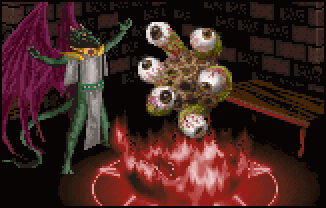
Another installment from Master of Magic, the Chaos Spawn, an obvious rip-off of D&D's iconic Beholder:

I actually like this design better than the Beholder,
with its weird mouth and bite attack ...

A terrifying creature summoned by a wizard with Chaos spellbooks, the Chaos Spawn is a thing with virtually no melee capability, and which nevertheless cuts through units of normal men with ease using its various gaze attacks ...

Probably a couple months ago, my wife asked me why she and her brothers-in-law, who all play a semi-weekly game in a non-Greyhame dungeon, have never encountered a beholder before. I expect the question was prompted in part by the appearance of the beholder (and thri-kreen, lich, and dragon) on the cover of the 2e Monstrous Manual, which I was perusing at the time.

My first basic answer was just that they're still not at a level where an encounter with a beholder would make any sense--with its death gaze, stoning gaze, disintegration ray, antimagic cone, etc. etc. they just wouldn't stand a chance. And yes, I want dungeons to have high level things that will destroy the party if they just blithely attack it ... but beholders are just so dangerous, and their highest level character is 8th level.

But honestly, that isn't the full answer--as I gave it, I also realized that I just don't like beholders much. They're iconic D&D, sure; and I like the idea of a thing with eyes that each project a different kind of ray or magic effect (especially if the effects aren't the same for every monster!); but I just think they look terrible, with that great gaping mouth (and I also remember all the frustrating fights I've had against beholders in Baldur's Gate 2 or Icewind Dale, and I just don't quite want to inflict that frustration on others ...)

So I don't like beholders much; but I do remember liking the aesthetic of the Chaos Spawn of Master of Magic (pictured above), so I thought I'd give a look at them to see if they might be a beholder rip-off that I could stomach to use in my games.

Per MoM the Chaos Spawn has stats: Chaos Spawn -- Magic (Chaos) -- Upkeep 12 (mana/turn) -- Melee (1) -- Defense (5) -- Resistance (10) -- Hits (15) -- Movement (1 Flying) -- Special (Death Gaze -4 save; Doom Gaze strength 4; Stoning Gaze -4 save; Poisonous Bite strength 4)

Death Gaze -- in melee, each figure in the unit opposing the Chaos Spawn must save at -4 or die without any chance to deal melee damage
Doom Gaze -- in melee, the entire unit opposing the Chaos Spawn automatically takes damage equal to the strength of the gaze, without any chance to resist or defend; figures killed by the gaze do not receive a chance to deal melee damage
Stoning Gaze -- in melee, each figure in the unit opposing the Chaos Spawn must save at -4 or be petrified without any chance to deal melee damage
Poison Attack (bite) -- in addition to melee, the unit opposing the Chaos Spawn must save with their resistance once per each point of strength of the poison attack or take that damage; figures killed by poison still deal damage during melee

------

So, the Chaos Spawn
AC 4
HD 8
THAC0 12
attacks: 1 stinger, 5 gaze attacks
damage: stinger 1-6 plus poison (save v. poison at -2 or die in 1-3 rds)
movement: fly 90'
special: death gaze (save v. death ray or die)
doom gaze (take 1-8 damage, no save)
stoning gaze (save v. petrification or be turned to stone)
fear gaze (save v. wands or affected as by a wand of fear effect)
confusion gaze (save v. spells or confused as per the spell)

considering gaze attacks, each gaze affects one character in melee, determined at random (there's no guarantee any particular character will ever meet any particular gaze, regardless of the creature's intentions); otherwise, characters in melee may choose to fight "from the corners of their eyes" taking -2 on their "to hit rolls" and taking a +2 penalty on their AC, but receiving a commensurate +2 bonus on saves; OR, characters in melee may choose to fight blind (blindfolded, eyes closed, fighting backwards with a mirror, etc.), attacking at -4 "to hit" and with a +4 penalty to AC, as if against an invisible creature, but also not vulnerable to the gaze attacks

------

It's still a pretty nasty monster, and not really all that different from a beholder ... but I'd be slightly more likely to use it in my own game.


Friday, November 24, 2017

Phantasmal Warriors

Those blue dudes up to the left are Phantom Warriors,
defending a Sorcery Node; later-game they'd be joined
by Phantom Beasts ...

In keeping with the idea of transposing Master of Magic monsters into D&D, I've always thought Phantom Warriors would be great, so here goes.

These guys are like mirror images that can also fight. They strike with phantom weapons that ignore armor, allowing them to hit often, and yet themselves being insubstantial, a single hit destroys one figure.

I figure there are two ways to look at these, one as monsters, the other as a spell:

Phantasmal Warriors (the monster)
No. Appearing 3-18
AC 9
hp "1" (any "hit" kills it)
THAC0 19
damage 1-6
movement 120'
special: all hits by phantasmal warriors ignore physical armor, striking both an unarmored man and a character in plate as if AC 9; BUT dexterity adjustments and magical bonuses to armor still count as AC against these attacks

Phantasmal Warriors (the spell)
level 4
range 1 (allied) creature
duration 6 turns
2-7 phantasmal representations of the target creature appear, randomly armed and armored. Each "phantom" is allowed one attack per round at THAC0 19 (but treating natural or worn armor as AC 9; dexterity adjustments and magical bonuses to armor still apply to this AC), doing 1-6 damage; furthermore, each "phantom" is struck as if AC 9, and any "hit", regardless of damage, dissipates the "phantom" thus struck


Tuesday, November 14, 2017

the Nightstalker

Before I publish the next Greyhame Dungeon play report, here's a monster recreated from one of my favorite games: the Nightstalker

Summoning a Nightstalker

A significant amount of my mental landscape when it comes to fantasy was laid by the old Microprose game Master of Magic (1994). Back in elementary school before I had any actual D&D rulebooks, I made up monsters according to their stats in Master of Magic; and though I may have ultimately switched rather completely to 3E in highschool, and now to B/X in 2012 onward, still Master of Magic stands as an ur-source, like The Lord of the Rings, or the Timelife Books: The Enchanted World series, or The Flight of Dragons cartoon.

The Nightstalker is a summoned creature from Master of Magic, which is in hindsight clearly a rip-off of the invisible stalker in D&D; and yet, the Nightstalker is undead, only able to be conjured with a wizard with Death spellbooks; moreover, the Nightstalker has a formidable death gaze attack, which the invisible stalker clearly lacks.

Here's the Nightstalker's abilities per Master of Magic (drawn from a PDF download of the manual):
Nightstalker -- Magic (Death) -- Upkeep (1 Mana) -- Melee (7) -- Defense (3) -- Resistance (8) -- Hits (10) -- Movement (2) -- Special (Death Gaze -2 save; Invisible)

From which I will draw this (soft) D&D version:

the Nightstalker
AC 0 (4 if one can see invisible)
HD 5
THAC0 15
damage 2-12 + death gaze
death gaze -- all characters in melee with the Nightstalker save against death or die (+2 on save, -2 "to hit" if characters look sideways; +4 to save, -4 "to hit" if characters fight with eyes closed/face averted/etc.)
save as a Fighter 6
180' movement
morale 11
immune to charm, sleep, cold
turned as an undead of HD+2 (i.e. 7 for this write-up)

------

Such a monster is, of course, terrible to use against a party that has no way to detect invisible ... and nevertheless, I wrote a small dungeon that included something along these lines as a possible wandering monster within (though that version was for 5E, rather than B/X D&D)

Naturally, I rolled its appearance a couple times, and whenever it showed up, the party was in a high dudgeon of terror given the fact that it's naturally invisible and can strike when it pleases--and with a death gaze to boot! Two lower level compatriots died under the horror of its death-gaze; and ultimately, the party looted what they wanted without ever killing the invisible monster stalking the dungeon below ...

The stats don't necessitate any particular HD, AC, or anything, I'm just spitballing according to what I know of the Master of Magic wargame system, and still downplaying the monster a bit. The Nightstalker could easily be scaled up or down depending on what you want to do with it--maybe it's semi-visible for low level parties (note that it doesn't have immunity to normal weapons, and may be struck by any old sword!); maybe it has HD 10 for a high level group that may or may not have see invisible.


Monday, November 6, 2017

Golden Bones and the Chained Guard: two new Skeletons

I told myself not to publish too many "play reports" in quick succession, so I'm posting these couple of monster-write-ups today, and I'll post the Greyhame Mountain Dungeon Expedition 7 tomorrow. So, without further ado, a couple of variant skeletons for use in any dungeon:

A particularly well-dressed skeleton

The Red Priests, a Chaotic sect of clerics and magic-users who more than dabbled in necromantic magics, created undead servants for themselves that were more than mere skeletons. Some were formed from the corpses of favored slaves; some from the bodies of guardians, sacrificed in tandem to create yet more effective guardians; and others were bodyguards duped by gifts of magic items that did more than promised upon the wielder's death (in the best tradition of Sauron granting the Nine Rings to the Ringwraiths!)

------

Firstly, the Gilded Slaves (or Golden Bones):

No. appearing 1-6 && 2-20 regular skeletons
HD 2
AC 5
THAC0 18
Damage by weapon (1-4 usually, sometimes 1-6, rarely 1-8) (on a d6, results 1-3/4-5/6)
Morale -- (they're skeletons)

Turned as zombies (i.e. as HD 2 undead)

Gilded with decorations to please the Red Priests who created them. Each skeleton comes decorated with (roll a single d6 to determine):

1) 2 gems for eyes (roll once for both gems)

2) silvered bones worth 10-60 gp

3) gilt bones worth 100-600 gp

4) one piece of jewelry worth 200-1200 gp set into the sternum

5) silver death mask  worth 20-80 gp

6) scrimshaw imagery on major bones (sternum, skull, femurs, etc.) worth 50 gp, OR 300-1800 to the right buyer

------

the Chained Guard

No. appearing 4-9 (d6+3)
HD 1
AC 7
THAC0 19, +1 per skeleton killed (well, -1 ... bonus +1 "to hit" per skeleton killed)
Damage 1-6, +1 per skeleton killed
Morale -- (again, they're skeletons--undead servitors have no morale)

Turned together as a single undead creature equal to the number of hit dice that remain in the group (i.e. 7 skeletons encountered on the first round are turned as a 7 HD monster; if after 3 rounds the skeletons are reduced to 4 and then turned, count the group as a 4 HD monster)

the Chain -- the entire group of skeletons is chained together at the ankles by either a silver chain (worth 10 gp/individual) or a gold chain (worth 50 gp/individual); moreover, this chain magically links the members of the group (4 to 9 skeletons) together, so that the death of any one skeleton in the group increases the "to hit" and damage rolls of each other member by +1.

That is, assuming a group of 5 skeletons, each rolls to hit with a THAC0 19 and 1-6 damage on the first round. If one is killed on the second round, the remaining 4 skeletons attack at THAC0 18 and with 2-7 damage. On the next round, if 2 more are killed, the remaining 2 skeletons attack at THAC0 16 and with 4-9 damage.

I've never bothered with the "dimensions/length" of the chain, but I'm a mean/lazy referee who wants to attack with all the skeletons regardless. If you want, you could come up with the actual line of the chain and let the Chained Guard get tangled up in their own fetters if too ambitious ...

Think these guys, except they're chain-ganged at the ankles
--and they'll hit you harder for every one that's re-killed!

Credit for this idea goes to Lloyd Alexander of The Chronicles of Prydain, in which the (living) Huntsmen of Arawn are linked together by evil magic, and all grow stronger for each one of their comrades who is slain. I've always loved that idea, and plagiarized it for several games; this is my favorite version of my own plagiarisms.

------

As for a third type, the Bodyguard of the Ring, I'll let imagination stew for a time. I've used them in one dungeon yet, and to good effect! It's true that there are no rumors of any of these particular skeleton-creations lurking in the Greyhame Mountain Dungeon--but then again, one never really knows what lies in store for oneself in the deep places of the world ...


Friday, November 3, 2017

Turtle Philosophers


Morla, alas, came to the ultimate conclusion that
nihilism is the only true philosophy

(thanks to Arnold K. at Goblin Punch with his Tortoise Tsardoms for some inspiration here)

Turtles can live for quite a long time (or more particularly tortoises, I suppose, but whatever), and the longest lived can survive for many centuries, especially those in fey or magical environments. Those that live for such a time have a penchant for long, deep thinking, and ancient memories, and put together can become philosophers of the highest order.

No particular turtle species necessarily produces such philosophers--ancient snapping turtles in the swamps, thousand-year-old tortoises on a desert island, sea turtles grown so old and large that they resemble islands, perhaps even dragon turtles! can all become philosophers--but those grown from the lesser species of turtle have the following stats:

------

Turtle Philosopher

HD 6
AC 2
THAC0 14 (for those who use it)
Attack 2-8
Morale 6 (they don't generally like violence)


Philosophize -- Turtle Philosophers obviously have a deep and abstruse understanding of the world and of philosophy, and to make their particular systems of thought even more esoteric, they often inherit or invent recondite terminologies for the various phenomena of philosophy (from long-remembered conversations with errant magic-users and Elves, perhaps). By making a great speech of these arcane understandings, a Turtle Philosopher may choose to confuse, put to sleep, or even charm characters (according to the rules for those spells, confuse, sleep, or charm person).

This ability may be used 3/day, OR without limit so long as the referee continues to spout semi-coherent philosophical arguments, explanations, or minutiae. Characters save against petrification (of thought--so a wisdom or will save for later systems), and must save at -2 if the referee manages to scrounge up something of an actual philosophical oration. But IF a player/character responds by actually engaging with the diatribe, perhaps nitpicking terms or drawing out implications, that character saves automatically, and grants a +2 on his or her comrades' saves.


Sagacity -- Furthermore, if some kind of a rapport can be developed with a Turtle Philosopher (what do they want?--new philosophies to ponder, answers to old philosophical problems, maybe something so mundane as the banishment of a nasty old troll from the local swamp-neighborhood), the Philosopher can act as a kind of sage for the player/characters. That means that for 1-6 questions per favor granted it, the Philosopher can deeply ponder and delve into memories, and produce a reasonable sagacious answer for each within 1-4 weeks. This includes identifying magic items, another thing sages do in my game.

------

Alas for some of the swamps inhabited by such a creature, the turtle becomes a Turtle Philosopher-King, obsessed with its own vision of an ideal society, which it attempts to foist onto its fellow citizens of the swamp (or desert island, or what have you). The Philosopher might also have a strange obsession with universal ur-shapes, geometry, or mathematics.

You all know how it ends when Yertle envisions
himself as the philosopher-king of his swamp ...

Turtle Philosopher-Kings have the same stats as their merely philosophizing kin, but they invariably attract some kind of following:

1) a School of 2-12 would-be Turtle Philosophers who are all HD 3, cannot yet spout philosophy, and who follow their Philosopher-King's commands absolutely

2) a Republic, somewhat along the lines laid out by the Philosopher-King, with 1-6 would-be Turtle Philosophers (as above), 4-16 lizardmen or bullywug Guardians, 2-12 Craftsmen, possibly forest gnomes, and 5-30 slaves, likely goblins, gripplis, etc.

3) a Cult of 5-30 lizardmen or bullywugs who worship the Philosopher-King as a reptile god and who offer semi-regular tribute

4) a Circle of 20-200 myconids whose "King" has found a deep rapport and companionship with the Turtle Philosopher-King

5) a Dragon (or Dragon Turtle) who has taken the Philosopher-King on as a kind of "court philosopher" in its lair, and to entertain its own ancient memory

6) an Imp who literally plays "Devil's Advocate" for the Philosopher-King's arguments; their cantankerous rapport is like two old men who regularly argue for argument's sake

------

Regardless as to whether it is a mere Philosopher or Philosopher-King, Turtle Philosophers sometimes attract semi-regular petitioners as a kind of oracle--or as a sage, approached by individuals seeking knowledge. Such petitioners might include:

1) peasants come seeking some kind of oracle from the Turtle-Philosopher

2) a magic-user (or an apprentice of some greater wizard-lord) come asking for advice concerning a spell, a magic-item's formula, or a magical component

3) an adventuring party seeking sagacious advice, about a dungeon or a monster, say

4) a troupe of Elves come to pay respects to an old friend, swapping old in-jokes, treading out old gossip, and sharing new rumors

5) a congress of the local animals--baboons, or finches, or a school of trout--come to ask advice about some dispute in their own affairs

6) a cleric looking for old dirt on a rival cult

------

Lastly, for the Greyhame Dungeoneers, there is an old legend that the Bronding kings and their naiad friends invited a Turtle-Philosopher to the waters above the Brokenbrand Falls to dwell there as a kind of court philosopher. The legends tell of a gem-and-gold-encrusted shell bequeathed by gracious sovereigns, and quibble about whether Brondr himself or one of his successors brought the dubiously named philosopher "Chelonius" to the falls.

Legends differ as to whether this particular Turtle-Philosopher preferred playing chess against the kings, or expounding on epistemology.


Monday, October 2, 2017

Expert Trivia

That is, a couple amusing items of trivia from the blue Expert book, which I found while keying a deep underground lake in one of the dungeons I'm writing.

I'm just tickled by this, as one sometimes is by the errata found within the rulebooks ...

Giant Sturgeon have more hit dice than Black Puddings (barely). At HD 10+2, a giant sturgeon has slightly more hp on average than a black pudding (HD 10), the same "to hit" chance, and does a respectable 2-20 damage with its bite compared to a black pudding's 3-24. The sturgeon also swallows a character whole on a "to hit" roll of 18+, which does an automatic 2-12 damage/round and forces a save against death ray, or the character is paralyzed (if not paralyzed, they can cut their way out ... DM's discretion how, though, beyond a -4 "to hit" against AC 7, as there's no damage threshold). Sure, giant sturgeon can be hit by non-magical attacks and don't split into smaller versions of themselves, but they're still terrifying monsters.

 (and honestly, with a giant thing like that, why wouldn't it be 10+2 HD ... or more?)

Of course, all the giant fish in D&D are terrifying. A Giant Catfish has more hit dice/hit points than a Hill Giant, a better "to hit" chance, and 5 attacks, one of which does as much damage as the hill giant's. And Giant Rockfish have HD 5+5 and 4 spine attacks, each with deadly poison, which makes them just that more terrifying than real stonefish (which are also deadly poisonous, but at least are normal fish-sized).

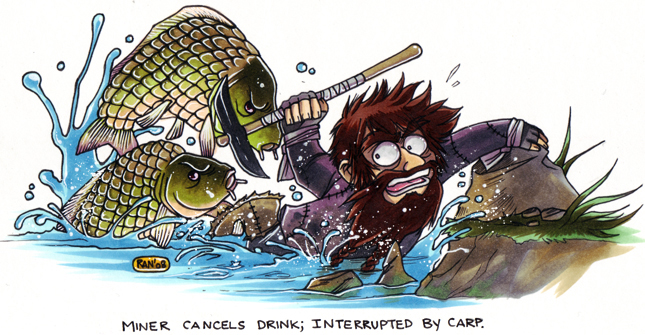
Outside of B/X, in the AD&D Monstrous Manual (2e)--I use all my sourcebooks when keying dungeons for variety's sake--the Giant Crayfish not only has HD 4+4 against the Ogre's HD 4+1, but the crayfish has two attacks, each doing more damage than the ogre's one attack (2-12/2-12 against 1-10 OR weapon +6). On top of which, the crayfish surprises with a -2 penalty for the players! And Giant Carp have from 8-12 hit dice ... those poor dwarves in Dwarf Fortress ...


One other thing that tickled me was that sharks in the blue Expert book are listed as having 18" speed, rather than the typical breakdown into B/X, i.e. "swim 180' (60')" for 18". That's the only speed in inches I've yet come across in B/X.


I don't think that I would really use these creatures as "typical" wilderness encounters on the water, on any kind of river or lake that sees civilized traffic. Their hugeness, represented in terms of hit dice, seems to represent something ancient and awful (e.g. a centuries-old sturgeon lurking at the bottom of a high mountain lake, unplumbed by man), or to mechanically iterate the horror one feels looking down into the blackness of unknown depths (say, a silent black lake in a vast and gloomy cavern, far below the surface of the world) and to fear what might lurk beneath.

The only place I can see such monstrosities existing near communities of men is as "gods" or spirits, venerated by the local tribe, offered sacrifices--perhaps manacled prisoners dropped over the gunwales of canoes from the middle of an alpine lake, or hacked into pieces and scattered like chum across the bloodstained waters. And naturally, such "gods" would also have treasures devoted to them, gold, gems, and even "lake swords" cast into the deeps to buy the god's benevolence--or tolerance--for the local fishermen; treasures ready to be seized by any adventurers foolhardy enough to face 10+ hit dice fishes and ridiculous enough to have waterbreathing as their only 4th level spell!