A good friend of mine had me create a character for a game I'd never heard of before. I was ... 9 maybe?
I played a fighter (simple to describe and create). I'm fairly confident I'd read The Hobbit by then, because I don't remember being phased by the presence of Orcs. What I do remember is that after killing several orcs in a semi-ruined city, I ran into one, an older orc who didn't immediately attack. I spoke with him; he asked me why I was killing his comrades.
How could I respond? I barely knew what kind of game I was playing. I have no memory at all why I was killing orcs to begin with ...
But I knew I was hooked. (Thanks, Jesse! I don't guess you know how much that little session expanded my horizons)
I pored over this friend's accumulated "monster manual", which was in the true old style of a three-ring binder filled with three-hole punched monster pages. Dozens of monster I'd never heard of. We made characters using his rules to attack our dads' dungeon (my dad and his are best friends from their college years, and played D&D together back when it was the LBBs); but we failed to do much of anything other than lather up an angry water-weird.
Back home, without any kind of actual D&D rulebook, I wrote a set of rules based on what I remembered, plus stats from the Master of Magic game that we had on the family computer. I introduced friends at school to the idea of the game; I remember I played a kind of gold dragon as a "DM character" for a little while, but ultimately abandoned that idea after fire-breathing my own enemy-creatures to death too many times.
Later on, I acquired the 2e Monstrous Manual as my first actual D&D book (I still have it; the binding is maintained with duct-tape now, and saving throw tables are written into its back pages). My only book then!--so all characters were Fighters without spells or special abilities. We still managed to make it interesting; one player was a minotaur with a Warhammer 40K-style chain-sword, one was a wererat, one was a halfling. A different game of mine with another friend had otter-people (courtesy of Redwall) and a vorpal demon-halberd emulating Ashitaka and his curse from Princess Mononoke.
Then at last, I acquired a Players Handbook--two, actually, both the first edition and the third edition versions ... I ran a short first edition game with a good friend and his ranger and cleric characters; but third edition games didn't really take off until high school ...
------
A response to an "old" guest-post over at Tenkar's Tavern that left me chewing on memories. Obviously, my experience in the beginning was similar to Michael Gross' experience, except I was the young referee trying to marshal players in the "wings" of the elementary school building during recess, using handwritten notes.
Which brings up another idea: D&D as a punk exercise, as articulated by the author of the Pits Perilous blog. You want to run a game? Great! Rulebooks are helpful, but they're not necessary. All you need is a gut understanding of a game that takes advantage of infinite freedom. The rules are yours to write/steal. ("Here are three chords; now go start a band," as the punk reference is made)
A seven-year-old can write a D&D scenario. Get to it!
(a further addendum: I had a friend in junior high and high school who had come up with his own "game" which started out entirely as a narrative give-and-take between him and us players. No dice, everything was his fiat; he had a world that he had imagined up, with a variety of strange creatures (most of them were reptilian something-or-others), and we explored it entirely through dialogue with him, without dice or anything. Just to point out that you don't even need the handwritten rules that some of us had; sheer imaginative force is sometimes enough. And thanks, Solomon! I really didn't appreciate your creation and originality as much as I should have back then!)
Showing posts with label master of magic. Show all posts
Showing posts with label master of magic. Show all posts
Wednesday, May 9, 2018

Sunday, December 10, 2017
the Chaos Spawn
Another installment from Master of Magic, the Chaos Spawn, an obvious rip-off of D&D's iconic Beholder:
A terrifying creature summoned by a wizard with Chaos spellbooks, the Chaos Spawn is a thing with virtually no melee capability, and which nevertheless cuts through units of normal men with ease using its various gaze attacks ...
Probably a couple months ago, my wife asked me why she and her brothers-in-law, who all play a semi-weekly game in a non-Greyhame dungeon, have never encountered a beholder before. I expect the question was prompted in part by the appearance of the beholder (and thri-kreen, lich, and dragon) on the cover of the 2e Monstrous Manual, which I was perusing at the time.
My first basic answer was just that they're still not at a level where an encounter with a beholder would make any sense--with its death gaze, stoning gaze, disintegration ray, antimagic cone, etc. etc. they just wouldn't stand a chance. And yes, I want dungeons to have high level things that will destroy the party if they just blithely attack it ... but beholders are just so dangerous, and their highest level character is 8th level.
But honestly, that isn't the full answer--as I gave it, I also realized that I just don't like beholders much. They're iconic D&D, sure; and I like the idea of a thing with eyes that each project a different kind of ray or magic effect (especially if the effects aren't the same for every monster!); but I just think they look terrible, with that great gaping mouth (and I also remember all the frustrating fights I've had against beholders in Baldur's Gate 2 or Icewind Dale, and I just don't quite want to inflict that frustration on others ...)
So I don't like beholders much; but I do remember liking the aesthetic of the Chaos Spawn of Master of Magic (pictured above), so I thought I'd give a look at them to see if they might be a beholder rip-off that I could stomach to use in my games.
Per MoM the Chaos Spawn has stats: Chaos Spawn -- Magic (Chaos) -- Upkeep 12 (mana/turn) -- Melee (1) -- Defense (5) -- Resistance (10) -- Hits (15) -- Movement (1 Flying) -- Special (Death Gaze -4 save; Doom Gaze strength 4; Stoning Gaze -4 save; Poisonous Bite strength 4)
Death Gaze -- in melee, each figure in the unit opposing the Chaos Spawn must save at -4 or die without any chance to deal melee damage
Doom Gaze -- in melee, the entire unit opposing the Chaos Spawn automatically takes damage equal to the strength of the gaze, without any chance to resist or defend; figures killed by the gaze do not receive a chance to deal melee damage
Stoning Gaze -- in melee, each figure in the unit opposing the Chaos Spawn must save at -4 or be petrified without any chance to deal melee damage
Poison Attack (bite) -- in addition to melee, the unit opposing the Chaos Spawn must save with their resistance once per each point of strength of the poison attack or take that damage; figures killed by poison still deal damage during melee
------
So, the Chaos Spawn
AC 4
HD 8
THAC0 12
attacks: 1 stinger, 5 gaze attacks
damage: stinger 1-6 plus poison (save v. poison at -2 or die in 1-3 rds)
movement: fly 90'
special: death gaze (save v. death ray or die)
doom gaze (take 1-8 damage, no save)
stoning gaze (save v. petrification or be turned to stone)
fear gaze (save v. wands or affected as by a wand of fear effect)
confusion gaze (save v. spells or confused as per the spell)
considering gaze attacks, each gaze affects one character in melee, determined at random (there's no guarantee any particular character will ever meet any particular gaze, regardless of the creature's intentions); otherwise, characters in melee may choose to fight "from the corners of their eyes" taking -2 on their "to hit rolls" and taking a +2 penalty on their AC, but receiving a commensurate +2 bonus on saves; OR, characters in melee may choose to fight blind (blindfolded, eyes closed, fighting backwards with a mirror, etc.), attacking at -4 "to hit" and with a +4 penalty to AC, as if against an invisible creature, but also not vulnerable to the gaze attacks
------
It's still a pretty nasty monster, and not really all that different from a beholder ... but I'd be slightly more likely to use it in my own game.
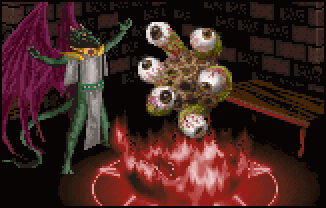 |
| I actually like this design better than the Beholder, with its weird mouth and bite attack ... |
A terrifying creature summoned by a wizard with Chaos spellbooks, the Chaos Spawn is a thing with virtually no melee capability, and which nevertheless cuts through units of normal men with ease using its various gaze attacks ...
Probably a couple months ago, my wife asked me why she and her brothers-in-law, who all play a semi-weekly game in a non-Greyhame dungeon, have never encountered a beholder before. I expect the question was prompted in part by the appearance of the beholder (and thri-kreen, lich, and dragon) on the cover of the 2e Monstrous Manual, which I was perusing at the time.
My first basic answer was just that they're still not at a level where an encounter with a beholder would make any sense--with its death gaze, stoning gaze, disintegration ray, antimagic cone, etc. etc. they just wouldn't stand a chance. And yes, I want dungeons to have high level things that will destroy the party if they just blithely attack it ... but beholders are just so dangerous, and their highest level character is 8th level.
But honestly, that isn't the full answer--as I gave it, I also realized that I just don't like beholders much. They're iconic D&D, sure; and I like the idea of a thing with eyes that each project a different kind of ray or magic effect (especially if the effects aren't the same for every monster!); but I just think they look terrible, with that great gaping mouth (and I also remember all the frustrating fights I've had against beholders in Baldur's Gate 2 or Icewind Dale, and I just don't quite want to inflict that frustration on others ...)
So I don't like beholders much; but I do remember liking the aesthetic of the Chaos Spawn of Master of Magic (pictured above), so I thought I'd give a look at them to see if they might be a beholder rip-off that I could stomach to use in my games.
Per MoM the Chaos Spawn has stats: Chaos Spawn -- Magic (Chaos) -- Upkeep 12 (mana/turn) -- Melee (1) -- Defense (5) -- Resistance (10) -- Hits (15) -- Movement (1 Flying) -- Special (Death Gaze -4 save; Doom Gaze strength 4; Stoning Gaze -4 save; Poisonous Bite strength 4)
Death Gaze -- in melee, each figure in the unit opposing the Chaos Spawn must save at -4 or die without any chance to deal melee damage
Doom Gaze -- in melee, the entire unit opposing the Chaos Spawn automatically takes damage equal to the strength of the gaze, without any chance to resist or defend; figures killed by the gaze do not receive a chance to deal melee damage
Stoning Gaze -- in melee, each figure in the unit opposing the Chaos Spawn must save at -4 or be petrified without any chance to deal melee damage
Poison Attack (bite) -- in addition to melee, the unit opposing the Chaos Spawn must save with their resistance once per each point of strength of the poison attack or take that damage; figures killed by poison still deal damage during melee
------
So, the Chaos Spawn
AC 4
HD 8
THAC0 12
attacks: 1 stinger, 5 gaze attacks
damage: stinger 1-6 plus poison (save v. poison at -2 or die in 1-3 rds)
movement: fly 90'
special: death gaze (save v. death ray or die)
doom gaze (take 1-8 damage, no save)
stoning gaze (save v. petrification or be turned to stone)
fear gaze (save v. wands or affected as by a wand of fear effect)
confusion gaze (save v. spells or confused as per the spell)
considering gaze attacks, each gaze affects one character in melee, determined at random (there's no guarantee any particular character will ever meet any particular gaze, regardless of the creature's intentions); otherwise, characters in melee may choose to fight "from the corners of their eyes" taking -2 on their "to hit rolls" and taking a +2 penalty on their AC, but receiving a commensurate +2 bonus on saves; OR, characters in melee may choose to fight blind (blindfolded, eyes closed, fighting backwards with a mirror, etc.), attacking at -4 "to hit" and with a +4 penalty to AC, as if against an invisible creature, but also not vulnerable to the gaze attacks
------
It's still a pretty nasty monster, and not really all that different from a beholder ... but I'd be slightly more likely to use it in my own game.
Friday, November 24, 2017
Phantasmal Warriors
 |
| Those blue dudes up to the left are Phantom Warriors, defending a Sorcery Node; later-game they'd be joined by Phantom Beasts ... |
In keeping with the idea of transposing Master of Magic monsters into D&D, I've always thought Phantom Warriors would be great, so here goes.
These guys are like mirror images that can also fight. They strike with phantom weapons that ignore armor, allowing them to hit often, and yet themselves being insubstantial, a single hit destroys one figure.
I figure there are two ways to look at these, one as monsters, the other as a spell:
Phantasmal Warriors (the monster)
No. Appearing 3-18
AC 9
hp "1" (any "hit" kills it)
THAC0 19
damage 1-6
movement 120'
special: all hits by phantasmal warriors ignore physical armor, striking both an unarmored man and a character in plate as if AC 9; BUT dexterity adjustments and magical bonuses to armor still count as AC against these attacks
Phantasmal Warriors (the spell)
level 4
range 1 (allied) creature
duration 6 turns
2-7 phantasmal representations of the target creature appear, randomly armed and armored. Each "phantom" is allowed one attack per round at THAC0 19 (but treating natural or worn armor as AC 9; dexterity adjustments and magical bonuses to armor still apply to this AC), doing 1-6 damage; furthermore, each "phantom" is struck as if AC 9, and any "hit", regardless of damage, dissipates the "phantom" thus struck
Tuesday, November 14, 2017
the Nightstalker
Before I publish the next Greyhame Dungeon play report, here's a monster recreated from one of my favorite games: the Nightstalker
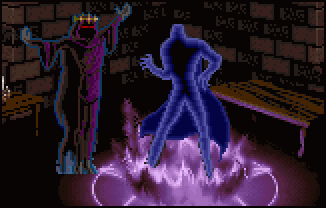 |
| Summoning a Nightstalker |
A significant amount of my mental landscape when it comes to fantasy was laid by the old Microprose game Master of Magic (1994). Back in elementary school before I had any actual D&D rulebooks, I made up monsters according to their stats in Master of Magic; and though I may have ultimately switched rather completely to 3E in highschool, and now to B/X in 2012 onward, still Master of Magic stands as an ur-source, like The Lord of the Rings, or the Timelife Books: The Enchanted World series, or The Flight of Dragons cartoon.
The Nightstalker is a summoned creature from Master of Magic, which is in hindsight clearly a rip-off of the invisible stalker in D&D; and yet, the Nightstalker is undead, only able to be conjured with a wizard with Death spellbooks; moreover, the Nightstalker has a formidable death gaze attack, which the invisible stalker clearly lacks.
Here's the Nightstalker's abilities per Master of Magic (drawn from a PDF download of the manual):
Nightstalker -- Magic (Death) -- Upkeep (1 Mana) -- Melee (7) -- Defense (3) -- Resistance (8) -- Hits (10) -- Movement (2) -- Special (Death Gaze -2 save; Invisible)
From which I will draw this (soft) D&D version:
the Nightstalker
AC 0 (4 if one can see invisible)
HD 5
THAC0 15
damage 2-12 + death gaze
death gaze -- all characters in melee with the Nightstalker save against death or die (+2 on save, -2 "to hit" if characters look sideways; +4 to save, -4 "to hit" if characters fight with eyes closed/face averted/etc.)
save as a Fighter 6
180' movement
morale 11
immune to charm, sleep, cold
turned as an undead of HD+2 (i.e. 7 for this write-up)
------
Such a monster is, of course, terrible to use against a party that has no way to detect invisible ... and nevertheless, I wrote a small dungeon that included something along these lines as a possible wandering monster within (though that version was for 5E, rather than B/X D&D)
Naturally, I rolled its appearance a couple times, and whenever it showed up, the party was in a high dudgeon of terror given the fact that it's naturally invisible and can strike when it pleases--and with a death gaze to boot! Two lower level compatriots died under the horror of its death-gaze; and ultimately, the party looted what they wanted without ever killing the invisible monster stalking the dungeon below ...
The stats don't necessitate any particular HD, AC, or anything, I'm just spitballing according to what I know of the Master of Magic wargame system, and still downplaying the monster a bit. The Nightstalker could easily be scaled up or down depending on what you want to do with it--maybe it's semi-visible for low level parties (note that it doesn't have immunity to normal weapons, and may be struck by any old sword!); maybe it has HD 10 for a high level group that may or may not have see invisible.
Saturday, October 14, 2017
Storming Mobrai Castle
I finally got to run something I've been longing to run for a very long time--a wargame scenario in my D&D game using the old Master of Magic rules (Master of Magic being a 1994 Microprose 4X game set in the two fantasy planes of Arcanus and Myrror).
I played a lot of MoM (Master of Magic ... Master of Orion was MoO), and I loved it, and I showed it to a few friends who also loved it, and it was always terribly frustrating that the game is single-player only. We had to play Heroes of Might and Magic to get a multiplayer game going, but it to me it was nothing compared to MoM. I always wanted to run something like MoM with my friends, paper and pencil style, and this afternoon I finally got that chance:
Clark the fighter and Allen the cleric (the long-running characters of my buddy Josh) along with Grimalf, human follower of Galtzak the Tiger-Faced Halfling (characters of another good friend, Renee, who was not present but gave her sanction to the wargame), hired a small army of mercenaries and stormed the rival stronghold of Mobrai Castle, several hexes upriver from Galtzak's castle in Galtshire.
The Background
Several years ago, Galtzak got his hands on a ruined castle in a swamp that had been overrun by lizardmen. He semi-cleared it by slaying the slaad that dwelled in the basement, but so overawed the lizardmen that they stayed on as "guests"/servants (he had to let their leader lick his eyes, because I explained that eye-licking was a sign of friendship between lizardmen, who can't blink ...). Possession of this castle jumpstarted a domain game, and the castle became the new home for a group of about 200 halflings who moved in once Galtzak (and company) cleared away some monsters and cleared some of the forest and got the castle repaired.
Fast forward a few years, and I've got a new group running in the setting (my wife and two of her brothers); they reach high enough level for me to suggest a run-through of I2: Tomb of the Lizard King (1982). I reworked the module--being about a lizard king, lizardmen, and set in a swampy jungle, it's perfect to drop into the jungle south of Galtzak's castle and have the lizard king's return threaten Galtzak's new shire (and I also rewrote N1: Against the Reptile God and dropped it in for good measure). (they did defeat the lizard king and have since returned to the main dungeon, leaving Galtzak to fend for himself once again)
Altogether, I also wrote a whole wilderness around Galtzak's castle that I'd never had the time nor impetus to write before. This wilderness included another castle slightly upriver from Galtshire--Mobrai Castle, the last castle of the County of Eor, erstwhile foes of the Lizard King, but ultimately cut off from other human realms and in civilizational decline/decay. There's only one castle left, with a handful of villagers, and I wrote a hook that the villagers hated their lord, Arkenbrand III. Mobrai, for not doing enough to push back the lizardmen (also, his priest was the priest helping Sakatha in the Tomb).
My wife and bros never found the castle nor took the hook, but when in Boise over the summer, I got together with Renee and Josh, and the peasants of Mobrai Castle sent a delegation to Galtzak seeking his aid in overthrowing Arkenbrand III. and placing some other more effective leader in his stead. Galtzak agreed; a screwball assassination attempt failed (ending merely with the abduction of Arkenbrand III.'s daughter's cat), and that was the situation when I left Boise to return home.
But I got permission from Renee to run a little wargame around the two castles; and Josh came into town yesterday; so today Clark and Allen, with Grimalf's help, assaulted Mobrai castle with a force of human mercenaries and lizardman and halfling levies from Galtshire.
The Setup
I allotted "unit" sizes based on the number of figures in a MoM unit, which is generally six figures per unit, depending on certain factors. This makes for some pretty small-scale war, which was completely appropriate for play today (Arkenbrand III. had maybe 50 men-at-arms in his castle at most), but could probably scaled up by factors of 5 or 10 for bigger battles and still retain the ruleset.
"Galtzak's" Forces
48 lizardmen armed with spears (6 units of 8 figures each)
12 human swordsmen-at-arms (2 units of 6 each)
48 halfling settler-levies (6 units of 8)
16 halfling slingers (2 units representing Galtzak's name-level followers)
Clark (human "paladin", a LG fighter who through religious vows can lay on hands)
Allen (human cleric, LG, Clark's follower)
Grimalf (human fighter, C, Galtzak's right hand man)
plus the mercenaries Clark hired on Galtzak's behalf:
12 longbowmen (2 units of 6)
12 heavy cavalry (3 units of 4)
So that's a little over 150 men sent to take this Mobrai Castle. Josh split his forces up with an interesting plan: he sent Clark, Allen, and the human fighters upriver first, and made it clear that they were setting up siege outside Mobrai Castle (and the castle's watchers saw them and returned with word of the assault to the castle); meanwhile, the halflings and lizardmen, led by Grimalf, left on another set of boats and landed further upriver from the castle at night, and then made their way through the hills to the western side of the castle (where was previously established a gap in the wall, through which the abortive assassination attempt was staged). I rolled two dice, and the castle defenders neither noticed the sneaking lizardman/halfling force, nor had the gap filled in (they didn't know about it).
Ultimately, Josh hoped to draw Arkenbrand III. Mobrai's men into battle below the castle, while the halflings and lizardmen filed in through the gap to take it from behind (and he hoped to capture Arkenbrand III. in the keep, assuming he would lead from the rear).
Well, Arkenbrand III. was ready for battle, and he did exactly what Josh hoped, leading his forces out in a sortie to crush the invaders, leaving a garrison of bowmen and spearmen to control the castle from the walls. Also, he had hired a pair of stone giants from the hills around his castle, which rather spooked Josh with their appearance.
Arkenbrand III. Mobrai's Forces
12 light cavalry (3 units of 4 figures)
24 human swordsmen (4 units of 6)
48 peasant spearman levies (6 units of 8)
12 bowmen (2 units of 6)
2 stone giants (each being its own figure, like a hero)
and Arkenbrand III. Mobrai himself (high level human fighter)
So, altogether about 100 men-at-arms defending the castle, half of them of poor morale, plus two giants. Yes, the odds were heavily skewed for Josh--but I'd written the castle's defenders long before, and that's just what Arkenbrand III. had (other than the newly hired giants). But that's war for you--often battles are heavily skewed one way or the other.
The Battle
Arkenbrand III. set up with his cavalry out front, himself behind to charge with them, with the giants slightly behind as "living siege engines" (they can throw a couple rocks per battle before closing to melee), flanked by wings of spearmen and swordsmen. He kept his bowmen in the castle towers in reserve, along with other spearmen (also with some intent to make sure the castle wasn't overrun by disgruntled peasants in his absence ...).
Josh/Clark set his troops up with cavalry up front, heroes and swordsmen just behind, and longbowmen off on the right flank. The halflings and lizardmen were going to start entering the castle through the gap in the wall two units per turn, and I would roll a d6 per turn of combat for the men inside the castle to notice, starting with a 1 in 6 notice, then a 2 in 6 next turn, then 3 in 6, etc.
The cavalry basically charged each other, while the giants and the longbowmen picked targets (and the bowmen on the walls were outside of range to do anything substantial). The giants' first volley, one boulder against Clark, one against a unit of his cavalry, both resulted doing no damage because of successful defense rolls. Then the cavalry meleed each other, and we began to roll dice in earnest.
After the first exchange, Clark's cavalry was suffering, because one unit had taken attacks from two opponents. Allen the cleric cast healing on this injured unit (for this scenario I used the MoM spell rather than D&D cure spells). Then Clark's cavalry replied in earnest, all three units attacking Mobrai's three cavalry, and Mobrai's horse was devastated. The longbowmen, meanwhile, nearly destroyed one of Mobrai's swordsmen units, which was marching forward with the other infantry in a slower line behind the cavalry.
On the next round, Arkenbrand III. Mobrai joined his cavalry against Clark's; though his cavalry ended up getting killed in their melees, Mobrai destroyed an entire unit single-handedly; then, over the course of the next round, destroyed a second unit of cavalry. The man was clearly a bad-ass, wrecking 4-man units of horsemen at a time, calling for Clark to stop being a coward and come fight me! But Clark signaled for his longbowmen to pincushion poor Mobrai; and as Mobrai took enough hits that I had him retreat, he ended up getting shot in the back with arrows (and ultimately dying).
The giants were marching forward by this time, each having thrown their complement of boulders--and Clark wisely sought to buy them off, rather than fight them directly, and with a called offer of piles of gold and herds of sheep, the giants looked at dead Lord Mobrai and decided to call the battle off. With their defection, the other soldiers threw down their arms.
Unfortunately, those on the castle did not immediately surrender--rather, they were engaged in a kind of ineffectual battle with the lizardmen infiltrating into the keep. See, Josh had sent his lizardmen up the walls to attack the bowmen and spearmen of Mobrai's reserve (and the halflings were going to go seize the keep, where Josh assumed Arkenbrand III. was). As the reserves noticed the lizardmen sneaking up on them (on the second turn), they turned and began to fight--and even after their comrades on the field below had surrendered, they continued to fight for several turns, terrified of the lizards' advance. But ultimately, they too surrendered, after three or four rounds in which neither side eliminated any unit completely.
Thus was Mobrai Castle stormed and claimed by Clark in the name of Galtzak the Tiger-Faced. The peasant levies were relieved of duty and sent back to the countryside to rebuild their farms, and Mobrai's men-at-arms were sent downriver to be held by Galtzak until he figures out what to do with them.
The Rules
A quick aside about the MoM rules: the game was based on 10% chance increments, base chance of landing a hit 30%, base chance of shrugging off a hit 30%, modified up or down by 10% for every +1 or -1 (so +1 to hit is 40% or 1-4 on a d10, etc.). I find this unique among wargames, though perhaps I'm not well versed with them. Most wargames I'm familiar with use d6s (because they're readily available in large numbers and easy to read quickly), but MoM was a computer game first, and so could do large amounts of math quickly (like, we were rolling 16 or 20 d10s at a time, picking out rolls of 1-3, and it took us a few rounds before we were doing it smoothly).
Also, every melee gives both units a chance to attack, at the attack strength of their figures at the beginning of the melee--casualties are only taken after both sides have rolled their attacks and defense. And defense was a weird roll to figure out; I gave Josh the benefit of rolling all his defense dice for his cavalry against the giant's first throw, but then thought that seemed wrong with the first cavalry melee. Sure enough, the example in the MoM rule book shows going through a unit figure by figure, and once we started doing that, melees started looking more like the MoM battles I remembered (enormously frustrating and satisfying almost simultaneously!).
Example:
... The basilisk has a melee attack strength of 15 (i.e., it has 15 sword icons on its statistics). Thus, the computer makes 15 die rolls for it, each with a base 30% chance to hit. With a little luck, the basilisk scores 5 hits from among those die rolls. The elven lords, in response, have a defense strength of four each (each figure has four shield icons among its statistics). So, the first elven lord figure steps up to defend against the basilisk’s 5 incoming hits. The computer rolls four dice (one for each shield), each with a base 30% to negate a single hit. Unfortunately, it completely misses and all five hits are scored against that elven figure. Since each elven lord figure only has three hits (i.e., three heart symbols on its statistics), it is killed and the two remaining hits are applied against the next elven lord figure. That figure gets to use its full complement of shield icons, making four rolls against the same 30% chance to stop a hit. With better luck than the last figure, it manages to block one hit, and so suffers the other. Thus, after this melee exchange, two [sic., should read three because "elven lords" have four figures to start] elven lord figures remain standing in this unit, the foremost of which has taken a single hit (one of his three heart symbols is darkened). ... (p. 94, Master of Magic Manual, 1994, pdf)
The Aftermath
Inside the keep of Mobrai Castle was Arkenbrand III.'s daughter, Loara Mobrai, who was older than the players had earlier suspected (i.e. 20's, not a child). As he liberated the castle and learned of her presence, Josh asked me if I still had my old infatuation random tables; I do ... percentile dice were rolled to see if any hero liked her, and if she liked any hero, and it turned out that Grimalf was infatuated with Loara, but Loara was infatuated with Clark (and Clark had no particular interest for her one way or the other). Loara therefore suggested a marriage between herself and Clark, to retain legitimacy of his lordship (she being the rightful heir), and Clark agreed (sorry, Grimalf--you have two wives already, both foisted on you by Galtzak to cover up his indiscretions!). A wedding was thrown, using 4500 gp donated to a Lawful cause to earn Allen and Clark some extra xps (a lordly wedding is definitely Lawful).
Other local notables were Johann Hatch, a leader of the peasants rebelling against Arkenbrand III., and who warily trusts Clark to be a good lord, fingers crossed; and Kol Giant-Teaser, a peasant who hates giants and was dismayed to see Clark let them go, but whose "reactions roll" of 12 indicated he thinks Clark is a badass hero regardless (and he smiles and nods when Clark tells him that there will be no killing of giants unless the giants start something ... right, "start" something, he repeats, a glint in his eyes).
According to his promise to the giants, Clark sends downriver (to civilization) to buy four riverboats and 400 sheep, and arranges for the sheep to be transported upriver to appease the giants (besides also giving the two 1000 gold each). They seem content with this for the moment.
And as for Galtshire, the lumber profits for the month are nixed as the lumber usually sold downriver from Galtshire is instead sent upriver to help the peasants rebuild their homesteads and farms, which were earlier ravaged by raiding bandits and lizardmen from the Tomb of the Lizard King.
So a second PC is now in control of a castle (at level 8, too early to have followers, and he owes a portion of his income to the other PC as his liege, but still, another domain!), and the threats to Galtshire from lizards and from other human lords jealous of their ancient status as Counts of Eor have been dealt with--but many other threats still lurk in the swamps and hill around Galtshire, even as 250 more halfling settlers come boating in to set up homes around the castle of Galtzak (and who knows what might happen settler-wise with Clark at Mobrai Castle!).
I played a lot of MoM (Master of Magic ... Master of Orion was MoO), and I loved it, and I showed it to a few friends who also loved it, and it was always terribly frustrating that the game is single-player only. We had to play Heroes of Might and Magic to get a multiplayer game going, but it to me it was nothing compared to MoM. I always wanted to run something like MoM with my friends, paper and pencil style, and this afternoon I finally got that chance:
Clark the fighter and Allen the cleric (the long-running characters of my buddy Josh) along with Grimalf, human follower of Galtzak the Tiger-Faced Halfling (characters of another good friend, Renee, who was not present but gave her sanction to the wargame), hired a small army of mercenaries and stormed the rival stronghold of Mobrai Castle, several hexes upriver from Galtzak's castle in Galtshire.
The Background
Several years ago, Galtzak got his hands on a ruined castle in a swamp that had been overrun by lizardmen. He semi-cleared it by slaying the slaad that dwelled in the basement, but so overawed the lizardmen that they stayed on as "guests"/servants (he had to let their leader lick his eyes, because I explained that eye-licking was a sign of friendship between lizardmen, who can't blink ...). Possession of this castle jumpstarted a domain game, and the castle became the new home for a group of about 200 halflings who moved in once Galtzak (and company) cleared away some monsters and cleared some of the forest and got the castle repaired.
Fast forward a few years, and I've got a new group running in the setting (my wife and two of her brothers); they reach high enough level for me to suggest a run-through of I2: Tomb of the Lizard King (1982). I reworked the module--being about a lizard king, lizardmen, and set in a swampy jungle, it's perfect to drop into the jungle south of Galtzak's castle and have the lizard king's return threaten Galtzak's new shire (and I also rewrote N1: Against the Reptile God and dropped it in for good measure). (they did defeat the lizard king and have since returned to the main dungeon, leaving Galtzak to fend for himself once again)
Altogether, I also wrote a whole wilderness around Galtzak's castle that I'd never had the time nor impetus to write before. This wilderness included another castle slightly upriver from Galtshire--Mobrai Castle, the last castle of the County of Eor, erstwhile foes of the Lizard King, but ultimately cut off from other human realms and in civilizational decline/decay. There's only one castle left, with a handful of villagers, and I wrote a hook that the villagers hated their lord, Arkenbrand III. Mobrai, for not doing enough to push back the lizardmen (also, his priest was the priest helping Sakatha in the Tomb).
My wife and bros never found the castle nor took the hook, but when in Boise over the summer, I got together with Renee and Josh, and the peasants of Mobrai Castle sent a delegation to Galtzak seeking his aid in overthrowing Arkenbrand III. and placing some other more effective leader in his stead. Galtzak agreed; a screwball assassination attempt failed (ending merely with the abduction of Arkenbrand III.'s daughter's cat), and that was the situation when I left Boise to return home.
But I got permission from Renee to run a little wargame around the two castles; and Josh came into town yesterday; so today Clark and Allen, with Grimalf's help, assaulted Mobrai castle with a force of human mercenaries and lizardman and halfling levies from Galtshire.
The Setup
I allotted "unit" sizes based on the number of figures in a MoM unit, which is generally six figures per unit, depending on certain factors. This makes for some pretty small-scale war, which was completely appropriate for play today (Arkenbrand III. had maybe 50 men-at-arms in his castle at most), but could probably scaled up by factors of 5 or 10 for bigger battles and still retain the ruleset.
"Galtzak's" Forces
48 lizardmen armed with spears (6 units of 8 figures each)
12 human swordsmen-at-arms (2 units of 6 each)
48 halfling settler-levies (6 units of 8)
16 halfling slingers (2 units representing Galtzak's name-level followers)
Clark (human "paladin", a LG fighter who through religious vows can lay on hands)
Allen (human cleric, LG, Clark's follower)
Grimalf (human fighter, C, Galtzak's right hand man)
plus the mercenaries Clark hired on Galtzak's behalf:
12 longbowmen (2 units of 6)
12 heavy cavalry (3 units of 4)
So that's a little over 150 men sent to take this Mobrai Castle. Josh split his forces up with an interesting plan: he sent Clark, Allen, and the human fighters upriver first, and made it clear that they were setting up siege outside Mobrai Castle (and the castle's watchers saw them and returned with word of the assault to the castle); meanwhile, the halflings and lizardmen, led by Grimalf, left on another set of boats and landed further upriver from the castle at night, and then made their way through the hills to the western side of the castle (where was previously established a gap in the wall, through which the abortive assassination attempt was staged). I rolled two dice, and the castle defenders neither noticed the sneaking lizardman/halfling force, nor had the gap filled in (they didn't know about it).
Ultimately, Josh hoped to draw Arkenbrand III. Mobrai's men into battle below the castle, while the halflings and lizardmen filed in through the gap to take it from behind (and he hoped to capture Arkenbrand III. in the keep, assuming he would lead from the rear).
Well, Arkenbrand III. was ready for battle, and he did exactly what Josh hoped, leading his forces out in a sortie to crush the invaders, leaving a garrison of bowmen and spearmen to control the castle from the walls. Also, he had hired a pair of stone giants from the hills around his castle, which rather spooked Josh with their appearance.
Arkenbrand III. Mobrai's Forces
12 light cavalry (3 units of 4 figures)
24 human swordsmen (4 units of 6)
48 peasant spearman levies (6 units of 8)
12 bowmen (2 units of 6)
2 stone giants (each being its own figure, like a hero)
and Arkenbrand III. Mobrai himself (high level human fighter)
So, altogether about 100 men-at-arms defending the castle, half of them of poor morale, plus two giants. Yes, the odds were heavily skewed for Josh--but I'd written the castle's defenders long before, and that's just what Arkenbrand III. had (other than the newly hired giants). But that's war for you--often battles are heavily skewed one way or the other.
The Battle
Arkenbrand III. set up with his cavalry out front, himself behind to charge with them, with the giants slightly behind as "living siege engines" (they can throw a couple rocks per battle before closing to melee), flanked by wings of spearmen and swordsmen. He kept his bowmen in the castle towers in reserve, along with other spearmen (also with some intent to make sure the castle wasn't overrun by disgruntled peasants in his absence ...).
Josh/Clark set his troops up with cavalry up front, heroes and swordsmen just behind, and longbowmen off on the right flank. The halflings and lizardmen were going to start entering the castle through the gap in the wall two units per turn, and I would roll a d6 per turn of combat for the men inside the castle to notice, starting with a 1 in 6 notice, then a 2 in 6 next turn, then 3 in 6, etc.
The cavalry basically charged each other, while the giants and the longbowmen picked targets (and the bowmen on the walls were outside of range to do anything substantial). The giants' first volley, one boulder against Clark, one against a unit of his cavalry, both resulted doing no damage because of successful defense rolls. Then the cavalry meleed each other, and we began to roll dice in earnest.
After the first exchange, Clark's cavalry was suffering, because one unit had taken attacks from two opponents. Allen the cleric cast healing on this injured unit (for this scenario I used the MoM spell rather than D&D cure spells). Then Clark's cavalry replied in earnest, all three units attacking Mobrai's three cavalry, and Mobrai's horse was devastated. The longbowmen, meanwhile, nearly destroyed one of Mobrai's swordsmen units, which was marching forward with the other infantry in a slower line behind the cavalry.
On the next round, Arkenbrand III. Mobrai joined his cavalry against Clark's; though his cavalry ended up getting killed in their melees, Mobrai destroyed an entire unit single-handedly; then, over the course of the next round, destroyed a second unit of cavalry. The man was clearly a bad-ass, wrecking 4-man units of horsemen at a time, calling for Clark to stop being a coward and come fight me! But Clark signaled for his longbowmen to pincushion poor Mobrai; and as Mobrai took enough hits that I had him retreat, he ended up getting shot in the back with arrows (and ultimately dying).
The giants were marching forward by this time, each having thrown their complement of boulders--and Clark wisely sought to buy them off, rather than fight them directly, and with a called offer of piles of gold and herds of sheep, the giants looked at dead Lord Mobrai and decided to call the battle off. With their defection, the other soldiers threw down their arms.
Unfortunately, those on the castle did not immediately surrender--rather, they were engaged in a kind of ineffectual battle with the lizardmen infiltrating into the keep. See, Josh had sent his lizardmen up the walls to attack the bowmen and spearmen of Mobrai's reserve (and the halflings were going to go seize the keep, where Josh assumed Arkenbrand III. was). As the reserves noticed the lizardmen sneaking up on them (on the second turn), they turned and began to fight--and even after their comrades on the field below had surrendered, they continued to fight for several turns, terrified of the lizards' advance. But ultimately, they too surrendered, after three or four rounds in which neither side eliminated any unit completely.
Thus was Mobrai Castle stormed and claimed by Clark in the name of Galtzak the Tiger-Faced. The peasant levies were relieved of duty and sent back to the countryside to rebuild their farms, and Mobrai's men-at-arms were sent downriver to be held by Galtzak until he figures out what to do with them.
The Rules
A quick aside about the MoM rules: the game was based on 10% chance increments, base chance of landing a hit 30%, base chance of shrugging off a hit 30%, modified up or down by 10% for every +1 or -1 (so +1 to hit is 40% or 1-4 on a d10, etc.). I find this unique among wargames, though perhaps I'm not well versed with them. Most wargames I'm familiar with use d6s (because they're readily available in large numbers and easy to read quickly), but MoM was a computer game first, and so could do large amounts of math quickly (like, we were rolling 16 or 20 d10s at a time, picking out rolls of 1-3, and it took us a few rounds before we were doing it smoothly).
Also, every melee gives both units a chance to attack, at the attack strength of their figures at the beginning of the melee--casualties are only taken after both sides have rolled their attacks and defense. And defense was a weird roll to figure out; I gave Josh the benefit of rolling all his defense dice for his cavalry against the giant's first throw, but then thought that seemed wrong with the first cavalry melee. Sure enough, the example in the MoM rule book shows going through a unit figure by figure, and once we started doing that, melees started looking more like the MoM battles I remembered (enormously frustrating and satisfying almost simultaneously!).
Example:
... The basilisk has a melee attack strength of 15 (i.e., it has 15 sword icons on its statistics). Thus, the computer makes 15 die rolls for it, each with a base 30% chance to hit. With a little luck, the basilisk scores 5 hits from among those die rolls. The elven lords, in response, have a defense strength of four each (each figure has four shield icons among its statistics). So, the first elven lord figure steps up to defend against the basilisk’s 5 incoming hits. The computer rolls four dice (one for each shield), each with a base 30% to negate a single hit. Unfortunately, it completely misses and all five hits are scored against that elven figure. Since each elven lord figure only has three hits (i.e., three heart symbols on its statistics), it is killed and the two remaining hits are applied against the next elven lord figure. That figure gets to use its full complement of shield icons, making four rolls against the same 30% chance to stop a hit. With better luck than the last figure, it manages to block one hit, and so suffers the other. Thus, after this melee exchange, two [sic., should read three because "elven lords" have four figures to start] elven lord figures remain standing in this unit, the foremost of which has taken a single hit (one of his three heart symbols is darkened). ... (p. 94, Master of Magic Manual, 1994, pdf)
The Aftermath
Inside the keep of Mobrai Castle was Arkenbrand III.'s daughter, Loara Mobrai, who was older than the players had earlier suspected (i.e. 20's, not a child). As he liberated the castle and learned of her presence, Josh asked me if I still had my old infatuation random tables; I do ... percentile dice were rolled to see if any hero liked her, and if she liked any hero, and it turned out that Grimalf was infatuated with Loara, but Loara was infatuated with Clark (and Clark had no particular interest for her one way or the other). Loara therefore suggested a marriage between herself and Clark, to retain legitimacy of his lordship (she being the rightful heir), and Clark agreed (sorry, Grimalf--you have two wives already, both foisted on you by Galtzak to cover up his indiscretions!). A wedding was thrown, using 4500 gp donated to a Lawful cause to earn Allen and Clark some extra xps (a lordly wedding is definitely Lawful).
Other local notables were Johann Hatch, a leader of the peasants rebelling against Arkenbrand III., and who warily trusts Clark to be a good lord, fingers crossed; and Kol Giant-Teaser, a peasant who hates giants and was dismayed to see Clark let them go, but whose "reactions roll" of 12 indicated he thinks Clark is a badass hero regardless (and he smiles and nods when Clark tells him that there will be no killing of giants unless the giants start something ... right, "start" something, he repeats, a glint in his eyes).
According to his promise to the giants, Clark sends downriver (to civilization) to buy four riverboats and 400 sheep, and arranges for the sheep to be transported upriver to appease the giants (besides also giving the two 1000 gold each). They seem content with this for the moment.
And as for Galtshire, the lumber profits for the month are nixed as the lumber usually sold downriver from Galtshire is instead sent upriver to help the peasants rebuild their homesteads and farms, which were earlier ravaged by raiding bandits and lizardmen from the Tomb of the Lizard King.
So a second PC is now in control of a castle (at level 8, too early to have followers, and he owes a portion of his income to the other PC as his liege, but still, another domain!), and the threats to Galtshire from lizards and from other human lords jealous of their ancient status as Counts of Eor have been dealt with--but many other threats still lurk in the swamps and hill around Galtshire, even as 250 more halfling settlers come boating in to set up homes around the castle of Galtzak (and who knows what might happen settler-wise with Clark at Mobrai Castle!).
Subscribe to:
Posts (Atom)