I dream of such things, but I tend to put my mind to other uses for the game, like designing new dungeons, new monsters, and new tricks; for treasure, I usually faithfully roll out the percentages per "treasure type", adjusting on the fly as seems to be needed. If I'm really motivated, I'll describe the pieces of jewelry--a gilded panoply, or a golden death mask, etc.--or replace the 1000s of gold or silver pieces with some other form of wealth, like ingots of copper or crates of trade goods.
So I was recently looking through a dungeon of mine, its hoards rolled up faithfully according to the B/X treasure charts, and I saw an excess of pieces of jewelry, all notated as JEWELRY: (1000) (600) (1400) (1300) etc. according to gp value rolled on 3d6 ... and a thought came to me as I tried to imagine what these pieces were--what if some of them were in fact not worth that amount of gold, but could be donated to the right cult or other party for their value in experience instead (as a limiting factor in the amount of gold I'm giving out ...)? I suppose these are basically "quest" items that grant "quest" xp--except their use would be to reduce "excessive" wealth from a rolled up hoard, yet to still grant xp for those characters willing to do a little extra leg work outside the dungeon.
Here are a few examples I came up with for a d12 roll--obviously just scratching the surface of what could be:
1) an altar service of wood and ceramic plates, cups, platters, etc. These humble items are of little value on the open market (maybe 25 gp if you're fortunate), but their very humbleness is sacred and symbolic to the Good cults. Returning these items to a local Good cult will net 3d6 x 100 experience
2) an oriflamme of Law, topped with a bronze Hand of Sabazios. Though interesting enough to be sold for half of its value (3d6 x 100), returning this battle standard to a local Law cult of Sabazios will earn its full value in experience for the party

3) a lead-lined cloak of penance, of literally no value on the open market (who wants a cape that literally weighs you down?), it can be turned over to the Good cult for a full 3d6 x 100 experience.
4) --slightly different--a charter of incorporation or a grant of monopoly over certain goods, unfortunately dedicated to some defunct guild or party, or otherwise outdated so that it has no market value. Nevertheless, it is of recent enough vintage that a Thieves' Guild or other such nefarious organization would be willing to buy it for 3d6 x 100 gold in order to use it as a basic standard for forging such documents for their own use
5) the acorn of a dryad's oak, or a sapling/clone of an Elfin aspen grove. It might have some gold value to certain individuals, decided by referee fiat, but otherwise it could be given over to a local Nature cult for a full 3d6 x 100 experience reward (yeah, I played Baldur's Gate II)
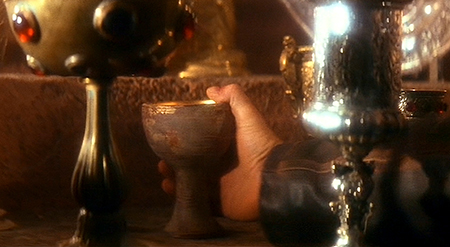
6) a simple wooden or ceramic chalice, a relic of a humble Good saint; perhaps surrounded by gaudy gold and jeweled chalices purporting to be the actual relic, but which are really all trapped with contact poison or a magical curse a la Indiana Jones; regardless, the chalice itself is worth next to nothing except to its relevant cult, earning 3d6 x 100 experience--OR to one who knows its value, in that it fills with water as good as a potion of cure light wounds 1/day when filled with simple water and blessed by a Good cleric
7) a sword of blood (or other metal-dependent weapon, like an axe or mace)--it's a +1 weapon, but because of its origins from iron drawn from the blood of sacrificial victims, Good characters wield it as a -1 weapon instead; but if a character decides to turn it over to the Good cult to redeem the item's inherent evil, they will receive at least 2500 experience
8) a trivial magic item--a cloak of minor comfort or a pot of cleanliness that cleans itself, or maybe a singing candlestick; such an item could be sold as a curio for 2d6 x 100 gold, but if turned over to the Arcane cult, will net the same gold plus 2d6 x 100 experience, or a cool 4d6 x 100 experience if given freely
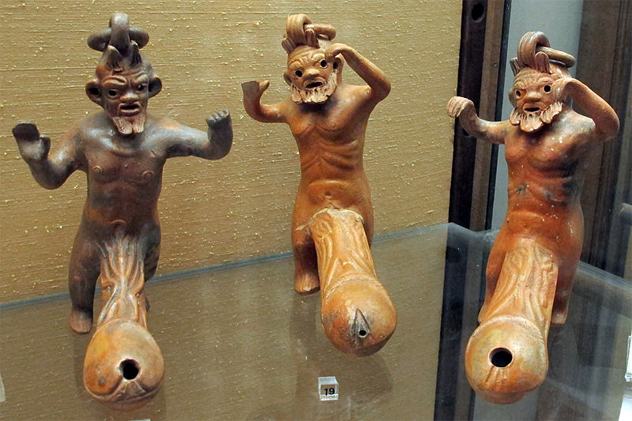
9) a leathern, earthenware, bronze, or smoothed-stone phallus; if you know the right people, the Evil cult will gladly accept it as a "relic" and invite you to an orgy and a mockery of another cult's ritual practices, possibly involving said "relic". The "relic" alone nets 3d6 x 100 experience, but attending the orgy doubles the experience and initiates you into the Evil cult. They'll even let you pet the cat.
10) a collection of river rocks or smoothed over stones. Not just lying around--these are in a chest or some other vessel, clearly important in some way, clearly organized with some sense of size and color, none of them magical or remarkable in any other way. They are the "grok rocks" of the local dwarven Clannish cult (they use them for divination by casting stones, playing marbles, etc.); there are 2-7 of them, each worth 1d4 x 100 experience, not depending on color or size, but on something ineffable about the stone itself
11) any holy symbol or other piece of religious imagery from another cult--rather than sell these for half their value in gold you can remand them to your own cult for the full value in experience instead (100 gold maximum--higher value pieces should be treated as "jewelry", saleable as close to cost as the referee allows, no bonus if given to your cult); Chaotic characters receive double this bonus
12) a ceremonial two-handed sword or other exaggerated weapon, so large and "intimidating" in its construction that it's worthless in battle. Because of the fine materials used in its construction, it can be sold as a typical piece of jewelry (3d6 x 100 gold), but if a Chaotic character takes it to their cult and offers it to their god, they gain 3d6+6 x 100 experience
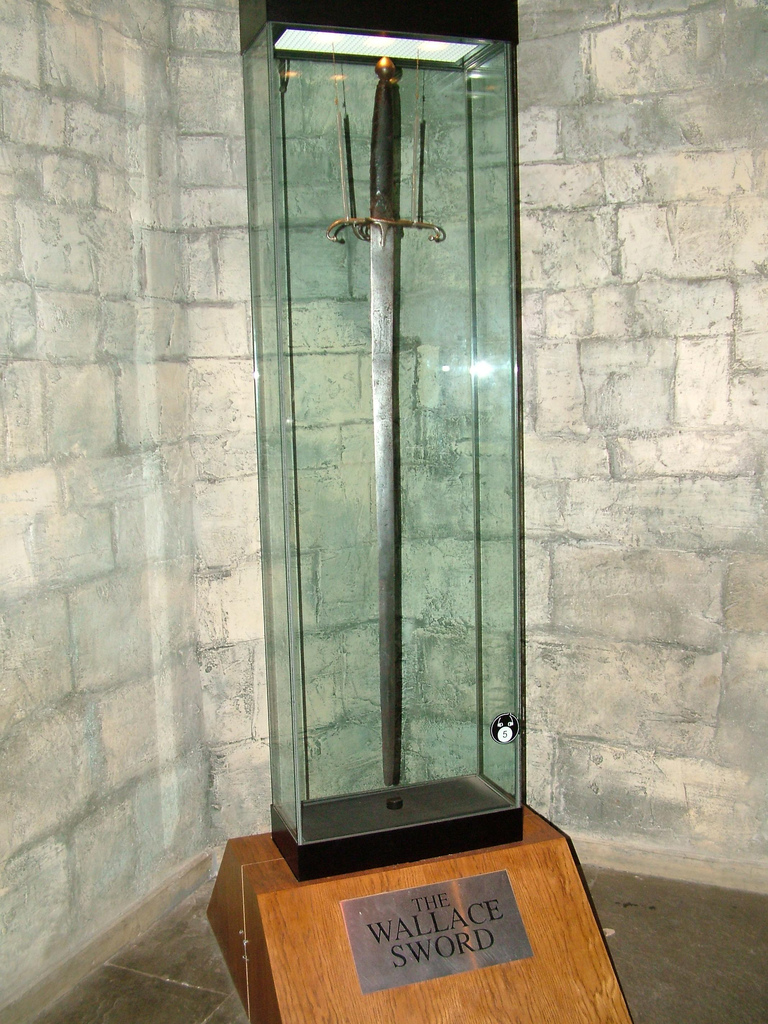 |
| "It's definitely a giant's sword ... Yeah, I definitely killed it single-handedly ... now I'm dedicating it to the Chaotic Temple of Self-Glorification with a memorial plaque dedicated to me for sweet, sweet XPs ..." |
The placement of such items in a treasure to replace those worth gold AND experience is, of course, rooted in that age-old advice of Gygax to limit the amount of gold to which players have access. I don't tend to be anywhere as extreme as his advice suggests one be, but I do worry sometimes about being a kind of monty-haul referee if I'm not careful (exacerbated, no doubt, by the fact that I've played in a few monty-haul type games where I've gotten vast sums for next to no work)