One of my characters in D&D is Laurantha the Unbeautiful, an Elf with too much of the haughty cruelty of the Elves in her face (Elves being soulless and non-empathic in my games), and possessed of too little of their supernatural beauty (she rolled like a 7 Charisma to start with). Over the course of her adventures she has reached level 5 (don't scoff! that requires 32,000+ xp! and she's at 55,000 or so ... and Eleithyia, my 8th level character in 5E, has far less xp than 5th level Laurantha ...). Well, sometime during carousing (on a different table than Jeff Rients' table--the referee liked the carousing idea, but snagged some other table from online, the contents of which I am ignorant), Laurantha "won" ownership of the local inn/tavern, the Dwarf's Beard Inn (think Han Solo "winning" the Millennium Falcon from Lando over poker). So Laurantha has an inn; so I had her sit out from adventuring for a while to develop two new spells, one allowing her to commune well with bees, the other to make really efficacious alcohol that gets a person drunk real fast, with the intent of beekeeping and making some really smashing mead (Laurantha's Efficacious Bee Charm, and Laurantha's Excellent Enchanted Mead).
So here are some rough calculations as to what that mead might cost to make, and what it might sell for (before she enchants it ...)
Following the "Joe's Ancient Orange Mead" recipe, 3.5# honey will produce 1 gallon of mead; 1 gallon of mead can be split into 8 "pints" of wine. One gallon will ferment to drinkability in 2 months (minimum), and get better (sell for more!) as it ages.
A pint of ale in 1E AD&D is 1 sp; I can buy a pint of beer at a local pub for $5, so let's say $1 : 1/5 sp : 2 cp. (a pint of mead sells for 5 sp; but given that you might spend $5 on a glass of wine at a pub, a glass which is something like a quarter or third of a pint, that's not unreasonable)
Google says a pound of honey right now costs about $6 (rounding up); so that's 12 cp per pound of honey. So to make a gallon of mead I need to pay 42 cp (or 4 silver, 2 copper).
At 1E prices, I could sell the gallon by the pint for 5 sp per pint, or 40 silver per gallon. Some chunk of that should be taxed away by local municipalities, plus I haven't added in the actual cost for barrels, bottles, and rent for a location to do this. Hopefully, keeping my own bees should reduce the overhead costs ... All in all, though, this should produce some kind of profit.
Costwise, a 10 gallon oak barrel could cost about 4 gold, per a quick Google search ("what does a 10 gallon oak barrel cost" which led to maybe $200, which reduces to 4 gold by my crunching). I assume I'll be able to reuse it, at least a few times, to reduce cost a bit (the ACKS book has a 20 gallon barrel costing a mere 3 sp, less than a 10th the Google search ... if I assume 2 gp per barrel, profits come out even better).
Let's do more abstraction. A 2015 survey in Bee Culture (maybe a good source?) suggests that the average yearly yield of honey per colony of bees was 58.9 pounds, or basically 60 pounds. Given that Laurantha has a spell that charms bees, but that apiary in a D&D world is not necessarily as technically efficient as now, let's assume something like half that yield (30 pounds) plus 30% for the effectiveness of the spell (40 pounds). Or, actually, to make the math really easy, let's just say average 35 pounds of honey per year. That means (on the very low end!) for every hive Laurantha can make 10 gallons of mead ... which means I need a lot of freaking hives to make "free" mead! Still, every hive is about 5 silver less to make about 400 more silver...
This abstract however suggests that average yield per year is 75-125 pounds of honey, or 200+ for "good" beekeepers. Also, that the cost for two hives for the first year is approximately $900, or 1800 cp, which is to say 18 gp. Man, that's cheap for an adventurer! The initial cost will take two months to make money, and given 10 to 30 years of productivity, that would be a minimum of 400 gold for ten years (not counting the initial start-up cost) :: a minimum of 35 pounds honey per year : 10 gallons mead per year : 400 silver per year. Double 35 pounds of honey to 70 pounds (still well below the mean suggested by the abstract) and double the profits.
1 yield = 35 pounds of honey
1 pound honey costs 12 cp (if bought)
1 hive = 0-4 yields (per year ... 0 would be a year where you don't harvest so the hive survives)
2 hives cost 18 gp (or 1 hive costs 10 gp--doubling allows redundancy between hives)
35 pounds of honey = 10 gallons mead (in two months)
10 gallons mead cost 420 cp / 42 sp / 4 gp + 2 sp (if from bought honey)
OR 1 hive = 0-40 gallons mead (if honey is harvested)
1 ten gallon barrel costs 2 gp
1 gallon = 8 pints
1 pint mead sells for 5 sp = 1 gallon mead sells for 40 sp = 10 gallons mead sell for 40 gp (400 sp)
1 yield of honey sells for 40 gp as mead
Bought Honey monthly profit per 10 gallons = -4.2(honey) & -20(barrel) & 400(mead) = 375.8 silver (not including taxes, fees, etc. for the right to sell alcohol ...)
Harvested Honey monthly profit per 10 gallons ... is a function involving the the possible yield and the reducing cost of reusing barrels (actually, the bought honey should include a "barrel reuse function" too) but I don't remember how to use functions.
But I can still drop an "Enchanted Mead" spell on it to make the mead make you drunk faster and presumably increase price! Haha!
... 'What about a little light?' said Bilbo apologetically. ---- 'We like the dark,' said all the dwarves. 'Dark for dark business! There are many hours before dawn.' ---- ... 'We are met to discuss our plans,' [said Thorin], 'our ways, means, policy, and devices. We shall soon before the break of day start on our long journey, a journey from which some of us, or perhaps all of us ... may never return.' ...
Tuesday, October 10, 2017
Monday, October 9, 2017
d12 More Oddments for Sale
I thought up a few more things than could fit on a d12 roll last night, and I filled in enough for a second table today at work while otherwise stocking shelves mindlessly. I was thinking each session that I would roll 2d12 and take one item from each table for sale that session. Again (per last night's post), these are items that are not regulated by any guild (sages' or magic-users' or any other), nor common enough to have a "market price", so players/characters will have to name a price and either get a reactions-roll as to whether it's enough, or actually role-play some haggling. The general asking price should be at least 100 gp.
Also, again, there's a chance that any item isn't really what the seller says it is, possibly just because the item is some bone claimed to be a saint's bone or a sending bone; or possibly, the item is essentially as-advertised, but defective in a serious way. So:
1 - a dagger fashioned from a killer bee's stinger--essentially a pixie's crysknife--it does 1-3 damage, has enough of the poison sac left for one hit to force a save against poison or die (at +2 on the save), and even if the poison fails, the stinger's barbs force it ever deeper into the wound for 1 additional damage every round, unless an entire round is spent digging it out
2 - a large egg; laid by what, the seller doesn't know, though he probably has some kind of pitch. It might be the egg of an owlbear, a gryphon, a giant eagle, a moa bird, a deinonychus, a demi-dragon, etc. (but it's not reptilian--reptile eggs are soft-shelled and this one is hard-shelled; and yes, a dinosaur is perfectly reasonable, dinosaurs are more birdlike than reptilian, they had feathers dammit). There is a 2 in 6 chance that the egg is inert because it wasn't incubated properly, but would still be worth something as a giant omelet or a sweet painted egg or something
3 - a troll's finger, the largest remaining piece of a destroyed troll, carefully and continuously carved to remain merely a regenerating finger. Sold by an ancient mountain man with an iron stomach who wants to retire--he used the finger as "emergency rations", cutting off a piece here or there to supplement meager rations with protein (no worries, stomach acids denature even troll proteins ...). If not properly carved for a week, it grows into an entire hand that seeks to strangle the character holding it, and then escape into the wilderness to regrow
4 - a vial of green slime; can be thrown like a flask of oil, and if it strikes and breaks on a creature, it begins its process of dissolving armor and clothes and turning flesh into another green slime colony; the colony within the vial is small, and so it only has 1 HD, and it takes twice as long (e.g. 2-8 rds) to do its slime thing
5 - 50% chance, either a piece of smoked salmon of knowledge OR fermented sleeper shark; the salmon of knowledge grants a single use of a random spell, magic-user or clerical; the sleeper shark grants a single use of contact higher plane as the magic-user spell (including esp. the insanity chance!)--those sharks have been around since the beginning of the world, and spoken with ancient aboleths and other strange things.
6 - a ghost pepper, so powerfully spicy that it allows contact with the spirit realm. It's unclear whether this means that eating the pepper raises one to a spiritual plane because of the pain (so like to death), or whether the oils within the pepper are so efficacious that even spirits might be affected by a sword smeared with their residue. That, or both might be possible. Regardless, eating the pepper raw causes 1-4 damage from sheer misery.
7 - the fingerbone (or other like, small remains) of a Good saint, Lawful holy man, or Natural mystic; incorporating it into a holy symbol grants +1 on the roll for number of hit dice affected by a turn undead attempt; possibly it could also be incorporated into a weapon (in the hilts of a sword, for instance, or a mace's head) to allow that weapon to strike undead otherwise struck only by silver or magical weapons
8 - a nosegay of dragonrose; ("dragonrose" is lifted from the animated film "The Flight of Dragons" (1982), a late Rankin & Bass project, and one of my favorite movies from my childhood; this clip has nothing to do with dragronrose, but is indicative of the film's imaginative nature) anyway, dragonrose has a pungent scent, and properties that put even dragons to sleep (given enough quantity); its effect on other creatures, even those of serpentine or lizardlike nature, might be comparable; the nosegay lasts 1-3 weeks before withering away
9 - a sending bone--some kind of spirit has been trapped within this bone (likely smaller than a femur, but larger than a knucklebone), and not necessarily the original owner of the bone. The spirit can be sent with a message to any creature whose name is known, and collect a short response. Unfortunately, such things are finicky creatures, and there is a 1 in 20 chance that the spirit goes berserk and attacks the named individual. Treat it as a shadow
10 - a roll of bark from an Elvish willow grove; it may be chewed directly, brewed into a tea, or worked into a poultice and applied directly to a wound; chewing it cures 1-2 hp of wounds, the tea cures 2-4 hp of wounds but requires a fire and a skin of water, and takes 1 turn to brew, while the poultice must be made over the course of a day, but can be applied to conscious or unconscious characters' wounds to cure 2-4 hp of wounds.
11 - a rowan shield; it performs as a normal shield (-1 AC, may be broken to prevent a "hit" from dealing damage)--but, rowan has a special magical property too. A rowan shield may be "broken" by a character to automatically save on one save against spells ("broken" in that it is sapped of vital forces and left as a brittle husk with no serious protective powers)
12 - a Ring of Unseen Servant OR Referee's Choice; the Ring produces an unseen servant on command (invisible spirit that can do simple things like sweep the floor, do dishes, take arrows out of an enemy's quiver, etc.--but any attack against it dispels it, and it cannot itself attack)--but, there is a distinct possibility that the Ring is actually a Djinni Ring, and that, as an heirloom passed down over several generations, its real power has been forgotten. The Djinni is happy to maintain the charade, masquerading as an unseen servant to quickly complete easy tasks and then return to its own leisure; it would of course be displeased to be discovered, but would have little legitimate pushback against the Ring's owner ... If this item is rolled, I would suggest a new item be created for future rolls, or that the referee pick an item from this or the previous list that seem particularly appropriate to the moment of the campaign (be that best served by usefulness or hilarity or otherwise ...)
Also, again, there's a chance that any item isn't really what the seller says it is, possibly just because the item is some bone claimed to be a saint's bone or a sending bone; or possibly, the item is essentially as-advertised, but defective in a serious way. So:
1 - a dagger fashioned from a killer bee's stinger--essentially a pixie's crysknife--it does 1-3 damage, has enough of the poison sac left for one hit to force a save against poison or die (at +2 on the save), and even if the poison fails, the stinger's barbs force it ever deeper into the wound for 1 additional damage every round, unless an entire round is spent digging it out
2 - a large egg; laid by what, the seller doesn't know, though he probably has some kind of pitch. It might be the egg of an owlbear, a gryphon, a giant eagle, a moa bird, a deinonychus, a demi-dragon, etc. (but it's not reptilian--reptile eggs are soft-shelled and this one is hard-shelled; and yes, a dinosaur is perfectly reasonable, dinosaurs are more birdlike than reptilian, they had feathers dammit). There is a 2 in 6 chance that the egg is inert because it wasn't incubated properly, but would still be worth something as a giant omelet or a sweet painted egg or something
3 - a troll's finger, the largest remaining piece of a destroyed troll, carefully and continuously carved to remain merely a regenerating finger. Sold by an ancient mountain man with an iron stomach who wants to retire--he used the finger as "emergency rations", cutting off a piece here or there to supplement meager rations with protein (no worries, stomach acids denature even troll proteins ...). If not properly carved for a week, it grows into an entire hand that seeks to strangle the character holding it, and then escape into the wilderness to regrow
4 - a vial of green slime; can be thrown like a flask of oil, and if it strikes and breaks on a creature, it begins its process of dissolving armor and clothes and turning flesh into another green slime colony; the colony within the vial is small, and so it only has 1 HD, and it takes twice as long (e.g. 2-8 rds) to do its slime thing
5 - 50% chance, either a piece of smoked salmon of knowledge OR fermented sleeper shark; the salmon of knowledge grants a single use of a random spell, magic-user or clerical; the sleeper shark grants a single use of contact higher plane as the magic-user spell (including esp. the insanity chance!)--those sharks have been around since the beginning of the world, and spoken with ancient aboleths and other strange things.
6 - a ghost pepper, so powerfully spicy that it allows contact with the spirit realm. It's unclear whether this means that eating the pepper raises one to a spiritual plane because of the pain (so like to death), or whether the oils within the pepper are so efficacious that even spirits might be affected by a sword smeared with their residue. That, or both might be possible. Regardless, eating the pepper raw causes 1-4 damage from sheer misery.
7 - the fingerbone (or other like, small remains) of a Good saint, Lawful holy man, or Natural mystic; incorporating it into a holy symbol grants +1 on the roll for number of hit dice affected by a turn undead attempt; possibly it could also be incorporated into a weapon (in the hilts of a sword, for instance, or a mace's head) to allow that weapon to strike undead otherwise struck only by silver or magical weapons
8 - a nosegay of dragonrose; ("dragonrose" is lifted from the animated film "The Flight of Dragons" (1982), a late Rankin & Bass project, and one of my favorite movies from my childhood; this clip has nothing to do with dragronrose, but is indicative of the film's imaginative nature) anyway, dragonrose has a pungent scent, and properties that put even dragons to sleep (given enough quantity); its effect on other creatures, even those of serpentine or lizardlike nature, might be comparable; the nosegay lasts 1-3 weeks before withering away
9 - a sending bone--some kind of spirit has been trapped within this bone (likely smaller than a femur, but larger than a knucklebone), and not necessarily the original owner of the bone. The spirit can be sent with a message to any creature whose name is known, and collect a short response. Unfortunately, such things are finicky creatures, and there is a 1 in 20 chance that the spirit goes berserk and attacks the named individual. Treat it as a shadow
10 - a roll of bark from an Elvish willow grove; it may be chewed directly, brewed into a tea, or worked into a poultice and applied directly to a wound; chewing it cures 1-2 hp of wounds, the tea cures 2-4 hp of wounds but requires a fire and a skin of water, and takes 1 turn to brew, while the poultice must be made over the course of a day, but can be applied to conscious or unconscious characters' wounds to cure 2-4 hp of wounds.
11 - a rowan shield; it performs as a normal shield (-1 AC, may be broken to prevent a "hit" from dealing damage)--but, rowan has a special magical property too. A rowan shield may be "broken" by a character to automatically save on one save against spells ("broken" in that it is sapped of vital forces and left as a brittle husk with no serious protective powers)
12 - a Ring of Unseen Servant OR Referee's Choice; the Ring produces an unseen servant on command (invisible spirit that can do simple things like sweep the floor, do dishes, take arrows out of an enemy's quiver, etc.--but any attack against it dispels it, and it cannot itself attack)--but, there is a distinct possibility that the Ring is actually a Djinni Ring, and that, as an heirloom passed down over several generations, its real power has been forgotten. The Djinni is happy to maintain the charade, masquerading as an unseen servant to quickly complete easy tasks and then return to its own leisure; it would of course be displeased to be discovered, but would have little legitimate pushback against the Ring's owner ... If this item is rolled, I would suggest a new item be created for future rolls, or that the referee pick an item from this or the previous list that seem particularly appropriate to the moment of the campaign (be that best served by usefulness or hilarity or otherwise ...)
d12 Semi-Magical Items For Sale at the Local Market
These are the kinds of items that aren't quite controlled by sages' or magic-users' guilds. They don't require a Wizard or Wizard-Lord to create, or they can be found/uncovered locally, or they're the kind of thing that adventurers might sell in local markets to be resold to other adventurers. There are no set "market prices" for these goods because they're too rare for any kind of "secure" price/profit. Rather, they must be haggled over (whether that be offer a price and roll a reactions roll, OR actually going through the motions of haggling with price/counter-price until both parties are satisfied or mutually incompatible). I would definitely not allow offers below 100 gp for any of these things, however (unless, perhaps, they're counterfeit ...)
Because these are being sold by free yeomen, traveling men, hunters, etc. at the local market--and not vetted by any sage or magic-users' guild--there is no guarantee that any particular item is actually what it's advertised as. The root of bryony, for instance, might actually be a human-like root of ginger; or it might even be an insidious imp, hoping to tempt some poor buyer down the path to Evil. Likewise, the memory moss might be exactly as advertised, or in fact be some kind of dark moss that is deadly-poisonous when eaten. Once acquired, they may, of course, be taken to a sage to be certainly identified--but the sage will likely charge the usual rate of 2000 gp/month of investigation!
1 - a giant-killer-bee honeycomb, which, if eaten all at once, cures 1-4 hit points; regardless of whether this is the promised killer bee honey, there is a 25% chance that the honey was made by bees with access to opium, lotus, or another like drug, and that it causes mild hallucinations when ingested
2 - part of a dragon's heart; normally dragon hearts are things of power that, when eaten by mortals, imbue the eater with something of the dragon's majesty (like the speech of birds or snakes, access to a single spell, or improved attributes, etc.). This particular item, being only a part, will grant the ability to comprehend languages for 2-12 turns (e.g. Siegfried sucking his thumb, burned on Fafnir's heart, which grants him comprehension of birdsong)
3 - keeping with dragons for a moment, a vial of dragon's blood is being hawked here. Everyone knows that dragon's blood is deadly poisonous, so that merely touching it can kill a man (or is that just a legend?); regardless, this vial, if poured over a weapon, should allow a single hit to poison an enemy so that they die immediately if they fail a save vs. poison. Where this vial really contains dragon's blood or not, there is a 10% chance that when applying it to a weapon, a character accidentally poisons him/herself (unless the character is an Assassin, or in some other way a qualified poisoner)--moreover, the sale of this deadly poison is, naturally, very illegal, and its price will be higher than other items, and its sale and possession must be kept in strictest secrecy
4 - a quill pen cut from the feather of an ancient raven; the magic inherent in the raven and crow tribes is such that a spellcaster (magic-user, elf, cleric, etc.) may use this quill to pen one scroll of one spell from first to third level, spending only 100 gp per level of the spell--and may do so without being the minimum level normally needed to scribe scrolls (e.g. 5th for ACKS, 9th for B/X, etc.)
5 - a handful of memory moss ("obliviax"); assuming this really is what is being sold, a character who eats it entirely will be granted a single use of a random spell from first through fourth level (regardless of being a magic-user or not), but will also be inflicted with some of the memories of the individual brain-drained by the moss. Such memories may be traumatic, or a kind of treasure map, or anything, really.
6 - a lantern with treated fire beetle glands which, if shaken, will shine as a lantern for 24 turns (duration of a lantern) because of the alchemical processes used to preserve the fire beetle glands' light-emitting properties. Assuming this is not a huckster selling you an accidental shake-em-up alchemists' fire bomb, it will have from 2 to 8 "charges" before the reagents within cease to react.
7 - a bottle of Laurantha's Enchanted Mead (or some imitator's knock-off); the bottle contains enough mead or wine to pour four goblets-worth of drink. Drinking any one goblet is enough to knock a sober man to drunkenness (save vs. poison to negate, -1 cumulative penalty and a new save per goblet drunk). A bad knock-off might leave a man blind for drinking it ...
OR
a bottle of the Mead of Poetry--if drunk in its entirety by one character, that character gains a +1 Charisma (even beyond 18), has a knack for verse forevermore (regardless of the player's ability, the character may speak poetically whenever they wish), and once over the next year may utter a doom (this can be a geas, a prophecy, some kind of unique boon tied to a nickname, etc., along the lines of what a skald or bard might proclaim)
8 - not done with dragons, apparently, a dragon's tooth which, if planted, will sprout a fully armed warrior which will either (on a good reactions roll) swear loyalty to the planting character, or (on a bad reactions roll) go berserk and attack the nearest creature. Legends tell that throwing a stone at a creature near it will force the earth-sprung warrior to attack that creature--but such tales are garbled things of old wives' tales and half-remembered epics from an earlier age
9 - a unicorn's horn, which will act as a wand of poison detection with 3-10 (d8+2) charges; OR, using up 3 charges by grinding up part of the horn and dissolving it in water or wine, one may make a potion of neutralize poison that most assuredly neutralizes all poisons. Given the unicorn's status as a symbol of innocence and purity, a Good character may not participate in the commodification of a unicorn without the express purpose of putting the horn to rest, without any benefit from its uses as a panacea.
10 - a root of bryony, properly harvested and trimmed on the days of the moon; the sages say that if it is buried in a graveyard and fed milk for 30 days, and then dug up and wound with a dead man's winding sheet, the root should become a Mandragora (a kind of familiar spirit); this root-spirit must be kept at the side of its creator. Whenever the creator is affected by something requiring a saving throw, he may choose to succeed automatically in a process that destroys the Mandragora. Furthermore, if the Mandragora is separated from its creator by more than 60 feet, it utters a death shriek forcing everyone within 60 feet to save vs. death or die, the creator included.
11 - a sprig of nightshade, properly harvested; the ancient Masters of Magic assure us of nightshade's use as a protection against enchantments, and so wearing a sprig of its flowers grants a +1 on all saves against hostile magic--assuming the blooms really are nightshade. The flowers last 1-4 weeks before crumbling into dust.
12 - a vial of water from the Well of Forgetfulness, of from the Well of Memory (50% chance for either, no guarantee the seller remembers which it is); one erases memories, leaving a character "catatonic" and inactive for 1-3 turns, and erasing one random spell from memory for the day if the drinker is a spellcaster; the other causes memories to surge forth, leaving a character overwhelmed by memory and confused (as the spell) for 2-7 rounds, though it does "re-memorize" one random spell for a spellcaster, from those already cast for the day. Other things beyond spells may be "forgotten" or "remembered" per referee fiat, though it should only be one "item" per vial.
Because these are being sold by free yeomen, traveling men, hunters, etc. at the local market--and not vetted by any sage or magic-users' guild--there is no guarantee that any particular item is actually what it's advertised as. The root of bryony, for instance, might actually be a human-like root of ginger; or it might even be an insidious imp, hoping to tempt some poor buyer down the path to Evil. Likewise, the memory moss might be exactly as advertised, or in fact be some kind of dark moss that is deadly-poisonous when eaten. Once acquired, they may, of course, be taken to a sage to be certainly identified--but the sage will likely charge the usual rate of 2000 gp/month of investigation!
1 - a giant-killer-bee honeycomb, which, if eaten all at once, cures 1-4 hit points; regardless of whether this is the promised killer bee honey, there is a 25% chance that the honey was made by bees with access to opium, lotus, or another like drug, and that it causes mild hallucinations when ingested
2 - part of a dragon's heart; normally dragon hearts are things of power that, when eaten by mortals, imbue the eater with something of the dragon's majesty (like the speech of birds or snakes, access to a single spell, or improved attributes, etc.). This particular item, being only a part, will grant the ability to comprehend languages for 2-12 turns (e.g. Siegfried sucking his thumb, burned on Fafnir's heart, which grants him comprehension of birdsong)
3 - keeping with dragons for a moment, a vial of dragon's blood is being hawked here. Everyone knows that dragon's blood is deadly poisonous, so that merely touching it can kill a man (or is that just a legend?); regardless, this vial, if poured over a weapon, should allow a single hit to poison an enemy so that they die immediately if they fail a save vs. poison. Where this vial really contains dragon's blood or not, there is a 10% chance that when applying it to a weapon, a character accidentally poisons him/herself (unless the character is an Assassin, or in some other way a qualified poisoner)--moreover, the sale of this deadly poison is, naturally, very illegal, and its price will be higher than other items, and its sale and possession must be kept in strictest secrecy
4 - a quill pen cut from the feather of an ancient raven; the magic inherent in the raven and crow tribes is such that a spellcaster (magic-user, elf, cleric, etc.) may use this quill to pen one scroll of one spell from first to third level, spending only 100 gp per level of the spell--and may do so without being the minimum level normally needed to scribe scrolls (e.g. 5th for ACKS, 9th for B/X, etc.)
5 - a handful of memory moss ("obliviax"); assuming this really is what is being sold, a character who eats it entirely will be granted a single use of a random spell from first through fourth level (regardless of being a magic-user or not), but will also be inflicted with some of the memories of the individual brain-drained by the moss. Such memories may be traumatic, or a kind of treasure map, or anything, really.
6 - a lantern with treated fire beetle glands which, if shaken, will shine as a lantern for 24 turns (duration of a lantern) because of the alchemical processes used to preserve the fire beetle glands' light-emitting properties. Assuming this is not a huckster selling you an accidental shake-em-up alchemists' fire bomb, it will have from 2 to 8 "charges" before the reagents within cease to react.
7 - a bottle of Laurantha's Enchanted Mead (or some imitator's knock-off); the bottle contains enough mead or wine to pour four goblets-worth of drink. Drinking any one goblet is enough to knock a sober man to drunkenness (save vs. poison to negate, -1 cumulative penalty and a new save per goblet drunk). A bad knock-off might leave a man blind for drinking it ...
OR
a bottle of the Mead of Poetry--if drunk in its entirety by one character, that character gains a +1 Charisma (even beyond 18), has a knack for verse forevermore (regardless of the player's ability, the character may speak poetically whenever they wish), and once over the next year may utter a doom (this can be a geas, a prophecy, some kind of unique boon tied to a nickname, etc., along the lines of what a skald or bard might proclaim)
8 - not done with dragons, apparently, a dragon's tooth which, if planted, will sprout a fully armed warrior which will either (on a good reactions roll) swear loyalty to the planting character, or (on a bad reactions roll) go berserk and attack the nearest creature. Legends tell that throwing a stone at a creature near it will force the earth-sprung warrior to attack that creature--but such tales are garbled things of old wives' tales and half-remembered epics from an earlier age
9 - a unicorn's horn, which will act as a wand of poison detection with 3-10 (d8+2) charges; OR, using up 3 charges by grinding up part of the horn and dissolving it in water or wine, one may make a potion of neutralize poison that most assuredly neutralizes all poisons. Given the unicorn's status as a symbol of innocence and purity, a Good character may not participate in the commodification of a unicorn without the express purpose of putting the horn to rest, without any benefit from its uses as a panacea.
10 - a root of bryony, properly harvested and trimmed on the days of the moon; the sages say that if it is buried in a graveyard and fed milk for 30 days, and then dug up and wound with a dead man's winding sheet, the root should become a Mandragora (a kind of familiar spirit); this root-spirit must be kept at the side of its creator. Whenever the creator is affected by something requiring a saving throw, he may choose to succeed automatically in a process that destroys the Mandragora. Furthermore, if the Mandragora is separated from its creator by more than 60 feet, it utters a death shriek forcing everyone within 60 feet to save vs. death or die, the creator included.
11 - a sprig of nightshade, properly harvested; the ancient Masters of Magic assure us of nightshade's use as a protection against enchantments, and so wearing a sprig of its flowers grants a +1 on all saves against hostile magic--assuming the blooms really are nightshade. The flowers last 1-4 weeks before crumbling into dust.
12 - a vial of water from the Well of Forgetfulness, of from the Well of Memory (50% chance for either, no guarantee the seller remembers which it is); one erases memories, leaving a character "catatonic" and inactive for 1-3 turns, and erasing one random spell from memory for the day if the drinker is a spellcaster; the other causes memories to surge forth, leaving a character overwhelmed by memory and confused (as the spell) for 2-7 rounds, though it does "re-memorize" one random spell for a spellcaster, from those already cast for the day. Other things beyond spells may be "forgotten" or "remembered" per referee fiat, though it should only be one "item" per vial.
Saturday, October 7, 2017
New Class: the Traveling Man
Not to overload things here with new classes, but I've written several for my game, and I wanted to sort of "get them out in full view," a couple now, a couple later. The Man-Ape was actually the most recently written (and my favorite issue, I won't lie ... the Free Goblin and the Hardy Yeoman, to be posted later, vie for second place); while the Traveling Man (or Traveling Woman, as you will), was the first, conceived a couple months heretofore.
It was a slower day at work, when I had the leisure not to rush about trying to do everything at once, and I was wondering how one might work up classes with prime requisites of Constitution or Charisma (rather than merely Strength for fighting-men, Intelligence for magic-users, Wisdom for clerics, and dexterity for thieves). After all, the original game had only fighting-men and magic-users--clerics and thieves were added in later. So why not tack on other classes after that? (but classes unrelated to the later iterations of ranger, bard, or sorcerer--I wanted to be original-ish)
Considering Charisma, I thought for a while of trying to come up with an Odysseus-type who could talk his way out of troubles; or a Siren class who could charm enemies. I considered coming up with new abilities, with new tables and trees and rolls to make under certain circumstances ... and then suddenly got sick of it all--after all, when fighting-men level up, they only get an additional hit die and (occasionally) a better "to hit" roll.
Hence, for the Traveling Man I tried to work only within the rule systems already presented in Basic. Certainly they have more fiddly particulars than a fighting-man, but I tried not to tack on any new rule system to their class (like a bard song ability, or whatever weird thing I could come up with that seemed Charisma-like).
Did I mention Odysseus? Ultimately, I did hope to create a class who might somewhat emulate his feats, cheating a Cyclops in part by claiming his name to be "Nobody," so that when the Cyclops calls to his brothers, "Nobody has blinded me!" the other Cyclopes only laugh and ignore him (and out of hubris, Odysseus reveals his name, and is thereafter damned to wander many years before returning home, bedding various siren-type sorceresses and telling tall tales about his own journeys and exploits).
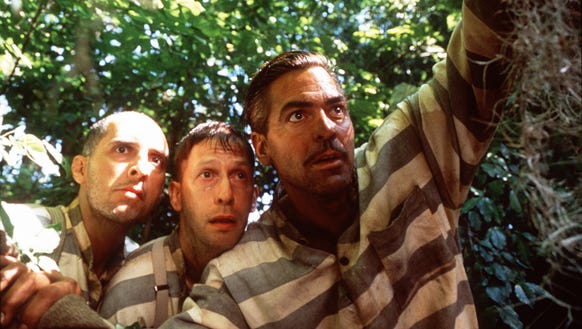
But also, through the mediation of the 2000 film O' Brother, Where Art Thou and the lead character Ulysses (i.e. Odysseus), I also began to think of the Traveling Man as the Rambling Gambler of Americana and Celtic folk. So.
The TRAVELING MAN (or WOMAN)
Level 1 -- Tramp -- 1d6 Hit Dice -- 0 XP -- +1 bonus language
Level 2 -- Trotter -- 2d6 HD -- 1500 XP
Level 3 -- Hitchhiker -- 3d6 HD -- 3000 XP -- +2 bonus languages
Level 4 -- Hobo -- 4d6 HD -- 6000 XP
Level 5 -- Rover -- 5d6 HD -- 12000 XP -- +3 bonus languages
Level 6 -- Rambler -- 6d6 HD -- 24000 XP
Level 7 -- Gambler -- 7d6 HD -- 50000 XP -- +4 bonus languages
Level 8 -- Supertramp -- 8d6 HD -- 100000 XP
Level 9 -- Wanderer -- 9d6 HD -- 200000 XP -- +5 bonus languages
Level 10 -- Wanderer 10th level -- +1 hp -- 300000 XP
Level 11 -- Wanderer 11th level -- +2 hp -- 400000 XP -- *languages
etc, every 100,000 XP earns 1 additional level and+1 additional hp
Traveling Men/Women (i.e. Travelers) fight as clerics and save as fighting-men; they may use any weapons or armor. Charisma is their prime requisite, and a Charisma of 13+ will net 5% extra xps at the end of the adventure, or Charisma 16+ will net 10% extra xps (not cumulatively).
Travelers, being garrulous individuals who make their way through the world with words, develop an ability to talk to just about anybody or anything. They receive +1 to any reaction roll involving speech or negotiations.
Moreover, as their rambling lives require Travelers to maintain their cool in various stressful situations (like trying to talk their way out of gambling debts or crossbow-weddings), Travelers are also able to impart some of their cool to others, granting followers and retainers +1 to morale scores.
Further, given their experience with various valuables--in pawn shops, card halls, bazaars, and yard sales--Travelers may appraise items with a general accuracy. Because of the generalized nature of this skill, particulars or odd historical details might be missed, but usually a Traveler can tell if any old gem or piece of jewelry is worth approximately 10 gp or 1500 gp. Further, this ability extends to familiarity with legends/aspects of magic items, resulting in a cumulative 5% chance per level (90% maximum) of correctly identifying any magic item that a Traveler handles (only one roll per item per level allowed).
Lastly, being gambling types (e.g. Simon and Garfunkel singing Roving Gambler and Rose of Aberdeen, or the traditional Rambling Gambler sung by the Irish Rovers) Travelers learn the games of chance of many cultures, cards especially. Once per week, a Traveler may set up a game with his own cash, up to 100 gp/level, and then wins -10% to +40% for himself; but he must also make a save against poison (at -1/100 gp) or binge, spending an additional 100 gp/level on further gambling.
I have further rules for Traveling Men and Women who reach Name Level (9th for this class)--they may elect either to settle down and build a permanent INN (whether they remain there, or leave a trusted second in charge is up to the individual and their own wanderlust ...), or gather a semi-permanent CARAVAN about themselves, a sort of traveling community that moves from place to place, buying and trading goods, gambling here and there, working odd jobs, and maybe being a little bit gypsy to boot.
But all of that is for Name Level Travelers. Right now, all that exists of this class is a single Traveling Man, played by one of my brothers-in-law, a first level Traveler seeking the halfling land of Hopshire to save the halflings there from Giants and "evil men". He is a newcomer to a larger party, a hanger-on amongst the fellows of Baldo the Halfling, the would-be hero of Hopshire. And alas, this traveling is set in a kind of limbo as we play first play through a certain other quest--though, of course, traveling forever is that at which a Traveling Man excels ...
It was a slower day at work, when I had the leisure not to rush about trying to do everything at once, and I was wondering how one might work up classes with prime requisites of Constitution or Charisma (rather than merely Strength for fighting-men, Intelligence for magic-users, Wisdom for clerics, and dexterity for thieves). After all, the original game had only fighting-men and magic-users--clerics and thieves were added in later. So why not tack on other classes after that? (but classes unrelated to the later iterations of ranger, bard, or sorcerer--I wanted to be original-ish)
Considering Charisma, I thought for a while of trying to come up with an Odysseus-type who could talk his way out of troubles; or a Siren class who could charm enemies. I considered coming up with new abilities, with new tables and trees and rolls to make under certain circumstances ... and then suddenly got sick of it all--after all, when fighting-men level up, they only get an additional hit die and (occasionally) a better "to hit" roll.
Hence, for the Traveling Man I tried to work only within the rule systems already presented in Basic. Certainly they have more fiddly particulars than a fighting-man, but I tried not to tack on any new rule system to their class (like a bard song ability, or whatever weird thing I could come up with that seemed Charisma-like).
Did I mention Odysseus? Ultimately, I did hope to create a class who might somewhat emulate his feats, cheating a Cyclops in part by claiming his name to be "Nobody," so that when the Cyclops calls to his brothers, "Nobody has blinded me!" the other Cyclopes only laugh and ignore him (and out of hubris, Odysseus reveals his name, and is thereafter damned to wander many years before returning home, bedding various siren-type sorceresses and telling tall tales about his own journeys and exploits).
But also, through the mediation of the 2000 film O' Brother, Where Art Thou and the lead character Ulysses (i.e. Odysseus), I also began to think of the Traveling Man as the Rambling Gambler of Americana and Celtic folk. So.
The TRAVELING MAN (or WOMAN)
Level 1 -- Tramp -- 1d6 Hit Dice -- 0 XP -- +1 bonus language
Level 2 -- Trotter -- 2d6 HD -- 1500 XP
Level 3 -- Hitchhiker -- 3d6 HD -- 3000 XP -- +2 bonus languages
Level 4 -- Hobo -- 4d6 HD -- 6000 XP
Level 5 -- Rover -- 5d6 HD -- 12000 XP -- +3 bonus languages
Level 6 -- Rambler -- 6d6 HD -- 24000 XP
Level 7 -- Gambler -- 7d6 HD -- 50000 XP -- +4 bonus languages
Level 8 -- Supertramp -- 8d6 HD -- 100000 XP
Level 9 -- Wanderer -- 9d6 HD -- 200000 XP -- +5 bonus languages
Level 10 -- Wanderer 10th level -- +1 hp -- 300000 XP
Level 11 -- Wanderer 11th level -- +2 hp -- 400000 XP -- *languages
etc, every 100,000 XP earns 1 additional level and
Traveling Men/Women (i.e. Travelers) fight as clerics and save as fighting-men; they may use any weapons or armor. Charisma is their prime requisite, and a Charisma of 13+ will net 5% extra xps at the end of the adventure, or Charisma 16+ will net 10% extra xps (not cumulatively).
Travelers, being garrulous individuals who make their way through the world with words, develop an ability to talk to just about anybody or anything. They receive +1 to any reaction roll involving speech or negotiations.
Moreover, as their rambling lives require Travelers to maintain their cool in various stressful situations (like trying to talk their way out of gambling debts or crossbow-weddings), Travelers are also able to impart some of their cool to others, granting followers and retainers +1 to morale scores.
Further, given their experience with various valuables--in pawn shops, card halls, bazaars, and yard sales--Travelers may appraise items with a general accuracy. Because of the generalized nature of this skill, particulars or odd historical details might be missed, but usually a Traveler can tell if any old gem or piece of jewelry is worth approximately 10 gp or 1500 gp. Further, this ability extends to familiarity with legends/aspects of magic items, resulting in a cumulative 5% chance per level (90% maximum) of correctly identifying any magic item that a Traveler handles (only one roll per item per level allowed).
Lastly, being gambling types (e.g. Simon and Garfunkel singing Roving Gambler and Rose of Aberdeen, or the traditional Rambling Gambler sung by the Irish Rovers) Travelers learn the games of chance of many cultures, cards especially. Once per week, a Traveler may set up a game with his own cash, up to 100 gp/level, and then wins -10% to +40% for himself; but he must also make a save against poison (at -1/100 gp) or binge, spending an additional 100 gp/level on further gambling.
I have further rules for Traveling Men and Women who reach Name Level (9th for this class)--they may elect either to settle down and build a permanent INN (whether they remain there, or leave a trusted second in charge is up to the individual and their own wanderlust ...), or gather a semi-permanent CARAVAN about themselves, a sort of traveling community that moves from place to place, buying and trading goods, gambling here and there, working odd jobs, and maybe being a little bit gypsy to boot.
But all of that is for Name Level Travelers. Right now, all that exists of this class is a single Traveling Man, played by one of my brothers-in-law, a first level Traveler seeking the halfling land of Hopshire to save the halflings there from Giants and "evil men". He is a newcomer to a larger party, a hanger-on amongst the fellows of Baldo the Halfling, the would-be hero of Hopshire. And alas, this traveling is set in a kind of limbo as we play first play through a certain other quest--though, of course, traveling forever is that at which a Traveling Man excels ...
Friday, October 6, 2017
New Class: the Man-Ape
One thing I love about pulp fiction like Robert E. Howard's Conan series and Edgar Rice Burroughs' John Carter of Mars books is the use of apes as enemies for the eponymous heroes to wrestle--the grey apes that Conan faces in close quarters and the four-armed white apes that dwell around the southern pole of Mars ... apes make great uncanny valley enemies, being not-quite-human, not-quite-beast, but definitely physically more powerful than human (and my wife thinks monkeys and apes are "creepy and demonic"), and all of this led me to think, "I need more apes in my D&D games."
I don't actually use apes as often as I feel like I should as monsters--when I remember, I'll add white apes, rock baboons, and hsing-hsing to my wandering monster rolls. But then again, apes don't always make sense in my dungeons; a catacombs filled with undead horrors, warped fey hounds, troglodytes, mad myconids, and a white-dragon cult doesn't necessarily have room for apes. So I figured the most reasonable way to get more ape-action in my games was to make a playable ape-class.
Hence, the MAN-APE! (and not Ape-Man, because that implies an apish man, like Tarzan, rather than a mannish ape like King Louis--from the Jungle Book, not French history!)
Level 1 -- Brute -- Hit Dice 2d8 -- 0 XP
Level 2 -- Ape -- HD 3d8 -- 2200 XP
Level 3 -- Great Ape -- HD 4d8 -- 4400 XP
Level 4 -- Grey Ape -- HD 5d8 -- 8800 XP
Level 5 -- Silverback -- HD 6d8 -- 18000 XP
Level 6 -- Beastlord -- HD 7d8 -- 36000 XP
Level 7 -- King of Monkeys // Kong -- HD 8d8 -- 72000
Level 8 -- King of the Jungle // King Kong -- HD 9d8 --150000
(no further advancement)
Yes, they start with two hit-dice, rather like AD&D rangers.
Strength is the Man-Ape's prime requisite, and 13+ will earn 5% more xps, while strength 16+ will earn 10% additional xps (not cumulatively).
Man-Apes fight and save as fighting-men of the same level. They start without any gold or possessions. Also, Man-Apes may not lead retainers until Name Level (7th, for my game ... unless the referee fiats otherwise).
Man-Apes begin with the languages of Ape and Signed Common; high intelligence might grant additional languages, assuming a forgiving referee. They also have a better ability to scent things than humans and demi-humans; this ability is intentionally left at that, to encourage unique attempts to use it.
As for armor, Man-Apes begin with a natural AC of 7, but they may only wear armor that is custom-made for them at double the normal cost. Further, if unarmored or wearing no heavier than leather armor, Man-Apes may climb anything reasonable without a check (a tree, a cliff with lots of easy handholds, etc.), or climb sheer surfaces as a thief of the same level, +5%.
When fighting, Man-Apes may use any weapon; but they may also strike with their fists in a two-attack routine (without penalty), each fist doing 1-3 damage (plus strength bonus, if applicable). If both fists hit, the Man-Ape does an additional 1-6 damage from rending (no strength bonus for this). This is only possible when fighting with fists, i.e. a sword-using Man-Ape cannot rend (though I have allowed the singular character of this class in my game to attack with his off-hand fist when wielding a weapon).
Further, Man-Apes being apes, they are capable of feats of strength that no man or demi-human could possibly emulate. That is, a Man-Ape need never "check" for normal strength-based tasks, except where the effort need be so herculean that even an ape would struggle. As a corollary to this, Man-Apes receive a +1 to their open door checks.
At Name Level (i.e. 7th for this class), a Man-Ape may acquire a troop of apes and jungle beasts--or build an urban manor and attempt to make his way in Civilization (and attempt to gather human followers). The troop of apes would be 2-12 apes; plus, if the Man-Ape (King) Kong ousts the current king of the jungle through violent combat, he receives vows of allegiance from the normal animals of the jungle (rather like the Elf Wizard-Lord's affinity for the animals within her own domain).
I don't have any rules for the urbane Man-Ape--I feel that such a course is one that must be charted on an individual basis.
Lastly, in my game and with my alignment rules (see Alignment in My Game), Man-Apes may only be of Chaotic, Good, Evil, or Natural alignment. They may not be of Lawful, Clannish, or Arcane alignment. But those are just my rules, for my alignments.
-
-
-
-
-
To date, I have only had one Man-Ape rolled up for any of my games--and not the Greyhame Mountain Dungeon, but my game with my wife and her brothers.
This poor creature, Zantar (see, because he's like Tarzan ...) lived a short but glorious life covering a mere two sessions. He was introduced to the party as they tried to figure out what to do about some orcs keeping watch from the tower-top above the dungeon-entrance. Along with some party members who could fly on their broomstick, and a mid-level thief, Zantar climbed the tower and participated in the assassination of the orc watchers.
But the real glory waited under the earth, on the third level of the dungeon. There, the party encountered a giant spider and several of her brood. Zantar really shone during this fight--not only did he tear one of the lesser spiders apart, but he personally slew the Shelob-type monstrosity as she lurked over another couple of party members--and because he rolled the killing blow with a rend after two hits with his fists, obviously he tore the spider's legs off and used them to beat her to death.
Alas, Zantar's glory was cut short when, despite being a first level character, the rest of the party agreed to put him up front and have him open doors (he did have that strength thing that gave him a bonus to opening doors). Well, upon opening the wrong door--one with an enemy lurking behind, an enemy who had heard the party's approach, an enemy who subsequently rolled surprise on the party--Zantar was struck by a level-draining attack and, being of mere first level, he was life-drained to death.
I keep hoping for others to roll up Man-Apes to follow in the glorious footsteps of deceased Zantar--and if I can get a coworker to show up at a Greyhame Mountain Dungeon session in a week, I might have him convinced to do just that. (and man, but I wish people would run with this and have characters like King Louis, Koko, Doctor Zaius, Caesar, Donkey (Kong) ... so many pop-culture apes and monkeys to reference!)
I don't actually use apes as often as I feel like I should as monsters--when I remember, I'll add white apes, rock baboons, and hsing-hsing to my wandering monster rolls. But then again, apes don't always make sense in my dungeons; a catacombs filled with undead horrors, warped fey hounds, troglodytes, mad myconids, and a white-dragon cult doesn't necessarily have room for apes. So I figured the most reasonable way to get more ape-action in my games was to make a playable ape-class.
Hence, the MAN-APE! (and not Ape-Man, because that implies an apish man, like Tarzan, rather than a mannish ape like King Louis--from the Jungle Book, not French history!)
Level 1 -- Brute -- Hit Dice 2d8 -- 0 XP
Level 2 -- Ape -- HD 3d8 -- 2200 XP
Level 3 -- Great Ape -- HD 4d8 -- 4400 XP
Level 4 -- Grey Ape -- HD 5d8 -- 8800 XP
Level 5 -- Silverback -- HD 6d8 -- 18000 XP
Level 6 -- Beastlord -- HD 7d8 -- 36000 XP
Level 7 -- King of Monkeys // Kong -- HD 8d8 -- 72000
Level 8 -- King of the Jungle // King Kong -- HD 9d8 --150000
(no further advancement)
Yes, they start with two hit-dice, rather like AD&D rangers.
Strength is the Man-Ape's prime requisite, and 13+ will earn 5% more xps, while strength 16+ will earn 10% additional xps (not cumulatively).
Man-Apes fight and save as fighting-men of the same level. They start without any gold or possessions. Also, Man-Apes may not lead retainers until Name Level (7th, for my game ... unless the referee fiats otherwise).
Man-Apes begin with the languages of Ape and Signed Common; high intelligence might grant additional languages, assuming a forgiving referee. They also have a better ability to scent things than humans and demi-humans; this ability is intentionally left at that, to encourage unique attempts to use it.
As for armor, Man-Apes begin with a natural AC of 7, but they may only wear armor that is custom-made for them at double the normal cost. Further, if unarmored or wearing no heavier than leather armor, Man-Apes may climb anything reasonable without a check (a tree, a cliff with lots of easy handholds, etc.), or climb sheer surfaces as a thief of the same level, +5%.
When fighting, Man-Apes may use any weapon; but they may also strike with their fists in a two-attack routine (without penalty), each fist doing 1-3 damage (plus strength bonus, if applicable). If both fists hit, the Man-Ape does an additional 1-6 damage from rending (no strength bonus for this). This is only possible when fighting with fists, i.e. a sword-using Man-Ape cannot rend (though I have allowed the singular character of this class in my game to attack with his off-hand fist when wielding a weapon).
Further, Man-Apes being apes, they are capable of feats of strength that no man or demi-human could possibly emulate. That is, a Man-Ape need never "check" for normal strength-based tasks, except where the effort need be so herculean that even an ape would struggle. As a corollary to this, Man-Apes receive a +1 to their open door checks.
At Name Level (i.e. 7th for this class), a Man-Ape may acquire a troop of apes and jungle beasts--or build an urban manor and attempt to make his way in Civilization (and attempt to gather human followers). The troop of apes would be 2-12 apes; plus, if the Man-Ape (King) Kong ousts the current king of the jungle through violent combat, he receives vows of allegiance from the normal animals of the jungle (rather like the Elf Wizard-Lord's affinity for the animals within her own domain).
I don't have any rules for the urbane Man-Ape--I feel that such a course is one that must be charted on an individual basis.
Lastly, in my game and with my alignment rules (see Alignment in My Game), Man-Apes may only be of Chaotic, Good, Evil, or Natural alignment. They may not be of Lawful, Clannish, or Arcane alignment. But those are just my rules, for my alignments.
-
-
-
-
-
To date, I have only had one Man-Ape rolled up for any of my games--and not the Greyhame Mountain Dungeon, but my game with my wife and her brothers.
This poor creature, Zantar (see, because he's like Tarzan ...) lived a short but glorious life covering a mere two sessions. He was introduced to the party as they tried to figure out what to do about some orcs keeping watch from the tower-top above the dungeon-entrance. Along with some party members who could fly on their broomstick, and a mid-level thief, Zantar climbed the tower and participated in the assassination of the orc watchers.
But the real glory waited under the earth, on the third level of the dungeon. There, the party encountered a giant spider and several of her brood. Zantar really shone during this fight--not only did he tear one of the lesser spiders apart, but he personally slew the Shelob-type monstrosity as she lurked over another couple of party members--and because he rolled the killing blow with a rend after two hits with his fists, obviously he tore the spider's legs off and used them to beat her to death.
Alas, Zantar's glory was cut short when, despite being a first level character, the rest of the party agreed to put him up front and have him open doors (he did have that strength thing that gave him a bonus to opening doors). Well, upon opening the wrong door--one with an enemy lurking behind, an enemy who had heard the party's approach, an enemy who subsequently rolled surprise on the party--Zantar was struck by a level-draining attack and, being of mere first level, he was life-drained to death.
I keep hoping for others to roll up Man-Apes to follow in the glorious footsteps of deceased Zantar--and if I can get a coworker to show up at a Greyhame Mountain Dungeon session in a week, I might have him convinced to do just that. (and man, but I wish people would run with this and have characters like King Louis, Koko, Doctor Zaius, Caesar, Donkey (Kong) ... so many pop-culture apes and monkeys to reference!)
Tuesday, October 3, 2017
Hoard of the Dragon Queen (2014, D&D 5e) -- a Review
I've been looking at my copy of "Hoard of the Dragon Queen" (2014) again, and recently ordered "Rise of Tiamat" (also 2014 ... God help me), because my friends and I were all a little disappointed that I let the adventure peter out at Chapter 4 (and there were 8 chapters in "Hoard ..."), and I recently saw some reviews of Pathfinder "adventure paths" at Against the Wicked City (this in particular) that suggested a way to "sandbox" the Pathfinder games--and I was hoping to do the same with "Hoard ..." (and I was wondering why I let it peter out to begin with?).
I originally picked up "Hoard of the Dragon Queen" (HODQ) out of a kind of forward-looking nostalgia--I wanted to be able to say that "we had played Hoard of the Dragon Queen when 5e first came out" the same way that someone might talk about first seeing the Drow when they first appeared in the TSR "Against the Giants" modules. It was when 5e was first coming out, and I had agreed to run a game for my group (and we're still playing 5e together, just not HODQ), and this particular module seemed appealing because my own character in B/X is the originator of a different kind of dragon cult (dedicated to the Black Dragon, whose wings are the night, whose scales are the stars, and whose darkness will one day cover the earth ...).
But the game petered out less than halfway through the book ... Why?
SPOILERS
... Surely everyone knows by now that a dragon attacking the town is the first thing that happens ("Chapter 1"); but when I ran this thing, I first sent the players on a normal dungeon crawl from town. Only on their return did I sprang the dragon-attack, because to me that felt more natural, that they were returning to town, rather than just arriving.
After the dragon attack, the players are instructed (by "important" NPCs) to go on a fact finding mission to the camp of bandits allied with the dragon ("Chapter 2"), thereby discovering that the bandits are amassing treasure to take away to help summon Tiamat, queen of dragons ... and then they're supposed to return to the camp afterwards, to find the bandits already gone and to explore a dungeon there ("Chapter 3"). But as soon as my players found out that the bandits meant to haul their stolen goods to Baldur's Gate (and beyond), they elected to try to cut the bandits off on the road, completely ignoring the dungeon in "Chapter 3" of the book.
So I made up (out of whole cloth) an overland adventure to get the players from the original town to Baldur's Gate, with their speed determining whether they catch the bandits or not. By good choices and by luck, the players arrived in town around the same time as the bandits ... and my group being who they are, they tracked the bandits down to their inn in-town and burned the building down around them!
That was the last session in the "Hoard of the Dragon Queen" that we played--not because I was at all discouraged by the PCs' actions (you better believe the authorities were going to come after them, and the dragon cult too!), but because as I read further into the book, I couldn't see how this would affect anything "up the line". (And yes, this means that we actually only played the first 2 of the 8 chapters in this book--shhh, my players don't know that!)
See, "Chapter 4" is a whole "on the road" thing about how the PCs hire themselves into the same caravan as the north-going bandits and just kind of tag along, with some filler encounters along the way--and with the bandits' and their loot already burned in a fire, this clearly wasn't going to fly!
Then "Chapter 5" is a roadhouse where the caravan stops, and under which exists a secret tunnel to a swamp-castle ("Chapter 6") through which all that treasure gets secretly ported by lizardmen ... (still not relevant to the situation as it developed) ...
And in "Chapter 6" the PCs are supposed to assault the castle to find the teleportation circle in its bowels that lead to ... a hunting lodge in some mountains ... (wait, where'd the treasure go?) ...
"Chapter 7" is a description of the hunting lodge, which is ... bypassed by the treasure the PCs are supposed to be following? (actually, by this point, the treasure for the titular hoard is an after thought ... really the PCs are just supposed to follow the crumbs to "Chapter 8" to fight some things in a floating ice castle) ...
"Chapter 8" is the floating ice-castle, which can be reached without even bothering the hunting lodge (I don't mind the sandboxiness to that, exactly, except ... why isn't the treasure just ported directly to this castle, where it's supposed to end up anyway? Why all that "on the road" crap to some other place--unless it's just level-grinding filler??).
In retrospect, clearly, I just should have made up some adventures that explain everything, and still taken the PCs to the flying ice-castle ... I guess ... except that would have defeated the purpose of buying a book with an adventure I ostensibly wanted to run, instead of just making it all up myself.
... All that said, looking at "Hoard of the Dragon Queen" again, I think I can see a way to make it into a sandbox about cutting off treasure-caravans and disrupting the Cult of the Dragon in that way ... and now I'm waiting for "Rise of Tiamat" to arrive in the mail, to see how functional or dismal my attempt at rewriting everything might be.
I originally picked up "Hoard of the Dragon Queen" (HODQ) out of a kind of forward-looking nostalgia--I wanted to be able to say that "we had played Hoard of the Dragon Queen when 5e first came out" the same way that someone might talk about first seeing the Drow when they first appeared in the TSR "Against the Giants" modules. It was when 5e was first coming out, and I had agreed to run a game for my group (and we're still playing 5e together, just not HODQ), and this particular module seemed appealing because my own character in B/X is the originator of a different kind of dragon cult (dedicated to the Black Dragon, whose wings are the night, whose scales are the stars, and whose darkness will one day cover the earth ...).
But the game petered out less than halfway through the book ... Why?
SPOILERS
... Surely everyone knows by now that a dragon attacking the town is the first thing that happens ("Chapter 1"); but when I ran this thing, I first sent the players on a normal dungeon crawl from town. Only on their return did I sprang the dragon-attack, because to me that felt more natural, that they were returning to town, rather than just arriving.
After the dragon attack, the players are instructed (by "important" NPCs) to go on a fact finding mission to the camp of bandits allied with the dragon ("Chapter 2"), thereby discovering that the bandits are amassing treasure to take away to help summon Tiamat, queen of dragons ... and then they're supposed to return to the camp afterwards, to find the bandits already gone and to explore a dungeon there ("Chapter 3"). But as soon as my players found out that the bandits meant to haul their stolen goods to Baldur's Gate (and beyond), they elected to try to cut the bandits off on the road, completely ignoring the dungeon in "Chapter 3" of the book.
So I made up (out of whole cloth) an overland adventure to get the players from the original town to Baldur's Gate, with their speed determining whether they catch the bandits or not. By good choices and by luck, the players arrived in town around the same time as the bandits ... and my group being who they are, they tracked the bandits down to their inn in-town and burned the building down around them!
That was the last session in the "Hoard of the Dragon Queen" that we played--not because I was at all discouraged by the PCs' actions (you better believe the authorities were going to come after them, and the dragon cult too!), but because as I read further into the book, I couldn't see how this would affect anything "up the line". (And yes, this means that we actually only played the first 2 of the 8 chapters in this book--shhh, my players don't know that!)
See, "Chapter 4" is a whole "on the road" thing about how the PCs hire themselves into the same caravan as the north-going bandits and just kind of tag along, with some filler encounters along the way--and with the bandits' and their loot already burned in a fire, this clearly wasn't going to fly!
Then "Chapter 5" is a roadhouse where the caravan stops, and under which exists a secret tunnel to a swamp-castle ("Chapter 6") through which all that treasure gets secretly ported by lizardmen ... (still not relevant to the situation as it developed) ...
And in "Chapter 6" the PCs are supposed to assault the castle to find the teleportation circle in its bowels that lead to ... a hunting lodge in some mountains ... (wait, where'd the treasure go?) ...
"Chapter 7" is a description of the hunting lodge, which is ... bypassed by the treasure the PCs are supposed to be following? (actually, by this point, the treasure for the titular hoard is an after thought ... really the PCs are just supposed to follow the crumbs to "Chapter 8" to fight some things in a floating ice castle) ...
"Chapter 8" is the floating ice-castle, which can be reached without even bothering the hunting lodge (I don't mind the sandboxiness to that, exactly, except ... why isn't the treasure just ported directly to this castle, where it's supposed to end up anyway? Why all that "on the road" crap to some other place--unless it's just level-grinding filler??).
In retrospect, clearly, I just should have made up some adventures that explain everything, and still taken the PCs to the flying ice-castle ... I guess ... except that would have defeated the purpose of buying a book with an adventure I ostensibly wanted to run, instead of just making it all up myself.
... All that said, looking at "Hoard of the Dragon Queen" again, I think I can see a way to make it into a sandbox about cutting off treasure-caravans and disrupting the Cult of the Dragon in that way ... and now I'm waiting for "Rise of Tiamat" to arrive in the mail, to see how functional or dismal my attempt at rewriting everything might be.
Monday, October 2, 2017
Expert Trivia
That is, a couple amusing items of trivia from the blue Expert book, which I found while keying a deep underground lake in one of the dungeons I'm writing.
I'm just tickled by this, as one sometimes is by the errata found within the rulebooks ...
Giant Sturgeon have more hit dice than Black Puddings (barely). At HD 10+2, a giant sturgeon has slightly more hp on average than a black pudding (HD 10), the same "to hit" chance, and does a respectable 2-20 damage with its bite compared to a black pudding's 3-24. The sturgeon also swallows a character whole on a "to hit" roll of 18+, which does an automatic 2-12 damage/round and forces a save against death ray, or the character is paralyzed (if not paralyzed, they can cut their way out ... DM's discretion how, though, beyond a -4 "to hit" against AC 7, as there's no damage threshold). Sure, giant sturgeon can be hit by non-magical attacks and don't split into smaller versions of themselves, but they're still terrifying monsters.
Of course, all the giant fish in D&D are terrifying. A Giant Catfish has more hit dice/hit points than a Hill Giant, a better "to hit" chance, and 5 attacks, one of which does as much damage as the hill giant's. And Giant Rockfish have HD 5+5 and 4 spine attacks, each with deadly poison, which makes them just that more terrifying than real stonefish (which are also deadly poisonous, but at least are normal fish-sized).
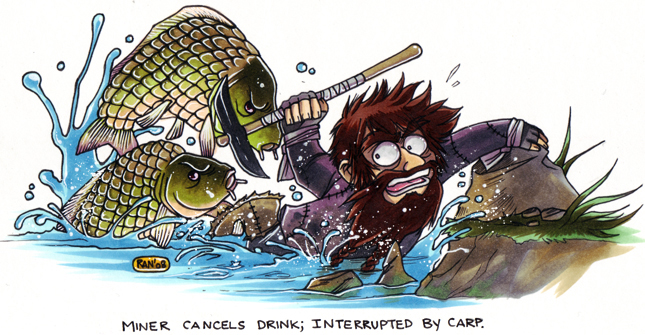
Outside of B/X, in the AD&D Monstrous Manual (2e)--I use all my sourcebooks when keying dungeons for variety's sake--the Giant Crayfish not only has HD 4+4 against the Ogre's HD 4+1, but the crayfish has two attacks, each doing more damage than the ogre's one attack (2-12/2-12 against 1-10 OR weapon +6). On top of which, the crayfish surprises with a -2 penalty for the players! And Giant Carp have from 8-12 hit dice ... those poor dwarves in Dwarf Fortress ...
One other thing that tickled me was that sharks in the blue Expert book are listed as having 18" speed, rather than the typical breakdown into B/X, i.e. "swim 180' (60')" for 18". That's the only speed in inches I've yet come across in B/X.
I don't think that I would really use these creatures as "typical" wilderness encounters on the water, on any kind of river or lake that sees civilized traffic. Their hugeness, represented in terms of hit dice, seems to represent something ancient and awful (e.g. a centuries-old sturgeon lurking at the bottom of a high mountain lake, unplumbed by man), or to mechanically iterate the horror one feels looking down into the blackness of unknown depths (say, a silent black lake in a vast and gloomy cavern, far below the surface of the world) and to fear what might lurk beneath.
The only place I can see such monstrosities existing near communities of men is as "gods" or spirits, venerated by the local tribe, offered sacrifices--perhaps manacled prisoners dropped over the gunwales of canoes from the middle of an alpine lake, or hacked into pieces and scattered like chum across the bloodstained waters. And naturally, such "gods" would also have treasures devoted to them, gold, gems, and even "lake swords" cast into the deeps to buy the god's benevolence--or tolerance--for the local fishermen; treasures ready to be seized by any adventurers foolhardy enough to face 10+ hit dice fishes and ridiculous enough to have waterbreathing as their only 4th level spell!
I'm just tickled by this, as one sometimes is by the errata found within the rulebooks ...
Giant Sturgeon have more hit dice than Black Puddings (barely). At HD 10+2, a giant sturgeon has slightly more hp on average than a black pudding (HD 10), the same "to hit" chance, and does a respectable 2-20 damage with its bite compared to a black pudding's 3-24. The sturgeon also swallows a character whole on a "to hit" roll of 18+, which does an automatic 2-12 damage/round and forces a save against death ray, or the character is paralyzed (if not paralyzed, they can cut their way out ... DM's discretion how, though, beyond a -4 "to hit" against AC 7, as there's no damage threshold). Sure, giant sturgeon can be hit by non-magical attacks and don't split into smaller versions of themselves, but they're still terrifying monsters.
(and honestly, with a giant thing like that, why wouldn't it be 10+2 HD ... or more?)
Of course, all the giant fish in D&D are terrifying. A Giant Catfish has more hit dice/hit points than a Hill Giant, a better "to hit" chance, and 5 attacks, one of which does as much damage as the hill giant's. And Giant Rockfish have HD 5+5 and 4 spine attacks, each with deadly poison, which makes them just that more terrifying than real stonefish (which are also deadly poisonous, but at least are normal fish-sized).
Outside of B/X, in the AD&D Monstrous Manual (2e)--I use all my sourcebooks when keying dungeons for variety's sake--the Giant Crayfish not only has HD 4+4 against the Ogre's HD 4+1, but the crayfish has two attacks, each doing more damage than the ogre's one attack (2-12/2-12 against 1-10 OR weapon +6). On top of which, the crayfish surprises with a -2 penalty for the players! And Giant Carp have from 8-12 hit dice ... those poor dwarves in Dwarf Fortress ...
One other thing that tickled me was that sharks in the blue Expert book are listed as having 18" speed, rather than the typical breakdown into B/X, i.e. "swim 180' (60')" for 18". That's the only speed in inches I've yet come across in B/X.
I don't think that I would really use these creatures as "typical" wilderness encounters on the water, on any kind of river or lake that sees civilized traffic. Their hugeness, represented in terms of hit dice, seems to represent something ancient and awful (e.g. a centuries-old sturgeon lurking at the bottom of a high mountain lake, unplumbed by man), or to mechanically iterate the horror one feels looking down into the blackness of unknown depths (say, a silent black lake in a vast and gloomy cavern, far below the surface of the world) and to fear what might lurk beneath.
The only place I can see such monstrosities existing near communities of men is as "gods" or spirits, venerated by the local tribe, offered sacrifices--perhaps manacled prisoners dropped over the gunwales of canoes from the middle of an alpine lake, or hacked into pieces and scattered like chum across the bloodstained waters. And naturally, such "gods" would also have treasures devoted to them, gold, gems, and even "lake swords" cast into the deeps to buy the god's benevolence--or tolerance--for the local fishermen; treasures ready to be seized by any adventurers foolhardy enough to face 10+ hit dice fishes and ridiculous enough to have waterbreathing as their only 4th level spell!
Subscribe to:
Posts (Atom)